The short answer
- Will the engine last after the repair?
- If the correct defect was actually fixed and the engine isn't run hot afterward, generally yes — but 7 of the 9 nameplates we've researched have a manufacturer document naming a different defect than a head gasket under the same symptoms.
- What does it cost?
- J.D. Power: $1,000-$3,000, average near $1,500. RepairPal (via ConsumerAffairs): $2,475-$3,246. Neither is brand-specific, and neither is ours.
- Which cars actually have a documented head gasket defect?
- Of the 9 nameplates checked, only the Honda Civic and Accord 1.5T — both under Honda's August 2026 warranty extension.
What the repair itself costs
Published estimates for a head gasket replacement cluster loosely around the same few thousand dollars, with real spread by source and by vehicle. J.D. Power puts the range at $1,000 to $3,000, averaging near $1,500. RepairPal figures reported by ConsumerAffairs run higher, $2,475 to $3,246. CRC Industries estimates $1,000 to $3,000 for a standard vehicle and $3,000 to $5,000 for a luxury or high-performance one, plus $50 to $100 in fluids. Every figure here is attributed to whoever published it — we sell VIN checks, not repairs, and price none of this ourselves.
None of those ranges is specific to any one engine, and that is the actual problem with the question “how long will it last.” An invoice that says “head gasket” can describe nine different underlying jobs, and only some of them are actually a head gasket.
Why NHTSA's ENGINE category isn't the same thing as a head gasket
Across our full 60-nameplate, 432,995-complaint corpus, ENGINE is the single largest complaint category of all — 85,870 reports, 19.8% of every complaint on file, ahead of ELECTRICAL SYSTEM and POWER TRAIN. That size is also the problem: ENGINE is NHTSA’s catch-all for anything under the hood, so a head gasket, a cracked PCV diaphragm, an EGR valve and a worn valve guide all land in the same bucket. Nothing in that category count is a head-gasket count on its own.
The only way to tell which is which is the same way this site’s nine existing head-gasket posts already did it: read the manufacturer’s own bulletins for that specific engine, not the complaint category. Nine primary-document investigations, lined up, are the thing no single-model competitor page on this query can produce.
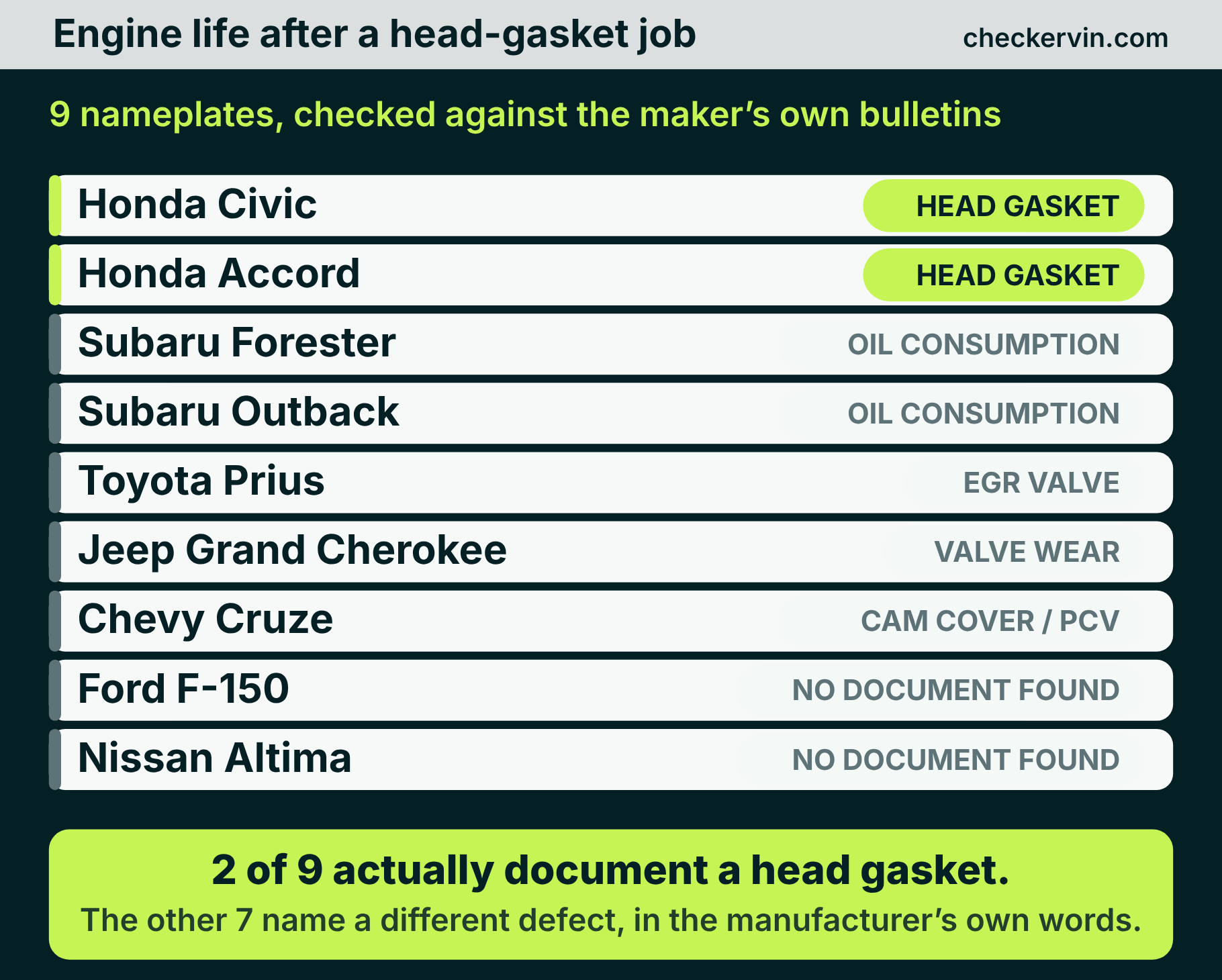
We checked our own 9 head-gasket posts
This site already carries a dedicated “head gasket replacement cost” post for nine nameplates, each built from a primary-document read of that manufacturer’s own bulletins. Lined up side by side, 2 of 9 have a document that actually names a head gasket as the defect. The other 7 have a documented defect that is something else, filed under the same ENGINE category.
| Nameplate | What the manufacturer actually documented |
|---|---|
| Honda Civic | Head gasket — Honda's Aug 26, 2026 extension covers the 1.5T (2016 on) for 10 years / 150,000 miles |
| Honda Accord | Head gasket — the same Aug 26, 2026 extension covers the 2018-2022 1.5T CVT and Hybrid |
| Subaru Forester | Oil consumption — bulletin 02-157-14R orders a short-block replacement; a gasket is a parts-list line in that job, not the defect |
| Subaru Outback | Oil consumption — the same 02-157-14R bulletin, scoped to the 2013-2014 FB25 |
| Toyota Prius | EGR valve and intake manifold — Toyota's 2010-2015 2ZR-FXE bulletins; no head-gasket bulletin exists for this engine |
| Jeep Grand Cherokee | Cylinder-head valve-guide wear — Warranty Bulletin D-14-12, 2011-2013 3.6L, fixed by replacing the head, not a gasket |
| Chevy Cruze | A cracked PCV diaphragm and a plant coolant air-trap — two GM bulletins, neither one a head gasket |
| Ford F-150 | No document found — zero of roughly 1,500 Ford communications searched name a head gasket (the same search on a 2017 Escape returns nine, confirming the search works) |
| Nissan Altima | No document found — ENGINE's share of complaints rose from about 5% (2008-2018) to about 18% (2019-2022), but no Nissan bulletin names a head gasket |
The 2 real cases: Honda Civic and Accord 1.5T
On August 26, 2026, Honda published a cylinder-head-gasket warranty extension naming the 2016-on Civic 1.5T and the 2018–2022 Accord 1.5T CVT and Hybrid: 10 years from purchase or 150,000 miles, with a separate window for cars already older than that. These are the only two nameplates in this set where “head gasket” is the manufacturer’s own word for the defect. In our corpus, ENGINE accounts for 5% of the 7,598 Civic complaints on file and 17.8% of the 11,594 Accord complaints — a real share, consistent with a genuine, documented engine defect rather than the thin presence a catch-all category shows on a car with no such issue.
The extension does not reach the Civic’s 2.0-liter non-turbo engine or any model year outside 2016–2022. See the Civic post and the Accord post for the bulletin numbers, the exact VIN ranges and the deadline on cars already past the standard window.
The oil-consumption imposters: Subaru Forester and Outback
Subaru’s bulletin 02-157-14R, “Engine Oil Consumption,” covers the FB25 in the 2011–2015 Forester and the 2013–2014 Outback. The remedy is a short-block replacement, and its parts list happens to include a head gasket — because replacing the short block requires removing the heads — not because the gasket itself is what failed. A shop quoting “head gasket replacement” on one of these cars may be quoting the same job this bulletin already covers under extended powertrain warranty, 8 years or 100,000 miles from the original warranty start date. See the Forester post and the Outback post for the exact labor hours and VIN-range detail.
The EGR imposter: Toyota Prius 2010-2015
The Prius’s head-gasket reputation belongs to the third generation, 2010–2015, running the 2ZR-FXE. Toyota never issued a head-gasket bulletin, recall or warranty extension for it. What it did document, repeatedly, is EGR valve and intake-manifold trouble on the same engine — symptoms that can present as coolant loss and overheating, the same complaints a head gasket produces. ENGINE accounts for only 3.2% of the 7,406 Prius complaints we can count, the thinnest share of any nameplate in this set, which is consistent with a narrower, better-documented cause rather than an undocumented gasket problem. See the Prius post for the EGR bulletin numbers and the cleaning procedure Toyota actually published.
Valve wear, a PCV crack, and no document at all
The remaining four nameplates each carry a different documented story. The Jeep Grand Cherokee has a 2011–2013 3.6L left-cylinder-head valve-guide-wear extension, fixed by replacing the head — not a gasket. The Chevy Cruze has two separate GM bulletins, one for a plant coolant air-trap and one for a cracked PCV diaphragm on the 1.4L cam cover; ENGINE still runs 33.9% of its 3,721 complaints, the highest share of any nameplate here, without a head-gasket document behind any of it. The Ford F-150 and Nissan Altima posts found no manufacturer document at all naming a head gasket, confirmed with a positive control — the same search applied to a 2017 Ford Escape returns nine hits, so the absence on the F-150 reads as a real absence, not a broken search.
What actually predicts whether it lasts
Set the specific defect aside and the factors that repair-industry sources name most consistently are not brand-specific. Whether the cylinder head itself was checked for warpage, rather than reassembled as-is, before the new gasket went on. The quality of the replacement gasket — at least one forum discussion of this exact question notes aftermarket gaskets failing sooner than factory parts. Correct torque sequence and reassembly procedure. And the factor named most often of all: not running the engine hot again afterward, since overheating is usually what damaged the original gasket in the first place.
- Confirm the shop diagnosed the actual failing part, not just 'head gasket' from the symptoms alone
- Ask whether the cylinder head was checked for warpage before reassembly
- Ask what gasket brand is being installed — OEM versus aftermarket
- Watch the temperature gauge for weeks afterward, not just days
- Keep the invoice; it is the service history a buyer or a warranty claim will ask for later
Before you authorize the repair
The cheap check comes first, and it is the same check across all nine nameplates in this post: confirm the exact engine by VIN, because the Subaru FB25 and the EJ-series engine it replaced look identical from outside the car, and the Civic’s 1.5T and 2.0-liter sit under one nameplate with very different coverage. Then check whether a manufacturer extension or bulletin already covers the actual documented defect on that specific engine before paying $1,000 to $5,000 out of pocket for a repair that might already be free.
A TSB-versus-recall check settles whether a document like the ones named in this post means a free repair on a specific VIN or just a diagnostic lead, and an engine lookup by VIN confirms which engine code is actually under the hood before anyone prices a job. A coolant-type checkis the free second step, since every documented defect in this post — real head gasket or not — shows up first as overheating or coolant loss.
If you're buying, not repairing
The same table reads as a shopping map. A Civic 1.5T or Accord 1.5T with a documented head-gasket repair in its history is the one case here where that repair is probably exactly what it says it is, and Honda’s extension may still apply — a warranty check by VINsettles whether coverage remains on that specific car before you negotiate around a past repair. On any of the other eight nameplates, a seller’s claim of “new head gasket” is worth confirming against what the manufacturer actually documented for that engine, because the invoice may describe a different job entirely — a short block, an EGR valve, a cylinder head — filed under the same generic line item.
Where this information comes from
- NHTSA — complaint databaseThe federal complaint record this post's ENGINE totals and shares are computed from, browsable by nameplate and model year.
- Honda — multi-model cylinder head gasket warranty extension, Aug 26, 2026, hosted by NHTSAThe only bulletin in this set that names a head gasket as the documented defect, covering the Civic 1.5T and Accord 1.5T.
- Subaru — Service Bulletin 02-157-14R, Engine Oil Consumption, hosted by NHTSAThe Forester/Outback FB25 oil-consumption remedy, whose parts list includes a head gasket without the gasket being the defect.
- Toyota — T-SB-0075-13, EGR valve bulletin, hosted by NHTSAThe 2010-2015 Prius 2ZR-FXE EGR remedy cited in place of any head-gasket document, which does not exist for this engine.
- Chrysler — Warranty Bulletin D-14-12, cylinder head, hosted by NHTSAThe Jeep Grand Cherokee 3.6L valve-guide-wear extension, fixed by a head replacement rather than a gasket.
- J.D. Power — head gasket replacement cost guideThe $1,000-$3,000 range and roughly $1,500 average quoted above.
- CRC Industries — blown head gasket repair costThe standard-vehicle and luxury/high-performance cost ranges quoted above, plus the fluids estimate.
Keep reading
Frequently asked questions
How long does an engine last after a head gasket replacement?
Mechanics and manufacturer forums generally agree a correctly diagnosed, correctly installed head gasket repair shouldn't shorten an engine's life — several sources describe something close to the car's normal remaining lifespan if the head itself wasn't warped and the engine wasn't run hot afterward. None of that holds if the job was misdiagnosed. Our own check of this site's 9 nameplate-specific head-gasket posts found that 7 of 9 have a manufacturer document naming a different defect entirely (oil consumption, an EGR valve, valve wear, a cracked PCV diaphragm) rather than a head gasket — and a repair aimed at the wrong part doesn't fix the part that's actually failing, however long the gasket itself then lasts.
What does head gasket replacement typically cost?
Published estimates vary by source and by vehicle. J.D. Power puts the range at $1,000 to $3,000, with an average near $1,500. RepairPal figures reported by ConsumerAffairs run $2,475 to $3,246. CRC Industries estimates $1,000 to $3,000 for standard vehicles and $3,000 to $5,000 for luxury or high-performance engines, plus roughly $50 to $100 in fluids. None of these figures is ours — we sell VIN checks, not repairs — and none of them is specific to any one of the nine nameplates in this post.
How do I know if my car's problem is really a head gasket?
Start by checking whether the manufacturer has documented anything at all for your exact engine and model year, because 7 of the 9 nameplates checked for this post have a bulletin naming a different root cause under the same symptoms — overheating, coolant loss, misfire. A VIN decode confirms the exact engine (the Subaru FB25 oil-consumption bulletin and the EJ-series engine it replaced look identical from the outside, for example), and a warranty check by VIN shows whether a documented extension already covers the real defect before anyone pays out of pocket for a diagnosis that assumes the gasket without confirming it.
Are Honda Civic and Accord head gaskets covered under warranty?
On the engines Honda named, yes. Honda's August 26, 2026 bulletins extended cylinder-head-gasket coverage to 10 years from purchase or 150,000 miles on the 2016-on Civic 1.5T and the 2018-2022 Accord 1.5T CVT and Hybrid, with a separate window for cars already past 10 years. That coverage is specific to those engines; it says nothing about the Civic's 2.0-liter non-turbo or any other nameplate in this post, each of which carries its own, different documented defect.
What actually makes an engine last after a head gasket job?
Repair-industry sources point to the same few factors repeatedly: whether the cylinder head itself was checked for warpage before reassembly, the quality of the replacement gasket (forum discussion on at least one nameplate notes aftermarket gaskets failing sooner than factory ones), correct torque and reassembly procedure, and — the factor named most often — never running the engine hot again afterward, since overheating is what damages a head gasket in the first place. None of that is specific to a brand; all of it matters more than the invoice's one line item for "head gasket."
Confirm the exact engine before you price the repair
A free CheckerVIN report shows the factory build, specifications and open recalls for any VIN — confirm what you're actually pricing before anyone touches the car.
Run a free VIN check