The short answer
- Which one is free?
- The recall. Federal law obliges the manufacturer to remedy a safety defect without charge. A bulletin carries no such duty.
- Then why read bulletins?
- Because they are the manufacturer documenting a known problem — and some of them announce extended coverage, which does mean a free repair.
- Why can I read them at all?
- A rule requires manufacturers to give NHTSA every defect communication, whether or not the defect is safety-related.
Owed
The recall remedy
Without charge, by statute
Offered
The bulletin repair
Billed unless covered
Either way
What must reach NHTSA
Safety-related or not
613
Campaigns in our extract
Across 73 model years
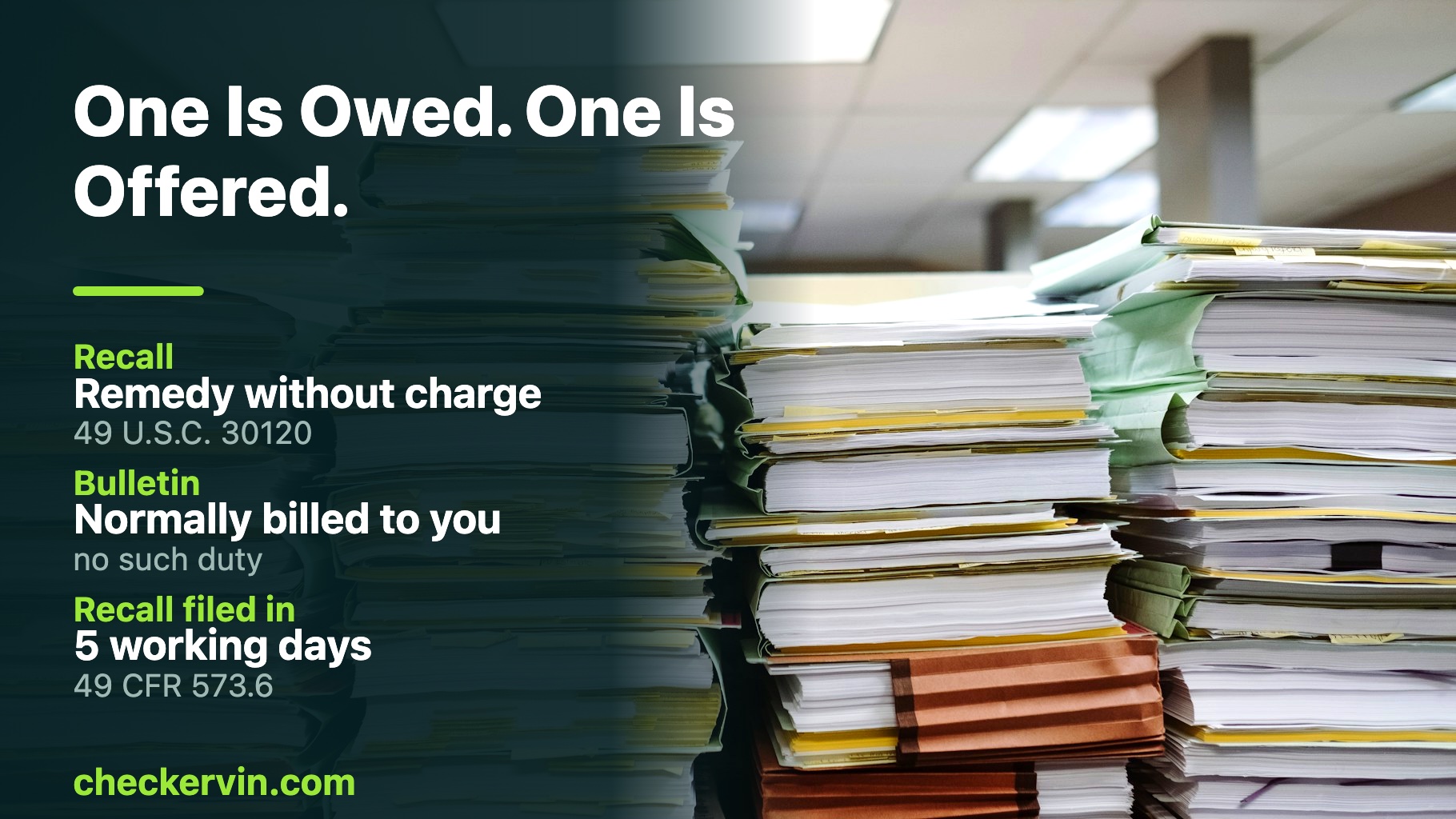
The short answer on who pays
A recall follows a determination that a vehicle contains a defect related to motor vehicle safety or fails to meet a federal safety standard. Once that determination is made, the manufacturer must remedy the problem without charge to the owner, and the obligation runs with the vehicle rather than with whoever owned it at the time.
A technical service bulletin is a different animal entirely. It is the manufacturer telling its dealer network how to diagnose and fix a problem it has seen enough times to be worth documenting. It is a repair instruction, not a promise, and by default the labor and parts are billed to whoever is standing at the service desk.
That is the whole of the difference most articles give you. The useful part starts with why you can read the second document at all.
What a service bulletin actually is
Bulletins are written for technicians. A typical one names the affected models and build range, describes the symptom in the language a customer would use, gives the diagnostic procedure, specifies the corrected part number, and sets a labor time. They are dry, specific, and far more candid about a car’s weaknesses than any marketing material will ever be.
They are also common. A manufacturer issuing many bulletins is not necessarily producing bad vehicles — it may be a manufacturer with a functioning feedback loop between warranty claims and engineering. Volume alone tells you very little, which is why the useful question is never “how many” but “which component, and on which model year.”
The rule that makes them public
Here is the provision the rest of the internet leaves out. Under 49 CFR § 579.5(a), each manufacturer shall furnish to NHTSA a copy of all notices, bulletins and other communications — including those sent by electronic means, and including warranty and policy extension communiqués and product improvement bulletins — sent to more than one dealer, distributor, lessor, lessee, owner or purchaser in the United States, regarding any defect in its vehicles or equipment.
Subsection (b) extends the same duty to communications about customer satisfaction campaigns, consumer advisories, recalls and other safety activity involving repair or replacement.
So the documents are not public because manufacturers volunteered them or because a journalist obtained them. They are public because a regulation requires them to be handed over, in copy, whenever they go to more than one recipient.
Why there is no TSB lookup by VIN, and what to do instead
People search for a TSB lookup by VIN constantly, and the assumption behind it is reasonable: the recall lookup takes a VIN and answers for one specific car, so the bulletin search ought to as well. It does not, and the reason is not that nobody has built the tool. It is that the two documents are filed with the government in completely different shapes.
A recall is filed as a population. Under 49 CFR § 573.6(c)(2), the manufacturer must identify the vehicles potentially containing the defect — for passenger cars, by make, line, model year and the inclusive dates, month and year, of manufacture — and must also describe the basis on which it drew that population and how the recalled vehicles differ from similar vehicles it did not include.
That filing is what makes a per-VIN answer possible. Once a manufacturer has committed to a build-date range and a basis for it, an individual vehicle either falls inside the population or outside it, and a lookup can say which.
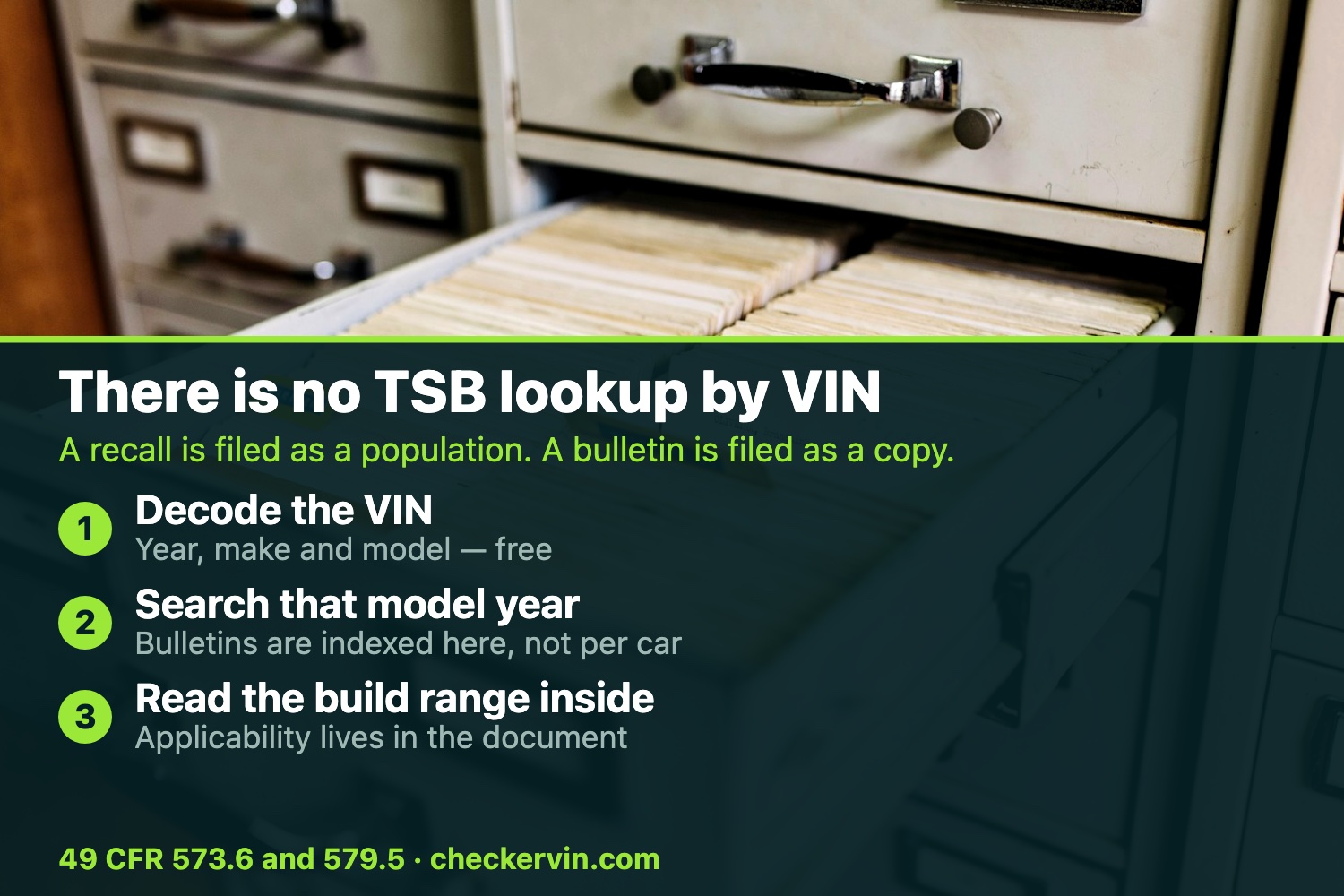
The practical route takes about a minute and is worth doing in this order.
- 1Decode the VIN to get the year, make and modelThis is the step the by-VIN search would have done for you. A free decode returns the model year, make, model and often the plant and body style, which is everything the bulletin index is organized around.
- 2Search bulletins on that year, make and modelNHTSA publishes them alongside complaints and recalls. You are looking for a component that matches the symptom you have, or that the complaint record for that year already flags.
- 3Read the build range inside the bulletin itselfBulletins frequently name a production date window or a range of VIN sequence numbers in their own text. That is where per-vehicle applicability actually lives — inside the document, put there by the manufacturer, rather than in an index anyone can query.
- 4Run the recall lookup separately, on the VINThat one genuinely is per-vehicle, for the reason above. Doing both is how you cover the two halves: the recall search resolves your car, the bulletin search resolves your model year.
What a recall must file, and how fast
The gap between the two documents is widest at the moment they are created, and the deadlines are the clearest way to see it.
Under § 573.6(a), a manufacturer must report to NHTSA each defect in its vehicles or equipment that it or the Administrator determines to be related to motor vehicle safety, and each noncompliance with a safety standard. Subsection (b) puts a clock on it: the report is due not more than five working days after the defect has been determined to be safety related.
| The obligation | The deadline |
|---|---|
| Initial report | Within 5 working days of the determination, carrying at minimum the manufacturer's name, the vehicle identification and the defect description |
| The remaining detail | Within 5 working days of the manufacturer confirming its accuracy |
| Corrections and updates | Within 5 working days of new information that updates or corrects what was already reported |
| Referring to the campaign | Every later submission must cite the recall campaign number once NHTSA has assigned one |
| A service bulletin | No deadline, no filed population, no campaign number |
The last row is the whole distinction in one line. A recall acquires a campaign number because there is a campaign — a defined population, a determination behind it, and a filing clock. A bulletin acquires none of that, which is why it can be issued quietly, revised without announcement, and superseded without anyone being written to.
It also explains something buyers find odd: why a manufacturer will sometimes fix a widespread problem for years under a bulletin and then, later, recall it. Nothing contradictory has happened. The determination that the defect is safety related is the event that starts the five-day clock, and until that determination is made the same fault sits in the other system entirely.
Reading a campaign number, which a bulletin does not have
Once NHTSA assigns one, every later submission on that recall has to cite it — which makes the campaign number the handle the whole system turns on. It is also readable, and knowing how saves a search.
The format is two digits, a letter, then a sequence: 24V-608. The digits are the year the campaign was filed. The letter says what kind of thing was recalled, and it is the part almost nobody knows.
| The letter | What the campaign covers |
|---|---|
| V | Vehicle |
| E | Equipment — a part or accessory rather than a whole vehicle |
| T | Tire |
| S | Child seat |
| C | Consumer — an item reported through the consumer channel |
Two consequences for a buyer. A campaign against a used car will normally carry a V, so an E or a T in a list of results is telling you the recall is against a component or a tire fitted to the vehicle rather than against the vehicle line itself — which changes who performs the remedy and sometimes where you take it.
And the year in front is the filing year, not the model year. A 2019 vehicle can perfectly well carry a campaign numbered 24V-something; it means the defect was determined in 2024, five years after the car was built. A recent campaign number on an older car is normal, and reading it as a sign the car is newly troubled gets the chronology backwards.
Four layers of 'known problem'
It helps to see where a bulletin sits. There are four distinct layers, they are produced by different parties, and they mean different things.
| Layer | Who produces it, and how much of it we hold |
|---|---|
| Complaints | Owners, filed with NHTSA — 63,160 across the 73 model years in our extract. Unverified individually, valuable in aggregate |
| Service bulletins | The manufacturer, to its dealers. Not in our extract at all — search NHTSA by year, make and model |
| Investigations | NHTSA, when a complaint pattern warrants it — 283 recorded against 54 of our 73 model years. An open question, not a finding |
| Recalls | A determination, with a remedy obligation attached — 613 campaigns in our extract |
Note the middle two. An investigation means the agency is asking whether a defect exists; it carries no repair obligation and may close without one. A bulletin means the manufacturer has already decided a problem exists and has written the fix — which is a stronger admission than an investigation, and a weaker entitlement than a recall.
Who pays, layer by layer
| If your car is affected by… | What it costs you |
|---|---|
| An open recall | Nothing. The remedy is without charge, subject to the statute's outer time limit |
| A recall whose remedy is not yet available | Nothing, but nothing happens yet either — get the campaign number and the manufacturer's status |
| A bulletin, vehicle under warranty | Normally nothing, because the warranty is what is paying — not the bulletin |
| A bulletin, vehicle out of warranty | Normally the full bill, unless the manufacturer offers goodwill |
| A published warranty or policy extension | Nothing, within its stated terms — this is the category worth hunting for |
| An open investigation | Nothing, and nothing owed. It is a question, not a remedy |
The category worth hunting for
Read § 579.5(a) again and notice what it lists alongside ordinary bulletins: warranty and policy extension communiqués. Manufacturers periodically extend coverage on a component that is failing more than it should — a longer term, a higher mileage cap, sometimes reimbursement for owners who already paid.
These are announced in exactly the same channel as routine repair instructions, and they are subject to the same submission duty, which means they end up in the same public pile. They are also the single most valuable thing a used-car buyer can find: an extension turns a known expensive fault into a covered one, and unlike a recall nobody is going to write to you about it.
The terms vary enormously and they are specific to a program, so the only reliable source is the manufacturer’s own bulletin. Read the document, not a summary of it — the model years, engine codes and production date ranges in these programs are narrower than the way they get described online.
How a buyer uses this before paying
- 1Run the recall lookup on the VIN firstIt is free, it is VIN-specific, and an open campaign is a free repair the previous owner never collected. This is the only one of the four layers that resolves to the individual car.
- 2Then search bulletins for the year, make and modelBulletins are indexed by vehicle, not by VIN. That is fine — you are researching whether this model year has a documented pattern, which is a question about the model year.
- 3Search the bulletin list specifically for coverage extensionsLook for warranty extension, policy extension, product improvement and customer satisfaction language. This is where a free repair hides in a pile of technical documents.
- 4Cross-check against the complaint record for that yearA bulletin plus a complaint spike on the same component is a much stronger signal than either alone — the manufacturer has admitted it and owners are still reporting it.
- 5Take the bulletin number to the inspectionA mechanic who knows which bulletin to look at can check that specific symptom deliberately instead of hunting. This is the cheapest way to turn research into a real answer about the car in front of you.
What a bulletin does not tell you
- Whether this particular car has the problem. Bulletins describe model-level patterns, and only an inspection resolves the individual vehicle.
- Whether the fix was ever performed. There is no public per-VIN record of bulletin work the way there is for recalls.
- How common the fault is. A bulletin is issued because a pattern was identified, not because a threshold was crossed.
- Whether the manufacturer will pay. Goodwill is discretionary and varies by dealer, mileage and how the request is made.
- Whether a bulletin has been superseded. Later revisions replace earlier ones, so check dates before relying on a procedure.
Held together, that is a fair description of what bulletins are for: they narrow the questions worth asking about a specific car. They do not answer them.
Where this information comes from
- 49 CFR § 579.5 — notices, bulletins and other communicationsThe duty to furnish NHTSA every defect communication sent to more than one recipient, including warranty and policy extension communiqués, whether or not the defect is safety-related
- 49 CFR § 573.6 — defect and noncompliance information reportThe five-working-day filing clock, and the requirement to identify the recall population by make, line, model year and inclusive dates of manufacture
- 49 U.S.C. § 30120 — remedies for defects and noncomplianceThe without-charge remedy obligation that a recall carries and a bulletin does not
- NHTSA recall lookupOpen campaigns against a specific VIN, free — the only VIN-level layer of the four
- NHTSA — datasets and APIsThe complaint, investigation and recall records the layer table is counted from
Keep reading
Frequently asked questions
Is a technical service bulletin the same as a recall?
No, and the difference that matters to you is who pays. A recall is a determination that a defect creates an unreasonable safety risk, and federal law obliges the manufacturer to remedy it without charge. A service bulletin is a repair instruction sent to dealers about a known problem, and it carries no such obligation — the work is normally billed unless the vehicle is under warranty or the manufacturer chooses to cover it.
Does a service bulletin mean a free repair?
Usually not by itself. But bulletins are worth reading precisely because some of them announce coverage: the federal rule requiring manufacturers to hand these documents to NHTSA names warranty and policy extension communiqués explicitly. A published extension of coverage is a bulletin that does mean a free repair, and it is the one category worth searching for by name.
Why are TSBs public at all?
Because 49 CFR § 579.5 requires each manufacturer to furnish NHTSA a copy of all notices, bulletins and other communications sent to more than one dealer or owner regarding any defect — and the rule says that obligation applies whether or not the defect is safety-related. That last clause is what makes the non-safety material public, and it is why a buyer can read about a known problem the manufacturer never had to recall.
Should a TSB stop me buying a car?
Rarely on its own. Bulletins exist in large numbers on well-engineered vehicles, because they are how a manufacturer distributes a fix once a pattern is identified. What is worth acting on is a bulletin describing an expensive component on the model year you are looking at, particularly where the complaint record for that year is an outlier against the rest of the nameplate.
Is there a TSB lookup by VIN?
No, and the reason is structural rather than a missing tool. A recall is filed with NHTSA as a population: 49 CFR 573.6(c)(2) makes the manufacturer identify the affected vehicles by make, line, model year and the inclusive months and years of manufacture, and explain how they differ from similar vehicles left out. That filing is what lets a lookup answer for one car. A bulletin reaches NHTSA under a different rule, 579.5, as a copy of a communication — no population, no build-date boundary, nothing for a VIN to be matched against. Decode the VIN to get the year, make and model, search bulletins on that, then read the production range printed inside the bulletin itself.
Start with the layer that resolves to your car
Decode any VIN free for the factory build, specifications and open safety recalls. No account, no card. Full vehicle history reports are launching soon.
Run a free VIN check