The short answer
- What does it cost?
- RepairPal lists $2,743–$3,761 for a Prius head gasket job, about three-quarters of it labor. Figures retrieved October 2026.
- Which Prius years?
- The 2010–2015 third generation with the 2ZR-FXE engine. Those years hold 84% of the Prius engine complaints we can count.
- Can it be prevented?
- The usual advice is to clean the EGR cooler, pipe and intake manifold before carbon causes misfires. Toyota’s own EGR bulletins back the cause, not a schedule.
The numbers, and whose numbers they are
We decode VINs, we do not repair engines, so the dollar figures here belong to someone else. RepairPal’s Prius head gasket estimator lists $2,743 to $3,761 for the job, of which $2,080 to $3,051 is labor and $664 to $709 is parts. It notes that the range leaves out taxes and fees and does not account for where you live, and its listing says the estimate was last updated on September 3, 2026. We retrieved it in October 2026.
Two things about that range are worth knowing before you hold a quote against it. First, the parts line is small next to the gasket kit’s real job: the labor is what you are paying for, because the cylinder head has to come off a hybrid engine packed tightly under the cowl. Second, the estimate prices a gasket job, and plenty of 2010–2015 owners are never offered one. Shops often quote a used or remanufactured engine instead. That is a different repair, which this page does not try to price.
One more scope note. The Prius has a second expensive repair that dominates search results, and it is not this one. If your warning is about the hybrid system rather than the gasoline engine, the hybrid battery replacement guide covers that job; the head gasket is a conventional engine repair on the 1.8-liter four-cylinder, not the battery.
Gasket job or engine swap: why quotes split
Toyota’s own labor clock shows how deep the engine work goes. Its bulletin T-SB-0169-16, the 2ZR-FXE oil consumption repair for 2010–2014 Prius models, books 16.6 hours to replace the pistons and rings. That procedure removes the cylinder head and lists a gasket kit among its parts. A head-gasket-only job stops short of the pistons, but the teardown overlaps, which is why the labor half of RepairPal’s range runs into the thousands.
Whether a shop quotes a gasket or a whole engine usually turns on what the gasket failure has already done. A breach that lets coolant into a cylinder can wash the oil film off the bore, and a car driven hot for too long can warp the head. If the head and bores pass inspection, a gasket job is a fair repair. If they do not, the gasket price is irrelevant.
| What the quote should say | Why it matters |
|---|---|
| Head checked for flatness, machined if needed | A warped head leaks again with a new gasket |
| EGR cooler, EGR pipe and intake manifold cleaned | Leaves the suspected cause behind if skipped |
| Which cylinders misfired, and a compression or leak-down result | Shows whether the bores survived |
| Coolant and thermostat, plus a check of the electric water pump | An overheat is the other common route to a failed gasket |
How the 2ZR-FXE is said to lose a head gasket
The third-generation Prius moved from the 1.5-liter 1NZ-FXE to the 1.8-liter 2ZR-FXE and added a cooled exhaust gas recirculation system. Exhaust is routed through a small cooler, past an EGR valve and back into the intake manifold, which feeds it to the cylinders through internal passages. Over high mileage, carbon from that exhaust builds up in the cooler, the valve and those passages.
The failure sequence described by Prius specialists and owners runs like this: the passages clog unevenly, some cylinders get more recirculated exhaust than others, those cylinders misfire or knock, and the repeated hammering eventually breaches the head gasket between a cylinder and a coolant passage. Owners call the end stage the “death rattle” because it often shows up as a loud shaking right after the engine starts. That chain of causes is the widely held explanation, not a Toyota statement. Toyota’s documents confirm the EGR problems on this engine; none of them names the head gasket.
The engine’s coolant pump is electric, so a pump failure means no circulation at all rather than a slow leak, and an engine that overheats can lift a gasket on its own. That is a second route to the same repair and a reason any quote should confirm the pump is working. The coolant type lookup by VIN shows the factory fill if the system has to be refilled after the job.
What 7,697 complaints say about the engine
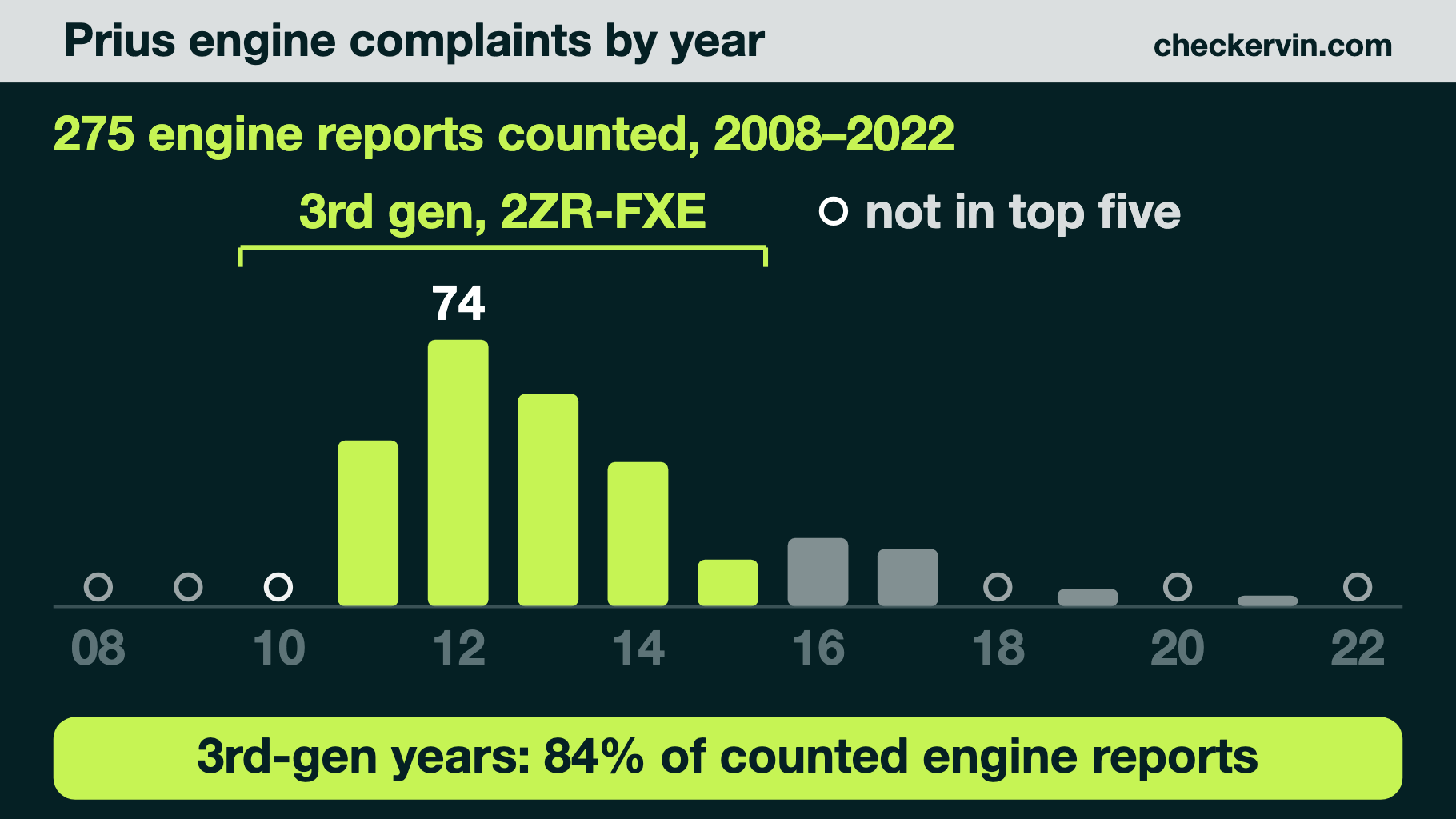
Our corpus of federal NHTSA complaints covers the 2008–2022Prius. The record carries each model year’s five most-reported components, and ENGINE makes that list in 9 of 15 years. Adding those up gives 275 engine complaints we can count. That is a minimum, not a total, because the 6 years where ENGINE missed the top five (2008, 2009, 2010, 2018, 2020, 2022) still had engine reports, just fewer than their fifth component.
With that caveat, the shape is clear. The 2010–2015 third generation holds 232 of the counted engine reports, 84% of them, and that is before the 2010 car is added. The 2016–2022 fourth generation, which kept a revised 2ZR-FXE, accounts for 43. The busiest single year is 2012, at 74 engine reports.
The scale matters too. In the third-generation years we can count, ENGINE is never more than 12% of a year’s complaints (the 2014 car), and across the years where both are counted (2011, 2012, 2013, 2014, 2015), SERVICE BRAKES draws about 5 times as many reports as ENGINE. In the federal record the loudest Prius problem is brakes, not the engine. ENGINE also covers every engine fault, from misfires to mounts, so it is an upper bound on head gasket complaints, never a count of them.
What owners describe when it goes
We searched the complaint narratives NHTSA publishes for every Prius model year for the words “head gasket.” The matches cluster in the 2010–2014 cars, with only scattered mentions before or after. Read together, they describe a consistent progression rather than a sudden failure.
- Shaking, rattling or a knock right after the gasoline engine starts, often worse when cold
- Misfire codes on one or two cylinders that new ignition coils do not cure
- Coolant disappearing from the reservoir with no visible leak
- White exhaust, and in later stages a temperature warning or loss of power
- A dealer or shop recommending a replacement engine rather than a gasket
A few narratives name a clogged EGR cooler or EGR valve directly, and one owner of a 2014 blames the intake manifold and EGR design. Those are owners’ accounts, not engineering findings, and we print no tally of them because a keyword match is not a verified failure. What the reports do establish is the symptom pattern a shop should rule in or out before it quotes anything.
Toyota’s EGR paper trail on the 2ZR-FXE
Toyota never issued a head gasket bulletin for the Prius, but it wrote about this engine’s EGR and intake system again and again. We read each of these on NHTSA’s servers.
| Toyota document | What it says |
|---|---|
| T-SB-0103-12 Rev1 (2012, revised 2014) | 2010–2014: P2111 and P0A0F below 23°F; improved intake manifold |
| T-SB-0075-13 (May 2013) | 2010–2012: P0401, insufficient EGR flow; improved EGR valve |
| T-SB-0116-15 (Nov. 2015) | 2010–2015: misfire with EGR active; new intake manifold and EGR pipe gasket |
| Warranty Enhancement ZF3 (June 2016) | Certain 2010–2012: sticking EGR valve, rattle at cold start; extended coverage |
| T-SB-0169-16 (Nov. 2016) | 2010–2014: oil consumption; new pistons and rings, head off, 16.6 hours |
T-SB-0116-15 is the closest Toyota comes to the owner story. It says some 2010–2015 Prius models may run rough or set P030# misfire codes during light acceleration while the EGR system is active, and its fix is a new intake manifold, the part whose internal passages distribute the recirculated exhaust. That is the misfire stage of the sequence above, written down by the manufacturer. It does not say misfires lead to gasket failure, and we will not say it for Toyota.
The oil consumption bulletin belongs in the same picture for a practical reason. A car that burns oil fouls its EGR circuit faster, and an invoice for that repair can show a new head gasket because the head comes off to reach the pistons. A 2010–2014 Prius with a head gasket on its service record may have had an oil consumption repair, not a gasket failure.
Why the EGR clean-out is the prevention
If carbon in the EGR path drives the misfires, removing the carbon before the misfires start is the cheapest place to intervene. On a third-generation Prius that means three parts, not one: the EGR cooler, the EGR valve and pipe, and the intake manifold, whose internal runners are where uneven clogging happens. Cleaning only the valve, or only the cooler, leaves the passages that feed the cylinders untouched.
Toyota publishes no cleaning interval for this, and none of its bulletins recommends a preventive clean-out. Timing is a judgment call. Owners and independent Prius shops tend to raise it at high mileage, when a car starts to shake on cold start, or when misfire or P0401 codes appear. We could not read a published shop price for the service that we could attribute properly, so we print none; ask for a quote that names all three components, plus new gaskets for each joint.
Before you authorize the repair
- Confirm the car is a 2010–2015 third-generation Prius with the 2ZR-FXE by VIN
- Ask how the gasket failure was confirmed: block test for combustion gas, cooling-system pressure test, or leak-down
- Ask which cylinders misfired and whether the bores were inspected with a scope
- Ask whether the EGR cooler, pipe, valve and intake manifold are cleaned in the quote
- Ask whether the electric water pump and thermostat were tested
The second item separates a diagnosis from a guess. Misfires on a 2ZR-FXE can come from coils, injectors or a sticking EGR valve, and coolant loss can come from a leaking pump. A chemical test showing combustion gas in the coolant is the evidence that the gasket itself has failed. The fourth item is where quotes for the same job differ most: a gasket replaced without clearing the carbon leaves the suspected cause in place. If the check engine light has recently been reset, the guide to spotting a cleared check engine light explains why stored codes may be missing.
Recalls and coverage: what pays for what
We queried NHTSA’s recall database for every Prius model year from 2008 through 2022, and the campaign counts matched our own recall data year for year. No campaign on a 2010–2015 car names the head gasket, the EGR system, the water pump or the cooling system. The one engine-cooling recall in our range, 12V536000, replaced the electric water pump on 2004–2009 Prius models, which are second-generation cars with a different engine.
| Program | What it actually covers |
|---|---|
| Recall | A safety defect, free at any dealer; none names the 2ZR-FXE head gasket |
| ZF3 warranty enhancement | Sticking EGR valve only, certain 2010–2012 cars, 10 years / 150,000 miles |
| Service bulletins | Repair steps and labor times; pay only while the car is under warranty |
| Class action | We found none on Prius head gaskets and claim none |
ZF3 deserves precision because it is the program most often misremembered. Toyota’s June 2016 notice covered about 517,900 vehicles, offered primary coverage until March 31, 2017 regardless of mileage, then secondary coverage for 10 years from first use or 150,000 miles. It applied only to cars that showed the sticking valve condition, and it paid for the EGR valve repair, not for engine damage. Every car it named is now past ten years. The Toyota recall check by VIN still matters for other open campaigns, including the inverter recalls on the same generation, and the Toyota warranty check by VIN helps estimate whether any factory coverage remains on a newer car.
If you are buying the Prius, not repairing it
Read the record as a shopping map. On a 2010–2015 car, ask for invoices showing an EGR clean-out or a head gasket job, and price the car as if neither was done if there is no paperwork. Start the car cold yourself, because the warning sign in owner narratives is a shake or rattle in the first seconds after the gasoline engine fires. Check the coolant reservoir against its marks and look for a crust line well above the current level. A Toyota VIN decode confirms the generation, engine and plant before you go further.
A fourth-generation car from 2016 on is not immune, but the counted record is much quieter, and we found no Toyota document or recall naming its head gasket. The Toyota Prius years-to-avoid breakdown covers the rest of the complaint record by year, well beyond the engine. For the same failure on a different engine, see the Subaru Forester head gasket cost post, and for the hybrid side of another Toyota, the Camry Hybrid battery cost post.
Where this information comes from
- Toyota T-SB-0116-15 (NHTSA copy) — misfire while driving with EGR active2010–2015 Prius 2ZR-FXE: P030# misfires while EGR is active; new intake manifold and EGR pipe gasket.
- Toyota T-SB-0075-13 (NHTSA copy) — MIL on, DTC P04012010–2012 Prius: insufficient EGR flow, fixed with an improved EGR valve.
- Toyota T-SB-0103-12 Rev1 (NHTSA copy) — DTC P2111 and P0A0F2010–2014 Prius: cold-weather fault fixed with an improved intake manifold.
- Toyota Warranty Enhancement Program ZF3 (NHTSA copy) — sticking EGR valveAbout 517,900 vehicles; coverage to March 31, 2017, then 10 years or 150,000 miles; EGR valve only.
- Toyota T-SB-0169-16 (NHTSA copy) — 2ZR-FXE oil consumption repair2010–2014 Prius: pistons and rings, cylinder head removed, gasket kit, 16.6 labor hours.
- NHTSA — recalls by VINThe official lookup; our year-by-year query found no recall naming a 2010–2015 Prius head gasket.
- NHTSA — vehicle complaintsThe federal complaint database our engine counts are computed from.
- RepairPal — Toyota Prius head gasket replacement estimateThe $2,743–$3,761 range and its labor and parts split, retrieved October 2026.
Keep reading
Frequently asked questions
How much does it cost to replace a head gasket on a Toyota Prius?
RepairPal's Prius head gasket estimator lists $2,743 to $3,761, with $2,080 to $3,051 of that in labor and $664 to $709 in parts, before taxes and fees and without adjusting for location. The listing says the estimate was last updated in September 2026; we retrieved it in October 2026, and the figures are RepairPal's, not ours. A complete job on a third-generation car should also include cleaning the EGR cooler, EGR pipe and intake manifold passages, which can add to the bill.
What years of Prius have head gasket problems?
The pattern belongs to the third generation, the 2010 to 2015 Prius with the 1.8-liter 2ZR-FXE engine (the 2012 to 2015 Prius V and Plug-in share it). Of the 275 Prius engine complaints we can count in the federal record from 2008 to 2022, 84% belong to those six model years. Owner narratives that mention a head gasket cluster in the 2010 to 2014 cars.
Is there a recall or warranty extension for Prius head gaskets?
No. We checked NHTSA's recall database for every Prius model year from 2008 to 2022 and found no campaign naming the head gasket, and we found no Toyota warranty extension or settlement covering it. Toyota's Warranty Enhancement Program ZF3 extended coverage for a sticking EGR valve on certain 2010 to 2012 Prius models to 10 years or 150,000 miles, but it covers the valve, not head gaskets, and every car it names has now passed ten years from first use.
Is it worth fixing a blown head gasket on a Prius?
It depends on whether the engine was overheated and whether the cylinder heads and bores are still serviceable. Many owners report being quoted a replacement engine instead of a gasket job, so ask the shop to explain why. A gasket job only makes sense if the heads check flat, the cylinders are not damaged, and the EGR circuit is cleaned at the same time; otherwise the same carbon problem can take out the new gasket.
Does cleaning the EGR system prevent Prius head gasket failure?
It addresses the cause most often blamed for it. Toyota's own bulletins for the 2ZR-FXE describe a sticking EGR valve, insufficient EGR flow and misfires while EGR is active, fixed with new valves and intake manifolds. Prius specialists and owners widely link carbon in the EGR cooler and intake manifold to the misfire and knock that precede gasket failure. Toyota does not publish an EGR cleaning interval, so the timing is a judgment call based on mileage and symptoms.
Confirm the generation before you price the repair
A free CheckerVIN report shows the factory build, engine, specifications and open recalls for any VIN, so you know whether you are looking at a 2ZR-FXE third-generation Prius before a shop quotes it.
Run a free VIN check