The short answer
- What does it cost?
- Reported quotes run from about $2,000 to $3,600 for a gasket job and $7,000 to $9,000 for a full reseal with machined heads. Those are their figures, not ours.
- Which years carry the problem?
- 2008-2012, the EJ25 years, hold 41% of every Outback engine complaint on record. After 2014 the category fades.
- Will Subaru pay?
- There is no head gasket recall or extension on the Outback. The oil-consumption and CVT extensions that did exist have expired.
The quotes, and who reported them
Nobody with a verifiable method publishes an Outback-specific head gasket price that we could open. What the search results carry instead are owner quotes, and they spread wide. On October 25, 2026, the result text for a Reddit r/subaru thread showed an owner of a 2006 Outback with both gaskets leaking who had collected quotes around $3,600 to replace them. Allied Motor Parts, a parts seller, says an Outback job runs around $2,000 with parts and labor. And a December 2024 thread on Subaru Outback Forums, filed under the 2015–2019 generation, describes Subaru-only shops in the Midwest quoting $7,000 to $9,000 for an engine reseal with the head gaskets and resurfaced heads.
The federal record adds a few first-person numbers of its own. Two owners of 2011 Outbacks wrote to NHTSA about their head gaskets: one said a dealer had quoted $2,000, the other that the repair cost close to $2,800. We could not open RepairPal’s estimator, which refuses automated requests, so no RepairPal range appears here.
A $2,000 job and a $9,000 job are not the same work at different markups. The low end is usually one or both gaskets on an engine that has not overheated. The high end is a complete reseal of every joint, with the heads sent out for machining. Which one you need starts with which engine you have, and on this nameplate that depends on the model year.
What 7,698 complaints say about the engine
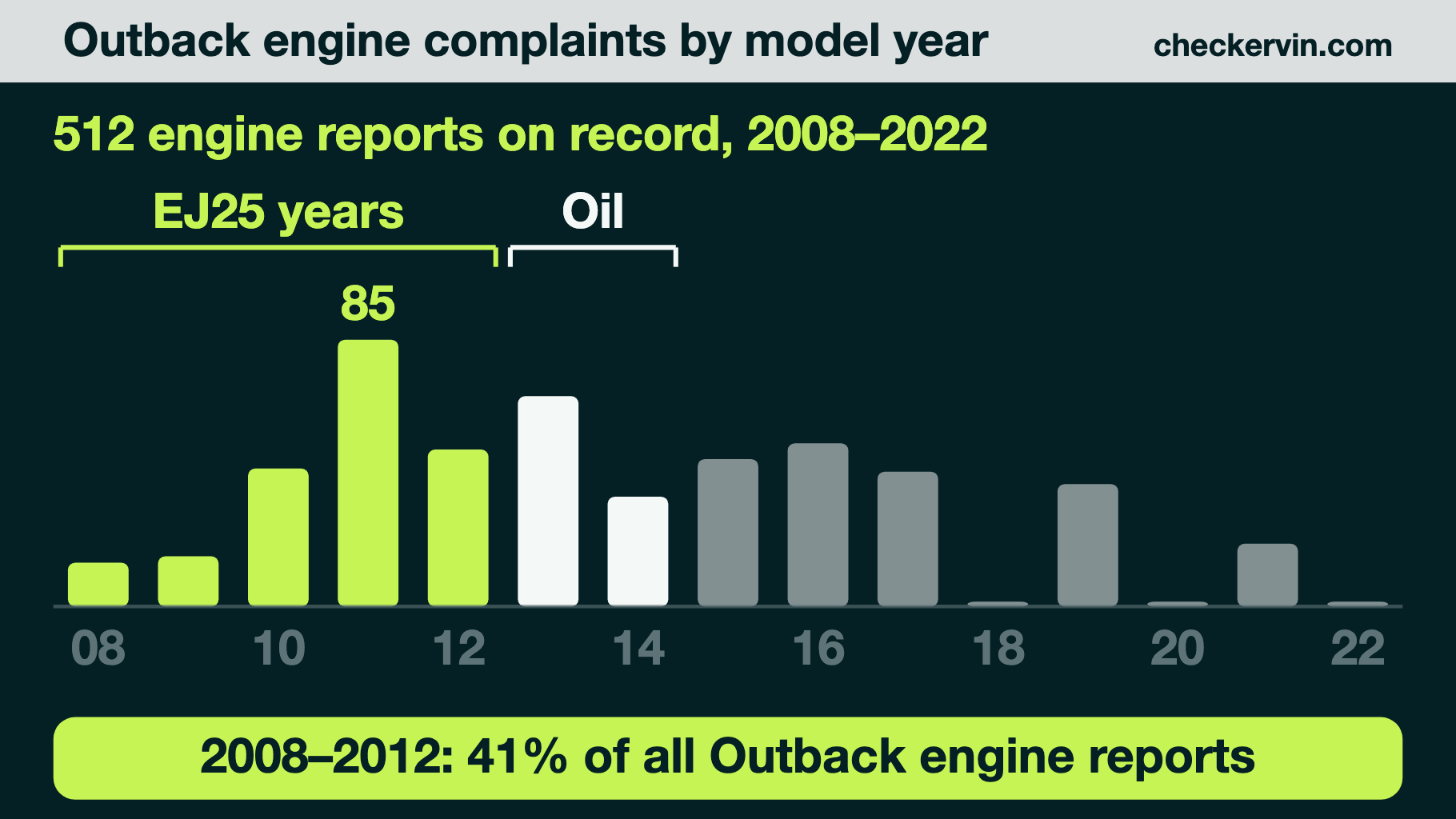
Our corpus of federal NHTSA complaints holds 7,698 owner reports against the 2008–2022 Outback. ENGINE, the category that captures head gasket complaints along with everything else under the valve covers, accounts for 512 of them, or 6.7%. For a car with the Outback’s reputation that is a small share. Electrical, windshield and wiper complaints dominate the later years by a wide margin.
Where the engine complaints sit is the useful part. The 2008 through 2012 model years hold 209 of the 512, or 41%, in five of the nameplate’s 15 years. The peak is 2011, with 85 engine reports, 13.1% of everything owners filed against that model year. The 2013 and 2014 cars add 102 more (20%), and 2013 is the only year the engine ranks first, with 67 reports (22.6% of that year). From 2015 onward the count thins, and in 2018, 2020 and 2022ENGINE does not make the year’s five most-reported categories at all. That means below fifth place, not zero.
One limit matters here. ENGINE is a category, not a diagnosis, and it does not separate a head gasket from a misfire or an oil leak. So we also searched the complaint narratives themselves for the words “head gasket.” Those mentions fall mostly in the 2008–2012 cars, turn rare from 2013, and disappear entirely in most later years. The two methods point at the same five model years.
Five engines under one badge
“Outback head gasket” assumes one engine. The 2008–2022 Outback was sold with five, and they do not share a failure pattern or a labor bill.
| Outback years | Engines offered |
|---|---|
| 2008-2009 | 2.5L EJ four; 2.5L EJ turbo (XT); 3.0L six (3.0R) |
| 2010-2012 | 2.5L EJ four; 3.6L six (3.6R) |
| 2013-2019 | 2.5L FB four; 3.6L six (3.6R) |
| 2020-2022 | 2.5L FB four, direct injection; 2.4L FA turbo (XT) |
The year-to-engine split for the 2013 change is Subaru’s own: its oil-consumption bulletin is written for “2013-14MY Legacy and Outback Models with 2.5L FB Engines.” The engine code sits in the VIN, so a Subaru VIN decode settles which of these you have before anyone quotes you, and an engine lookup by VIN does the same for displacement.
2008-2012: the EJ25 years
These are the cars the reputation belongs to. The federal narratives from these years read in two registers. The 2008 and 2009 reports talk mostly about oil seeping from the gasket edge at 50,000 to 100,000 miles, found during service and priced at shop rate. The 2010–2012 reports more often describe a car that overheated, sometimes with little warning, and a gasket diagnosed afterward. A few owners add that the instrument cluster of that era gave them a warning light rather than a temperature gauge to watch.
On an EJ engine the timing belt, idlers and water pump sit in front of the work, so a head gasket job and a timing-belt service share most of their labor. That is why many EJ quotes bundle them, and why a quote that leaves the belt out deserves a question if the belt is anywhere near its replacement interval.
The same years carry a bigger problem in the record, and it is not the engine. In 2010 through 2012 POWER TRAIN logs 417 complaints against ENGINE’s 179, outweighing it in every one of those years. That is the Lineartronic CVT, which Subaru covered with a separate extension to 10 years/100,000 miles on 2010–2015 Outback 2.5L models. If the car in front of you is a 2010–2012, the transmission history matters as much as the gaskets; our Forester CVT fluid post covers what the same transmission family asks of an owner.
2013-2014: an oil problem, not a gasket
The one year where ENGINE tops the Outback’s complaint list is 2013, the first year of the FB25. It is easy to read that as more head gaskets. Subaru’s own paperwork says otherwise. Bulletin 02-157-14R, which we read in full on NHTSA’s server, covers 2013–2014 Legacy and Outback models with the 2.5L FB engine for excessive oil consumption. It defines the threshold as more than one-third of a quart in 1,200 miles, measured by a dealer oil consumption test, and the repair for a confirmed car is a replacement short block.
The bulletin extended powertrain coverage for that condition to 8 years/100,000 miles from the original warranty start date, and for a period ending April 21, 2017 covered every affected car regardless of mileage. A related Subaru memo to dealers describes the class action behind it as covering certain 2011–2015 Subarus. Eight years from a 2014 sale ended in 2022, so this coverage has run out for any Outback sold on a normal schedule.
2015 and later: seams before gaskets
The FB and FA engines in the 2015–2022 Outback are mostly sealed with formed-in-place liquid gasket at their seams, and that changes what an “oil leak from the heads” usually is. Subaru’s bulletin 02-192-24R, revised April 2025 and applying to all FA and FB engines, sets out the oil-leak diagnosis by VIN. It tells technicians to start by ruling out areas improved in production, then to reseal specific joints: the timing chain cover against the cylinder head and block, the cam carriers, and the oil pan. For the current-generation Outback it lists VIN breaks where those production changes took effect.
The complaint record agrees that this generation is quieter. The 2015–2019 cars hold 181engine reports and the 2020–2022 cars 20 in our top-five data, with no year above 9.3% of its own complaints. A few narratives from these years do mention head gaskets, among them a 2019 owner reporting a leak at about 55,000 miles. A seep diagnosed as a head gasket on an FB engine is worth a second question: which joint, and does the bulletin’s seam list rule it out?
The labor differs too. The FB and FA use timing chains rather than the EJ’s belt, so the familiar “do the belt while you’re in there” bundle does not apply the same way, and a reseal of the chain cover is its own job with its own price.
The 3.6R six
The 3.6R option ran from 2010 through 2019, and its record on head gaskets is thin. No Subaru bulletin we found among the Outback’s communications names a head gasket condition on the six, and the oil-consumption bulletin is written for the 2.5L only. Among the complaint narratives, only two that mention a head gasket name the 3.6-liter engine: a 2015 owner told at about 54,000 miles that the driver’s-side gasket was starting to go, and a 2011 owner who reports gaskets replaced three times before the engine itself was swapped. Two reports across a decade of production are a footnote, not a pattern.
The six still costs more to work on when it does need gaskets. It is a larger engine in the same bay, and quotes for it should be compared only with other quotes for the 3.6R. The 2015 3.6R also sits inside the CVT extension, which named the 3.6L for that year alone.
Recalls, bulletins and the coolant question
There is no head gasket recall on the Outback. We queried NHTSA’s recall database for every model year from 2008 through 2022. One campaign, 10V196000 on early 2010 cars, is filed under engine cooling, but its summary is a CVT cooler hose that can crack and leak transmission fluid. It is not a gasket campaign. We checked the text search against a vehicle known to have a gasket recall first, so the null is a result, not a broken query.
We also pulled every manufacturer communication NHTSA lists for the 2008–2022 Outback, close to two thousand documents, and searched them. None is a head gasket bulletin or a head gasket warranty extension, and none mentions Subaru’s cooling system conditioner. That conditioner program is real, but it belongs to an earlier era: SlashGear describes Subaru’s 2004 service program WWP-99, which offered a free dose of the conditioner to owners of late-1990s and early-2000s 2.5-liter Subarus. We could not open that bulletin directly, and nothing in the record we read extends it to the Outbacks covered here.
Two bulletins in that set do touch the cooling system: a countermeasure thermostat for a rare cold-soak condition on 2013–2014 cars, and a fix for a thermostat-related check engine code on 2011–2012 cars. Neither is a gasket repair. Our guide to bulletins versus recalls explains why a service bulletin is not free work, and the Subaru recall check shows what is actually open on a given VIN.
Reading a head gasket quote
The quickest way to make two quotes comparable is to ask each shop the same questions in writing.
- Which engine code, and one side or both? A single-side job is a smaller bill but leaves the other gasket as old as the failed one
- What confirms the diagnosis: a combustion-gas test of the coolant, a leak-down or compression test, or a visual seep at the gasket edge
- Are the heads going to a machine shop to be checked for flatness and resurfaced, and is that priced in or a sublet extra
- On an EJ engine, are the timing belt, idlers and water pump included, and with what parts
- Thermostat, coolant, oil and filter, and new head bolts where the procedure calls for them
- The warranty on the finished job, in months and miles
A shop that has seen the engine overheat should also say whether it checked the heads for warping. That is the line item that most often turns a low quote into a high final bill.
Repair it, or sell it as is
On a 2008–2012 Outback with high mileage, a $2,000 to $3,600 gasket bill can approach a large share of what the car is worth. The owner in the 2024 forum thread was weighing a $7,000-plus quote against a car at 185,000 miles, which is the calculation in its starkest form. Look up the car’s market value for your trim and mileage first; it is the other half of the arithmetic.
A few facts tip the decision. An external seep that has not caused overheating can often be watched and topped up for a while, which buys time to shop quotes. An engine that has already overheated is a bigger risk and a weaker candidate for a gasket-only repair. And an Outback sold with a known gasket leak sells at a discount, so selling only wins if the repair costs more than that discount.
If you are shopping for one
The record works as a shopping map. A 2008–2012 Outback is the era where head gaskets belong on the inspection list: ask for receipts showing whether the gaskets have been done, look for oil and coolant residue along the gasket line, and confirm the engine code with a VIN decode. A 2013–2014 car raises the oil question instead; ask whether it went through the short block program. From 2015, the engine is one of the quieter parts of the Outback’s record.
Use the Subaru warranty check by VIN to see what coverage remains on a newer car, and read which Outback model years draw the most complaints overall rather than judging the car on the engine alone. If you are looking at a 2015, our 2015 Outback record breaks that single year down. For routine engine costs on the same nameplate, the Outback spark plug post explains why boxer-engine labor runs higher than the parts suggest.
Where this information comes from
- NHTSA — Outback complaint databaseThe federal complaint record this page's figures are computed from, and the narratives searched for head gasket mentions.
- NHTSA-hosted Subaru bulletin 02-157-14R — Engine Oil ConsumptionRead in full: 2013-2014 Outback 2.5L FB, 8 years/100,000 miles, short block remedy, one-third quart per 1,200 miles threshold.
- NHTSA-hosted Subaru bulletin 02-192-24R — Engine Oil Leak Diagnostic ProceduresAll FA and FB engines: VIN-break tables and the seams to reseal, including timing chain cover, cam carriers and oil pan.
- NHTSA-hosted Subaru bulletin 16-107-17R — CVT Warranty Extension2010-2015 Outback 2.5L CVT and 2015 3.6L coverage extended to 10 years/100,000 miles.
- NHTSA recalls API — Outback by model yearQueried for every model year 2008-2022; no head gasket campaign, checked against a known-positive vehicle first.
- Subaru Outback Forums — head gasket replacement at 185kThe $7,000-$9,000 reseal quotes, read from search-served result text on October 25, 2026; the forum blocks automated fetches.
- Allied Motor Parts — Subaru blown head gasketThe around-$2,000 figure, read from search-served result text on October 25, 2026.
- SlashGear — Subaru head gasket problems explainedSecondary source for the 2004 WWP-99 coolant conditioner program; the bulletin itself could not be opened.
Keep reading
Frequently asked questions
How much does a Subaru Outback head gasket replacement cost?
Owner-reported quotes span a wide band. Search results we pulled on October 25, 2026 show an owner of a 2006 Outback on Reddit quoting about $3,600 for both gaskets, an Allied Motor Parts article putting the job around $2,000, and a 2024 Subaru Outback Forums thread on a 2015-2019 car where Subaru-only shops quoted $7,000 to $9,000 for a full engine reseal with resurfaced heads. The spread is mostly scope: one gasket or both, machining, and whether the timing components and water pump ride along. We sell VIN checks, not repairs, and publish no price of our own.
Which Subaru Outback years have head gasket problems?
In the federal complaint record the concentration is 2008-2012, the last Outbacks whose base 2.5L was the EJ-series engine. Those five model years hold 209 of the Outback's 512 engine complaints (41%), peaking in 2011, and owner narratives that mention a head gasket cluster in the same years. The engine category is not a head gasket count, so treat this as where to look harder, not proof that a given car will fail.
Do newer Subaru Outbacks still have head gasket problems?
Far less, on the record we hold. 2013 is the only year the engine tops the Outback's complaint list, and Subaru's own bulletin ties the 2013-2014 Outback 2.5L to excessive oil consumption, which it repaired with a new short block, not a gasket. From 2015 the engine category never exceeds 9.3% of a model year's complaints, and it falls below the top five in 2018, 2020 and 2022. On the FB and FA engines, Subaru's current oil-leak bulletin points technicians at timing-cover and cam-carrier seams first.
Is there a recall or extended warranty for Outback head gaskets?
No recall. We queried NHTSA's recall database for every Outback model year from 2008 through 2022 and found no campaign naming a head gasket, after confirming the same text search finds one on a vehicle known to have it. Among the Outback bulletins NHTSA lists, there is no head gasket warranty extension either. The extensions that do exist covered the 2013-2014 2.5L's oil consumption (8 years/100,000 miles) and the 2010-2015 CVT (10 years/100,000 miles), and both have now run out by time on any car sold on schedule.
Can you keep driving an Outback with a leaking head gasket?
It depends on which kind of leak it is, and only a shop that has looked at the engine can tell you. An external oil seep at the edge of the gasket is a different situation from coolant loss, overheating or combustion gas in the cooling system. Several federal complaints on 2010-2012 Outbacks describe the temperature warning coming on with little notice before a gasket failure. If the temperature warning lights or coolant keeps disappearing, stop driving and get it diagnosed; an engine that overheats repeatedly can turn a gasket job into a cylinder head or engine job.
Confirm the engine before you price the gaskets
A free CheckerVIN report shows the factory build, engine, specifications and open recalls for any VIN, so you know which Outback you are pricing.
Run a free VIN check