The short answer
- What does it cost?
- RepairPal lists an average of $2,457–$3,281 for an Altima head gasket job, before taxes and fees. The V6 and a warped head cost more.
- Will Nissan pay?
- Not for a gasket: no Altima recall or extension names one. A 2018 2.5-liter car may be in Nissan's cylinder head campaign PC716.
- Which years to watch?
- The 2019–2022 car: engine reports are at least 18% of its complaints, against 5% for 2008–2018. Coolant-loss reports cluster there.
The numbers, and whose numbers they are
CheckerVIN decodes VINs and lists open recalls; we do not repair cars, so the prices on this page come from other sources and say so. RepairPal’s Nissan Altima head gasket estimator, as its listing read on November 23, 2026, puts the average job at $2,457 to $3,281: $1,737 to $2,549 of labor and $720 to $732 of parts, before taxes and fees and not adjusted for where you live. Its page for the 2019 Altima runs higher, at $2,696 to $3,648. RepairPal blocks direct requests from our research tools, so those are the figures its own search listings displayed, matched in two separate searches.
Look at the split rather than the total. Parts barely move between the low and high ends; labor carries almost all of the spread. That is the nature of this repair: the gasket itself is a modest part, and the bill is the time it takes to drain the cooling system, strip the intake, exhaust and timing chain, lift the head, check it for flatness and put it all back. RepairPal’s averages are also a single number for every Altima engine, and the Altima has had four.
Which engine you have changes the job
| Altima years and engine | What a head gasket job involves |
|---|---|
| 2008–2018 2.5L four (QR25DE) | One head, one gasket; chain-driven, so the timing cover comes off |
| 2008–2018 3.5L V6 (VQ35DE) | Two heads, two gaskets; rear bank sits against the firewall |
| 2019–2022 2.5L four (PR25DD) | One head; direct-injected engine new to this generation |
| 2019–2022 2.0L VC-Turbo (KR20DDET) | One head; same engine family as bearing recall 25V437 |
The federal fuel-economy listings confirm the split by year: a 2.5-liter four and a 3.5-liter V6 from 2008 through 2018, then a 2.5-liter four for every 2019–2022 Altima plus a 2.0-liter turbo on upper trims (SR and Platinum through 2021, SR only in 2022). The engine code is printed on the build data that a Nissan VIN decode returns, and the engine size lookup by VIN settles the four-or-six question before any shop writes a quote.
The V6 is the one that changes the arithmetic. Even when only one bank is leaking, the intake and timing chain come off to reach it, which is why V6 quotes often include both gaskets: the second one will not be cheaper to reach later. Every Altima engine here is chain-driven; the Altima timing chain post covers that system on its own, and a head job is a sensible time to inspect the chain guides while they are exposed.
What 9,770 complaints say, as a share
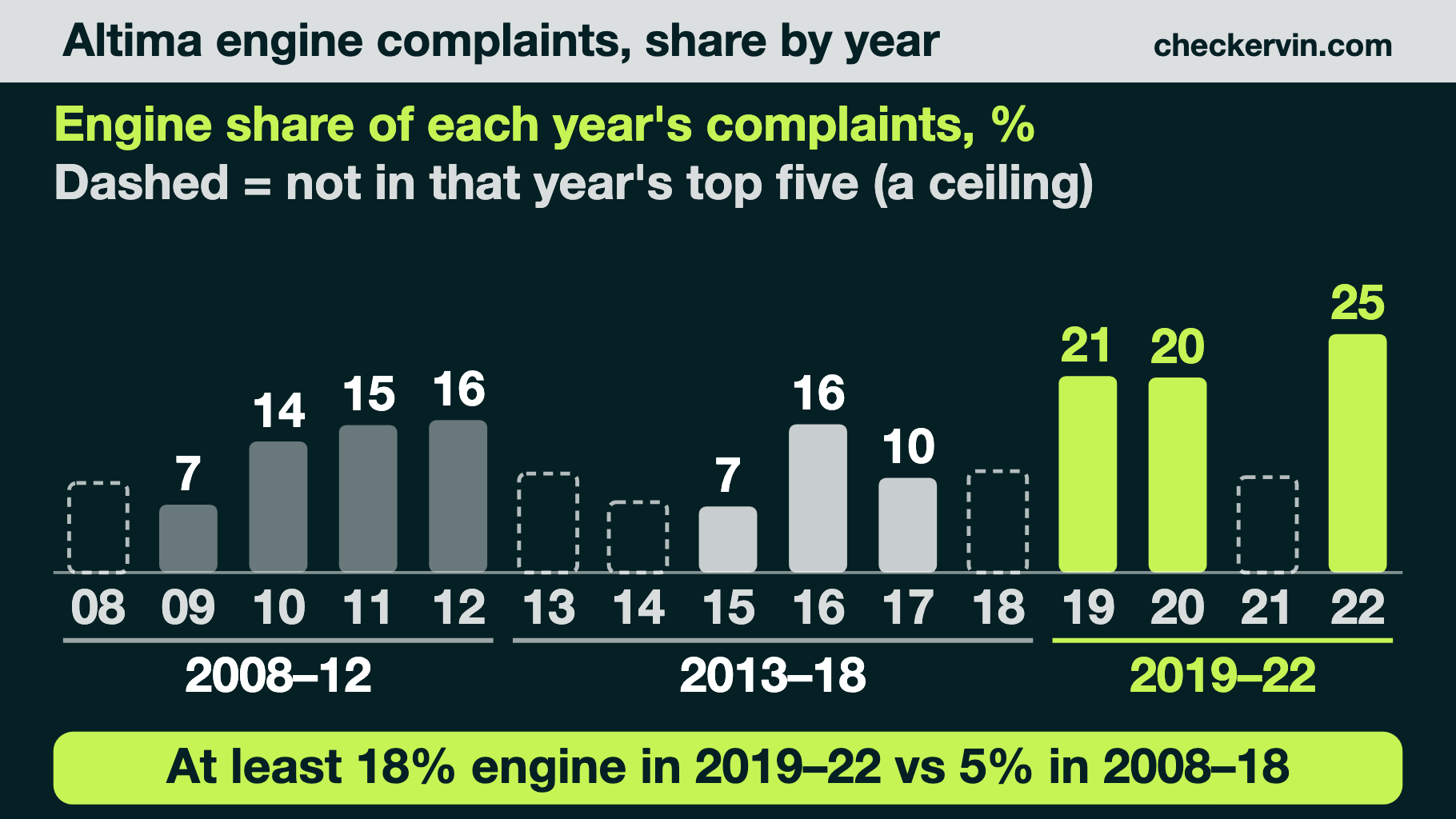
Our corpus of federal NHTSA complaints holds 9,770 reports against the 2008–2022 Altima. ENGINE makes the top five components in 10 of the 15 model years, for at least 555 engine reports; in 2008, 2013, 2014, 2018, 2021it ranks below fifth and is not counted, so the total is a minimum. ENGINE is NHTSA’s bucket for every engine fault, from stalling to misfires to failed sensors. It sets a ceiling on head gasket complaints and is never a count of them.
Raw counts favor the high-volume years. The 2009 car has the most engine reports, 114, partly because it has more complaints of every kind. Dividing each year’s engine reports by its own total gives a fairer picture. On the 2008–2018 cars, engine reports make up between 7% and 16% of each counted year. On the 2019 car the figure is 21%, and on the 2020 car 20%. Pooled, the 2019–2022 generation spends at least 18% of its complaint record on the engine, against at least 5% for 2008–2018. The 2022 bar is tall but rests on only 20 complaints, so read it as a hint, not a pattern.
How often owners actually write “head gasket”
We read the complaint narratives NHTSA publishes for every Altima model year from 2002 to 2022 and searched them for “head gasket,” “cracked head,” “cylinder head,” “overheat” and “coolant.” The Altima’s head gasket reputation is older than our data. The phrase turns up far more often on the 2002 car than on any later year, and many of those owners tie it to the pre-catalyst that broke up on early 2.5-liter engines and to heavy oil burning. Nissan recalled 2002 Altimas in campaign 03V084000 partly because certain engine conditions could overheat the pre-catalyst, and recalled some 2006 2.5-liter cars in 06V223000 for piston rings that let the engine burn oil.
From 2008 through 2018, “head gasket” shows up only in scattered single narratives: a 2008 V6 owner told at an oil change that the gaskets were seeping coolant, a 2013 owner whose car would not restart after a radiator failure, a 2017 owner told the number-four cylinder’s gasket needed replacing. Nothing in that stretch looks like a repeating failure. The engine complaints from those years are mostly about other things, which the timing chain post walks through in detail.
The one Nissan campaign about an Altima cylinder head
The only Nissan action we found that reaches an Altima cylinder head is an emissions recall, not a safety recall, and it is not about the gasket. Campaign PC716, announced April 1, 2020, covers 5,557 2018 Altimas with the 2.5-liter QR25DE built between November 27, 2017 and January 23, 2018 (plus 2,209 Rogues). Nissan says a machining issue in some engines could let oil escape past the valve guides into the combustion chamber, slowly degrading the catalyst. It states the condition has no effect on safety or fuel consumption.
The dealer procedure in bulletin NTB20-025a is specific. The technician reads the first four characters of the serial number cast into the front of the cylinder head, enters them with the VIN into Nissan’s system, and if the head is from the suspect lot, pulls all four spark plugs. If plug one or two is darker than plug three or four, Nissan replaces the long engine assembly, the exhaust manifold catalyst and both oxygen sensors at no charge. Nissan expected about 90% of cars to pass inspection and leave.
That matters for pricing a gasket job on a 2018 2.5. A shop chasing oil fouling or a smoky start on one of these cars may be looking at a condition Nissan already pays to fix with a whole engine. Run the VIN through the Nissan recall check and ask a dealer whether PC716 is open before paying anyone to lift the head.
2019–2022: coolant loss, grille shutters and a bearing recall
The 2019–2020 narratives read differently from anything before them. Many were filed in 2025 and 2026, and a run of them describe coolant disappearing and engines running hot: thermostats replaced twice, warm air from the vents with the A/C on, an “Engine Malfunction, Power Reduced” message. Among them, one 2019 owner reports a blown head gasket that a shop repaired before the engine failed anyway, one 2020 owner was told the head was cracked, and another 2019 owner was told coolant on the spark plugs meant a new engine. Few of these narratives say whether the car has the 2.5 or the turbo.
Several owners blame the active grille shutter, the motorized louver behind the grille. Nissan did extend coverage on that part: campaign PC989, from November 2023, extends the emission warranty on the 2019–2020 Altima’s shutter to 15 years or 150,000 miles across 260,484 cars, because the shaft to the motor can twist or crack and leave the shutter closed with codes P059F or P159F. Nissan’s bulletin says the fault has no effect on safety or drivability and mentions only reduced fuel economy; owners in the complaint file say their cars overheated. Both are on the record, and the bulletin does not settle which is right for a given car.
The turbo adds one more check. Recall 25V437000 covers 443,899 vehicles with Nissan’s VC-Turbo engines, including 5,685 2019–2020 Altimas, for engine bearings that may have manufacturing defects. That is a bottom-end failure, not a gasket, but an engine that is knocking and losing power can be misread as either. On a 2019–2020 turbo, the open-recall check comes before any head work.
Prove the gasket before paying for it
A head gasket is the expensive answer to a set of symptoms that have cheaper causes, and the Altima’s own paperwork includes several of them. A stuck grille shutter, a thermostat, a radiator seam and an overheating catalyst can all look like a gasket at first. The tests that separate them cost a fraction of the repair.
| What you notice | What it can point to |
|---|---|
| Coolant reservoir dropping, no drips under the car | Coolant entering a cylinder, or a slow external leak that evaporates |
| Running hot with check-engine codes P059F or P159F | Stuck grille shutter on a 2019–2020 car (PC989) |
| Misfire on a cold start that fades as it warms | Coolant seeping into a cylinder overnight |
| Oil fouling on plugs 1 or 2 of a 2018 2.5 | Possible PC716 valve-guide condition, not a gasket |
| Knock and power loss on a 2019–2020 turbo | Bearing failure under recall 25V437, not a gasket |
The standard tests are a cooling-system pressure test, a chemical block test that checks the coolant for combustion gas, and a cylinder leak-down test that shows which cylinder is losing pressure into the cooling system. A positive block test plus a leak-down result on a specific cylinder is a strong case. Ask what the factory filled the system with, too: the coolant type lookup by VIN shows it, so a top-up with the wrong fluid is easy to spot on the invoice.
How long the job takes, and why nobody agrees
We could not find a Nissan document that publishes a flat-rate time for an Altima head gasket. Shops quote from commercial labor guides, and owner forums repeat numbers without saying which engine or year they came from. RepairPal’s split gives a usable proxy: labor is roughly 70 to 78 percent of its Altima estimate, and the labor-only range on its general page is wider than the entire parts bill.
The engine sets the floor. On the four-cylinder there is one head to lift and the timing chain cover to remove. On the 3.5-liter V6 there are two heads, two sets of chain hardware and an intake plenum in the way, and the rear bank sits tight against the firewall in the Altima’s transverse layout. Machining is separate time again: if the head is out of flat, it goes to a machine shop to be resurfaced or, if cracked, replaced. A useful question for any quote is how many book hours it assumes and whether head machining is inside or outside that number.
Gasket, used engine or remanufactured engine
Owners on a tight budget usually weigh three paths. The first is the gasket job itself, sensible when testing shows a leak on a head that checks flat and the engine has not been run hot for long. The second is a used engine from a salvage yard, the cheapest swap and the one with the least known history. The third is a remanufactured engine. Fraser Engine Co., a remanufacturer, listed its rebuilt 2.5-liter QR25DE for Altimas at a $3,299 sale price on November 23, 2026, with a $300 core deposit, $250 round-trip shipping and a three-year, unlimited-mile warranty. That is the engine only; installation labor is added on top.
Set that beside RepairPal’s gasket average and the decision becomes clearer. A clean gasket job is cheaper than a reman engine installed. A gasket job that finds a cracked head, or an engine that has mixed coolant into its oil long enough to wipe the bearings, lands close to engine-swap money without the swap’s warranty. On an older Altima, also weigh the transmission: a high-mileage CVT can be the next big bill, and the Altima transmission replacement post prices that job.
Before you authorize the repair
- Confirm the engine by VIN: 2.5 four, 3.5 V6, or 2.0 VC-Turbo
- On a 2018 2.5, ask a Nissan dealer whether campaign PC716 is open on the VIN
- On a 2019–2020 car, check for codes P059F or P159F and the PC989 shutter extension
- On a 2019–2020 turbo, run the VIN for recall 25V437000 before any engine work
- Ask how the failure was confirmed: pressure test, block test, leak-down
- Ask how many book hours the quote assumes and whether head machining is extra
If the shop recommends an engine instead of a gasket, ask to see what it found: a straightedge reading on the head, a photo of a crack, oil analysis showing coolant. Those turn a judgment call into something you can compare across quotes.
If you are buying the Altima, not repairing it
On a test drive, start the car cold and watch for a rough first minute, check that the coolant sits at the full mark with the engine cold, and look for a sweet smell from the exhaust or the vents. On a 2019–2020 car, ask whether the grille shutter has been replaced and watch the temperature gauge in slow traffic. A seller who has added coolant every week has told you something important.
Records help more than mileage here. An Altima with a documented cooling-system repair and no overheating since is a better bet than one with a fresh gasket and no explanation of why it failed. The Nissan Altima years-to-avoid page lays out the full complaint record by year, the Nissan warranty check by VIN helps estimate what factory coverage remains, and the Altima alternator post covers the electrical side of the same cars.
Where this information comes from
- Nissan campaign bulletin PC716/PC717 (NHTSA copy) — QR25 cylinder head emission recall5,557 2018 Altimas built Nov. 27, 2017 to Jan. 23, 2018; valve-guide machining; free inspection and engine if needed.
- Nissan NTB20-025a (NHTSA copy) — 2018 Altima and Rogue cylinder head inspectionThe serial-number and spark-plug inspection that decides whether the engine is replaced.
- Nissan campaign PC989 (NHTSA copy) — 2019–2020 Altima active grille shutter extension15 years or 150,000 miles, 260,484 cars, codes P059F and P159F; Nissan's statement on drivability.
- NHTSA — Part 573 safety recall report 25V437443,899 VC-Turbo vehicles in total, 5,685 of them 2019–2020 Altimas; engine bearings, not gaskets.
- NHTSA — recalls by VINOur year-by-year query for 2002–2022 found no Altima recall naming a head gasket.
- NHTSA — vehicle complaintsThe federal complaint database our engine figures and narrative reading come from.
- fueleconomy.gov — Altima engines by yearConfirms the 2.5L four and 3.5L V6 through 2018 and the 2.0L turbo on 2019–2022 upper trims.
- RepairPal — Nissan Altima head gasket replacement estimateThe $2,457–$3,281 average and its labor and parts split, from RepairPal's listing, November 2026.
- Fraser Engine Co. — remanufactured 2.5L Nissan enginesThe $3,299 remanufactured QR25DE listing used for the engine-swap comparison, November 2026.
Keep reading
Frequently asked questions
How much does it cost to replace a head gasket on a Nissan Altima?
RepairPal's Altima estimator lists an average of $2,457 to $3,281, with $1,737 to $2,549 in labor and $720 to $732 in parts, before taxes, fees and local rates, as its listing read in November 2026. Its 2019 Altima page runs higher, at $2,696 to $3,648. Those averages assume the head and block are flat; a warped or cracked head adds machining or a replacement head, and the V6 has two heads and two gaskets to replace.
Is it worth fixing a blown head gasket on an Altima?
It depends on what the teardown finds and what the car is worth. A confirmed gasket leak on a flat head is a contained repair. If the engine kept running hot until the head warped, or coolant got into the oil and damaged bearings, an engine swap can cost about the same: Fraser Engine Co. listed a remanufactured 2.5-liter QR25DE for Altimas at $3,299 plus shipping and a core deposit in November 2026, before installation. Get the failure proven with a pressure or block test before choosing.
Are Nissan Altimas expensive to fix?
For the head gasket specifically, the Altima is not a documented problem car: we found no Nissan warranty extension or NHTSA recall naming an Altima head gasket in any model year from 2002 to 2022. The costly Altima repairs with paper behind them are the CVT, which Nissan covered with warranty extensions on 2013–2018 cars, and the 2019–2020 2.0-liter VC-Turbo engine under bearing recall 25V437.
How many hours does it take to replace a blown head gasket on an Altima?
We found no Nissan bulletin that publishes a flat-rate time for an Altima head gasket, so treat any single number online with caution. The cost tells the story instead: labor is roughly two-thirds or more of RepairPal's Altima estimate. The four-cylinder has one head and one gasket; the 3.5-liter V6 has two, with the rear bank against the firewall, so it takes longer. Ask the shop for the book hours it is quoting from and whether machining is extra.
Is there a recall for Nissan Altima head gaskets?
No. Our query of NHTSA's recall database for every Altima model year from 2002 to 2022 found no campaign naming a head gasket. The closest Nissan action is emission recall campaign PC716, which inspected the cylinder head serial number on 5,557 2018 Altimas with the 2.5-liter engine built between November 27, 2017 and January 23, 2018, and replaced the engine free if a machining defect at the valve guides was confirmed. It concerned oil getting past the valve guides, not the gasket.
Know the engine before you price the gasket
A free CheckerVIN report shows the factory build, engine, specifications and open recalls for any VIN, so you know which Altima job you are actually pricing.
Run a free VIN check