The short answer
- What does it cost?
- RepairPal lists $2,275–$3,099 on average for a Civic head gasket, most of it labor. A warped head or block adds parts and hours.
- Will Honda pay?
- On a 2016-or-later Civic 1.5T or Si, possibly: Honda extended gasket coverage to 10 years or 150,000 miles in August 2026.
- The deadline?
- 2016–2017 turbo Civics are covered only until May 31, 2027, under bulletins 26-099 and 26-097. Check the VIN now.
$2,275–$3,099
RepairPal Civic average
Labor $1,546–$2,268, as listed Oct 2026
10 yr / 150k
Honda gasket extension
2016–2024 Civic 1.5T and Si, from purchase
May 31, 2027
2016–2017 window closes
Bulletins 26-099 (CVT) and 26-097 (manual, Si)
5 of 7
1.5T-era years ENGINE misses the top five
2016–2022 NHTSA complaints
What a Civic head gasket job costs, and whose numbers they are
We decode VINs; we do not rebuild engines. The dollar figures below belong to RepairPal, and the hours belong to Honda. Both were read on October 26, 2026.
| Source | What it says about a Civic head gasket |
|---|---|
| RepairPal estimator | $2,275 to $3,099 average; labor $1,546 to $2,268, parts $729 to $831, before taxes and fees (updated September 3, 2026) |
| Honda flat rate, 2016–2021 1.5T | 11.5 hours gasket only; 11.9 with a new head; 14.7 with a short block; 14.8 with both |
| Honda flat rate, 2022–2024 1.5T | 11.3 hours gasket only; 11.7 with a head; 13.9 with a short block; 14.1 with both |
RepairPal’s range is the one to hold a shop quote against. Labor is about two thirds of it, which is what a head gasket looks like on a modern transverse four-cylinder: the gasket costs little, and getting to it means draining the cooling system, unbolting the intake, exhaust and turbocharger plumbing, and lifting the head. On the 1.5T, Honda’s own parts list for the gasket-only repair runs to more than twenty lines, including turbocharger gaskets, a turbo oil-feed filter, a fuel pipe set and intake manifold gaskets.
The Honda hours are not a retail price. They are what Honda pays its dealers under the warranty extension, and we print them because they show how the bill grows once the head is off. The gap between 11.5 and 14.8 hours is a warped head or block. The Honda hours also assume the inspection kit and procedure in the bulletin, so an independent shop’s book time may differ.
Honda’s August 2026 extension, Civic by Civic
On August 26, 2026, Honda told its dealers it was extending cylinder head gasket coverage across the Accord, Civic and CR-V. The background paragraph is the same in every Civic bulletin: under certain conditions the gasket’s effectiveness may be reduced, which can cause overheating, coolant loss or misfire. The coverage runs to 10 years from the original date of purchase or 150,000 miles, whichever comes first.
| Civic | Honda bulletin and coverage |
|---|---|
| 2016–2021, 1.5L turbo with CVT | 26-008: 10 years or 150,000 miles |
| 2016–2021, 1.5L turbo manual; 2017–2020 Si | 26-009: 10 years or 150,000 miles |
| 2022–2024, 1.5L turbo with CVT | 26-011: 10 years or 150,000 miles |
| 2022–2024, 1.5L turbo manual; 2022–2026 Si | 26-010: 10 years or 150,000 miles |
| 2016–2017, 1.5L turbo, CVT | 26-099: until May 31, 2027 |
| 2016–2017, 1.5L turbo manual; 2017 Si | 26-097: until May 31, 2027 |
Honda revised every one of these on September 25, 2026. Version 3 adds two details that change what an owner can expect. Misfire codes P0300 through P0304 are no longer required for a repair, and the coverage applies whether or not the car was ever declared a total loss, sold for salvage or given a branded title. Honda said it would begin mailing owners in early October 2026, but the bulletins tell dealers to run a VIN status inquiry, so the absence of a letter proves nothing.
Only the turbo engine and the Si are named, and the EPA’s fueleconomy.gov listings show the 1.5-liter turbo sold alongside a non-turbo 2.0-liter in the same model years, so two Civics of the same year can sit on opposite sides of the line. The engine on your title matters more than the trim badge on the trunk; our engine size by VIN lookup reads it from the factory record.
2016–2017: the May 31, 2027 deadline
A 10-year clock started at purchase has already run out on most 2016 Civics, and it runs out on 2017s over the coming year. Honda’s answer was a second pair of bulletins, 26-099 for the 2016–2017 turbo with the CVT and 26-097 for the manual and the 2017 Si, both titled with the same phrase: “(6 Month) – Expires May 31, 2027.” The dealer announcement describes them as a six-month grace period for cars no longer eligible because of age.
The wording changed between versions, and the change favors owners. The first version of 26-099, dated August 26, extended coverage to May 31, 2027 or 150,000 miles. Version 3, dated September 25, extends it to May 31, 2027 “regardless of time in service or mileage.” Read literally, a high-mileage 2016 turbo Civic that would fail the 150,000-mile test under 26-008 is still inside 26-099 until that date. The VIN status inquiry is what decides, and we would ask a dealer to confirm it in writing.
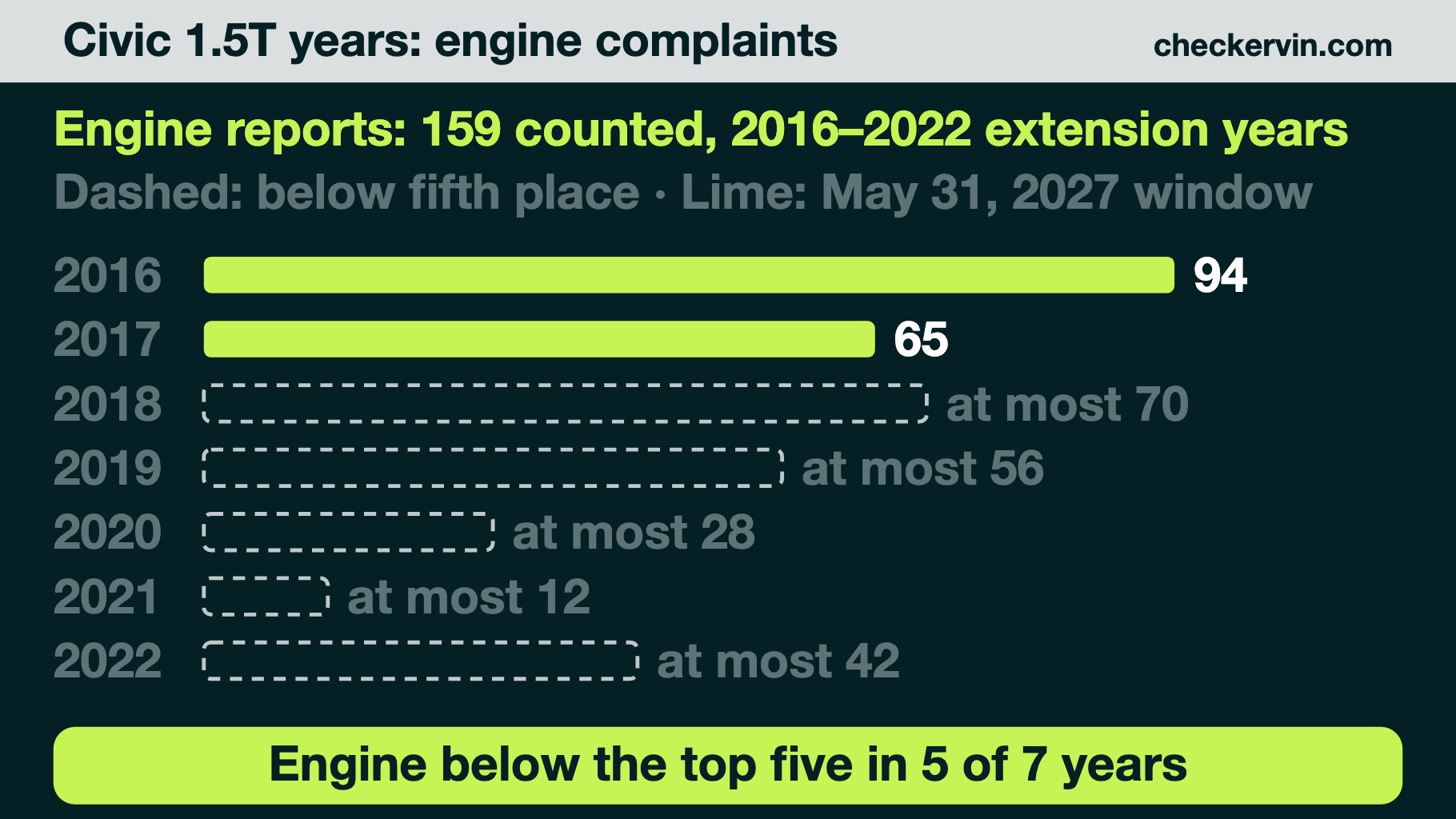
The two bulletin years are also the only extension years where the engine category is big enough to show up in the record. Engine complaints are 94 for 2016 and 65 for 2017 in our data, 10% of everything filed against those two model years. That category holds every engine fault on both the turbo and the 2.0-liter, so it is context, not a head gasket count.
The Civics the extension does not name
The 2.0-liter non-turbo Civic from 2016 through 2024 is the largest group left out. Honda does have a 2.0-liter Civic bulletin in the same set, 26-012, but its title limits it to the 2025–2026 Civic, which is outside our data. A 2016–2024 LX or Sport with the 2.0-liter pays for its own gasket unless a VIN status inquiry says otherwise. The same goes for the Civic Type R, which none of the bulletins we read names.
Older Civics are a different story with a different part. On 2008–2015 cars we found no Honda head gasket bulletin and no recall. The largest engine figure in our whole Civic record is the 2008 model year, at 162 reports, and on those cars the expensive coolant problem was the engine block itself. Coolant loss on a 2006–2009 Civic is often the block, not the gasket, and that post covers the Honda bulletin and why its coverage has ended.
The Accord got a parallel set of bulletins on the same day, which our Accord head gasket replacement cost post maps model by model. Subaru owners have a much older version of this problem, set out in our Forester head gasket replacement cost post.
How a Honda dealer proves the gasket has failed
The bulletins are specific about what counts as a failure, and it is worth knowing before you walk in. The inspection starts with a cold engine and a full trouble-code printout. The technician fits a cooling-system pressure tester, runs the engine until the fan cycles or coolant reaches 194°F, brings the system to 18 psi, pulls all four spark plugs and runs a borescope camera into each cylinder, scanning the line where the head meets the block.
If coolant is visible on a cylinder wall, the dealer photographs it with the VIN, repair order number, date and engine number in the frame, and that photo goes with the warranty claim; Honda says claims without it will be denied. If no coolant is found, the bulletin reads, in Honda’s words, “This bulletin does not apply,” and the car goes back to normal troubleshooting.
That gives an owner two practical points. First, a car that is overheating or misfiring for some other reason will not qualify, however old the turbo engine is. Second, the independent shop you may use for a second opinion can run the same check: a pressure test and a borescope are standard tools, and an image of coolant in a cylinder is the evidence to bring to the dealer.
Oil dilution is a different 1.5T fault
The 1.5-liter turbo Civic already had a well-known engine complaint before 2026, and it is easy to mix the two up. Oil dilution is fuel getting into the engine oil, and Honda tied its fix to cold-weather states and driving style. Owners describe an oil level that rises between changes and oil that smells of gasoline.
Honda dealt with it in two steps. In December 2018 it announced a product update for certain 2016–2018 Civics with the 1.5-liter turbo sold in 21 cold-weather states, updating engine and transmission software; the A/C control unit was first replaced and, from February 2019, reflashed instead. In April 2019 it extended the warranty on the camshafts and rocker arm assemblies from 5 years or 60,000 miles to 6 years with unlimited miles from the original sale. Six years from sale has now passed for any 2016–2018 Civic sold new before late 2020, so on nearly every car that extension is over.
The overlap is in the warning lights. Honda’s dilution notices list misfire codes P0300 through P0304, plus P0172 for a rich mixture and a whirling noise from the engine. The head gasket bulletins list P0300 through P0304 too. The difference is what leaves the engine: a dilution car gains oil and smells of fuel; a gasket car loses coolant with no puddle and shows coolant in a cylinder. The head gasket bulletins we read do not mention oil dilution, and we are not suggesting one caused the other.
What the complaint record shows, and what it cannot
NHTSA has no head gasket category. A gasket complaint lands in the engine category alongside oil dilution, stalls, misfires and the 2008 block cracks, so the figures here are an upper bound on gasket trouble and context for it, never a count.
Our corpus holds 7,501 complaints against the 2008–2022 Civic. Across the 2016–2022 years the extension reaches, there are 4,023complaints, and the engine category makes a year’s top five only in 2016 and 2017, for 159 reports counted. In the other 5 years it ranks below fifth place. That is not zero: in each of those years the engine figure is at most the fifth-place count, which tops out at 70 in 2018. Even if every one of those ceilings were filled, the whole 2016–2022 engine figure could not exceed 367. The category that leads those years is steering, at 1,825 reports counted.
Why so little, if Honda has extended coverage across seven model years? Timing and mileage. Reading the narratives NHTSA publishes, head gasket mentions on 2016-and-later Civics are rare, and nearly all of them were filed in 2025 or 2026, years after most of each model year’s complaints came in. Several name the 1.5-liter turbo and describe the pattern the bulletins list: coolant disappearing with no visible leak, misfires, limp mode. The complaint file is a lagging instrument; Honda’s warranty data is not, and the extension is the better signal. Our Honda Civic years-to-avoid breakdown scores each year on its whole record.
For scale across the whole nameplate, the engine category reaches a year’s top five in 5 of 15 years, for at least 378 reports counted from 2008 to 2022.
Recalls that touch a Civic engine
A recall would make the repair free at any age, so we checked. On October 26, 2026 we queried NHTSA’s recall API for the Civic in every model year from 2008 through 2022. No campaign names a head gasket, coolant loss or overheating. The recall counts match our data year for year, which is how we know the query was seeing the full list.
The one engine-internal campaign is 16V074000, filed under engine and engine cooling: certain 2016 Civics with the 2.0-liter engine, built between September 22, 2015 and February 3, 2016, may have piston wrist pin circlips missing or misinstalled. It is a non-turbo campaign and has nothing to do with gaskets, but it is a reason to run the VIN before paying for engine work on a 2016. Fuel-pump recalls 20V314000, 21V215000 and 23V858000 also reach Civic years in this span; a failing pump can cause stalling, not a gasket failure.
Our Honda recall check runs the open-recall lookup. A warranty extension will not show up there, which is the point of our TSB vs recall explainer: bulletins and extensions are found through a dealer, and they pay only within their own terms.
Gasket, head or short block: what changes the bill
Every Civic bulletin sorts the repair into three outcomes once the head is off. If the head and block are flat, it is a gasket. If the head is warped, the head is replaced. If the block deck is warped, the short block is replaced. Honda sent dealers a warpage inspection kit with a straight edge and feeler gauges for that decision.
On a car outside coverage, that sorting is where an estimate can grow. A gasket-only job is the RepairPal range. A head adds the cost of a complete cylinder head assembly, and a short block takes the job past the point where many owners of an older Civic stop and weigh the car’s value. The fastest route to a short block is to keep driving an overheating engine; a car that is losing coolant should be parked and towed, not topped up and driven.
Whatever the outcome, refill with the coolant the engine was built for. Honda’s parts list calls for its Type 2 long-life coolant, and our coolant type by VIN page matches the refill to the car.
Before you pay for a Civic head gasket
- Confirm the engine. A 1.5L turbo or Si points to a Honda bulletin; a 2016–2024 2.0-liter does not.
- Ask a Honda dealer for a VIN status inquiry on the head gasket campaigns, even with no letter in the mail.
- On a 2016–2017 turbo, book the inspection before May 31, 2027; a later repair order is not valid.
- Ask for the borescope result: coolant in a cylinder is Honda's test, and a photo is the evidence.
- If a shop quotes a head or short block, ask for the warpage measurement in writing.
- Rule out oil dilution first if the oil level is rising rather than the coolant falling.
If you already paid for a gasket on an eligible car before August 2026, the bulletins we read say nothing about reimbursement. Ask Honda directly and keep the invoice; we could not verify a reimbursement route, so we will not promise one. For the in-service date that starts every Honda warranty clock, see our Honda warranty check by VIN.
Shopping a used 1.5T Civic
The extension adds value to a 2018–2021 turbo Civic under 150,000 miles, because a failure that would have cost thousands is now Honda’s on most of them. It does much less for a 2016–2017, whose window closes on May 31, 2027. On those cars, ask the seller whether a head gasket has already been done, and by whom; a dealer repair under 26-099 or 26-008 will be on Honda’s records.
Look for the signs the bulletins list: a coolant reservoir below the line on a cold engine, a misfire or a check-engine light, a temperature gauge that climbs. A seller who has been topping up coolant without finding a leak is describing the failure. Our 2016 Honda Civic recordcollects that year’s complaints and recalls in one place, and the Honda VIN decoder confirms engine, transmission and plant before you spend money on an inspection.
Where this information comes from
- Honda dealer message, Aug 26, 2026 — Warranty Extension: 2016–2026 Multi-Model Cylinder Head Gasket (NHTSA-hosted)Lists every Civic bulletin by number, the 10-year/150,000-mile terms and the six-month grace period for cars past the age limit.
- Honda Service Bulletin 26-099 v3 — 2016–17 Civic 1.5T (CVT) head gasket, expires May 31, 2027 (NHTSA-hosted)Coverage to May 31, 2027 regardless of time in service or mileage; inspection procedure and flat rates.
- Honda Service Bulletin 26-097 v3 — 2016–17 Civic 1.5T (M/T) and 2017 Si (NHTSA-hosted)The manual-transmission and Si counterpart of 26-099, with the same May 31, 2027 end date.
- Honda Service Bulletin 26-008 v3 — 2016–21 Civic (CVT) head gasket (NHTSA-hosted)10 years or 150,000 miles; branded titles included; 11.5 to 14.8 flat-rate hours by repair outcome.
- Honda Service Bulletin 26-009 v3 — 2016–21 Civic and 2017–20 Si (M/T) head gasket (NHTSA-hosted)Same terms for the manual turbo and the Si.
- Honda Service Bulletins 26-011 v3 (2022–24 CVT) and 26-010 v3 (manual and Si) — NHTSA-hostedThe 2022-and-later turbo bulletins; 11.3 to 14.1 flat-rate hours. 26-010 is MC-11037696-0001.
- Honda dealer message, Apr 5, 2019 — 2016–18 Civic oil dilution warranty extension (NHTSA-hosted)Camshafts and rocker arms extended to 6 years, unlimited miles; lists P0300–P0304 and P0172. The Dec 21, 2018 product update is MC-10152439-0001.
- NHTSA — recalls API, 2016 CivicReturns 16V074000, the 2.0-liter piston circlip campaign. Queried for 2008–2022 on October 26, 2026; no head gasket campaign found.
- NHTSA — recall lookup by VINRun your own car; also the source of the complaint records computed above.
- EPA fueleconomy.gov — 2016 Civic engine listingsShows the 1.5-liter turbo and the 2.0-liter offered in the same model year; 2020 also queried.
- RepairPal — Honda Civic head gasket replacement estimateThe $2,275–$3,099 average quoted above, as listed October 26, 2026.
Keep reading
Frequently asked questions
How much does it cost to replace a head gasket on a Honda Civic?
RepairPal's Civic head gasket estimator lists an average of $2,275 to $3,099, with $1,546 to $2,268 in labor and $729 to $831 in parts, before taxes and fees, as its listing read on October 26, 2026. Those are RepairPal's figures, not ours. On a 1.5-liter turbo Civic from 2016 on, Honda's 2026 warranty extension may pay for the covered repair, so check the VIN with a Honda dealer before paying anyone.
Is there a Honda Civic head gasket recall?
No. NHTSA's recall database, queried October 26, 2026 for every Civic model year from 2008 to 2022, has no campaign that names a head gasket. Honda issued warranty extensions instead, on August 26, 2026: Service Bulletins 26-008 and 26-009 for the 2016–2021 Civic 1.5-liter turbo and 2017–2020 Si, and 26-010 and 26-011 for 2022-on turbo cars and the Si. Each extends head gasket coverage to 10 years from the original purchase date or 150,000 miles.
Is my 2016 or 2017 Civic too old for Honda's head gasket extension?
Not yet, if it has the 1.5-liter turbo. Honda gave 2016–2017 turbo Civics their own bulletins, 26-099 for the CVT and 26-097 for the manual and the 2017 Si, which run to May 31, 2027. The September 25, 2026 versions say that coverage applies regardless of time in service or mileage. After May 31, 2027, Honda says repair orders under them are no longer valid. A dealer's VIN status inquiry confirms whether your car is listed.
Does the extension cover the 2.0-liter Civic?
Not for 2016–2024. The 2016–2024 bulletins name only the 1.5-liter turbo and the Si. Honda's list does include a 2.0-liter bulletin, 26-012, but it is for the 2025–2026 Civic. A 2016–2024 Civic LX or Sport with the 2.0-liter is outside every Civic bulletin we read, so a head gasket on one of those cars is a normal repair bill unless a VIN inquiry says otherwise.
Is 1.5T oil dilution the same problem as the head gasket?
No. Oil dilution is fuel getting into the engine oil, which Honda addressed in 2018–2019 with a software update for 2016–2018 Civics sold in 21 cold-weather states and a camshaft and rocker arm warranty extension of 6 years with unlimited miles. A failing head gasket lets coolant into the cylinders. Both can set misfire codes P0300 to P0304, which is why they get confused. Honda's head gasket test is a borescope look for coolant inside each cylinder.
Know the engine before you price the gasket
A free CheckerVIN report shows the factory engine, specifications and open recalls for any VIN, so you know whether a Honda bulletin could apply before you pay for a repair.
Run a free VIN check