The short answer
- What does it cost?
- RepairPal lists an average of $2,294–$2,971 for an Accord head gasket job, before taxes and fees. Warped heads or blocks push it higher.
- Will Honda pay?
- For many 2018–2022 Accords, yes: Honda extended head gasket coverage to 10 years or 150,000 miles in August 2026. It is not a recall.
- What about older Accords?
- No extension covers their gaskets. Their engine complaints point to sticking oil rings and failing starters, not head gaskets.
The numbers, and whose numbers they are
CheckerVIN decodes VINs and lists open recalls; we do not repair cars, so the dollar figures here are other people’s. RepairPal’s Honda Accord head gasket estimator, as its listing read on October 25, 2026, puts the average job at $2,294 to $2,971: $1,277 to $1,874 of labor and $1,017 to $1,098 of parts, excluding taxes and fees and not adjusted for where you live. RepairPal blocks direct requests from our research tools, so that is the figure its own search listing displayed, not one we read on the page itself.
Honda’s service bulletins give a second, independent sense of scale in hours rather than dollars. For a 2018–2022 gasoline Accord, Honda books 11.5 hours for a gasket-only repair, 12.0 when the cylinder head is replaced too, and 14.7 to 14.8 when the short block goes in. The hybrid runs from 10.8 hours for the gasket alone to 15.5 for the full set. Multiply any of those by a local shop rate and the spread in owner quotes stops looking strange: the gasket is cheap, the hours are not, and the price depends on what the technician finds once the head is off.
Honda's August 2026 extension changes the math
On August 26, 2026, Honda published a set of warranty extensions for the cylinder head gasket. The three that reach Accords in our data are Service Bulletin 26-003 for the 2018–2022 Accord with the CVT, 26-004 for the 2018–2020 Accord with the manual transmission, and 26-006 for the 2018–2022 Accord Hybrid. Each says the gasket’s effectiveness “may be reduced” under certain conditions, causing overheating, coolant loss or misfire, and each extends coverage to 10 years from the original date of purchase or 150,000 miles, whichever comes first.
Honda revised all three on September 25, 2026. Version 3 adds two details that matter to anyone pricing this job. Trouble codes P0300 through P0304 are no longer required for a repair, and the extension applies whether or not the car was ever declared a total loss, sold for salvage or given a branded title. Honda will mail owners a notice, but the bulletins tell dealers to check eligibility with a VIN status inquiry, so a missing letter does not mean a car is out.
Which Accords the extension covers, and which it doesn't
| Accord | Head gasket coverage beyond the factory warranty |
|---|---|
| 2008–2012 (all engines) | None; 2008–11 four-cylinders had a piston-ring extension instead |
| 2013–2017 (all engines) | None found in any Honda bulletin or NHTSA recall |
| 2018–2022 with CVT (1.5T) | SB 26-003: 10 years or 150,000 miles |
| 2018–2020 with manual | SB 26-004: 10 years or 150,000 miles |
| 2018–2022 Hybrid | SB 26-006: 10 years or 150,000 miles |
| 2018–2022 2.0T automatic | Not named in either gasoline bulletin; ask for a VIN status check |
| 2023–2026 Accord and Hybrid | SB 26-005 and 26-007, same terms (outside our data) |
The 2.0-liter turbo line deserves a note. That engine came with a 10-speed automatic (and, through 2020, a six-speed manual), so the automatic falls outside 26-003’s CVT scope, and both gasoline bulletins’ repair procedures are written around the 1.5-liter engine. We read nothing in them that rules a 2.0T in or out by name, and at least one owner narrative in NHTSA’s database describes a dealer declining a 2.0T claim. The VIN status inquiry is the only answer that counts. A Honda VIN decode confirms the engine and transmission before you make the call.
What 9,607 complaints say about the engine
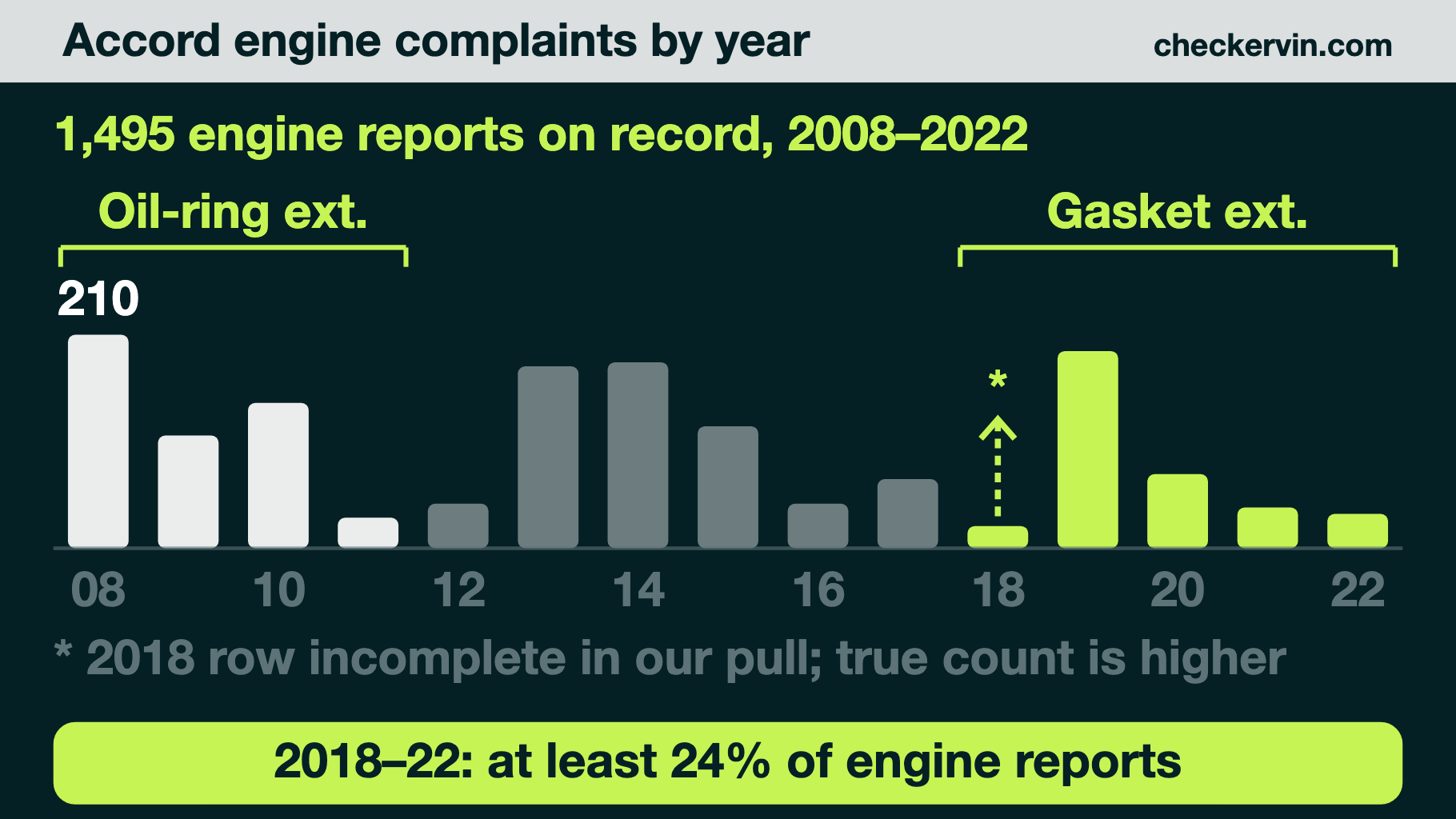
Our corpus of federal NHTSA complaints holds 9,607 reports against the 2008–2022 Accord, and 1,495 of them sit in the ENGINE category. ENGINE makes the top five components in 15 of the 15 model years, so every year is counted. That category covers every engine complaint, from misfires to starters to oil burning, so it is an upper bound on head gasket trouble, never a count of it.
By generation, the 2008–2012 cars hold 538 engine reports (36%), the 2013–2017 cars hold 594 (40%), and the 2018–2022 cars hold 363, at least 24%. The busiest single year is 2008, at 210. The raw counts flatter the older cars, which have had more years and more owners to complain. Measured as a share of each generation’s own complaints, engine reports run 15% and 14% for the two older generations and 20% for the 2018–2022 car, and the single highest share of any year belongs to the 2019 Accord, at 26%.
The 2019 car carries 194 engine reports, more than any Accord since the 2008 model. When we read NHTSA’s complaint narratives for each model year, the words “head gasket” were close to absent from 2008 through 2017 and then turned up repeatedly from 2018 onward, many of them naming the 1.5-liter turbo and describing coolant loss, misfires and a shaking engine.
Why the 2018 bar is too short
The 2018 bar on the chart shows 22 engine reports out of 113complaints, and it is wrong in the direction that matters. When we queried NHTSA’s live complaint database for the 2018 Accord on October 25, 2026, it returned many times the complaints our August 2026 pull recorded for that year, and among the extra reports head gasket failures were the most common engine theme. Every other model year matched our data within about a tenth, and the recall counts matched exactly, so the gap is specific to that one row.
We have not patched the number by hand, because every figure on this page recomputes from the same dataset and a typed correction would rot. Read the 2018 bar, and the 24% share for the 2018–2022 cars, as floors. The real 2018 picture is worse, and it matches what Honda’s bulletins describe. Most of the narratives that mention a head gasket on these cars were filed in 2025 and 2026, years after the cars were new.
2008–2012: the engine problem was oil rings, not gaskets
The eighth-generation Accord logged 494 engine reports across 2008–2011alone, yet almost none of them are about gaskets. The narratives from those years lean heavily on oil burning. Honda’s own explanation is in Service Bulletin 12-087, “Sticking Rings Resulting in High Engine Oil Consumption,” which covers 2008–2011 Accord four-cylinders. It blames deposits on the oil-control rings formed by repeated hard acceleration on a cold engine, and the remedy, after an oil consumption test, is new pistons and rings.
Honda extended piston and ring coverage on those cars to 8 years or 125,000 miles, announced to dealers in April 2015. By the calendar, every eligible car has now passed eight years. One detail explains why a 2010 four-cylinder invoice can list a head gasket without the car ever having a gasket problem: the ring job lifts the cylinder head, and the bulletin’s parts list includes a new head gasket for reassembly. The V6 cars of this era drew a separate oil-consumption class action, which Autoblog reported as settled in 2013; we could not read the settlement documents themselves, so its terms are not repeated here.
2013–2017: starters and oil, still not gaskets
The ninth-generation car’s engine bars are tall, peaking at 183for the 2014 model, but the narratives behind them describe something else. For 2013 through 2015 the most common engine theme is the starter, with oil consumption next. We found no Honda bulletin or NHTSA recall naming a head gasket on any 2013–2017 Accord. The engine-adjacent recall in this span, 15V121000, covers certain 2014 and 2015 four-cylinder Accords assembled with improperly torqued connecting-rod bolts, which can cause power loss or an oil leak.
That leaves the ordinary route to a head gasket failure: heat. Any engine that runs hot after a coolant leak, a failed water pump or a stuck thermostat can lift a gasket or warp a head. On these cars the question to ask is not the model year but the cooling history, and the coolant type lookup by VIN shows what the factory filled the system with. For the chain-driven valve train on the same engines, the Accord timing chain post covers the cold-start rattle bulletins.
How Honda confirms a head gasket failure
The 2026 bulletins are unusually specific about what counts as a failed gasket, and the same steps make a good test of any shop’s diagnosis. Honda tells technicians to start with a cold engine, print a full trouble-code check, fit a cooling-system pressure tester, run the engine to operating temperature (194°F), bring the system to 18 psi, then pull all four spark plugs and look into each cylinder with a borescope for coolant on the cylinder wall. The warranty claim needs that borescope photo, with the engine number visible.
| What you notice | What it can point to |
|---|---|
| Coolant reservoir dropping, no drips under the car | Coolant entering a cylinder; the bulletin pattern |
| Shaking or misfire on cold starts that fades | Coolant fouling a cylinder overnight |
| Temperature gauge climbing, heater blowing cold | Combustion gas in the cooling system, or a plain leak |
| Oil low with no leak on a 2008–2011 four-cylinder | Sticking oil rings (SB 12-087), not a gasket |
Independent shops often add a chemical block test, which checks the coolant for combustion gas, before any teardown. A positive block test plus a borescope image of coolant in a cylinder is a strong case. A reservoir that drops slowly with neither is more likely a hose, a radiator seam or a water pump, and the bill for those is a fraction of a gasket job.
Gasket, head, or short block: why quotes diverge
Honda’s bulletins do not assume the gasket is the whole problem. Once the head is off, the technician checks the head and the block for warpage, and the repair branches into four tiers: gasket only, gasket and cylinder head, gasket and short block, or all three. On the gasoline car those tiers run from 11.5 to 14.8 flat-rate hours, and on the hybrid from 10.8 to 15.5, before parts. A short block is not a small add-on.
That branching is why two shops quoting the same car can be thousands apart. One prices the gasket and assumes flat surfaces; another prices the worst case. An engine that kept being driven while it overheated is the one most likely to land in the expensive tiers, which is the best argument for stopping early and testing before the gauge settles the question for you.
Before you pay for the repair
- On a 2018–2022 Accord, ask a Honda dealer for a VIN status inquiry on the head gasket extension before anything else
- Confirm engine and transmission by VIN: 1.5T CVT, manual, 2.0T automatic or hybrid
- Ask how the failure was confirmed: pressure test, block test, borescope image of coolant in a cylinder
- Ask whether the quote assumes a flat head and block, and what happens if either is warped
- On a 2008–2011 four-cylinder burning oil with no leak, ask whether an oil consumption test was done
The first item can turn a four-figure bill into none. If you already paid for a gasket on an eligible car, the bulletins we read say nothing about reimbursement, so ask Honda directly and keep the repair order, the trouble-code printout and any photos the shop took.
If you are buying the Accord, not repairing it
For a 2018–2022 car, the extension is now part of the car’s value. A 2018 sold new in 2018 stays covered into 2028 unless it passes 150,000 miles first, so mileage matters as much as age. Ask the seller whether a head gasket was already replaced under the bulletin, check that the coolant sits at the full mark when the engine is cold, and listen for a rough idle in the first minutes after a cold start.
A branded title does not void this extension, which is unusual enough to be worth knowing if you are looking at a rebuilt-title car. It still voids plenty of other coverage, so price it accordingly. The Honda recall check shows open safety campaigns on the same VIN, the Honda warranty check by VIN helps estimate what factory coverage remains, and the Honda Accord years-to-avoid page lays out the rest of the complaint record by year. For the transmission side of the same car, see the Accord transmission fluid change post, and for a car where the head gasket story belongs to an older engine, the Forester head gasket post.
Where this information comes from
- Honda Service Bulletin 26-003 v3 (NHTSA copy) — 2018–22 Accord (CVT) head gasket10 years or 150,000 miles; branded titles included; 11.5–14.8 flat-rate hours; the borescope inspection procedure.
- Honda Service Bulletin 26-004 v3 (NHTSA copy) — 2018–20 Accord (M/T) head gasketThe same extension for manual-transmission Accords.
- Honda Service Bulletin 26-006 v3 (NHTSA copy) — 2018–22 Accord Hybrid head gasketThe hybrid version, with 10.8–15.5 flat-rate hours.
- Honda Service Bulletin 12-087 v6 (NHTSA copy) — sticking oil rings, 2008–11 Accord L4The early engine problem: pistons and rings extended to 8 years or 125,000 miles; head gasket in the parts list.
- Honda campaign notice, April 2015 (NHTSA copy)Announces the 2008–2011 Accord oil-consumption extension to dealers.
- NHTSA — recalls by VINOur year-by-year query found no Accord recall naming a head gasket.
- NHTSA — vehicle complaintsThe federal complaint database our engine counts are computed from.
- RepairPal — Honda Accord head gasket replacement estimateThe $2,294–$2,971 average and its labor and parts split, from RepairPal's listing, October 2026.
Keep reading
Frequently asked questions
How much does it cost to replace a head gasket on a Honda Accord?
RepairPal's Accord estimator lists an average of $2,294 to $2,971, with $1,277 to $1,874 in labor and $1,017 to $1,098 in parts, before taxes, fees and local rates, as its listing read in October 2026. If the head or block turns out to be warped, the job grows: Honda's own bulletins book 11.5 hours for a gasket-only repair on a 2018–2022 gasoline Accord and up to 14.8 hours when the short block is replaced too. On an eligible 2018–2022 car, Honda's warranty extension may make the covered repair free.
Is there a recall for Honda Accord head gaskets?
No. Our query of NHTSA's recall database for every Accord model year from 2008 to 2022 found no campaign naming a head gasket. What Honda issued instead, on August 26, 2026, is a set of warranty extensions: Service Bulletins 26-003 (2018–2022 Accord with the CVT), 26-004 (2018–2020 manual) and 26-006 (2018–2022 Hybrid) extend cylinder head gasket coverage to 10 years from the original purchase date or 150,000 miles, whichever comes first. A dealer confirms eligibility with a VIN status inquiry.
Which Honda Accord years have head gasket problems?
The documented pattern is the 2018–2022 tenth-generation car and its successors, which is why Honda's 2026 extensions start there. Before 2018 the Accord was not known for head gaskets; complaint narratives in NHTSA's database rarely mention one, and the engine fault Honda documented for 2008–2011 four-cylinder cars was sticking oil-control rings. Even with our 2018 row incomplete, the 2018–2022 years hold at least 24% of the Accord's engine complaints in our data.
What are the signs of a blown head gasket on a 1.5T Accord?
Honda's bulletin lists overheating, coolant loss and misfire, sometimes with trouble codes P0300 through P0304 stored, though the latest version says codes are not required for a repair. Owners commonly describe a coolant reservoir that keeps dropping with no visible leak and a rough or shaking engine on cold starts. The dealer check is specific: pressurize the cooling system, warm the engine, pull the spark plugs and look into each cylinder with a borescope for coolant.
Does Honda's head gasket extension cover a rebuilt or salvage title Accord?
Yes, according to the September 2026 revision of the bulletins. Versions 3 of 26-003, 26-004 and 26-006 state the extension applies regardless of whether the car was declared a total loss, sold for salvage or carries a branded title. That is the reverse of Honda's 2015 oil-consumption extension for 2008–2011 four-cylinder Accords, which excluded branded-title cars. Eligibility still runs through a dealer's VIN status inquiry.
Know the engine before you price the gasket
A free CheckerVIN report shows the factory build, engine, specifications and open recalls for any VIN, so you know which Honda bulletin to ask the dealer about.
Run a free VIN check