The short answer
- What does a branded title mean?
- It means the state has permanently recorded an event in the vehicle's history on the title itself. The most common brands are salvage, rebuilt, flood or water damage, lemon or manufacturer buyback, and odometer discrepancy. Once applied, a brand cannot legitimately be removed.
- Which brands are most serious?
- Salt-water flood damage is the hardest to remediate, because corrosion progresses for years after the repair. Structural collision damage and odometer brands follow. Hail and theft-recovery brands are often the least consequential, depending on what was actually done to the car.
- How do I find out if a title is branded?
- Check the VIN against the federal NMVTIS system through an approved provider, which is where states report title brands. Do not rely on the paper title alone — a washed title looks clean precisely because the brand was dropped when it was reissued in another state.
Permanent
Brands never come off
They follow the VIN for life
20–40%
Typical value discount
Versus a clean-title car
50
States, different wording
Same meaning underneath
NMVTIS
Where brands are recorded
Federal, run by the DOJ
What “branded” actually means
A title is the legal document establishing who owns a vehicle. A brand is an additional designation printed on that title, applied by a state motor vehicle agency, recording that something significant happened to the vehicle.
The purpose is disclosure. Without brands, a car written off after a serious crash could be repaired and sold as though nothing had happened, and the buyer would have no way to know. The brand travels with the vehicle so that every subsequent buyer inherits the information along with the car.
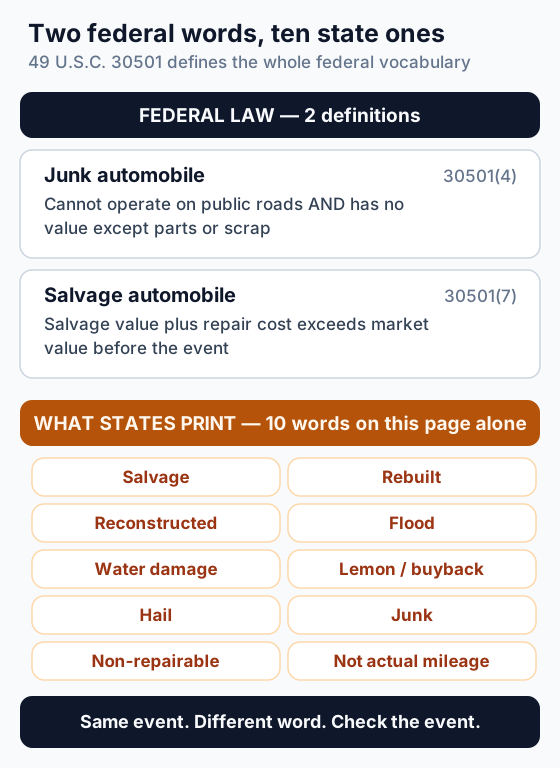
The two words federal law actually knows
Here is the thing that explains almost every confusing brand you will ever see on a title: the federal government has a vocabulary of two. Everything else on the list further down this page was invented by a state.
The National Motor Vehicle Title Information System was created by the Anti-Car Theft Act, now codified at 49 U.S.C. chapter 305, and the statute opens by defining its terms. It defines a certificate of title as nothing more than a document issued by a State showing ownership of an automobile — a state instrument, not a federal one. Then it defines exactly two conditions a vehicle can be in:
| The federal term | What the statute requires for it to apply |
|---|---|
| Junk automobile — 49 U.S.C. 30501(4) | Both tests must be met: the automobile is incapable of operating on public streets, roads and highways, AND it has no value except as a source of parts or scrap |
| Salvage automobile — 49 U.S.C. 30501(7) | Damaged by collision, fire, flood, accident, trespass or other event, to the extent that its fair salvage value plus the cost of repairing it for legal operation would be more than its fair market value immediately before the event |
That is the complete list. There is no federal definition of a flood title, a lemon title, a hail title, a rebuilt title or a reconstructed title. Those words exist because individual states wrote them, which is why the same car can cross a state line and acquire a different label for the identical history, and why a brand you have never heard of is not necessarily a rare event — it may just be a rare word.
Clean versus branded
A clean title simply means no brand has been recorded. It is the absence of a mark rather than a certification of quality — a car can have been in several accidents, repaired each time, and still hold a clean title, provided no insurer ever declared it a total loss.
That distinction matters when you read a history report. “Clean title” and “no accidents” are different claims, and only one of them is established by the title document.
Every brand type you are likely to meet
| Brand | What it records |
|---|---|
| Salvage | An insurer declared the vehicle a total loss. Generally cannot be registered or driven until repaired and re-inspected. |
| Rebuilt / reconstructed | A previously salvage vehicle, repaired and passed a state inspection, now legal to register. |
| Flood / water damage | Damaged by immersion. Sometimes a standalone brand, sometimes the underlying cause of a salvage brand. |
| Lemon / manufacturer buyback | Repurchased by the manufacturer under a state lemon law after repeated unrepaired defects. |
| Odometer discrepancy / not actual mileage | The recorded mileage is known or suspected to be inaccurate. Also appears as TMU — true mileage unknown. |
| Junk / non-repairable / certificate of destruction | Cannot legally be rebuilt or re-registered. Parts and scrap only. |
| Hail damage | Totaled by hail. Frequently cosmetic, and among the less severe reasons for a brand. |
| Fire damage | Damaged by fire. Severity ranges from a contained engine-bay fire to structural heat damage. |
| Theft recovery | Reported stolen, later recovered. What matters is what was stripped or damaged while it was gone. |
| Police / taxi / fleet use | Recorded in some states. Not damage — it signals hard duty cycles and high hours. |
Salvage: the most common brand
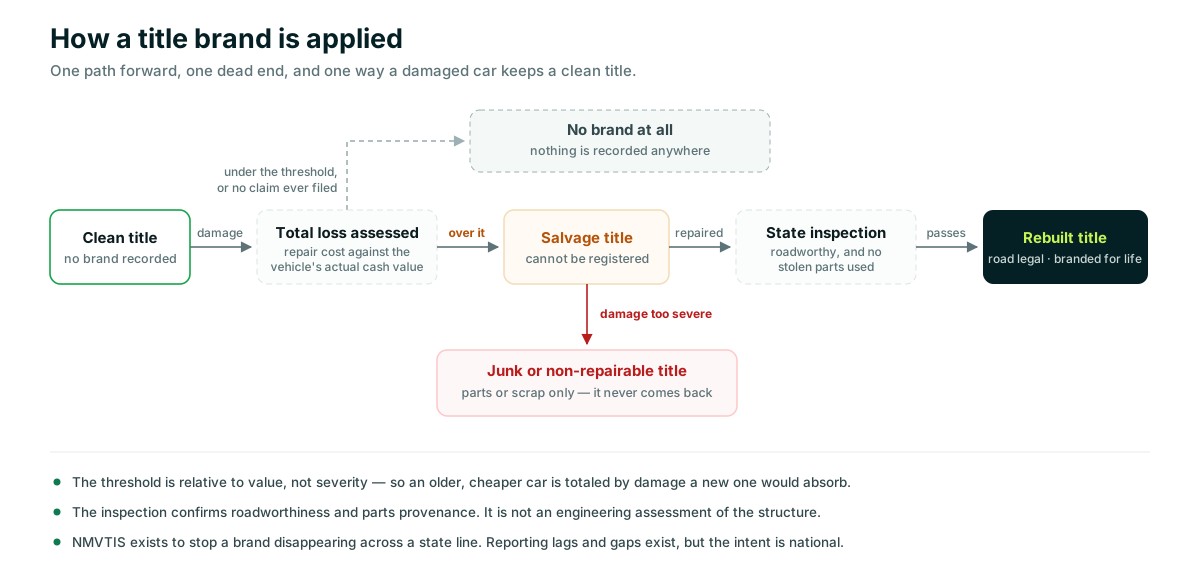
A salvage brand means an insurer assessed the damage, compared the repair estimate against the vehicle's actual cash value, and concluded that repairing it was not economic. The threshold is set by state law and varies widely — commonly between 70% and 100% of value, with some states applying a formula rather than a flat percentage.
The consequence people miss is that the threshold is relative to value, not to severity. A twelve-year-old car worth a few thousand dollars is totaled by damage that a new vehicle would absorb without a brand. Many salvage-branded cars therefore suffered damage that looks modest — which is exactly why the cause matters more than the brand.
Rebuilt: salvage that came back
When a salvage vehicle is repaired and passes a state inspection, it receives a rebuilt title. It can be registered, insured and driven, and it keeps the brand permanently.
The inspection behind it is narrower than most buyers assume. It generally confirms basic roadworthiness and that no stolen parts were used — it is not an engineering assessment of whether the structure was restored to factory specification.
Because rebuilt is the brand you will encounter most often on cars actually for sale, it deserves its own treatment. We cover the inspection, the insurance problem and the pre-purchase checklist in detail on the rebuilt title page linked below.
Flood and water damage: the one to fear
Flood damage behaves differently from collision damage, and the difference is why experienced buyers treat it as a separate category of risk. Collision damage is visible, localized and either repaired or not. Water damage is diffuse, hidden, and progressive.
Water reaches wiring harnesses, connectors, control modules, seat rails, seatbelt retractors and the interior of body cavities. Corrosion continues quietly for years, producing electrical faults that appear long after the sale and are expensive to chase because they are intermittent.
- Silt or dried mud in the spare wheel well, under carpets, or inside seat rails
- A musty smell, or an air freshener working hard to disguise one
- Water lines or staining inside door panels and on interior trim
- Corrosion on unpainted metal, screw heads and electrical connectors
- Fogging or a water line inside headlight and taillight housings
- Interior carpet or upholstery that is newer than the rest of the car
- Electrical faults that come and go, or accessories that work intermittently
Lemon law and manufacturer buyback
Every state has a lemon law giving buyers a remedy when a new vehicle has a substantial defect the manufacturer cannot fix within a reasonable number of attempts. When the manufacturer repurchases the vehicle, the title is branded.
This brand is different in character from the damage brands. The vehicle was not wrecked — it had a persistent fault. The critical question is whether the underlying defect was ever diagnosed and corrected before the car was resold, because manufacturers do repair and resell buybacks.
Ask specifically what the defect was and what was done about it. A documented repair of a known issue is a very different proposition from a car whose original fault was never identified.
Odometer brands: not actual mileage
When a state has reason to believe the recorded mileage is wrong, the title is branded — typically as “not actual mileage”, “odometer discrepancy” or “true mileage unknown”.
Sometimes the cause is innocent: a replaced instrument cluster resets the display, and the brand records that the number on the dash no longer reflects the distance traveled. Sometimes it is deliberate rollback, which is a federal offense.
Either way the practical effect is the same. You cannot use mileage to judge the vehicle's condition or value, which removes the single most-used input in used car pricing. Price it on inspection and service history instead.
Junk and non-repairable
This is the terminal designation. A junk, non-repairable or certificate-of-destruction title means the vehicle cannot legally be rebuilt, retitled or registered. Its remaining lawful uses are parts and scrap.
What a brand does to what the car is worth
Expect 20% to 40% below a comparable clean-title vehicle, with the exact figure driven by the brand type, the model and how thoroughly the history is documented.
The mistake buyers make is treating the discount as a saving. It is not consumed when you buy — it is inherited, and you hand it back when you sell, because your buyer applies the same discount you did. A branded vehicle only makes financial sense if you keep it long enough for the gap to be irrelevant, or if you never intend to sell it.
Liquidity is the other cost. Branded vehicles take longer to sell, attract fewer buyers, and are frequently declined at trade-in. If you may need to move the car quickly, price that in.
Insurance and financing on a branded vehicle
Liability coverage is generally available. Physical damage coverage is where the difficulty starts, and lending is where it often ends.
- Some carriers decline comprehensive and collision on branded vehicles entirely
- Others require a pre-coverage inspection with dated photographs
- A future total-loss payout is calculated on the reduced branded value
- Most mainstream lenders will not finance a branded vehicle at all
- Credit unions and specialist lenders sometimes will, usually at higher rates
- Extended warranty and service contract providers frequently exclude branded titles
Why brands are permanent and portable
The Anti-Car Theft Act of 1992 directed the creation of the National Motor Vehicle Title Information System, administered by the US Department of Justice. Its purpose was precisely to stop brands from disappearing when a vehicle crossed a state line.
Insurance carriers, junk yards and salvage yards are required to report into NMVTIS, and state titling agencies check it before issuing a title — a duty written into 49 U.S.C. 30503(b) rather than left to policy. Reporting lags and gaps exist, but the architecture is deliberate: a brand applied anywhere should surface everywhere.
A handful of states stop titling vehicles altogether once they pass an age line. Alabama sets that line as an age rather than a fixed year, so it rolls forward annually and vehicles keep aging out of the title system — and out of the brand record with it.
The check the law requires before a new title is issued
Title washing works by moving a car until some state issues clean paperwork. The reason that is harder than it sounds is a specific statutory duty, and it is worth knowing exactly what it obliges a state to do.
49 U.S.C. 30503(b) requires every state to establish a practice of performing an instant title verification check before issuing a certificate of title to anyone claiming to have bought a vehicle from someone in another state. The statute then spells out what the state has to send:
- The vehicle identification number of the automobile the title is sought for
- The name of the state that issued the most recent certificate of title
- The name of the individual or entity that title was issued to
- And the operator must be given an opportunity to send back what its search found
Two of those three fields are the reason a washed title is fragile. The state cannot simply look at the document in front of it — it has to name the previous state and the previoustitleholder, which is precisely the history a washing attempt is trying to leave behind. And 49 U.S.C. 30501(2) has already established that the document being replaced is only a state’s own paperwork, so replacing it changes nothing about the federal record it is checked against.
The enforcement behind all of it is modest and worth knowing honestly: 49 U.S.C. 30505(a) makes a violator liable to the government for a civil penalty of not more than $1,000 for each violation. That is the scale of the deterrent, which is one reason the practical defense remains the one in the next section rather than trust in the system catching everything.
Title washing, and the signals that expose it
Title washing is moving a branded vehicle between states until a reissued title comes back without the brand. The car is unchanged; only the paperwork has been laundered.
- Several state transfers in quick succession with no matching change of owner
- A title issued recently in a state far from where the car is being sold
- A seller who resists you running the VIN, or supplies a report screenshot instead
- A clean title on a car showing obvious repair evidence — overspray, mismatched panel gaps, replaced structure
- A price well below comparable clean-title cars with no explanation offered
- Paperwork where the title issue date is much more recent than the ownership date
The defense is simple and it is the same in every case: check the VIN against the national record yourself, rather than reading the document the seller hands you.
How to check for a brand before you buy
- 1Get the VIN off the vehicle, not the listingWindshield plate and driver's door jamb. Confirm they match each other and the title document.
- 2Run the national title recordCheck the VIN through an NMVTIS-approved source, which is where states report brands. This is the check a paper title cannot substitute for.
- 3Run the free theft and salvage lookupNICB VINCheck covers vehicles reported stolen or salvaged by participating insurers. Free, and a useful second angle.
- 4Ask directly and in writingAsk whether the vehicle has ever been declared a total loss, flooded, or repurchased by the manufacturer. A written answer creates a record.
- 5Inspect for evidence the paperwork missedAn independent pre-purchase inspection catches repaired structural damage and flood exposure that never generated a claim and therefore never generated a brand.
Where this information comes from
- 49 U.S.C. 30501 — definitionsThe only two vehicle conditions federal law defines: junk automobile and salvage automobile
- 49 U.S.C. 30503 — state participationThe instant title verification check required before titling an out-of-state purchase, and the three fields it must carry
- 49 U.S.C. 30505 — penalties and enforcementCivil penalty of not more than $1,000 for each violation
- NMVTIS — National Motor Vehicle Title Information SystemThe US Department of Justice system that makes title brands portable between states
- NICB VINCheckFree theft and salvage lookup from participating insurers
- NHTSA recall lookupFree open-recall check by VIN, independent of title status
Keep reading
Frequently asked questions
What is a branded title on a vehicle?
A branded title is a title carrying a permanent designation recording something significant in the vehicle's past — that it was declared a total loss, flooded, repurchased by the manufacturer under a lemon law, or had its odometer reading called into question. The brand stays with the vehicle for the rest of its life.
Is a branded title always bad?
It is always a discount and always a question. Some brands are far more serious than others: salt-water flooding is close to disqualifying, while hail damage that totaled an older car may be purely cosmetic. The brand tells you to investigate, not automatically to walk away.
Can you remove a brand from a title?
No, not legitimately. Brands are designed to be permanent and to follow the vehicle across state lines through the federal NMVTIS system. Anyone offering to clear a brand is describing title washing, which is fraud.
How much does a branded title reduce value?
Commonly 20% to 40% below a comparable clean-title vehicle, varying by brand type, model and age. The discount is inherited rather than consumed — you save when you buy and give it back when you sell.
Will a dealer take a branded title in trade?
Some will, at a conservative wholesale price, and some franchise dealers decline entirely because branded vehicles are harder to retail. Expect a materially lower trade-in offer than the same car with a clean title, and expect fewer buyers if you sell privately.
Check the title before you check the tires
Run any VIN free and see what the record holds — build data, specifications and open safety recalls. No account required.
Run a free VIN check