The short answer
- How do you check a warranty by VIN?
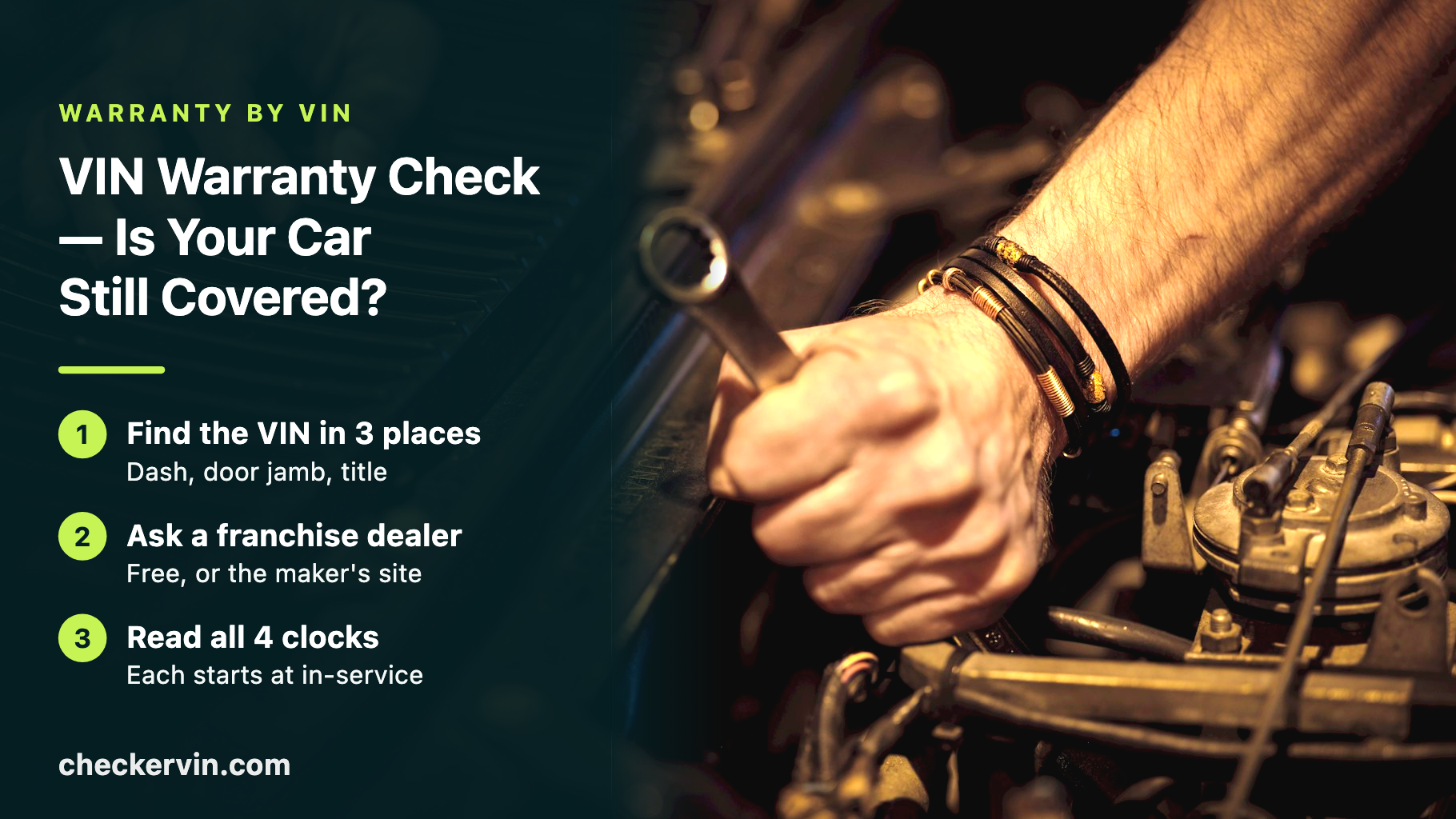
- Call any franchise dealer for that make, give them the 17-character VIN, and ask the service department for the warranty status and in-service date. Most manufacturers also expose this on their owner portal once you register the VIN. Both are free.
- Why does the in-service date matter so much?
- Because coverage runs from first delivery, not from the model year or the build date. A car built early and sold late has more coverage left than its year implies; one used as a demonstrator has less.
- What is not warranty?
- Safety recalls, which are free regardless of warranty status, and vehicle service contracts sold by third parties, which are a separate commercial product with their own terms.
In-service
When the clock starts
Not the build or model year
Free
The warranty check itself
Any franchise dealer
8/100k
Federal EV battery minimum
Years and miles
Separate
Recalls are not warranty
Free whatever the age
How to check
- 1Get the VIN from the vehicleBase of the windshield on the driver's side, or the door jamb sticker. Photograph it rather than transcribing it.
- 2Call a franchise dealer for that makeAny dealer, not necessarily the selling one. Ask the service department for the in-service date and remaining warranty coverage. This is routine and free.
- 3Or register the VIN on the manufacturer's owner siteMost makes let you add a vehicle by VIN and show coverage status, open recalls and service history in one place.
- 4Ask specifically what remains, not just whether it is coveredBasic, powertrain, corrosion, emissions and any hybrid or EV battery coverage run for different terms. Get each one.
- 5Get it in writing before you buyA screenshot or printed summary from the dealer is worth having if a seller has made claims about remaining coverage.
The in-service date: where the clock actually starts
This is the single most misunderstood thing about used car warranties. Coverage does not begin when the vehicle was built, and it does not begin on January 1 of the model year. It begins on the in-service date — the day the vehicle was first delivered to a retail customer or first put into service by the dealer.
The consequences run in both directions, and both are worth money.
| Situation | Effect on your coverage |
|---|---|
| Car built early, sat on the lot, sold late | You gain. The warranty clock did not start until delivery, so a car with an older model year can have more coverage left than expected. |
| Demonstrator or loaner before retail sale | You lose. The vehicle was placed in service when the dealer began using it, so coverage started earlier than the sale date suggests. |
| Model year does not match in-service year | Entirely normal. Manufacturers build ahead, and a vehicle can be delivered in a different calendar year from its model year. |
The warranties a new vehicle carries
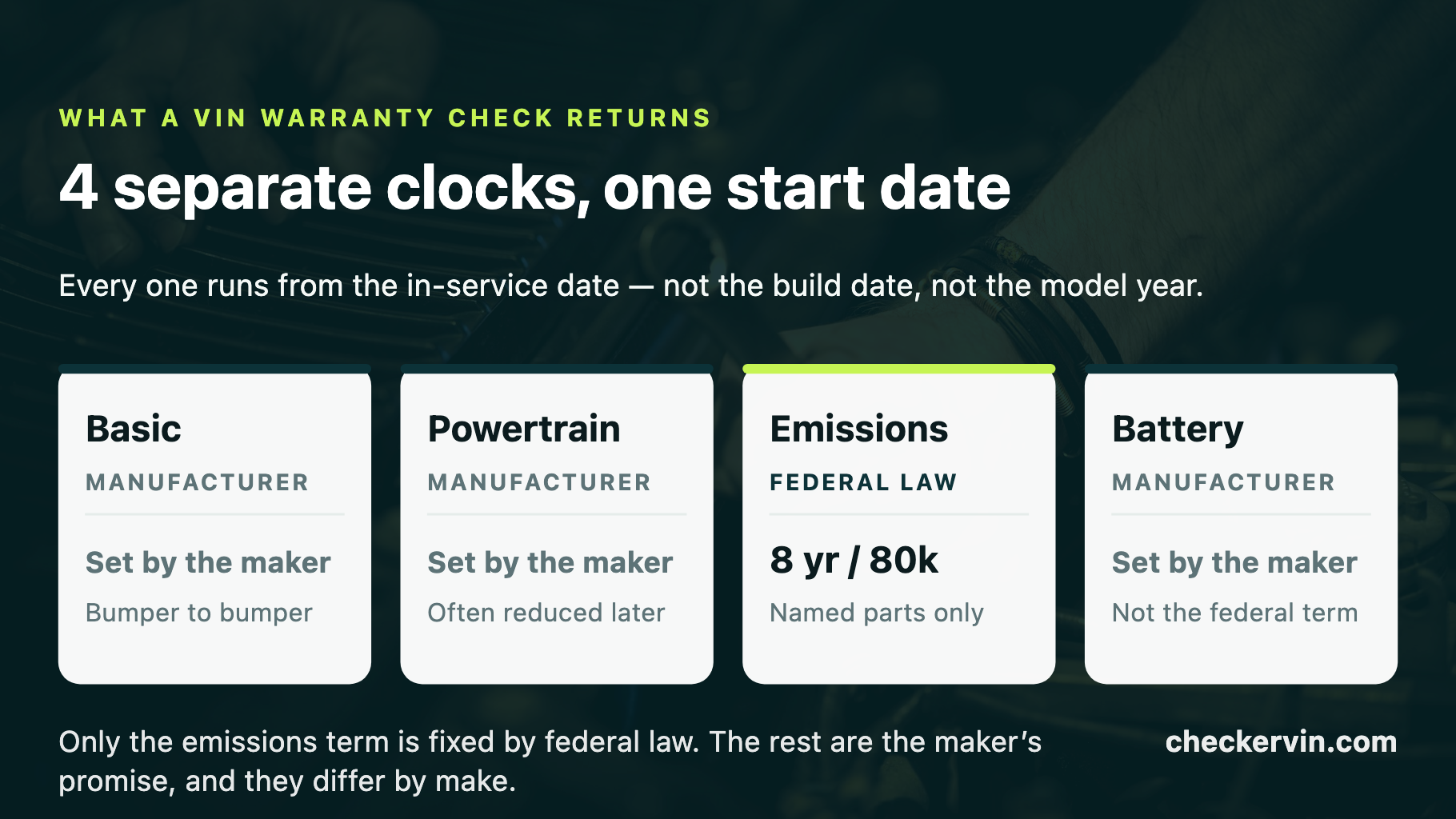
A new car is covered by several separate warranties running concurrently for different terms. “Is it still under warranty?” is therefore an incomplete question — the answer differs by component.
| Coverage | What it covers |
|---|---|
| Basic / bumper-to-bumper | Most components against defects in materials or workmanship. The shortest of the major coverages, and the first to expire. |
| Powertrain | Engine, transmission and drive components. Runs longer than basic, and is the coverage most likely still active on a used car. |
| Corrosion / perforation | Rust that penetrates a body panel. Long terms, but usually only for actual perforation rather than surface rust. |
| Emissions | Federally mandated. Covers emissions-related components — see below, because the terms are set by law rather than by the manufacturer. |
| Hybrid / EV battery and components | Long-term coverage on the traction battery and related hardware, with a federal minimum. |
| Roadside assistance | A service benefit rather than a repair warranty. Frequently does not transfer to a second owner. |
The federal emissions warranty is not the manufacturer’s choice
Most warranty terms are set by the manufacturer as a commercial decision. The emissions warranty is different: it is required by federal law under the Clean Air Act, and it applies regardless of what the manufacturer would prefer.
It runs in two tiers. A shorter term covers emissions-related components generally, and a substantially longer term covers major components including the catalytic converter and the onboard emissions control computer.
Hybrid and electric vehicle battery coverage
Traction battery coverage is the longest coverage on most electrified vehicles, and it is worth being precise about where it comes from, because it is not the federal emissions warranty. That warranty runs eight years or 80,000 miles and covers specified major emission control components — the catalytic converter, the emissions control computer and the onboard diagnostic device. The traction battery is not among them. The long battery terms you see advertised, commonly eight years or 100,000 miles, are manufacturer commitments rather than a federal floor. California, and the states that follow its rules, does impose its own battery warranty and durability requirements, and those phase in by model year rather than applying to every used EV on the lot.
On a used hybrid or EV this is frequently the most valuable coverage remaining, because the battery is the most expensive component and the one a buyer most worries about. It transfers with the vehicle.
- Confirm the exact remaining term against the VIN, not against the model year
- Ask whether the vehicle was originally sold in a state with extended requirements, since that can affect the term
- Ask what the coverage actually promises — replacement, or repair to a stated capacity threshold
- Confirm whether the battery has ever been replaced, which may restart or alter coverage
- Check drive unit and charging hardware coverage separately from the battery itself
What transfers when you buy the car
Factory warranties generally attach to the vehicle rather than the owner, so the balance of the basic and powertrain terms usually passes to you. But the detail varies by manufacturer and it is worth confirming rather than assuming.
- Basic and powertrain coverage normally transfer for the remaining term
- Some manufacturers reduce powertrain coverage for subsequent owners — check the specific make
- Roadside assistance and courtesy benefits frequently do not transfer
- Some transfers require paperwork or a small fee; ask whether anything must be filed
- Emissions coverage transfers, since it is a legal requirement rather than a benefit
- Battery and hybrid coverage normally transfers with the vehicle
Four things the booklet says that the brochure does not
Manufacturer marketing quotes headline terms. The warranty booklet that ships in the glovebox is the document that actually governs, and it routinely carries conditions no advertisement mentions. Four examples, all taken from one manufacturer’s current printed guide, show the kind of thing worth reading for.
- Who is covered is defined by use, not by purchase — coverage reads “if you are a purchaser for use of the vehicle”, which is why a used buyer inherits the remaining term
- A diesel engine can carry a longer term than the powertrain warranty around it — 100,000 miles against 60,000 on the same truck
- Towing can be covered, but only to the nearest authorized dealer — drive past it to a shop you prefer and the cost is yours
- Gradual battery capacity loss is excluded — an electric or hybrid battery that simply holds less charge than when new is not a warranty claim
The last of those is the one that surprises people most, and it is worth stating plainly: a high-voltage battery warranty covers the battery failing, not the battery aging. Loss of capacity with time and use is normal, expected, and specifically written out of the coverage. A seller telling you the battery is “still under warranty” has said nothing at all about how much range the car has left.
What actually voids coverage — and what does not
Warranty denial is a real risk but a narrower one than sellers of add-on products suggest. A manufacturer generally has to connect the failure to the cause rather than simply pointing at a modification.
| Claim | Reality |
|---|---|
| Using an independent shop voids the warranty | It does not. You may have routine maintenance performed anywhere, provided the work meets the specification and you keep records. |
| Aftermarket parts void everything | A manufacturer generally must show the part caused the failure. A modification can void coverage on related components, not automatically on the whole vehicle. |
| Missing a service kills the warranty | Neglecting required maintenance can support a denial where it caused the failure. Keeping receipts is the defense. |
| A branded title voids the factory warranty | A salvage or rebuilt brand generally does end factory coverage. This is one where the seller's optimism is usually wrong. |
| Track use is fine | Competition or track use is excluded by most warranties. Do not assume otherwise on a performance car. |
Certified pre-owned coverage is a separate thing
A manufacturer certified pre-owned program adds coverage on top of whatever remains of the original factory warranty. It is backed by the manufacturer and honored at its dealers, which makes it meaningfully different from a third-party contract.
What it is not is a guarantee of condition. Certification involves an inspection and a reconditioning standard, but a certified car can still have accident history or a branded past depending on the program's rules. Run the VIN regardless.
Recalls are not warranty, and that is good news
People conflate these constantly, usually to their own disadvantage. A safety recall is a legal obligation on the manufacturer to remedy a defect it has determined exists. Warranty is a commercial promise about defects in materials and workmanship.
The practical difference: a recall repair is free regardless of the vehicle's age, mileage or warranty status, and regardless of how many owners it has had. An out-of-warranty car with an open recall still gets that repair for nothing.
The expiring-warranty call is a scam
If you have owned a car in the United States you have received the call: an urgent recorded message saying your vehicle's warranty is about to expire and this is your final notice. It is a sales operation for third-party service contracts, and the urgency is manufactured.
- Your manufacturer does not cold-call you about warranty expiry with a countdown
- The caller usually does not know what vehicle you own — they are working from a list
- The phrase 'final notice' about a warranty is a sales device, not a real deadline
- Never give payment details or a VIN to an unsolicited caller
- If you want to know your coverage, call a dealer yourself with the VIN — it is free
- Report persistent calls rather than engaging with them to get removed from a list
Vehicle service contracts, sold as extended warranties
The product commonly sold as an extended warranty is a vehicle service contract — an agreement with a third party to pay for certain repairs. Some are backed by manufacturers, most are not, and quality varies enormously.
They can be worthwhile on an expensive vehicle with a known repair profile. The decision should turn on the actual terms rather than on the fear the sales approach is designed to create.
- Read the exclusions list before the coverage list — that is where the product is defined
- Check whether it is a manufacturer-backed program or a third-party administrator
- Establish who pays the shop, and whether you must pay first and claim back
- Check whether you can use your own repair shop or must use their network
- Confirm what happens if the administrator ceases trading
- Compare the total cost against realistic repair costs for that specific vehicle
- Check whether the contract is transferable and refundable, and on what terms
Making a warranty claim
- 1Take it to a franchise dealer for the makeFactory warranty work is performed by the manufacturer's dealer network. An independent shop cannot claim against the factory warranty on your behalf.
- 2Describe the symptom, not your diagnosisReport what the vehicle does, when, and under what conditions. A diagnosis you supply can narrow what gets investigated.
- 3Bring your service recordsParticularly if the vehicle has been maintained outside the dealer network.
- 4Ask for the decision in writing if a claim is deniedA written reason lets you evaluate it and escalate if the reasoning does not hold.
- 5Escalate to the manufacturer if neededManufacturer customer relations can review a dealer's decision, and sometimes offer goodwill assistance on a vehicle just outside coverage.
Where this information comes from
- EPA — federal emissions warranty coverageThe 8-year/80,000-mile term, and the three components it actually covers
- CARB — California vehicle and emissions warranty periodsWhere longer battery and ZEV requirements come from, and how they phase in
- NHTSA recall lookupFree open-recall check by VIN — separate from warranty, and free at any age
- EPA — vehicle emissions warrantyThe federal agency behind the mandated emissions warranty terms
- NHTSA vPIC — public VIN decoderConfirm the vehicle the VIN describes before checking coverage
Keep reading
Frequently asked questions
How do I check my warranty by VIN?
Give the VIN to any franchise dealer for that make and ask the service department for the warranty status, or sign in to the manufacturer's owner site with the VIN. Both return the in-service date and what coverage remains. There is no charge for the check.
When does a new car warranty actually start?
At the in-service date — the day the vehicle was first delivered to a retail customer or put into service as a demonstrator or loaner. Not the build date and not the model year, which is why a car can have less coverage left than its age suggests.
Does the warranty transfer to a second owner?
The basic and powertrain warranties usually do transfer for the remainder of their term. Some manufacturers reduce powertrain coverage for subsequent owners or restrict certain benefits to the original purchaser, so confirm the specifics for that make.
Are recall repairs covered even if my warranty expired?
Yes. Safety recalls are separate from warranty entirely. The manufacturer must perform a recall remedy at no cost regardless of the vehicle's age, mileage or warranty status, subject to the statutory age limit on the free-repair obligation.
Is an extended warranty the same as a manufacturer warranty?
No. What is sold as an extended warranty is usually a vehicle service contract from a third party, with its own terms, exclusions and claims process. It is a separate product from the manufacturer's warranty and carries none of the same guarantees.
Start with the VIN
Decode any VIN free for the factory build, specifications and open safety recalls. No account required.
Run a free VIN check