The short answer
- What does it cost?
- RepairPal lists $5,075–$6,922 for a 2019 F-150 in Los Angeles. Ford pays dealers 13.5 to 24.2 hours to replace both heads, depending on the engine.
- Is it a known F-150 problem?
- Not on paper. No Ford service document indexed to the 2008–2022 F-150 names a head gasket; Ford's two head replacements were valve faults.
- What should I check first?
- The engine and build date by VIN, then the cheaper coolant leaks Ford has documented on these trucks before anyone pulls a head.
13.5 h
Ford: both heads, 2020 3.3L
Program 20B21
24.2 h
Ford: both heads, 2.7L 4x4
TSB 19-2384
0
Ford F-150 documents naming a head gasket
2008–2022, NHTSA index
1 of 15
Years cooling made the top five
NHTSA complaints
The numbers, and whose numbers they are
Published F-150 head gasket estimates are thin. The one specific figure we could find comes from RepairPal: $5,075 to $6,922 for a 2019 F-150 in Los Angeles, a range the page says excludes taxes, fees and related repairs. It was read from the page’s own text through search on November 22, 2026, because RepairPal blocks direct fetches from our tools. It is one city and one model year. We did not find a national F-150 head gasket page on RepairPal or any F-150 head gasket page on Kelley Blue Book, and one parts site quoting under $150 for the job is not worth repeating.
We sell VIN checks, not repairs, and publish no price of our own. What we can add is the number every honest quote is built on: the hours. Ford publishes the time it pays a dealer for warranty work, and twice in this truck’s 2008–2022 run it published that time for taking the cylinder heads off.
Ford's own clock for taking F-150 heads off
A head gasket sits between the cylinder head and the block, so replacing it is most of a cylinder head replacement: the same teardown, minus the new head. Ford never wrote an F-150 bulletin for a gasket, but it wrote two for heads, and both include the gasket in the parts. They are the closest Ford-published measure of what this job takes on these engines:
| Ford document | Job and warranty labor time |
|---|---|
| Program 20B21 (2020 F-150, 3.3L V6) | Replace one head — 11.6 to 11.7 hours; both heads — 13.5 hours |
| TSB 19-2384 (2016–2017 F-150, 2.7L EcoBoost) | Replace both heads — 23.3 hours on 4x2, 24.2 hours on 4x4 |
Two things stand out. On the 3.3L, the second head adds less than two hours, because most of the time goes into getting to the first one. That is why shops so often quote both sides once a truck is apart. On the 2.7L the clock nearly doubles. The bulletin’s parts list explains it: turbocharger flange gaskets and mounting hardware, both high-pressure fuel tubes, an oil pan and a crankshaft pulley bolt sit alongside the “Cylinder Head Gasket Kit,” because the turbos and their plumbing come off with the heads.
For a sense of scale only, at an example rate of $150 an hour, 13.5 hours of labor is $2,025 and 24.2 hours is $3,630, before a single part. Use your own shop’s posted rate. A dealer working under Ford’s clock and an independent working from a labor guide will not land on the same total, but a quote whose hours sit far above the matching row is pricing more than heads and gaskets.
What 19,621 complaints say about cooling
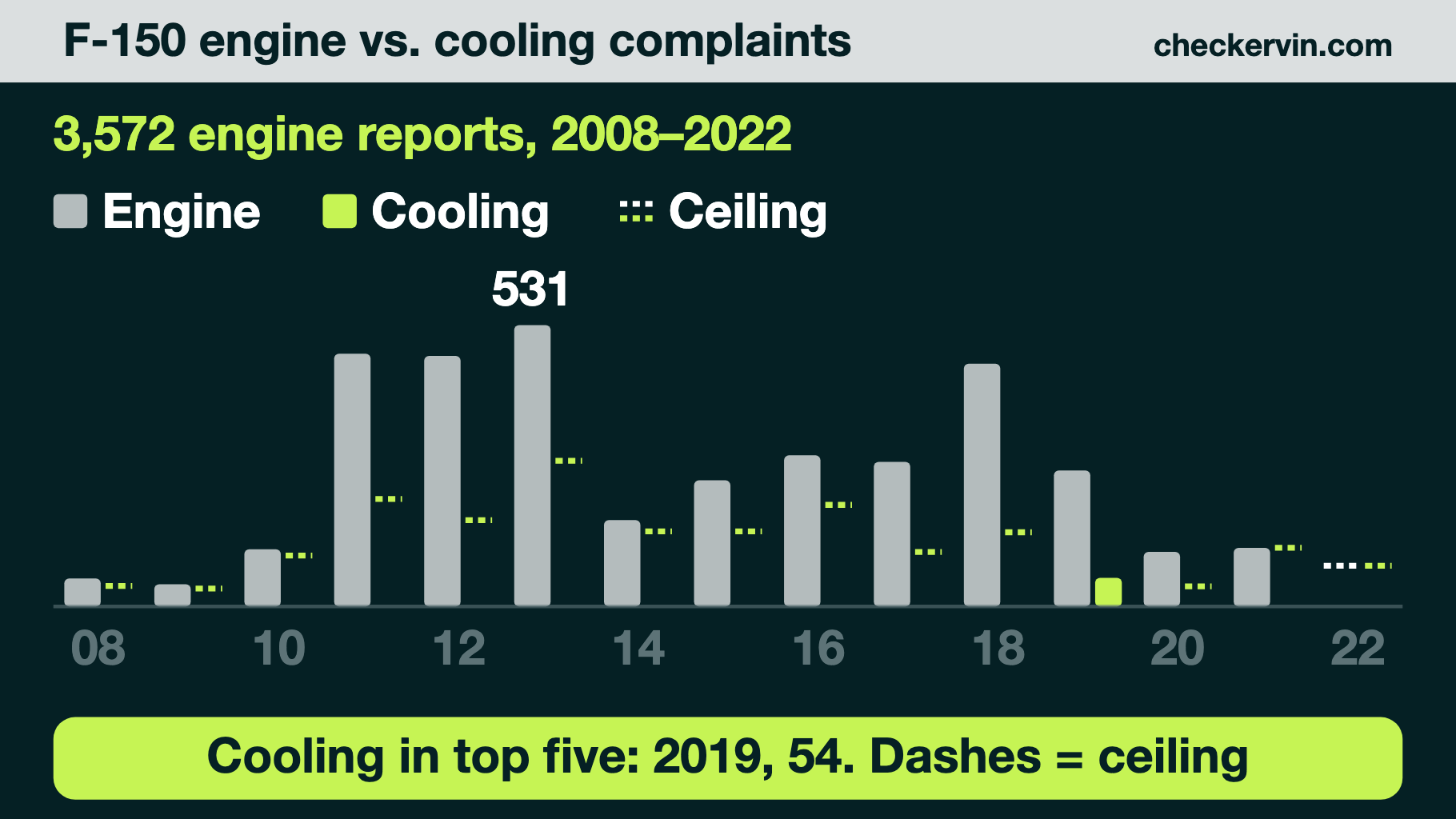
Our corpus of federal NHTSA complaints holds 19,621 owner reports against the 2008–2022 F-150. NHTSA has no head gasket category, so the closest signal is two broad ones. ENGINE covers every engine fault, from timing chains to oil leaks, and makes the top five components in 14 of 15 model years, with at least 3,572 reports counted across those years. ENGINE AND ENGINE COOLING, the category where overheating and coolant loss usually get filed, is the one a gasket failure should push up.
It barely moves. The cooling category reaches a model year’s top five only in 2019, with 54 reports, about 5% of that year’s complaints. In the other 14years it sits below the fifth-place component, so it holds fewer reports than that year’s fifth-place count — a ceiling between 34 and 275 depending on the year, not a measured number. The engine-complaint peak, the 2013 truck at 531, is a timing and powertrain story the sibling posts cover, not a cooling one. For 2022, ENGINE itself falls below the top five, so the chart draws a ceiling there too, never a zero.
Reading the complaint narratives themselves points the same way. Owners use the words “head gasket” in only scattered single reports across these model years, on several different engines, with no year or engine where they cluster. Complaints are unverified owner reports, not failure rates, but a pattern this flat is a different picture from trucks with a known gasket defect.
What Ford has published, and the word it never uses
NHTSA indexes the technical service bulletins, special service messages and customer satisfaction programs a manufacturer sends its dealers. We pulled every one indexed to the 2008–2022 F-150 under its regular cab, SuperCab and SuperCrew listings, roughly 1,500 documents, and searched their summaries. None mentions a head gasket. Because a silent search can just mean a broken search, we ran the same query on the 2017 Ford Escape, whose 1.5-liter engine Ford did document for coolant getting past the head gasket. It returned nine.
What Ford did write about F-150 heads comes in two documents, and both are valve problems that happen to require removing the heads. Everything else in the coolant pile points at parts that sit outside the engine’s combustion seal: hoses, housings, heat exchangers, and sensors that misreport temperature.
2016–2017 2.7L EcoBoost: new heads for worn valve guides
TSB 19-2384, issued December 18, 2019 and superseding TSB 18-2237, covers 2016–2017 F-150s with the 2.7L EcoBoost built from April 1, 2016 through January 1, 2017. The symptoms are a rough idle in park or neutral once warm and oil consumption of more than a quart in under 3,000 miles, sometimes with misfire codes and blue smoke “only after a hot restart.” Ford traced it to “a concern with the cylinder head valve guides” and the fix is both heads, with a new head gasket kit, at the 23.3 or 24.2 hours above.
The bulletin changes nothing about coverage. It points to the ordinary new-vehicle, emissions and extended-plan terms, and on a 2016 or 2017 truck those have long since run out for most owners, so this is a customer-paid job today unless an extended service plan applies. In our data the 2016 truck carries 285 engine complaints and the 2017 truck 273, covering every engine Ford sold those years, so treat them as context, not a count of 2.7L heads.
The useful point for anyone with a smoking 2.7L: oil burning through valve guides and coolant leaking past a gasket look different. Blue smoke after a hot restart with falling oil points at the bulletin; a dropping coolant level does not.
2020 3.3L: heads replaced for trucks built in one March week
Customer Satisfaction Program 20B21, dated June 4, 2020, covers 2020 F-150s with the 3.3L V6 built at Dearborn from March 11 through 18, 2020, or at Kansas City from March 14 through 19. Ford wrote that these engines have “shallow pressed valve seats in the cylinder heads,” which can cause rough idle, misfire and lost power. The program’s repair table names each truck by VIN and says whether the left head, the right head or both get replaced; it lists 73 F-150s.
The program ran through June 4, 2021, with no mileage limit, and has ended. It matters now mainly as evidence. A 2020 3.3L built in that window should have paperwork showing the new heads, and the labor table it carries is the cleanest Ford measure of what one head or both cost in time on an F-150 V6. The 2020 truck as a whole carries 103 engine complaints in our data, one of the lower counts in the run.
Coolant loss that is not a head gasket
A truck that keeps needing coolant is where most head gasket quotes start. On the F-150, Ford has documented several leaks that cost far less than heads, and they are worth ruling out first:
- 2021–2023 3.5L PowerBoost hybrid: cracked coolant spigots on the exhaust heat exchanger can lose coolant and overheat the engine (SSM 51485); the spigots are now sold as a pair
- 2021–2023 F-150 hybrid: Program 24N04 offers a one-time exhaust gas heat recovery replacement for 15 years or 150,000 miles, and notes the unit's coolant inlet port can break and leak
- EcoBoost engines: the turbochargers are coolant-fed, and Ford tells technicians to check its turbocharger oil and coolant leak bulletin before replacing a turbo
- Heater and degas hoses and the 3.5L thermostat housing: Ford has bulletins on several, all outside the engine's combustion seal
The last item has its own post. F-150 water pumps are mounted on the outside of the engine and driven by the accessory belt, not buried behind the timing cover, and the F-150 water pump cost breakdown walks through the hose and housing bulletins engine by engine. The hybrid program is the one to check by VIN today: when Ford issued it in September 2024, dealers were not yet authorized to repair F-150 hybrids while parts were short, so its status on a given truck is a dealer question. Coolant type matters too: Ford began filling 2019 F-150s built from January 2, 2019 with Motorcraft Yellow, and the coolant type lookup by VIN settles which one belongs in the reservoir.
Reading the smoke on an EcoBoost
White exhaust is the symptom most people link to a blown gasket, and on this truck it misleads more often than usual. Ford’s SSM 47557, for 2017–2018 trucks with the 2.7L, says plainly that “some smoke during cold start is normal for EcoBoost engines” because of how they fuel, and sends technicians to the normal diagnostic manual only if smoke continues once the engine is at operating temperature.
| What you see | What it more likely means |
|---|---|
| White vapor for a minute after a cold start | Normal on an EcoBoost, per Ford — watch whether it stops |
| White smoke that continues when fully warm, coolant dropping | Coolant is burning — a gasket, a cracked head or a coolant-fed turbo |
| Blue smoke after a hot restart, oil dropping | Oil past valve guides — the 2016–2017 2.7L bulletin |
| Overheating with no smoke and no missing coolant | Often a sensor or a cooling-system part, not the gasket |
Engine recalls that sit near the heads
We queried NHTSA’s recall database for every F-150 model year from 2008 through 2022 and checked the instrument first: the campaign count for each year matched our corpus. No recall names a head gasket or coolant loss. Two engine campaigns touch the heads. Campaign 17V672 covers certain 2018 F-150s with 3.5L engines whose cylinder heads “may have been machined without lubrication supply holes for the camshaft bearing journals.” Campaign 24V635 covers 2021–2022 F-150s with the 2.7L or 3.0L EcoBoost whose intake valves may break. Both are engine failures, not gasket leaks, and both are free at a dealer if open.
One more lookalike: an F-150 that blew a spark plug out of its head has a damaged thread, not a failed gasket. That trouble belongs to Ford’s older two-valve V8s, while the 2008 5.4L three-valve is known for plugs that break on removal; the F-150 spark plug post has the bulletins. The Ford recall lookup by VIN shows whether any campaign is still open on a specific truck.
How to prove it before paying for heads
Because a gasket job means a day or more of labor, the diagnosis deserves its own line on the invoice. A shop should be able to show which of these it did and what it found:
- Cooling system pressure test, cold and warm, with the leak located or ruled out
- Chemical combustion-gas test at the reservoir, which detects exhaust in the coolant
- Cylinder leak-down test, cylinder by cylinder, to find which bank is leaking
- Scan for misfire and coolant-temperature codes, and the freeze-frame data when they set
- Oil inspection for coolant contamination, and a check of the turbo coolant lines on an EcoBoost
Ask, too, whether the heads will go to a machine shop to be checked for flatness, and whether that is in the quote. An aluminum head that has overheated may need resurfacing or replacement, and that is where an estimate grows after the truck is already apart.
Heads, a whole engine, or neither
The hours make the decision sharper than a price guide can. Ford pays up to 16.3hours to install a complete long block in a 2021–2022 F-150, as the F-150 engine replacement post details. Its allowance for replacing both heads on an earlier 2.7L runs past 23 hours. The trucks are a few years apart and the jobs are not identical, but on a twin-turbo F-150 a two-head repair is not the cheap alternative it sounds like. If the block is also suspect, or the engine has overheated hard, price a replacement engine before authorizing heads.
On a V8 or the non-turbo V6, a head job sits well below an engine swap in labor, and on a truck with a sound bottom end it is usually the better repair. Either way, the gasket is cheap and the time is not, which is why quotes for “just the gasket” and for heads end up closer together than owners expect.
If you are buying the truck, not repairing it
Start with the engine and build date. An F-150 VIN decode confirms both, and both Ford head documents turn on them: a 2.7L built between April 1, 2016 and January 1, 2017, or a 3.3L built in the March 2020 window, should come with receipts for new heads. The engine size lookup helps when a listing is vague about which V6 is under the hood, and a warranty check by VIN shows whether any powertrain coverage is left on a newer truck.
Then look for yourself. Check the coolant level cold, look under the oil cap, and watch the exhaust after the engine is fully warm, not just at start-up. The F-150 years-to-avoid breakdown covers the rest of the complaint record by model year.
Where this information comes from
- Ford TSB 19-2384 (NHTSA copy) — 2.7L cylinder head replacement2016–2017 F-150 built April 1, 2016 to January 1, 2017: valve guides, both heads with a gasket kit, 23.3–24.2 labor hours.
- Ford Customer Satisfaction Program 20B21 (NHTSA copy)2020 F-150 3.3L built in March 2020: shallow valve seats, 11.6 to 13.5 labor hours, VIN repair table.
- Ford SSM 51485 (NHTSA copy) — PowerBoost coolant loss2021–2023 hybrid: cracked exhaust heat exchanger coolant spigots, a coolant leak that is not a gasket.
- Ford Customer Satisfaction Program 24N04 (NHTSA copy)One-time exhaust heat recovery replacement for 2021–2023 F-150 hybrids, 15 years or 150,000 miles.
- Ford SSM 47557 (NHTSA copy) — 2.7L cold-start smokeFord's statement that some smoke at cold start is normal on EcoBoost engines.
- NHTSA — recalls and manufacturer communicationsSource of the recall query and the service-bulletin index searched for this post; no recall names a head gasket.
- RepairPal — 2019 F-150 head gasket, Los AngelesThe $5,075–$6,922 figure quoted above, retrieved November 22, 2026; one city and one model year.
Keep reading
Frequently asked questions
How much does it cost to replace a head gasket on a Ford F-150?
RepairPal's estimator lists $5,075 to $6,922 for a 2019 F-150 in Los Angeles, before taxes, fees and related repairs; we found no national F-150 figure on its site. Ford's own warranty labor times explain the size of the bill: 13.5 hours to replace both cylinder heads on a 2020 3.3L V6, and 23.3 to 24.2 hours on a 2016–2017 2.7L EcoBoost, where the turbochargers come off too. Multiply the matching hours by your shop's posted rate, then add gaskets, bolts, fluids and machining.
Is it difficult to replace a head gasket on an F-150?
It is one of the bigger jobs on the truck. Every F-150 engine from 2008 to 2022 is a V6 or V8, so there are two heads and two gaskets, and a failure on one bank usually means a shop quotes both. On the twin-turbo 2.7L, Ford's bulletin has the technician remove the turbochargers, high-pressure fuel lines and oil pan along the way, which is why its allowance runs past 23 hours. It is not a driveway job for most owners.
Can I still drive an F-150 with a bad head gasket?
Only as far as a shop, and only while the temperature gauge stays normal. A leaking gasket that lets coolant into a cylinder or combustion gas into the cooling system can overheat the engine quickly, and an overheated aluminum head can warp, which turns a gasket job into a head or engine job. If the gauge climbs or a coolant over-temperature warning appears, stop and shut the engine off.
What are the first signs of a blown head gasket?
Coolant that disappears with no puddle, white exhaust that keeps coming after the engine is warm, overheating, bubbles in the coolant reservoir, misfire codes on one cylinder, or milky oil. On an EcoBoost F-150, read the smoke carefully: Ford says some white smoke at cold start is normal on those engines, and blue smoke after a hot restart on a 2016–2017 2.7L points to the valve-guide problem Ford fixed with new heads, not to a gasket.
Do Ford F-150s have head gasket problems?
Not in Ford's own paperwork. Among roughly 1,500 Ford service communications NHTSA indexes to the 2008–2022 F-150, none mentions a head gasket in its summary. Ford did publish two cylinder-head replacements: worn valve guides on 2016–2017 2.7L EcoBoost trucks built from April 2016 through January 1, 2017, and shallow valve seats on 2020 3.3L trucks built in one March 2020 week. The cooling complaint category reached the truck's top five in 1 of 15 model years.
Confirm the engine before you price the heads
A free CheckerVIN report shows the factory build, engine, specifications and open recalls for any VIN, so you know which Ford document, if any, applies to that truck.
Run a free VIN check