The short answer
- Can you look up a license plate owner?
- Private individuals cannot. The federal Driver's Privacy Protection Act restricts personal information in motor vehicle records to enumerated permitted uses — law enforcement, insurers, courts, and licensed parties acting within the statute. Curiosity is not a permitted use in any state.
- What do the plate-lookup websites actually sell?
- Usually vehicle information tied to the plate, general public records, or a subscription — not the registered owner's identity, which they cannot lawfully hand an ordinary consumer. Read what you are buying before paying.
- What answers a used-car question, then?
- The VIN. Build data, recalls, theft and salvage records and the national title history all key off it, and every legitimate check on this site runs from it. In a sale, ask for the VIN — it is the number that was designed to be shared.
1994
When the DPPA passed
Federal, after a stalking murder
Federal
The same floor in all 50 states
States can only add to it
Permitted
Uses are enumerated
Curiosity is not one
VIN
The number that answers
Everything a purchase needs
The short answer
If you are a private individual wanting to know who owns a plate — the car that cut you off, the one parked outside, the seller you are sizing up — the answer is that no lawful consumer service will tell you, in any state. The Driver's Privacy Protection Act restricts registered-owner information to a defined list of permitted uses, and personal curiosity is deliberately not on it.
If your situation is one the law actually covers — an accident, a crime, a court proceeding — the route runs through a permitted user: police, your insurer, or an attorney. Those routes work, and they are covered below.
The DPPA, and why it exists
Congress passed the Driver's Privacy Protection Act in 1994 after the murder of actress Rebecca Schaeffer, whose killer obtained her home address through her motor vehicle record. Before the law, many states sold or handed out registration data on request; the case made the danger concrete.
The statute prohibits state motor vehicle agencies — and anyone downstream of their data — from disclosing personal information from motor vehicle records except for enumerated permitted uses. It carries civil and criminal penalties, and it applies to the resellers and data brokers as much as to the agencies themselves.
The permitted uses, roughly
| Who | Why they qualify |
|---|---|
| Law enforcement and courts | Carrying out official functions — the hit-and-run route runs through here. |
| Insurers and their agents | Claims investigation, antifraud work and underwriting. |
| Employers, narrowly | Verifying commercial driver information required by law. |
| Licensed private investigators | Only when acting for a purpose that is itself permitted under the statute. |
| Tow yards and impound lots | Notifying owners of towed or impounded vehicles. |
| Businesses with consent or legitimate need | Verification tied to a transaction the individual initiated — not cold lookups. |
It is the same in every state
Plate-lookup searches are heavily state-flavored — people search their own state's name expecting local rules. But the DPPA is federal law: it sets the same floor in all fifty states, and states may only add restrictions on top, which several do.
So the answer for Florida, Texas, California and every other state is the answer on this page. Our state guides — from Florida to New York — cover what genuinely differs by state: titles, inspections, regional risks and transfer quirks. The plate rule is not one of those things.
Tag, plate, license plate: the word changes, the law does not
A large share of the people asking this question do not use the word plate at all. In Florida, Georgia, Alabama and much of the South, the metal rectangle on the back of a car is a tag, the office that issues it is the tag office, and what you are looking for is a car tag lookup. Elsewhere the same object is a license plate and the same search is a plate lookup.
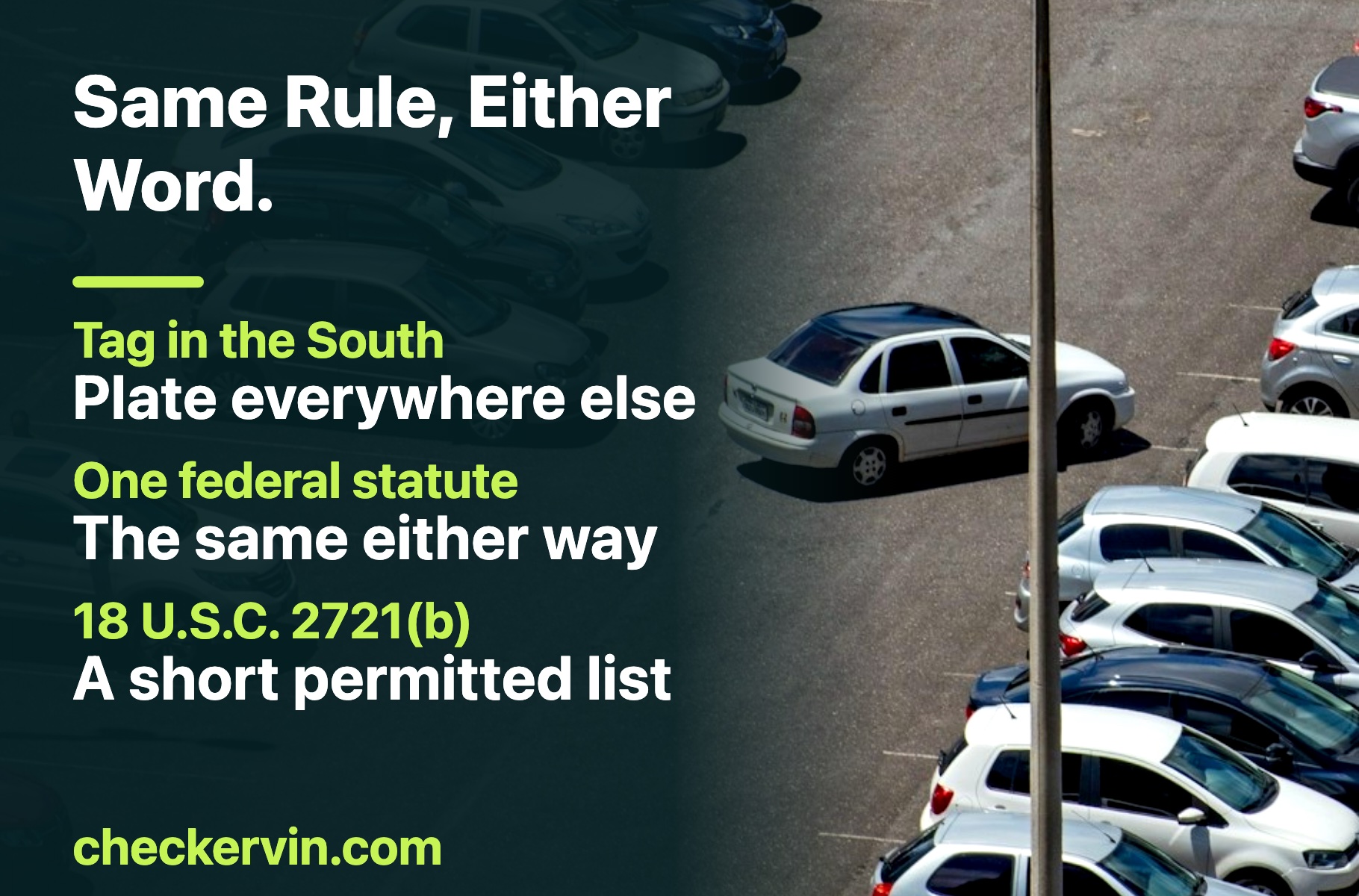
It is worth saying plainly, because the vocabulary difference makes people think there is a different rule waiting for them somewhere: there is not. The Driver's Privacy Protection Act is a federal statute. It governs personal information in motor vehicle records held by a state department of motor vehicles, whatever that state calls its plates, its tags or its agency. A Georgia tag lookup and a Michigan plate lookup run into the identical wall, for identical reasons.
The vocabulary has one practical consequence worth naming. Because the two words return different pages, people searching one of them often never see what was written for the other, and conclude the answer must be different in their state. It is not. If you have been reading tag-lookup results and getting a different impression from a friend reading plate-lookup results, the difference is in the search box, not in the law.
Two related words are worth separating while we are here, because they are genuinely different things rather than regional synonyms. A temporary tagis the paper or cardboard placard issued at sale before metal arrives, and it frequently has not reached a statewide database yet — which is why a search on one so often returns nothing at all, and why that particular blank is not evidence of anything. And a vanity or personalized plate is still an ordinary registration; the custom characters change nothing about who may look up the person behind them.
Plate versus VIN: the number that actually answers
Nearly every plate-lookup search is really one of two questions wearing a disguise: “should I buy this car?” or “who is this person?” The second is what the DPPA exists to prevent. The first has a better tool entirely.
| What you want to know | Which number answers it |
|---|---|
| What the car is — build, engine, year | The VIN, decoded free |
| Open safety recalls | The VIN, through NHTSA, free |
| Stolen or written off | The VIN, through NICB, free |
| Title brands and odometer records | The VIN, through NMVTIS, a few dollars |
| Who owns it | Nobody's business without a permitted use — by design |
Legitimate routes, by situation
- 1Buying a car: ask for the VINA private seller has no reason to withhold it — it is visible through the windshield. Hesitation is itself an answer.
- 2Accident or hit and run: police and insurerBoth are permitted users. Give them the plate, the location and the time; identification is their job and they are equipped for it.
- 3Ongoing harassment or a safety threat: law enforcementA report creates the record that lets police act on the plate. Self-help identification is both unlawful and, in these situations, dangerous.
- 4A legal dispute: your attorneyLitigation is a permitted use. Counsel can obtain records properly, in a form a court will accept.
- 5An abandoned vehicle: the city or countyLocal authorities identify owners of abandoned and towed vehicles as a routine permitted function.
The lookup-site economy
Search any plate-lookup phrase and the results fill with sites implying they will name the owner. They will not — they cannot, lawfully, for a consumer. What follows payment is predictable:
- Vehicle data tied to the plate — make, model, year — presented as though it were the promised answer
- Unrelated public-records results for names the site guesses you might mean
- A subscription enrollment described as a one-time report
- A request for your own details, which become the product
- Nothing at all, behind a refund process designed not to be used
What it actually costs to break this, which nobody mentions
Every page on this subject, including the earlier sections of this one, tells you the DPPA prohibits the lookup. Almost none of them tell you what happens to the person who does it anyway, and that is the half worth knowing — because it is the half that explains why no legitimate business will sell you this.
The prohibition itself sits at 18 U.S.C. 2722: it is unlawful for any person knowingly to obtain or disclose personal information from a motor vehicle record for any use not permitted under section 2721(b). That is the companion to the permitted-use list above, and it points at the person doing the obtaining rather than only at the agency holding the data.
| Provision | What it establishes |
|---|---|
| 18 U.S.C. 2722(a) | Unlawful to knowingly obtain or disclose the information for a use not permitted under 2721(b) |
| 18 U.S.C. 2722(b) | Unlawful to make false representation to obtain personal information from an individual's motor vehicle record |
| 18 U.S.C. 2723(a) | A person who knowingly violates the chapter shall be fined under title 18 |
| 18 U.S.C. 2723(b) | A state DMV with a policy or practice of substantial noncompliance faces a civil penalty of up to $5,000 a day, for each day of it |
| 18 U.S.C. 2724(a) | The individual the information pertains to may bring a civil action in United States district court |
| 18 U.S.C. 2724(b) | Actual damages but not less than liquidated damages of $2,500, plus punitive damages, attorneys' fees and equitable relief |
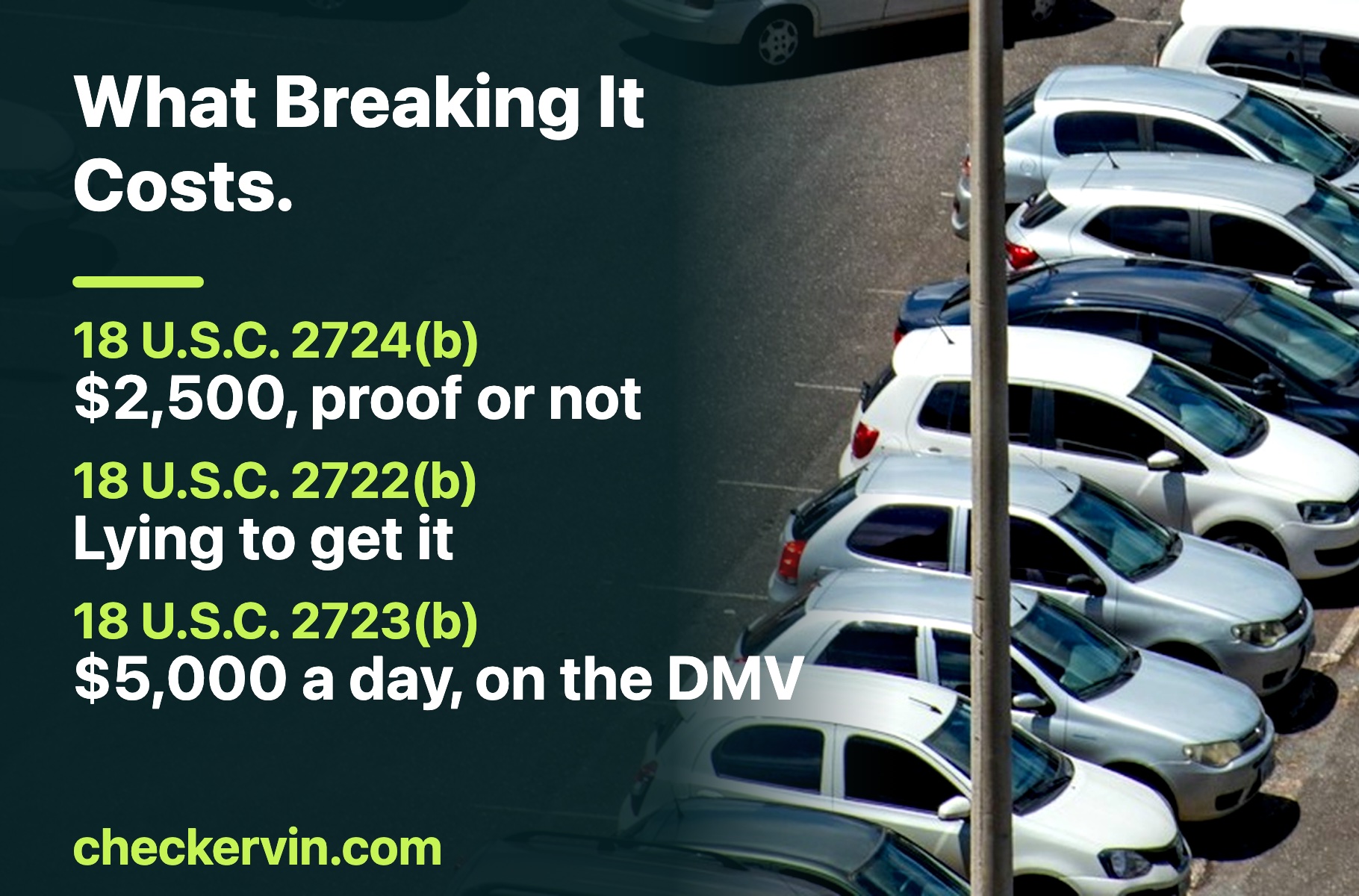
Read 2724(b) slowly, because it is the provision that makes this real rather than theoretical. The floor is not the harm you can prove. A court may award actual damages but not less thanliquidated damages of $2,500 — so the person whose record was pulled does not have to demonstrate a loss to recover. Punitive damages are available on proof of willful or reckless disregard of the law, and reasonable attorneys' fees and litigation costs come on top.
The false-representation trap, and why the sites are built this way
Now put 2722(b) next to the lookup-site economy described above, because together they explain a business model that otherwise looks merely sleazy.
Section 2722(b) makes it unlawful to make a false representation to obtain personal information from an individual's motor vehicle record. Not to obtain it unlawfully — to misrepresent yourself in order to get it. That is a separate offense from the one in 2722(a), and it attaches to the request rather than to the data.
This is precisely what a checkout page asking you to affirm a permitted purpose is steering you toward. Many of these services present a dropdown of DPPA permitted uses and invite you to pick one so the search can proceed. If none of them is truthfully your reason, selecting one is not a formality you clicked past. It is the conduct the subsection describes, and the liability created by 2724 runs to you, the person who obtained the information, not only to the site that sold it.
- A dropdown of permitted uses is a request for a representation, not a menu
- The liquidated-damages floor in 2724(b) needs no proof of loss by the person you looked up
- Curiosity, a dispute with a neighbor and suspicion of a partner are none of the permitted uses
- A site's willingness to sell you the search is not a defense that the search was lawful
- If your reason genuinely is permitted, the route is the state agency, not a data broker
Hit and run: what actually works
This is the case where the frustration is most justified — you have the plate, you have the damage, and the law will not let you look up the driver. But the working route is faster than it feels:
- Write the plate down immediately; memory degrades in minutes
- Photograph the scene, the damage and any debris before anything moves
- Note the time, location, direction of travel and vehicle description
- File the police report the same day — it is what activates the permitted-use machinery
- Give your insurer everything; uninsured-motorist coverage often applies to hit and run
- Canvass for cameras — doorbells, storefronts, dashcams — while footage still exists
If you are the seller
The privacy logic runs in your favor too. When you sell a car, the plate stays tied to your record until the transfer completes — which is why every state guide on this site says the same two things: complete the transfer promptly and formally, and follow your state's rule on whether plates stay with the seller or the car.
And sharing the VIN with a prospective buyer costs you nothing. It exposes no personal information — it describes the car, not you — and a buyer who runs it and likes the result is closer to a deposit.
Where this information comes from
- 18 U.S.C. 2724 — civil actionThe private right of action, and the $2,500 liquidated-damages floor
- 18 U.S.C. 2722 — additional unlawful actsObtaining for an unpermitted use, and making a false representation to obtain
- 18 U.S.C. 2723 — penaltiesCriminal fine, and up to $5,000 a day against a substantially noncompliant DMV
- 18 U.S.C. §2721 — the Driver's Privacy Protection ActThe federal statute restricting disclosure of motor vehicle records
- NHTSA recall lookupFree open-recall check — by VIN, the number that answers
- NICB VINCheckFree theft and salvage lookup from participating insurers
Keep reading
Frequently asked questions
Can I look up who owns a license plate?
As a private individual, no. The federal Driver's Privacy Protection Act restricts personal information in motor vehicle records to enumerated permitted uses — insurers, law enforcement, licensed investigators acting within the statute, and similar. Private curiosity, dating-app vetting and neighborhood disputes are not on the list.
Are the websites that promise plate-owner lookups legal?
Sites that return a registered owner's identity to an ordinary consumer are operating outside the DPPA's permitted uses, whatever their terms of service imply. Most such sites actually deliver something else after payment — vehicle data, public records unrelated to the plate, or nothing.
Is a plate lookup legal in some states but not others?
The DPPA is federal, so the floor is the same everywhere. States can be stricter than the federal statute but cannot open registered-owner identities to casual lookups. A site claiming a particular state allows it is describing its marketing, not the law.
What can I do after a hit and run?
Write down the plate, photograph what you can, and give it to the police and your insurer. Both are permitted users under the DPPA — they can identify the owner, and your insurer can pursue the claim. That route works; a lookup site does not.
What should I use instead when buying a car?
The VIN. It unlocks the factory build, open recalls, theft and salvage checks and the national title record — everything a purchase decision needs. A seller who offers a plate but hesitates on the VIN has answered a question you had not asked.
Got the VIN? That one you can run
Decode any VIN free for the factory build, specifications and open safety recalls. No account, no card.
Run a free VIN check