The short answer
- What does it cost?
- We found no RepairPal Grand Cherokee gasket figure; it prices a cylinder head at $3,063–$3,547 (2015 page). Chrysler's warranty time for a 3.6L left head is 8.7 hours before add-ons.
- Is there a known defect?
- Yes, but it is a head, not a gasket: 2011–2013 3.6L left heads with valve seat and guide wear. The 10-year/150,000-mile extension has run out.
- Which years do owners report?
- Gasket complaints in NHTSA narratives cluster on 2017–2020 3.6L models. No Stellantis bulletin or recall names a gasket on them.
8.7 h
Left head swap, WK 3.6L
Warranty time, TSB 09-002-14
10.6 h
With 4x4 and air suspension
Same bulletin's add-ons
10 yr / 150k
X56 left head extension
2011–2013, now expired
15 of 15
Years ENGINE is top five
Federal complaint record
The numbers, and what each one actually prices
None of the dollar figures here are ours. CheckerVIN sells VIN checks, not repairs. The first thing to know is what is missing: we could not find a RepairPal head gasket estimate for the Grand Cherokee at all, and Kelley Blue Book’s 2014 Grand Cherokee head gasket page served no pricing when we loaded it. What RepairPal does publish is the next job up. Its 2015 Grand Cherokee page lists cylinder head replacement at $3,063 to $3,547, and its 2008 Grand Cherokee estimator lists $3,292 to $3,806, both retrieved in November 2026 and both before taxes, fees and local labor rates.
A cylinder head job includes a new head gasket, so those ranges sit above a gasket-only repair on one bank. They are a sensible ceiling for the common case and a floor for the bad one: two banks, a warped head that has to be machined, or a block that cannot be resurfaced.
The most specific number comes from Chrysler. Its 2014 service bulletin for the 3.6L left cylinder head gives dealers 8.7 hours to replace that head on a Grand Cherokee, plus 1.6 hours on four-wheel-drive trucks and 0.3 hours with air suspension, 10.6hours in all. That is warranty time, what the manufacturer pays its dealers, not a retail quote, but it tells you the scale: a head on this V6 is a full day’s work before parts. Multiply by your shop’s posted hourly rate and the RepairPal ranges make sense.
2,059 engine reports, and a cooling category that barely registers
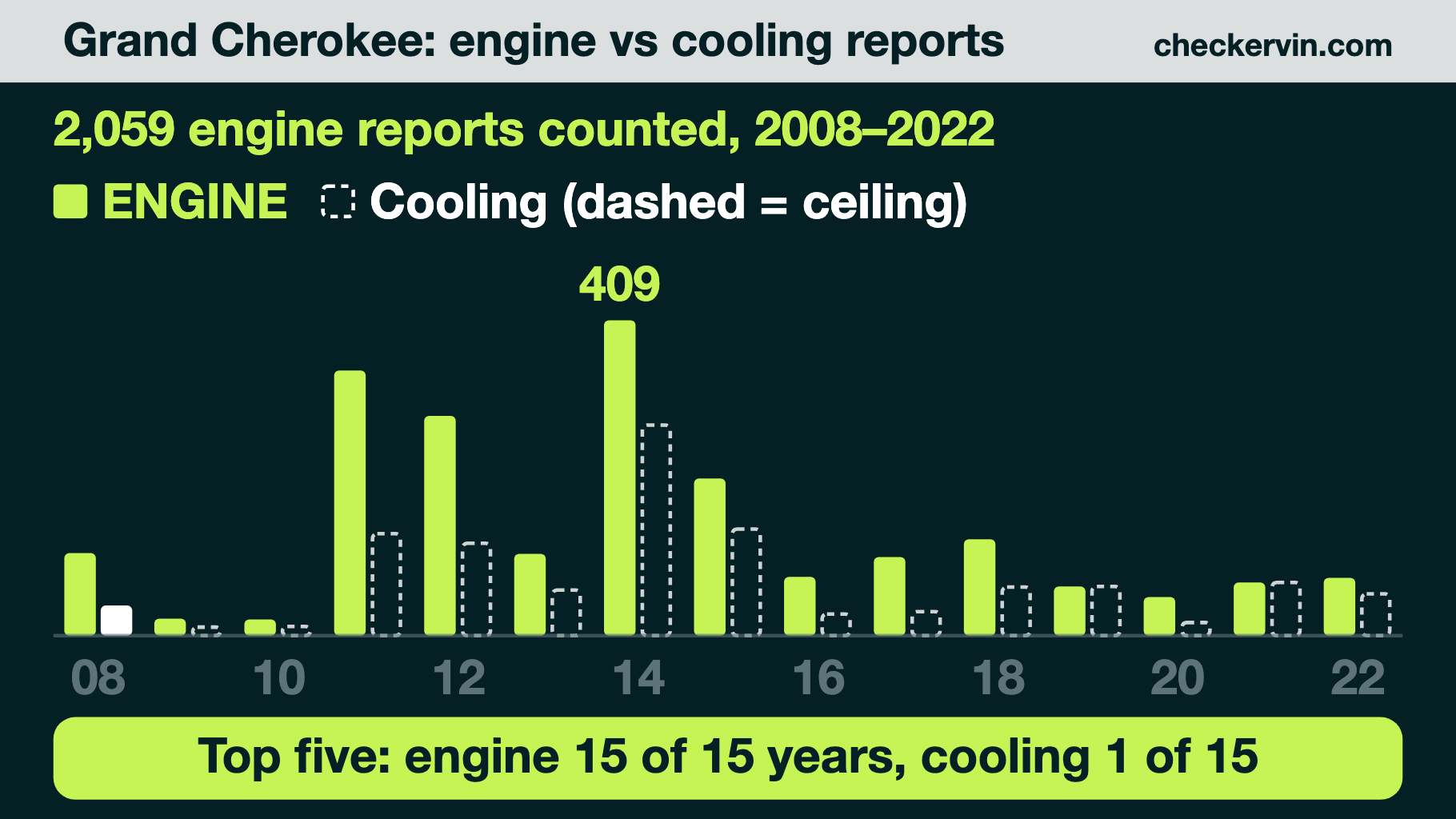
NHTSA has no head gasket category. An owner describing a blown gasket files under ENGINE, or under ENGINE AND ENGINE COOLING. Our corpus holds 11,924 complaints against the 2008–2022 Grand Cherokee, and 2,059 of them, about 17%, are ENGINE reports counted in each year’s top five. That sum is a minimum, not a total. ENGINE reaches the top five in 15 of 15 years. It ranks first in 2017, when it was about 28% of that year’s complaints, and second in 2008 and 2016. The peak count is the 2014 model at 409.
The cooling category tells a different story. It reaches the top five only in 2008 (39 reports). Every other year it ranks below fifth, and our data stores only the top five, so the most it could have been is that year’s fifth-place count. That ceiling ranges from 11 in 2009 to 273 in 2014. The chart draws those ceilings as dashed outlines, never as counts.
Two cautions keep this honest. ENGINE covers every engine Jeep sold that year and every kind of engine fault, from oil leaks to valvetrain noise, so it caps head gasket complaints rather than counting them. And the one year the cooling category does appear, 2008, its narratives read mostly as stalling reports, several tied to an ignition switch recall, not overheating.
2011–2013: the head problem Jeep documented, which is not a gasket
The 3.6L Pentastar V6 arrived in the Grand Cherokee for 2011. Within a few years Chrysler had a problem on one side of it. Warranty bulletin D-14-12, dated June 10, 2014, extended the warranty on the 3.6L left cylinder head of select 2011–2013 vehicles, the Grand Cherokee among them, from 5 years or 100,000 miles to 10 years or 150,000 miles from the in-service date. The owner letter attached to it names the cause: “a valve guide and valve seat wear condition on the left cylinder head.”
The symptom is a misfire, not coolant loss. Service bulletin 09-002-14 Rev. B lists the codes: P0300 for multiple misfires, or P0302, P0304 or P0306 for cylinders 2, 4 and 6, the left bank. The technician runs a cylinder leakage test on those three cylinders, and only if one shows 25% leakage or more does the bulletin call for a new left head. The parts list includes a new head gasket, but the gasket is collateral. The fault is in the head.
That matters on an invoice. A 2011–2013 3.6L with a flashing check-engine light and a misfire on an even-numbered cylinder is the documented failure, and a shop that quotes it as a “blown head gasket” is pricing the wrong repair. Those three model years hold 735 of the Grand Cherokee’s 2,059 counted engine reports, 36%, though the ENGINE category covers far more than heads.
2016 and later: what owners report, and what Stellantis has published
Read the complaint narratives owners file with NHTSA and the phrase “head gasket” is rare before 2016. It turns up most often in reports against 2017–2020 Grand Cherokees, the “Pentastar Upgrade” years of the 3.6L. The stories repeat: coolant disappearing with no visible leak, a misfire on one cylinder, white smoke at start-up, and a shop that finds coolant in a cylinder, usually somewhere between 50,000 and 115,000 miles. Several owners say a dealer recommended a replacement engine rather than a gasket. Those four model years hold 341 counted engine reports, 17% of the total.
Here the record stops. We searched the manufacturer communications NHTSA files against every Grand Cherokee model year, the recall database and NHTSA’s investigation lists for the nameplate, and found no Stellantis document, recall or federal investigation that names a head gasket on a 2016-or-later Grand Cherokee. The owner reports are real, but no manufacturer document confirms a pattern, and we will not call one a defect.
What Stellantis has published for these years is valvetrain work, and it produces the same first symptom. Dealer notice 9100498, revised in February 2025 and filed against 2016–2022 Grand Cherokees, describes 3.6L misfires and rough idle from worn intake camshaft lobes and rocker arms at 10,000 to 60,000 miles, and tells technicians to use a camshaft and rocker kit instead of a whole engine. Notice 9100132, filed against the 2022 model, tells them to check for collapsed intake lash adjusters before replacing an engine for ticking. A misfire on a 3.6L is therefore not, by itself, evidence of a gasket. Coolant in the cylinder is.
The EcoDiesel: a coolant recall that looks like a gasket
The 3.0L turbo diesel appears in EPA’s Grand Cherokee listings for 2014–2016 and 2018–2019, with no diesel listed for 2017. Recall 20V699 covers 2014–2019 Grand Cherokees with that engine: the EGR cooler “may crack and allow pre-heated vaporized coolant to enter the EGR system,” where it can burn inside the intake manifold, which NHTSA says can increase the risk of a fire. Dealers replace the cooler free and inspect the intake manifold.
Coolant vanishing into the intake with no external leak is exactly what a head gasket complaint sounds like. On a diesel Grand Cherokee losing coolant, the recall is the first check, and paying for a gasket diagnosis before running the VIN through the Jeep recall lookup would be an expensive way to learn the fix was free.
The 2.0 turbo: a block problem that mimics a gasket
The newest Grand Cherokees add a case Stellantis has written down. Bulletin 09-018-25, dated July 16, 2025, covers 2021–2024 Grand Cherokee and Grand Cherokee L models (the WL body) built with Jeep’s 2.0L turbo four, including the plug-in hybrid version. The symptoms are a rough idle on a cold start that smooths out after about 30 seconds and a low coolant bottle. The cause the bulletin gives is porosity in the cylinder block.
Its test is the one any careful shop would use for a gasket: bring the engine to temperature, pressurize the cooling system to 21 psi for 12 minutes, and look into the misfiring cylinder with a borescope for coolant. If coolant is there, the bulletin calls for a replacement long block, not a gasket, because a porous block will keep leaking under a new one. It is information only, not an authorization for free repair. In our data the 2.0L turbo appears only in the 2022 model year, the 4xe plug-in hybrid, so this applies to a small slice of the record.
2008–2010: five engines and a thinner record
The older WK body ran a wider engine list. EPA’s listings show a 3.0L diesel, a 3.7L V6, the 4.7L and 5.7L V8s and the 6.1L SRT8 V8 for 2008; the diesel is gone for 2009 and the 4.7L for 2010. These three years carry 150 counted engine reports, most of them from 2008. We found no Chrysler bulletin naming a head gasket for any of them in the communications NHTSA files against these model years.
With engines this old, a head gasket diagnosis is often the start of a value conversation rather than a repair one. RepairPal’s 2008 cylinder head range of $3,292 to $3,806 can approach what a high-mileage example is worth. Confirm the engine with a VIN engine lookup before any quote, because the labor differs sharply between a V6 and a V8.
How a dealer is told to prove it
The Stellantis documents above share one habit: test before you replace. Three tests settle most head gasket arguments on a Grand Cherokee, and each comes from a manufacturer procedure.
| Test | What it shows, per Stellantis documents |
|---|---|
| Cylinder leakage test | 25% or more on cylinders 2, 4 or 6 sends a 2011–2013 3.6L to a new left head (09-002-14) |
| Pressure test plus borescope | 21 psi on a hot engine, then look for coolant in the misfiring cylinder (09-018-25) |
| Valve cover inspection | Worn intake cam lobes or rockers explain a 3.6L misfire without any coolant loss (9100498) |
| Heat tabs on replacement engines | Red means coolant passed 255°F, enough to warp the heads (S2109000004) |
External leaks come first, and the bulletin on the 2.0L says so outright. On a 3.6L, coolant that pools at the front of the engine or in the valley under the intake has well-documented sources that cost far less than a gasket; our Grand Cherokee water pump post walks through Stellantis’s inspection order for them. A gasket is the diagnosis left after those are ruled out, not the first guess.
Overheating is the hinge. Stellantis tells technicians that a replacement engine whose coolant passed 255°F will warp its heads and leak coolant. A gasket that failed on its own can be a gasket job. A gasket that failed because the engine cooked itself is usually a head job at least.
Is it worth fixing?
The answer turns on what the tests found and what the truck is worth, in that order. A confirmed gasket leak on one bank, on an engine that never ran hot, is a contained repair priced below the RepairPal head ranges. Two banks, warped heads or coolant found in the oil push it toward those ranges or past them. A porous block or a dealer recommending a long block puts you in engine-replacement territory, where the vehicle’s value decides.
- Confirm the engine by VIN: 2.0L turbo, 3.6L V6, a V8, or the 3.0L diesel
- On a 2014–2019 diesel, check recall 20V699 before paying for any coolant diagnosis
- On a 2011–2013 3.6L with a misfire on cylinder 2, 4 or 6, ask for the leakage test numbers
- Ask for the pressure-test result and a borescope photo of coolant in the cylinder
- Ask whether the engine overheated, and whether the quote is one bank or both
- Get gasket, head and long-block prices separately before you choose
If you are buying the Grand Cherokee, not repairing it
The same documents work as a shopping list. On a 2011–2013 3.6L, ask whether the left cylinder head was ever replaced; a dealer repair under the X56 extension is a point in the truck’s favor, not against it. On a 2017–2020 3.6L, check the coolant level cold, look for white smoke at a cold start, and be wary of a recently cleared check-engine light, which our guide to a cleared check-engine light explains how to spot. On a diesel, confirm 20V699 was done.
A pre-purchase inspection that includes a cooling-system pressure test costs a fraction of any repair on this page. The Grand Cherokee years-to-avoid breakdown covers the rest of the complaint record, and a VIN warranty check shows what factory coverage, if any, is left.
Where this information comes from
- Chrysler warranty bulletin D-14-12 (NHTSA copy) — X56 3.6L left cylinder headExtends select 2011–2013 Grand Cherokee left heads to 10 years/150,000 miles; names valve guide and seat wear.
- Chrysler TSB 09-002-14 Rev. B (NHTSA copy) — 3.6L misfire, left headThe leakage test, the 25% threshold and the 8.7-hour Grand Cherokee time allowance with add-ons.
- Stellantis TSB 09-018-25 (NHTSA copy) — 2.0L block porosity2021–2024 WL Grand Cherokee 2.0L turbo: coolant in a cylinder from block porosity, pressure and borescope test.
- Stellantis STAR case S2109000004 (NHTSA copy) — engine heat tabsCoolant above 255°F will warp the heads and leak coolant.
- Stellantis STAR case S1709000010 Rev. B (NHTSA copy) — cam and lifter wearFiled against Grand Cherokees from 2009 on; misfire from valvetrain wear, a gasket look-alike. Names no engine.
- NHTSA — recalls by VINThe official lookup, including recall 20V699 for the 2014–2019 EcoDiesel EGR cooler.
- EPA / DOE fueleconomy.gov — Grand Cherokee engines by yearThe engine list per model year used above, including the diesel years and the 2022 2.0L turbo.
- RepairPal — 2015 Jeep Grand Cherokee repair costsThe $3,063–$3,547 cylinder head figure quoted above, retrieved November 2026.
- RepairPal — 2008 Grand Cherokee cylinder head estimateThe $3,292–$3,806 range quoted above, retrieved November 2026.
Keep reading
Frequently asked questions
How much does a Jeep Grand Cherokee head gasket replacement cost?
RepairPal does not publish a Grand Cherokee head gasket figure that we could find. It prices the closest job, cylinder head replacement, at $3,063 to $3,547 on its 2015 Grand Cherokee page and $3,292 to $3,806 for a 2008, as retrieved in November 2026. On the 3.6L V6, Chrysler's own warranty time for replacing the left cylinder head on a Grand Cherokee is 8.7 hours, plus 1.6 for four-wheel drive and 0.3 for air suspension. A gasket-only job on one bank should cost less than a head; both banks, machining or a warped block cost more.
Is getting a head gasket fixed on a Grand Cherokee worth it?
It depends on what the test finds and what the vehicle is worth. If a cylinder leakage or cooling-system pressure test confirms a gasket on one bank and the engine never overheated badly, a repair in the low thousands can make sense on a vehicle worth well more than that. If the engine ran hot, Stellantis's own technicians are told that coolant above 255°F warps heads, which pushes the job toward heads or a replacement engine. Get the test result in writing before deciding.
Can you drive a Jeep Grand Cherokee with a blown head gasket?
Not safely or for long. A leaking gasket lets coolant into a cylinder or combustion gas into the cooling system, and the engine can overheat with little warning. A Stellantis service document says an engine whose coolant passes 255°F will warp its heads and leak coolant, which turns a gasket job into a head or engine job. On 2014–2019 EcoDiesel models, coolant loss can also point to recall 20V699, an EGR cooler crack NHTSA links to fire risk. Stop driving and have it towed for diagnosis.
Are Jeep Grand Cherokees known for head gasket problems?
Not in Jeep's own documents. The documented head problem is different: 2011–2013 Grand Cherokees with the 3.6L V6 could suffer valve guide and seat wear in the left cylinder head, causing misfires, and Chrysler extended that head's warranty to 10 years or 150,000 miles. Owners do describe head gasket failures in NHTSA complaints, most often on 2017–2020 models with the 3.6L, but we found no Stellantis bulletin, recall or federal investigation naming a head gasket on any Grand Cherokee from 2008 through 2022.
Is the 3.6L left cylinder head warranty extension still active?
Almost certainly not. Chrysler warranty bulletin D-14-12, dated June 10, 2014, extended coverage on the left cylinder head of select 2011–2013 Grand Cherokees with the 3.6L engine to 10 years or 150,000 miles from the in-service date, whichever came first. Even a 2013 first sold in 2014 passed ten years in 2024. A dealer can still check the VIN for the X56 message, and the bulletin offered reimbursement to owners who had paid for the repair during coverage.
Confirm the engine before you price the repair
A free CheckerVIN report shows the factory build, engine, specifications and open recalls for any VIN, so you know which Stellantis bulletin or recall applies.
Run a free VIN check