The short answer
- How do you read a VIN?
- In three blocks. Characters one to three are the World Manufacturer Identifier — country and maker. Four to eight are the Vehicle Descriptor Section, where the manufacturer describes the vehicle. Nine to seventeen are the Vehicle Identifier Section: a check digit, the model year, the plant, and a serial number.
- Which characters matter most?
- The tenth, which gives the model year, and the ninth, which validates the whole number mathematically. Between them they tell you how old the vehicle is and whether you have transcribed the VIN correctly.
- Is a VIN the same on every vehicle?
- The framework is. Positions four to eight are defined by each manufacturer individually, which is why a decoder that queries the manufacturer's filed structure returns a correct answer where a generic chart does not.
17
Characters since 1981
Model year, not calendar
3
Blocks of information
Maker, vehicle, identity
9th
The self-checking digit
Catches a mistyped VIN
I O Q
Letters never used
Too close to 1 and 0
Three blocks, one number
| Block | Positions and purpose |
|---|---|
| World Manufacturer Identifier | Characters 1–3. Who built the vehicle and in which country. Assigned internationally, so the same code means the same maker everywhere. |
| Vehicle Descriptor Section | Characters 4–8. What the vehicle is — model, body, engine, restraint system. Each manufacturer defines this block for itself. |
| Vehicle Identifier Section | Characters 9–17. Which specific vehicle: a check digit, the model year, the assembly plant, and a sequential serial number. |
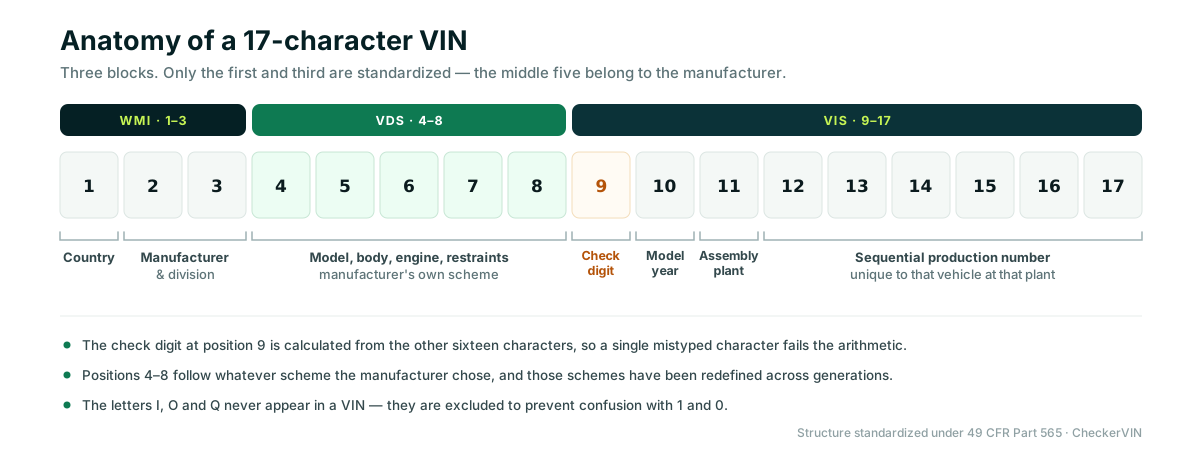
The split matters because only the first and third blocks are standardized. The middle five characters follow whatever scheme the manufacturer chose, and those schemes have been redefined across generations — which is why reading a VIN from a fixed chart misidentifies vehicles from the wrong era.
All seventeen positions
| Position | What it encodes |
|---|---|
| 1 | Country of manufacture |
| 2 | Manufacturer |
| 3 | Vehicle type or manufacturing division |
| 4–8 | The manufacturer's descriptor: model, body style, engine, restraint system |
| 9 | Check digit, calculated from the other sixteen characters |
| 10 | Model year |
| 11 | Assembly plant |
| 12–17 | Sequential production number, unique to that vehicle at that plant |
Position 1: where it was built
| Starts with | Country of manufacture |
|---|---|
| 1, 4 or 5 | United States |
| 2 | Canada |
| 3 | Mexico |
| J | Japan |
| K | Korea |
| L | China |
| S | United Kingdom |
| W | Germany |
| Y | Sweden or Finland |
| Z | Italy |
Positions 2 and 3: who built it
The second character identifies the manufacturer and the third the vehicle type or division. Together with the country code they form the World Manufacturer Identifier, issued under an international scheme so that a given code means the same maker anywhere.
Two things follow that catch people out. Large manufacturers hold many identifiers, split across countries, plants and vehicle classes — so a single brand has several valid prefixes. And luxury divisions carry their own identifiers separate from their parent brand, even where a vehicle shares a platform and engine with one.
Positions 4 to 8: what the vehicle is
This block carries model line, body style, engine and restraint system, and it is the part of the VIN each manufacturer defines for itself. There is no shared standard for what any individual character means here.
The practical consequence: the same letter in position eight means different engines on different makes, and often on the same make in different decades. A decode that queries the manufacturer's filed structure for that model year resolves it. A chart usually does not.
Position 9: the check digit
The ninth character is arithmetic rather than description, and it is the most underrated character in the VIN. Every other character is converted to a number, multiplied by a fixed positional weight, and summed. The remainder after dividing that total by eleven becomes the check digit, with a remainder of ten written as the letter X.
What it buys you is immediate error detection. A VIN whose check digit does not compute has almost certainly been mistyped or misread — which is why a decoder can tell you something is wrong before it tells you anything about the vehicle.
- 1If a VIN fails, suspect the letters firstI, O and Q never appear. A zero misread as an O, or a one misread as an I, is the most common cause of a failed check.
- 2Then check the transcriptionSeventeen characters copied by hand from a plate behind glass produce errors at a predictable rate. Photograph instead.
- 3Then consider the sourceA VIN supplied by a seller that will not validate is worth confirming against the plate on the vehicle itself.
Position 10: the model year
| Code | Model year |
|---|---|
| A | 2010 |
| B | 2011 |
| C | 2012 |
| D | 2013 |
| E | 2014 |
| F | 2015 |
| G | 2016 |
| H | 2017 |
| J | 2018 |
| K | 2019 |
| L | 2020 |
| M | 2021 |
| N | 2022 |
| P | 2023 |
| R | 2024 |
| S | 2025 |
| T | 2026 |
| V | 2027 |
| W | 2028 |
| X | 2029 |
| Y | 2030 |
The sequence runs on a thirty-year cycle. The digits 1 through 9 covered model years 2001 to 2009, and before that the same letters ran from A for 1980 through to Y for 2000. A letter alone is therefore ambiguous across three decades until you place the vehicle by generation or by the plant code.
Position 11: which plant assembled it
The eleventh character identifies the assembly plant within the manufacturer's own scheme. Codes have been reassigned across decades as facilities opened, closed and changed products, so a static table is a poor guide.
It matters most for recalls. Manufacturers frequently scope a campaign to vehicles built at one plant between two dates, which is why two otherwise identical vehicles can carry entirely different recall exposure.
Positions 12 to 17: the serial number
The last six characters are the sequential production number — the count of vehicles off that line. This is what makes the VIN unique rather than merely descriptive.
On most vehicles it is simply a serial. On limited-production and collectible models it can carry real meaning, because a low number or a number within a known range may indicate an early build or a specific production batch that enthusiasts track.
The regulation counts four sections, not three
Three blocks is how almost everyone teaches a VIN, and it is how the diagram above is drawn, because it maps cleanly onto what each part does: who built it, what it is, and which particular one it is. It is worth knowing that the federal regulation does not divide it that way.
49 CFR 565.15 sets out four sections rather than three. The first is characters one to three. The second is characters four to eight. The third is a single character — position nine, the check digit, standing on its own. The fourth is characters ten to seventeen. The regulation does not use the names world manufacturer identifier, vehicle descriptor section or vehicle identifier section at all; those belong to the international standard the federal scheme sits alongside, and that standard draws its own boundaries differently again.
| 49 CFR 565.15 | Characters |
|---|---|
| First section | 1–3 |
| Second section | 4–8 |
| Third section | 9 — the check digit alone |
| Fourth section | 10–17 |
Nothing about the per-position meanings changes. Position nine is the check digit under either description, position ten is the model year, position eleven is the assembly plant. What changes is only where the lines between groups are drawn, and that is why two careful sources can describe the same number differently without either being wrong.
There is a practical use for knowing this. If you are ever comparing a decoder’s output against a printed chart and the block labels disagree, check the per-position meanings before concluding that anyone has made a mistake — a genuine error shows up as a position carrying the wrong meaning, not as a boundary drawn in a different place.
The three letters a VIN never contains
I, O and Q are excluded from the standard entirely, because they are too easily confused with the digits 1 and 0.
This is more useful than it sounds. Reading a corroded plate, you never have to decide whether a character is a letter O or a zero — it is a zero. Not whether it is an I or a one — it is a one. And if a VIN you have typed will not validate, one of those three substitutions is the first thing to check.
What is never in a VIN
A VIN describes the vehicle as built. Several things people expect to find in it are simply not there, and knowing which saves a great deal of wasted searching.
- Paint color — the code is on a separate label, not in the VIN
- Trim name — the descriptor narrows it, but marketing names are not encoded
- Owner details, which are held by state agencies and are not public
- Mileage, accidents, title brands or service history
- Options fitted after the factory, and any modification since
- Software features on vehicles where capability is licensed rather than installed
For the first of those, where the paint code actually lives covers each major make. For the history items, title brands are the place to start.
Before the standard: shorter, inconsistent numbers
The 17-character format became mandatory for the 1981 model year. Earlier vehicles carry manufacturer-specific numbers, commonly ten to thirteen characters, with no check digit and no standardized position for the model year.
Modern decoders cannot read them, because the data was never filed in that format. That is expected rather than a fault — identifying a pre-1981 vehicle means going to factory tags and marque registries instead.
Reading yours: the make-specific part
Everything above applies to every vehicle. What differs by manufacturer is the middle block and the specific identifier codes — and that is where the make-specific guides come in.
- Which manufacturer identifiers that brand uses, and what each covers
- What the engine character means for that make in that era
- Which plant codes correspond to which facilities
- Where that manufacturer records options — a sticker, a data card, a build record
- The known issues that make a particular generation worth checking carefully
Pick your make from the links below, or find the VIN on the vehicle first if you do not have it yet.
Where this information comes from
Keep reading
Frequently asked questions
How do you read a VIN number?
Split the 17 characters into three blocks. Characters one to three identify the manufacturer and country. Four to eight describe the vehicle — model, body, engine and restraint system. Nine is a check digit, ten the model year, eleven the assembly plant, and twelve to seventeen the production sequence.
What does each digit of a VIN mean?
Position one is the country of manufacture, two and three the manufacturer and vehicle type, four to eight the manufacturer's own vehicle description, nine a mathematical check digit, ten the model year, eleven the plant, and the final six a sequential serial number unique to that vehicle.
Which VIN character is the year?
The tenth. It runs on a 30-year cycle using letters and digits, skipping I, O, Q, U and Z. F is 2015, K is 2019, M is 2021, P is 2023, R is 2024, S is 2025 and T is 2026. Digits 1 to 9 covered 2001 to 2009.
Why are there no I, O or Q in a VIN?
Because they are too easily confused with the digits 1 and 0. The standard excludes them entirely, which is genuinely useful when reading a worn plate — if a character looks like an O it is a zero, and if it looks like an I it is a one.
How does the check digit work?
Each of the other sixteen characters is converted to a number and multiplied by a fixed positional weight. The products are summed and divided by eleven, and the remainder becomes the check digit, with ten written as X. A VIN that fails this has almost certainly been mistyped.
Or skip the manual reading
Enter any VIN for the factory build, specifications, assembly plant and open safety recalls. Free, no account.
Run a free VIN check