The short answer
- Can I match on color?
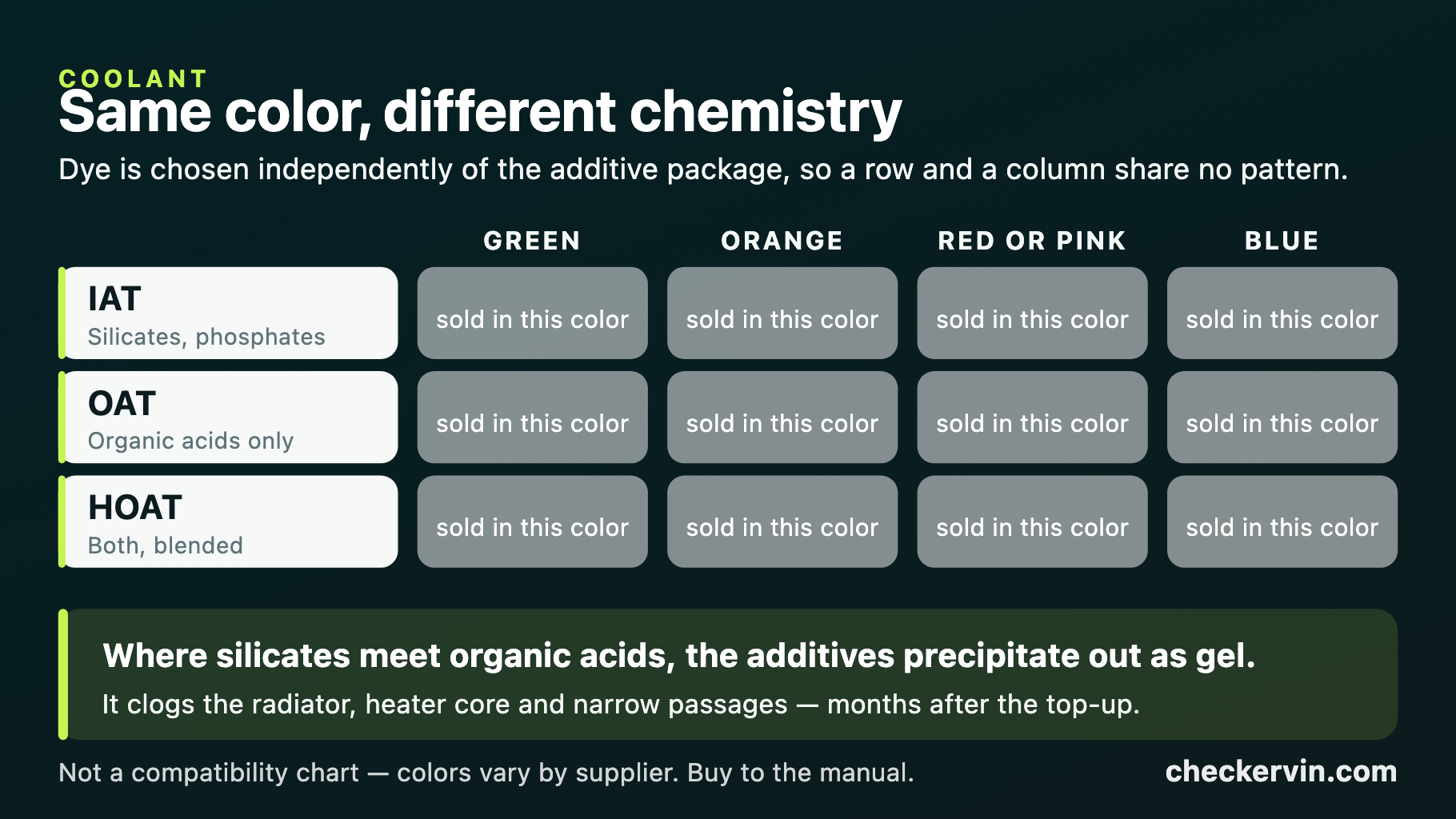
- No. Dye is chosen independently of the additive package. Two green coolants can be different families.
- What does mixing do?
- Silicates meeting organic acids can make the additives precipitate out as a gel that clogs the radiator and heater core.
- Where is the real answer?
- The owner's manual, for the engine the VIN identifies. There is no coolant field in any VIN decoder.
Nothing
What color tells you
Dye is chosen independently
Three
Additive families
IAT, OAT and hybrid HOAT
Gel
What a bad mix forms
Additives precipitate out
Months
When it shows up
Not on the day you top up
Color is not chemistry
This is the whole correction, and it is worth being blunt about because the habit it replaces is so widespread.
Coolant is dyed. The dye exists so the fluid is visible in a translucent tank, so leaks show up on a driveway, and so it is obviously not water. Which dye a manufacturer chooses is their decision, and it is made independently of the corrosion-inhibitor package that determines what the coolant is compatible with.
The consequences run both ways. Two bottles of the same color can contain different chemistry. One chemistry can be sold in several colors by different suppliers. And a vehicle’s original fill color is not a specification you can shop against — it is a description of what a previous fill looked like.
Three families, not a spectrum
Underneath the colors there are broadly three approaches to stopping a cooling system corroding, and they use different chemistry to do it.
| Family | How it protects, and where it belongs |
|---|---|
| IAT — inorganic additive technology | The traditional approach, using inorganic inhibitors including silicates and phosphates. It protects quickly and depletes relatively fast, which is why systems using it are serviced more often. Common on older vehicles. |
| OAT — organic acid technology | Uses organic acid inhibitors and is free of silicates and phosphates. Protects more slowly but lasts far longer, and is the approach modern aluminum-intensive engines are generally designed around. |
| HOAT — hybrid organic acid technology | A blend, combining organic acids with silicates or phosphates to get some of the fast protection of the first and some of the longevity of the second. |
Note what separates them: the presence or absence of silicates and phosphates alongside organic acids. That is not a quality ranking. It is the specific fact that makes two of them react.
What mixing actually does
The reason mixing matters here, and matters differently from mixing engine oils, is that the failure is a chemical reaction rather than a dilution.
Where an inorganic package’s silicatesmeet an organic acid package’s acids, the additives can react and fall out of solution. Engineering sources describe the result plainly: the protective additives precipitate, forming a gel or sludge.
That gel then does mechanical damage in a system designed around clear flow. It clogs the radiator, the heater core and the narrow passages through the engine. The consequence is not uniformly weaker protection everywhere — it is localized overheating, because some passages stop flowing while others carry on.
Why nothing happens on the day
There is a shape here we have now met several times on this site, and naming it is the most useful thing this section can do.
Top up with the wrong family and the car drives away fine. The temperature gauge sits where it always does. Nothing overheats on the way home, and nothing warns you. The reaction takes time, the deposits accumulate gradually, and the flow restriction becomes significant somewhere down the road.
By the time the symptom arrives, it presents as a cooling fault — a thermostat, a water pump, a radiator, a head gasket. Those get diagnosed and replaced, sometimes correctly, while the actual cause is a bottle bought months earlier on the basis of matching color.
It is the same delayed-failure shape as a battery of the wrong construction, a wheel with the wrong lug seat, or a key that was cut but never programmed. Nothing punishes the shortcut at the moment it is taken, which is exactly why the shortcut survives.
The roadside top-up
The practical situation this page most needs to answer honestly: the warning light is on, you are not at home, and the choice is what to put in.
Getting the engine somewhere safe outranks additive chemistry that afternoon. If you do not know what is in the system, adding water is generally the lesser problem than adding a coolant that may be incompatible with it — water dilutes, it does not react. Distilled is better than tap; tap is better than a seized engine.
- Let it cool before opening anything — a hot cooling system is under pressure
- Prefer water over an unknown coolant if the existing fill is unknown to you
- Add only what is needed to get to a shop, and treat it as temporary
- Have the system checked properly afterwards, because water alone lowers boil and freeze protection and dilutes the inhibitors
- Tell whoever works on it what you added — it changes what they should do next
The point is not that water is fine. It is that the emergency and the maintenance decision are different decisions, and conflating them is how a temporary fix becomes a permanent fill.
What the VIN is doing here
The same indirect role it plays across this family of questions, and worth being precise about.
The federal decoder holds a build record — make, model, model year, body class, displacement, cylinders, fuel type. There are no fluid specifications in it and never have been. Coolant requirement is an engineering decision the manufacturer publishes and revises, exactly as with the oil specification covered on our oil type guide.
What the VIN gives you is an unambiguous identification of the engine, which is what the requirement attaches to. That matters more than it sounds: a single model in a single year can be sold with several engines, and a cooling system designed around an aluminum-intensive engine can have different requirements from the one beside it in the same showroom.
Where the answer actually is
Four sources, in descending order of authority, and the first two settle almost every case.
- 1The owner's manualThe authority. It names the specification the manufacturer requires, which is the thing to buy against — not a color and not a brand.
- 2The reservoir cap or an under-hood labelMany vehicles carry the specification, or at least a warning about which type to use, right where you would be pouring.
- 3A dealer parts desk, given the VINThey resolve the exact engine from the number and read the specification from the manufacturer's own system. Useful when the manual is gone.
- 4The back label of the bottle, not the frontThe front sells a color and a brand. The back lists the specifications the product claims to meet — that is the part to match against your manual.
Topping up against flushing
Two different jobs, and knowing which one you are doing changes what is acceptable.
Topping up adds to what is already there, so compatibility with the existing fill is the entire question. This is where a color-matched guess does its damage, because the new fluid meets the old one immediately.
Flushing and refilling replaces the contents, which is the clean way out of an unknown or a known-bad mix. It is also the honest answer when somebody has already mixed families: draining and refilling with the correct specification removes the reacting pair rather than diluting it.
If you have topped up with something you now suspect was wrong, that is a reason to have the system drained sooner rather than to wait and see. The gel does not un-form.
Concentrate, premix and water
A smaller distinction that causes its own share of trouble.
- Concentrate is undiluted and must be mixed with water before use, in the ratio the manufacturer states
- Premix — often labeled ready to use — is already diluted, and adding more water dilutes it below its intended protection
- Where dilution is called for, distilled or deionized water avoids introducing minerals that tap water carries
- Pouring concentrate in neat does not give better protection; the water is part of how the system carries heat
Buying premix removes one opportunity to get it wrong, which on a job done once every few years is worth something.
What a bad mix looks like later
Worth knowing because these get attributed elsewhere, and because catching it early is much cheaper than catching it late.
| What you notice | What it can indicate |
|---|---|
| Cloudy, thickened or gritty coolant in the tank | The clearest sign. Healthy coolant is translucent; a fluid that looks like a milkshake or carries visible particles is telling you something. |
| The heater blowing cool when the engine is warm | The heater core has very narrow passages, so it is frequently the first thing a gel blocks. |
| Temperature that creeps up in traffic but is fine at speed | Consistent with restricted flow, which is exactly what precipitated additives cause. |
| Deposits or residue on the cap and filler neck | Visible without tools, and worth a look on any car you are considering buying. |
Buying used, with unknown history
This is a genuine, free inspection point on any used car, and it takes ten seconds.
Open the hood and look at the coolant in the expansion tank. You are not judging the color — that is the point of this page — you are judging clarity. Translucent fluid with no visible particles is the good outcome. Cloudy, thick, rusty or gritty is a finding, and so is residue crusted around the cap.
On a car with no service records you have no way to know what has been put in it, and a previous owner topping up on color is common precisely because it seems reasonable. Our maintenance report guide covers why service history is thin, and our pre-purchase inspection guide covers what a proper examination reaches.
The check sequence
Decode the VIN free to establish the exact engine and trim. Read the manual for the specification that engine requires. Match the back label of the bottle to that specification rather than to a color. Where the existing fill is unknown, drain and refill rather than top up. And check open recalls through NHTSA at no cost while you have the number in front of you.
Where this information comes from
- Mishimoto — coolant basics and why not to mix themEngineering discussion of the additive families and what happens chemically when incompatible packages are combined
- Eni — can coolants and antifreeze be mixed?Manufacturer guidance on compatibility between inhibitor technologies
- NHTSA recall lookupOpen safety recalls by VIN, free — worth running while you have the number to hand
Keep reading
Frequently asked questions
Can I find my coolant type from the VIN?
Indirectly. The federal decoder has no coolant field — it returns the build record, not service specifications. What the VIN does is establish exactly which engine and trim you have, and the coolant requirement follows from the engine. Take that to the owner's manual or a dealer parts desk, which is where the actual specification lives.
Can I mix two coolants if they are the same color?
Color tells you nothing about chemistry. Manufacturers choose dye independently of the additive package, so two green coolants can belong to different families and one family can appear in several colors. Matching on color is matching on the one attribute that carries no information about compatibility.
What happens if I mix the wrong coolants?
The failure is chemical rather than a simple dilution of protection. Where an inorganic coolant's silicates meet an organic acid package, the additives can react and precipitate out of solution as a gel. That gel clogs the radiator, the heater core and the narrow passages in the engine, which produces localized overheating.
Is it safe to top up with water in an emergency?
Getting a hot engine home matters more than additive chemistry that afternoon, and adding water is generally the lesser problem compared with adding an incompatible coolant. It is a way to reach a shop, not a fix — water alone lowers the boiling and freezing protection and dilutes corrosion inhibitors, so have the system corrected properly afterwards.
Does CheckerVIN return a coolant specification?
No. Our free lookup returns the factory build, specifications and open safety recalls from the federal decoder, which carries no fluid specifications. Decode the VIN to confirm the engine, then use the manual.
Start with the VIN
Decode any VIN free for the factory build, specifications and open safety recalls. No account, no card.
Run a free VIN check