The short answer
- What does a VIN check cost here?
- Nothing. There is no charge, no card field, and no payment system connected to this site. You enter a VIN and an email address, and the report opens.
- Is there a subscription or free trial?
- No. A recurring charge needs payment details to attach to, and none are ever collected. There is nothing to cancel because there is nothing to enrol in.
- How can I verify that without trusting the claim?
- Run a check. If a card is never requested, no charge is possible. That single observation settles it faster than any promise on a page like this one.
$0
Cost of a VIN check
No card requested at any step
None
Subscriptions or trials
No payment system is connected
The only thing we ask for
So the report can reopen later
§8403
The law that governs billing
15 U.S.C. 8401–8405, ROSCA
What we charge, stated plainly
Nothing. A VIN check on this site costs nothing, and there is no point in the flow where money is discussed. The reason is not generosity in the abstract: the data we hand over today is federal work product. Vehicle build and specification records come from the manufacturer’s own filings through NHTSA, and open safety recalls come from NHTSA directly. Those are published so the public can read them.
That distinction matters more than a price. Where a record is public, charging for it is a convenience fee. Where a record is licensed — title brands, accident reports, auction histories — somebody genuinely paid for it, and any site offering that layer for nothing is being paid another way. Being clear about which layer you are getting is the whole substance of billing transparency.
The pattern this page exists to name
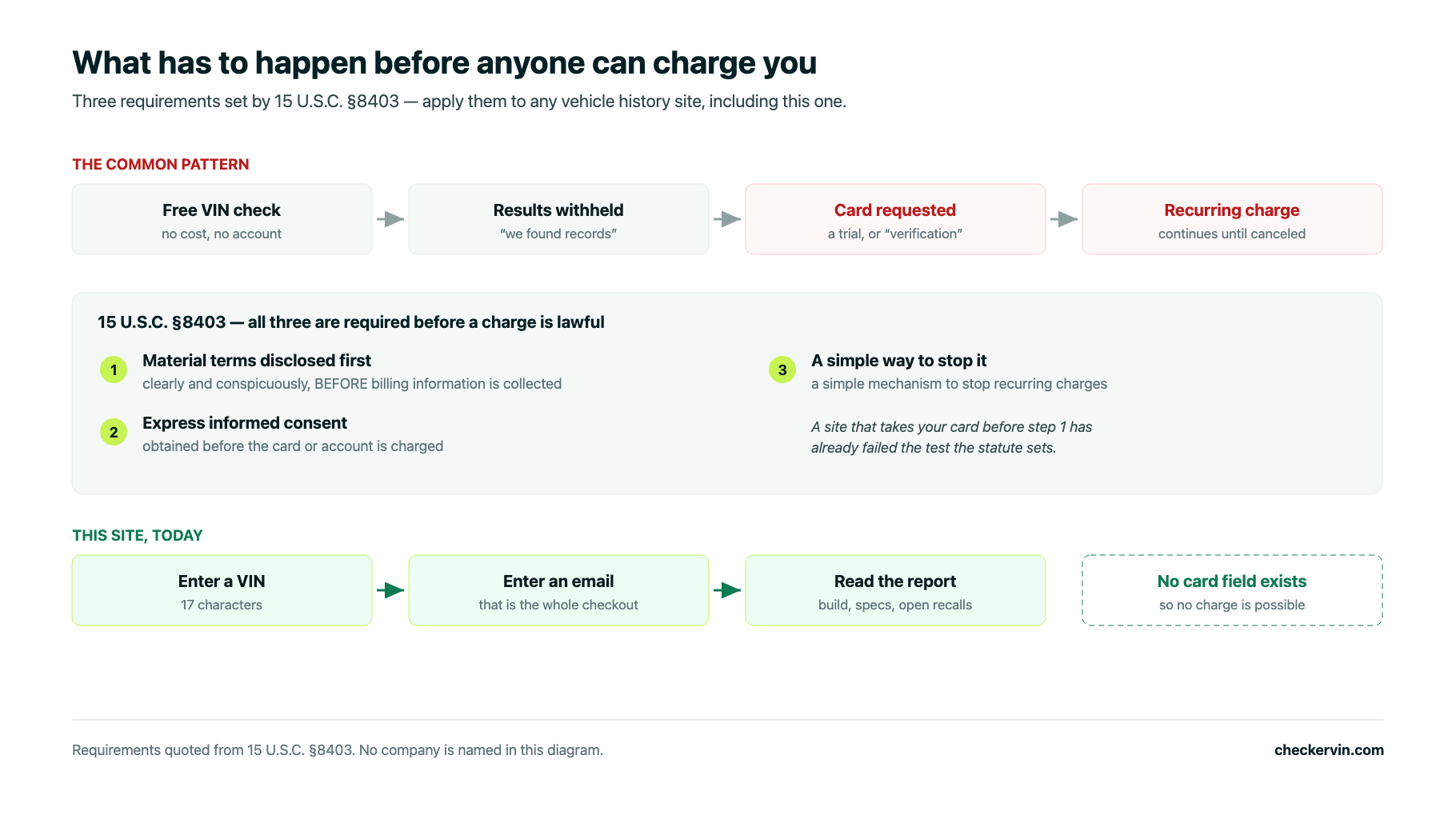
The vehicle history category has a recognizable shape that catches people. It starts honestly: a genuinely free VIN search, no account required. The results page then reports that records exist — a number of them, often an alarming number — without showing what they say. Unlocking them requires a card, presented either as a low-priced trial or as identity verification rather than as a purchase. The charge that follows recurs monthly until somebody notices and cancels.
Every individual step in that sequence can be disclosed somewhere in the fine print, which is precisely why the law does not ask whether the terms were disclosed somewhere. It asks when, and how clearly, and whether consent was obtained before the charge rather than inferred after it.
What federal law actually requires
Online billing through what the statute calls a negative option feature — an arrangement where silence or inaction is treated as agreement to be charged — is governed by the Restore Online Shoppers’ Confidence Act, 15 U.S.C. 8401–8405. Section 8403 makes it unlawful to charge a consumer through such a feature unless the seller does three specific things.
| What 15 U.S.C. §8403 requires | What it means in practice |
|---|---|
| Material terms disclosed first | Clearly and conspicuously, and before billing information is collected — not after, and not on a linked page |
| Express informed consent | Obtained before the card, debit card or bank account is charged; a pre-ticked box or an inferred agreement is not consent |
| A simple mechanism to stop | A straightforward way to end recurring charges, rather than a retention queue or a cancellation-by-phone-only route |
Read the order of the first requirement carefully, because it is the one that does the work. The terms must be in front of you before the site takes your billing information. A page that collects the card first and explains the recurring charge on the confirmation screen has the sequence backwards, and the sequence is the rule.
How to check any VIN site in thirty seconds
This applies to us as readily as to anyone else, and you should use it on us. The point of publishing a standard is that it can be turned around on the publisher.
- 1Run the free check firstUse a VIN you have to hand. Note the exact point at which the site stops showing you things.
- 2Watch for the card fieldIf one appears, stop and read what sits immediately beside it, not what a footer link promises.
- 3Look for the word that recursMonthly, per month, renews, until canceled, membership. A one-time purchase says so in the same breath as the price.
- 4Find the cancellation route before payingIf you cannot see how to stop it before you start it, that is the answer to whether the mechanism is simple.
Run those four steps here and the sequence ends early: there is no card field to find, so steps three and four have nothing to examine. That is the entire claim this page makes, and it is checkable in less time than reading this sentence took.
What is free today, and what is not built yet
Transparency about billing is worth little without the same honesty about coverage, so here is the boundary. What arrives today is the factory build and specification record decoded from the VIN, and every open safety recall campaign NHTSA lists against that vehicle. Those are complete, current and free.
What does not arrive today is the licensed history layer — title brands, accident and damage records, odometer readings, theft and lien records. The report shows those sections as pending rather than hiding them, because they are the reason most people run a check and you deserve to know they are absent before you start rather than after. When that layer launches it will be paid, because it is bought.
- Factory build and specifications, decoded from the VIN — free, complete today
- Open NHTSA safety recall campaigns for that vehicle — free, complete today
- Title brands, accident records, odometer and theft history — not available yet, shown as pending
- No card is requested for any of it, including the sections that are not ready
Why we ask for an email, since it is free
An email address is the only thing the check asks for, and it does three jobs. It lets the report be sent to you rather than living only in a browser tab. It lets you reopen the same report later without running the VIN again. And it is how you would be told if NHTSA issues a new recall campaign against that vehicle after you looked, which is the one piece of vehicle news that genuinely cannot wait.
It is not a payment step, not a trial enrollment, and not a placeholder for a card request later in the flow. What is stored, how long it is kept, and how to have it removed are set out on the privacy page.
If a paid tier launches, what changes
The licensed history layer costs real money per lookup, so if and when it launches it will carry a price. Stating the commitment now, while there is nothing to sell, is worth more than stating it later when there is:
- One-time purchases, priced per report — no subscription, no membership, no auto-renewal
- The price shown in full before any payment field appears, in line with the disclosure ordering §8403 requires
- No card details collected for a free check, ever, for any reason including verification
- This page updated on the same day anything here changes, rather than quietly
If a vehicle history site has already charged you
The practical route runs in three steps. Ask the seller in writing to cancel and refund, keeping the message and any reply. If charges continue, or the cancellation route turns out to be a phone queue rather than a button, report it to the Federal Trade Commission — that is the agency that enforces ROSCA, and the reports are what build the cases. Then dispute the charge with your card issuer, who can block further recurring attempts from the same merchant.
Keep the dates. A recurring charge that continued after a documented cancellation request is a materially stronger complaint than a general dissatisfaction, and the statutory language about a simple mechanism to stop recurring charges is the specific hook.
Where this information comes from
- Restore Online Shoppers’ Confidence Act — 15 U.S.C. §§ 8401–8405The federal statute governing negative-option billing online, published by the FTC
- FTC — report fraud, scams and bad business practicesWhere to report a site that charged you or made cancellation difficult
- NHTSA recall lookupThe federal source behind the recall section of every report here, free to the public
Keep reading
Frequently asked questions
Is CheckerVIN really free?
Yes. There is no charge for a VIN check, and there is no payment step anywhere in the flow. You enter a VIN, you enter an email address, and the report opens. No card is requested, stored or charged, because the site has no payment system connected to it at all.
Do you ask for a credit card?
No. There is no card field on any page of this site. That is the simplest thing to verify and the fastest way to tell a free service from a trial: run the check and see whether a card is ever requested. If one is, read the terms beside it before you type anything.
Will I be enrolled in a subscription or a trial?
No. A recurring charge requires payment details, and we never collect any, so no subscription or auto-renewing trial exists or can exist. Under 15 U.S.C. 8403 a site must disclose all material terms before it collects billing information and obtain express informed consent before charging.
Why do you ask for an email address if it is free?
So the report can be sent to you and reopened later without re-running the check, and so we can tell you if a new recall is issued for that VIN. It is not a payment step and it is not a trial signup. The privacy page explains what is stored and how to have it deleted.
What should I do if a VIN site has already charged me?
Ask the seller to cancel and refund first, in writing. If recurring charges continue or the cancellation route is not simple, report it to the Federal Trade Commission at ReportFraud.ftc.gov and dispute the charge with your card issuer. ROSCA requires a simple mechanism to stop recurring charges.