The short answer
- What does it cost?
- RepairPal lists $2,572–$3,386 for a typical head gasket job and $2,000–$4,000 on its Forester head gasket page. Labor is most of it.
- Which Foresters are known for it?
- The EJ25 cars, through the 2010 model year. In our 2008–2022 data those years hold just 9% of Forester engine complaints.
- What about 2011–2015?
- Those FB25 years had a documented oil-consumption problem, fixed with a new short block. That is a different repair with a different price.
The numbers, and whose numbers they are
We sell VIN checks, not repairs, so every dollar figure here belongs to someone else. RepairPal’s general head gasket estimator lists $2,572 to $3,386 for the job, splitting it into $1,669 to $2,449 of labor and $903 to $937 of parts, and notes that the range leaves out taxes, fees and your location. Its Forester page on head gaskets leaking oil gives a wider average, $2,000 to $4,000. Both were retrieved in October 2026 from RepairPal’s own listings.
The live search results for this question also carry owner threads and social posts quoting their own bills, some well above those ranges and at least one in Australian dollars. We could not read those figures on the pages themselves, so none are repeated here. What we can add is the part a price survey cannot: which Forester engine you are dealing with, what Subaru itself documented for it, and where the federal complaint record puts the engine trouble.
Why labor is most of the bill
Every Forester engine is a horizontally opposed four-cylinder. The two cylinder heads sit on either side of the block, low and tight against the frame rails, rather than on top where a technician can reach them. Shops commonly lift the engine out to do a head gasket job properly, which is why the labor line dwarfs the gasket set.
Subaru’s own labor clock gives a sense of scale for nearby work. Its Service Bulletin 02-157-14R, the oil-consumption repair for 2011–2014 Foresters, books 11.5 to 12.0 hours to replace the short block, a job that removes the engine and both heads and lists new head gaskets among its parts. A head-gaskets-only job skips the block swap, but the access work is much the same, which is why independent quotes for it routinely start in the low thousands.
| What the quote should say | Why it matters |
|---|---|
| Engine out, or in the car | Changes hours sharply; ask which the shop is pricing |
| Heads checked for flatness and machined | A warped head will leak again with a new gasket |
| Timing belt, idlers and water pump (EJ25) | The belt comes off anyway; most shops replace it |
| Coolant, conditioner and oil | Subaru lists coolant and Cooling System Conditioner on its own repair |
Two engines, two stories
The single most useful fact before pricing anything is which engine the Forester has, because the answer changes both the risk and the bill. The non-turbo Forester used the EJ25 single-overhead-cam engine through the 2010 model year. That engine drives its camshafts with a timing belt, and it is the one behind the long-running Subaru head gasket story: a slow seep of oil or coolant at the outer edge of the gasket, usually at high mileage.
For 2011 Subaru put the FB25 in the non-turbo Forester. Its own service bulletin for the 2011–2014 Forester names the “2.5L FB” engine and walks technicians through removing its timing chains, so there is no belt to bundle into an FB25 head gasket job. The turbocharged XT kept an EJ-series engine until the 2014 redesign, so a 2011–2013 XT belongs with the older story, not the newer one. The engine lookup by VIN and the timing belt or chain check settle which one a given car carries.
What 5,042 complaints say about the engine
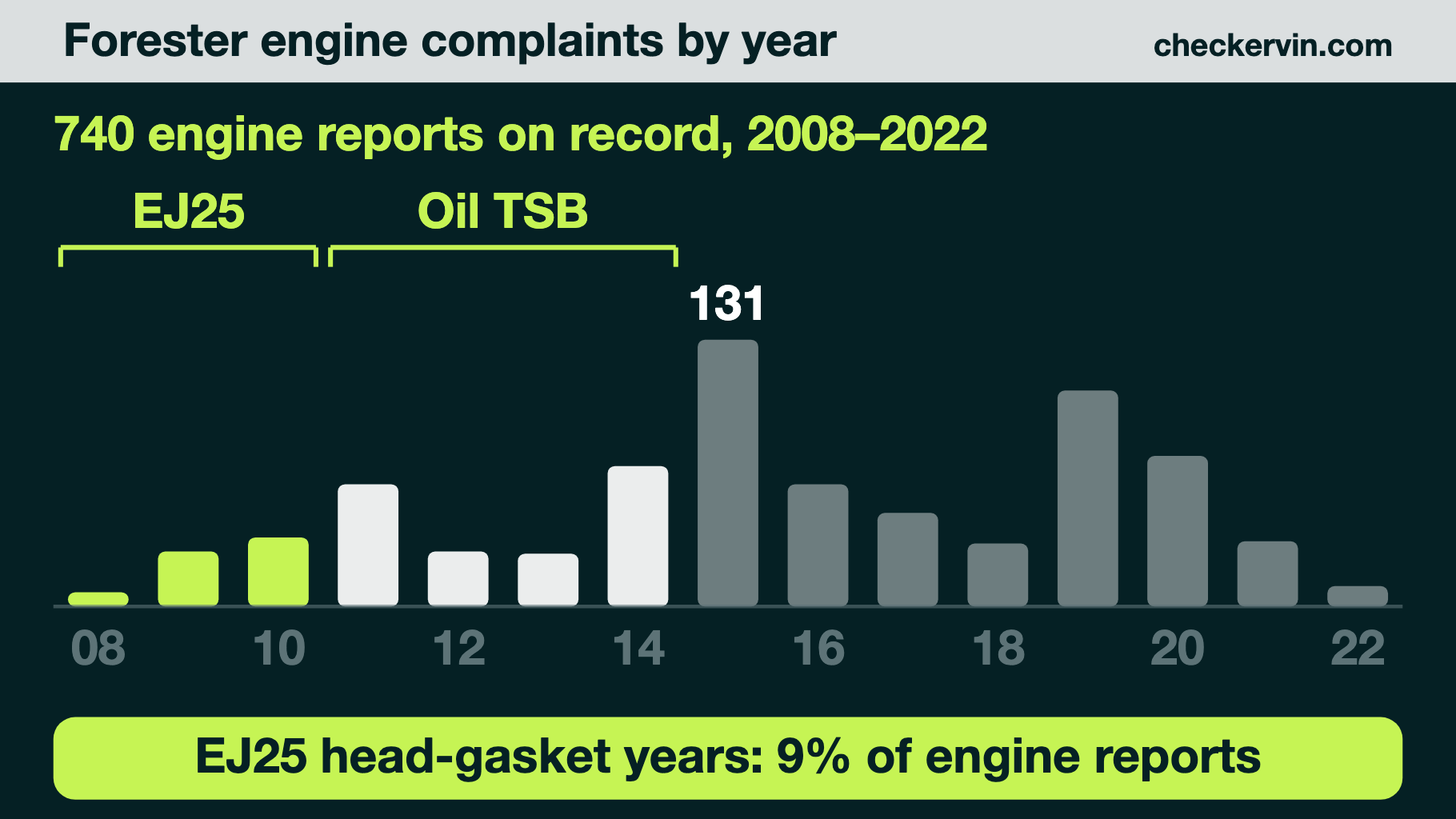
Our corpus of federal NHTSA complaints holds 5,042 reports against the 2008–2022 Forester, and 740 of them fall in the ENGINE component category. ENGINE makes the top five components in 15 of those 15 model years, so no year is missing from the count. Lay those engine reports out by year and the shape is not what the head gasket reputation predicts.
The 2008–2010 EJ25 years hold 68 engine reports, 9% of the total. The four years Subaru’s oil-consumption bulletin names, 2011–2014, hold 182, or 25%. The remaining 66% sits in 2015 and later. The single busiest year is 2015, at 131 engine reports.
Raw counts rise and fall with how many cars of each year are on the road, so it also helps to ask how much of each year’s complaints are about the engine. In the EJ25 years, engine reports are 14% of all complaints. In the 2011–2014 oil-consumption years they rise to 25%, peaking at 41% for the 2011 car. From 2015 onward they fall back to 13%.
2008–2010: the EJ25 years, where the reputation lives
The 2008–2010 Forester is where a head gasket quote is most expected, and the record supports that narrowly. These three years carry 7, 27 and 34 engine reports, with ENGINE in the top five components in 3of the three. When we searched the complaint narratives NHTSA publishes for each Forester model year for the words “head gasket,” the matches clustered in these cars, with only scattered mentions after them.
Two cautions keep that honest. The ENGINE category covers every engine complaint, from misfires to mounts, so not every one of those reports is a gasket. And the reputation is older than our data: most of the EJ25’s head gasket history belongs to the 1999–2007 cars, which our corpus does not cover. Secondary accounts describe an earlier Subaru program, WWP-99, that added Cooling System Conditioner to late-1990s and early-2000s 2.5-liter cars for small external coolant seeps. We could not find a primary copy of it, it predates every car in our data, and we found no Subaru extension covering head gaskets on a 2008–2010 Forester.
2011–2015: the engine problem was oil, not gaskets
The FB25 years are where people searching this phrase most often get confused. Subaru’s Service Bulletin 02-157-14R, first issued in August 2014 and revised through 2018, covers “2011-14MY Forester Models with 2.5L FB Engines” and 2015 manual-transmission Foresters. Its subject is engine oil consumption, and its remedy is to replace the engine short block once an oil consumption test confirms the car burns more than a third of a quart in 1,200 miles.
The confusion is understandable. That short block job pulls the engine, removes both cylinder heads and installs new head gaskets, and the bulletin lists them in its parts table alongside coolant and Cooling System Conditioner. So a 2012 or 2014 Forester’s repair invoice can show new head gaskets when the actual fault was piston rings. Subaru’s production change information for the bulletin describes redesigned piston rings phased in from specific VINs, which is why later 2014 automatics and later 2015 manuals fall outside it.
The class action that grew out of the same problem settled in 2016. Subaru’s retailer notice lists 2011–2014 Foresters below VIN *529004 with an automatic or CVT and 2011–2015 Foresters below VIN *543650 with a manual. The settlement extended Powertrain coverage for excessive oil consumption to 8 years or 100,000 miles, with cash reimbursement claims due by October 1, 2016. Subaru denied the cars were defective. On the calendar, every car on that list has now passed eight years in service.
2016–2022: the FB25 after the fix
The second hump on the chart, around 2015 and again near 2019, is easy to misread as a gasket problem returning. The record does not say that. The 2015car is the busiest single year for engine reports, and it sits right at the edge of the oil-consumption bulletin, which still covers 2015 manuals. The 2019–2020 bump coincides with the next-generation Forester and its direct-injected FB25, and we found no Subaru document or NHTSA recall naming the head gasket on any 2016–2022 car.
That does not make a late Forester immune. Any engine that has run hot, run low on coolant or been filled with the wrong coolant can lift a gasket. It just means the reason to suspect one on these cars is the car’s own cooling history, not the model year. The coolant type lookup by VIN shows what the factory filled it with.
External seep, internal failure, or something else
A shop quoting head gaskets should be able to say which of three things it found, because they carry different urgency and sometimes different repairs.
| What the shop sees | What it usually means |
|---|---|
| Oil wetness at the lower edge of a head | External oil seep at the gasket; often slow, but it worsens |
| Crusted coolant at the head-to-block seam | External coolant seep; watch the level and temperature |
| Coolant loss with no visible leak, bubbles in the tank | Internal failure; combustion gas is entering the cooling system |
| Milky oil, white exhaust, overheating | Internal failure; stop driving and test before anything else |
The external kinds are the classic EJ25 pattern, and owners sometimes run them for months with a watchful eye on the coolant and oil levels. The internal kind is a different decision. An engine that keeps overheating can warp its heads, and at that point the cost of the job climbs past a gasket set. On FB-engine cars, an oil-consumption complaint without any visible leak points toward the 02-157-14R pattern rather than a gasket at all.
What the recall record covers, and what it doesn't
We queried NHTSA’s recall database for every Forester model year from 2008 through 2022, and the campaign counts matched our own recall data year for year. No campaign names a head gasket. Three touch the engine: 08V460000 on certain 2009 Foresters with an improperly assembled turbocharger oil supply pipe, 16V162000 on certain 2015–2016 Forester 2.0XT models with a turbocharger intake duct that may crack, and 19V856000 on certain 2019 models whose PCV valve can separate. None of them pays for head gaskets.
| Program | What it actually pays for |
|---|---|
| Recall | A safety defect, free at any dealer |
| Warranty extension (02-157-14R) | Oil consumption only, 8 years / 100,000 miles from warranty start |
| Service bulletin | Repair instructions and labor time; pays nothing outside warranty |
| Goodwill | Dealer and Subaru discretion, usually near the end of warranty |
Running the specific VIN is still worth it, because several Forester years carry open recalls on other systems. The Subaru recall check shows which remain unrepaired, and the Subaru warranty check by VIN helps estimate whether any factory coverage is left on a newer car.
Before you authorize the repair
- Confirm the engine by VIN: EJ25 (through 2010, and turbo XT to 2013) or FB25
- Ask whether the leak is external oil, external coolant, or internal, and how it was confirmed
- On an FB25 car with low oil and no visible leak, ask whether an oil consumption test was done
- On an EJ25 car, ask whether the timing belt, idlers and water pump are in the quote
- Ask whether the heads will be checked for flatness and machined if needed
The first and third items do the most work. A 2012 Forester that drinks oil and has a dry engine is not a head gasket candidate in the usual sense, and a quote that treats it as one is solving the wrong problem. The fourth item is where quotes for the same EJ25 job diverge: some include a full timing service, others price the gaskets alone and leave the belt for later.
If you are buying the Forester, not repairing it
The record reads as a shopping map. On a 2008–2010 car, ask for paperwork showing the head gaskets and timing belt were done, and price the car as if they were not if there is none. On a 2011–2015 car, ask whether a short block was replaced under 02-157-14R, and check the oil level on the dipstick yourself. A Subaru VIN decode confirms the engine, trim and build year in one step.
Then look under the car with a flashlight at the lower edges of both cylinder heads, where an EJ25 seep shows first, and check the coolant overflow tank for a crust line well below where the coolant now sits. The Subaru Forester years-to-avoid breakdown covers the rest of the complaint record by year, well beyond the engine. For the drivetrain side of the same car, see the Forester transmission fluid change post, and for another Subaru engine job priced by labor, the Outback spark plug cost post.
Where this information comes from
- Subaru Service Bulletin 02-157-14R (NHTSA copy) — engine oil consumptionApplies to 2011–2014 Forester FB25 and 2015 manuals; short block remedy with head gaskets in the parts list; 11.5–12.0 labor hours; 8-year/100,000-mile extension.
- Subaru retailer notice, February 2016 (NHTSA copy) — oil consumption settlementThe settlement's Forester VIN cutoffs by transmission type.
- Subaru retailer FAQ, April 2016 (NHTSA copy) — settlement termsCoverage terms, the October 1, 2016 claim deadline and Subaru's denial of any defect.
- NHTSA — recalls by VINThe official lookup; our year-by-year query found no recall naming a Forester head gasket.
- NHTSA — vehicle complaintsThe federal complaint database our engine counts are computed from.
- RepairPal — head gasket replacement estimateThe $2,572–$3,386 general range and its labor and parts split, retrieved October 2026.
- RepairPal — Forester head gasket leaking oilThe $2,000–$4,000 Forester average quoted above, retrieved October 2026.
Keep reading
Frequently asked questions
How much does it cost to replace the head gaskets on a Subaru Forester?
RepairPal's general head gasket estimator lists $2,572 to $3,386, with $1,669 to $2,449 of that in labor and $903 to $937 in parts, before taxes, fees and local rates. Its Forester page on head gaskets leaking oil puts the average at $2,000 to $4,000. Both figures were retrieved in October 2026 and are RepairPal's, not ours. On an older EJ25 Forester, expect a quote to include the timing belt and often the water pump, because the belt has to come off to remove the heads.
What years did the Subaru Forester have head gasket problems?
The reputation belongs to Foresters with the 2.5-liter EJ25 SOHC engine, which the non-turbo model used through the 2010 model year. Our federal complaint data starts in 2008, so it sees only the last three of those years, and they hold 9% of the Forester's engine complaints from 2008 to 2022. From 2011 the non-turbo Forester used the FB25, and the engine problem Subaru documented for 2011 to 2014 cars was oil consumption, not head gaskets.
Can you drive a Subaru with a blown head gasket?
It depends which kind of failure it is. A slow external seep of oil or coolant at the edge of the gasket can sometimes be watched for a while if you check fluid levels often and the engine never runs hot. An internal failure, with coolant disappearing without a visible leak, bubbles in the overflow tank, white exhaust or overheating, is different: continuing to drive can warp the cylinder heads and turn a gasket job into an engine replacement. When in doubt, have a shop pressure-test the cooling system and test the coolant for combustion gas before driving further.
Is the Subaru oil consumption settlement still active for the Forester?
Almost certainly not for any car today. Subaru's Service Bulletin 02-157-14R extended Powertrain coverage for excessive oil consumption on 2011 to 2014 Foresters with the FB25, and 2015 manual-transmission cars, to 8 years or 100,000 miles from the original warranty start date. Every one of those cars has now passed eight years in service, and claim forms for cash reimbursement had to be postmarked by October 1, 2016. A dealer can confirm a specific VIN's coverage history.
Do 2016 and 2017 Foresters have head gasket problems?
Neither year shows a documented head gasket pattern. Both run the FB25, and we found no Subaru bulletin, warranty extension or NHTSA recall naming the head gasket on them. Our data records 60 engine complaints against the 2016 Forester and 46 against the 2017, across every kind of engine concern. A head gasket can still fail on any engine that has overheated, so a cooling-system history matters more than the model year.
Confirm the engine before you price the repair
A free CheckerVIN report shows the factory build, engine, specifications and open recalls for any VIN, so you know whether you are pricing an EJ25 head gasket job or something else.
Run a free VIN check