The short answer
- What does it cost?
- A RepairPal sample cited by ConsumerAffairs puts a 2011 Cruze at $1,338–$3,027, mostly labor. Head machining or overheating damage adds to it.
- Is there a recall or GM coverage?
- No. No Cruze recall, bulletin or special coverage on NHTSA's files names the head gasket.
- What should happen first?
- A pressure test, a combustion leak test and a leak-down test. GM documented coolant-loss and rough-idle faults on the 1.4L that look like a gasket and are not.
33%
Engine share of complaints
2011–2015 Cruze
32%
Engine share of complaints
2017–2019 Cruze
$1,338+
2011 Cruze sample
RepairPal, via ConsumerAffairs
None
Head gasket recalls
NHTSA, 2011–2019
The numbers, and whose numbers they are
We decode VINs; we do not repair cars or sell parts. So every dollar figure here belongs to whoever published it, and for this job the published figures are thin. The most specific one we found is a table on ConsumerAffairs that cites sample estimates from RepairPal. Its row for a 2011 Chevrolet Cruze reads $1,338 to $3,027 in total, split into $388 to $878 for parts and $950 to $2,149 for labor. We read it in October 2026 from the page’s search listing, because the page itself would not load for us; treat it as a secondhand figure for one model year.
We could not read a Cruze head gasket estimate on RepairPal directly, and Kelley Blue Book’s 2013 Cruze page showed no head gasket price at all when we checked. Several other sites publish Cruze-specific numbers without saying where they came from, and we have left those out.
What the sample does show is the shape of the bill. Labor is most of it, because the job means draining the cooling system, taking off the intake and exhaust side of the engine, the cam cover, the timing drive and the cylinder head itself, then putting it all back. Parts are the smaller line until the head turns out to be warped and needs a machine shop, or until an overheating episode has damaged something else. A quote that does not say whether the head will be checked for flatness is a quote that can grow.
When the repair costs more than the Cruze is worth
This is the part of the Cruze head gasket question that most cost pages skip. Kelley Blue Book’s national values for a 2013 Cruze, listed as valid through October 25, 2026, put a typical trade-in at about $1,250 to $2,575 and a private-party sale at about $3,600 to $5,400, depending on trim. Its Fair Purchase Price, what a dealer typically gets, starts at $4,150 for the LS and LT sedans. Those figures assume a car in good, running condition. A Cruze with a suspected head gasket failure is worth less than that on any lot.
Put the two sets of numbers side by side and the upper half of the RepairPal sample range is close to, or above, the private-party value of an early Cruze. That does not mean the repair is never worth doing. A car you know, with a recent timing service and a failure caught before it overheated badly, can be worth more to you than a stranger’s Cruze at the same price. It does mean the diagnosis has to be right, because paying for a gasket the car did not need is money you will not recover when you sell. Our page on car value by VIN explains what a VIN can and cannot tell you about that number.
What a failed head gasket looks like on a Cruze
A head gasket seals three things from each other: combustion gas, coolant and oil. A Cruze gasket can fail in the same ways any engine gasket can, and the owner narratives filed with NHTSA describe each of them. The difference that matters for cost is whether the leak is internal or external.
| What you notice | What it suggests |
|---|---|
| Coolant level falls, nothing drips, no crust anywhere | Coolant may be entering a cylinder or the oil; test before assuming |
| Bubbles in the reservoir with the engine running | Combustion gas pushed into the cooling system, a classic gasket sign |
| Sweet-smelling white exhaust that persists when warm | Coolant burning in a cylinder |
| Misfire on one cylinder after the car sits overnight | Coolant seeping onto a piston while parked |
| Milky, tan residue on the dipstick or oil cap | Coolant in the oil, though short trips can leave condensation too |
One technician’s note in the NHTSA files for a 2016 Cruze describes exactly the internal pattern: coolant sitting on top of one piston, a spark plug soaked in coolant, and oil mixed through the cooling system. That is a gasket job. A puddle under the front of the car is usually not. If the coolant is leaking outside the engine, start with our Cruze water pump cost guide, which covers the external leak points GM documented on this car.
GM's documented look-alikes on the 1.4L
The early 1.4-liter turbo Cruze has a paper trail of faults that produce gasket-like symptoms. None of them is a gasket, and every one is cheaper. We read GM’s own documents for each.
| GM document | What it describes |
|---|---|
| Program 14417A, August 2014 (2011–2014, 1.4L LUJ/LUV) | Low coolant in the reservoir with no external leak. GM's stated cause: air trapped during the factory fill, purging over time. Fix: refill, 0.3 hour. Ended August 12, 2016. |
| Special Coverage N202299080, July 2020 (2011–2014, 1.4L) | Cracked PCV diaphragm in the camshaft cover lets in unmetered air: rough idle, check-engine light, lean code P0171. Cover replacement booked at 0.6 hour on the Cruze. |
| PIP5036, 2012–2013 (2011–2013 Cruze) | Oil consumption or blue exhaust smoke. Technicians check the PCV hoses, turbo and intake for oil, then the pistons and rings. |
The first row deserves a long look, because “losing coolant with no leak” is the phrase that sends most Cruze owners toward a head gasket quote. GM’s own explanation for that symptom on 2011–2014 1.4L cars was not a gasket at all. It told dealers to bleed the system through the radiator vent screw, refill with Dex-Cool, and run the engine until the fans cycled twice. A level that drops once and then holds after a proper bleed points away from the gasket. A level that keeps dropping, week after week, points toward it.
The second row matters because a rough idle with a check-engine light is another symptom people pin on a gasket. GM’s coverage runs 10 years or 120,000 miles from the in-service date, so it has expired for most 2011–2014 cars by now, but the diagnosis in it still applies: listen for a whistle at the PCV valve on the cam cover and check for vacuum at its vent. GM also notes the coverage is not for oil leaks, so oil seeping at the top of the engine is a cam cover question, not a head gasket one.
The tests that prove a head gasket failed
A head gasket diagnosis should come with evidence you can read on the invoice. These are the standard tests, and a shop that quotes the job without any of them is guessing with your money.
- Cooling-system pressure test, cold and warm, to find or rule out external leaks
- Combustion leak (block) test: a fluid that changes color when exhaust gas is present in the coolant
- Cylinder leak-down test, listening for air escaping into the coolant reservoir
- Compression test across all four cylinders
- Spark plugs pulled and read; a clean, steam-washed plug in one cylinder is telling
The combustion leak test is cheap and quick, and it is the one that separates a gasket from GM’s trapped-air explanation. If the fluid changes color, exhaust gas is reaching the coolant, which means the gasket, a cracked head or a cracked block. If it does not, keep looking. Ask for the leak-down result by cylinder: a gasket failure usually shows up on one cylinder or between two neighbors, which also tells the shop where to look when the head comes off.
What 3,707 complaints say about the Cruze engine
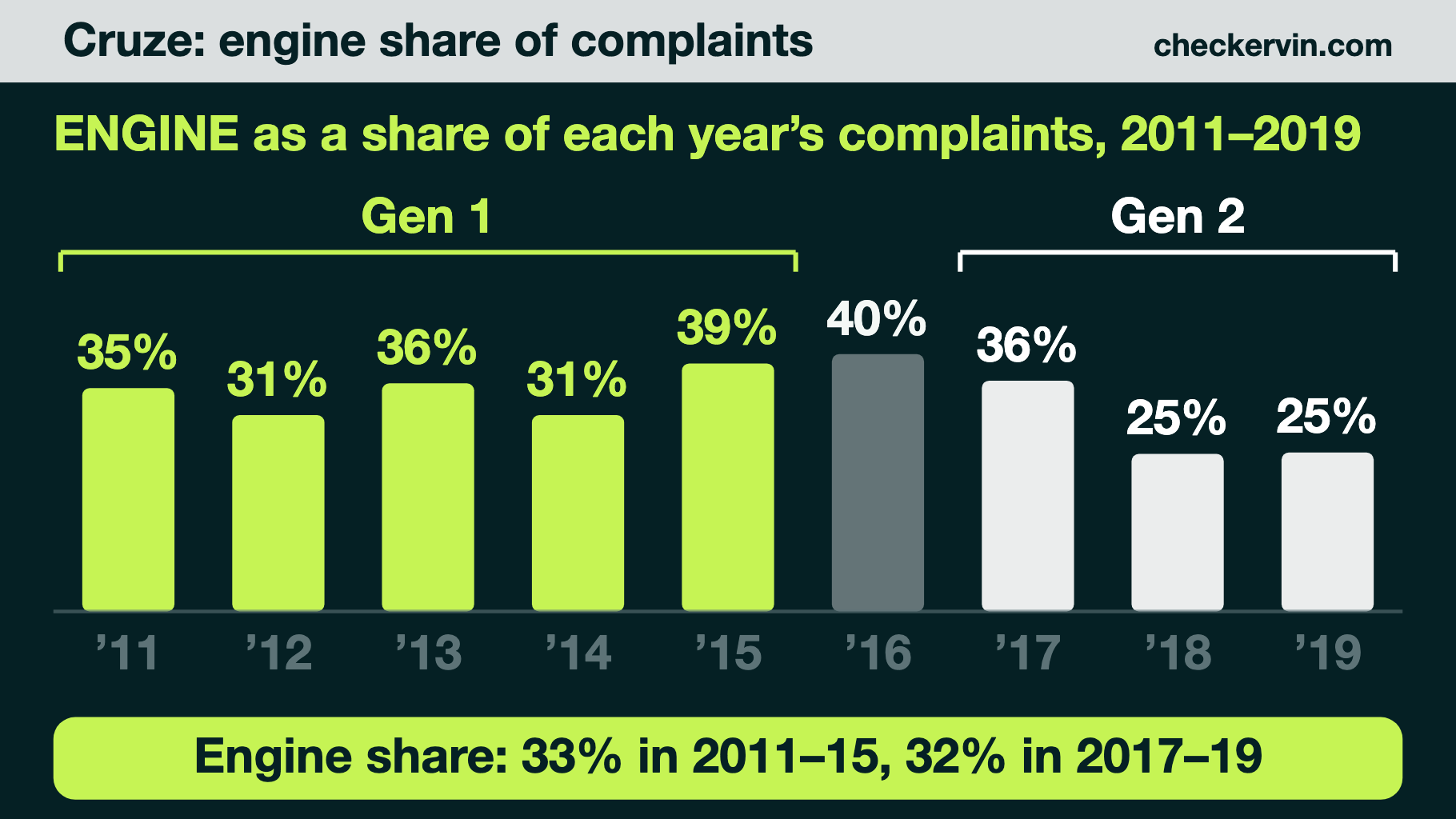
Our corpus of federal NHTSA complaints holds 3,707 reports against the 2011–2019 Cruze, and 1,253 of them, about 34%, fall in the ENGINE category. ENGINE makes the top five components in 9 of those 9 model years. The raw counts are lopsided toward the early cars, which our water pump post covers. Here we ask a different question: in each model year, what share of all the complaints is about the engine?
The answer barely moves between generations. Across 2011–2015, engine reports make up 33% of everything owners filed, 1,048 reports in all. Across 2017–2019, the second-generation years, they make up 32%, from a much smaller base of 330 complaints. The highest single-year share is 40% for the 2016 car, a model year that blends the old-body Cruze Limited with the new car. The lowest is 25%, in 2018 and again in 2019.
So the later Cruze draws fewer complaints overall, but the engine is still a third or so of what owners complain about. What changes is what they write. When we searched the complaint narratives for each model year for the words “head gasket,” the matches sat in the 2011–2016 files. The 2017–2019 files returned none.
What the record does not prove
NHTSA has no head gasket category. ENGINE holds every engine complaint from every engine Chevrolet sold that year, from turbo failures and oil leaks to misfires and mounts, so the share on the chart is an upper bound on gasket trouble and never a count of it. Complaints are unverified owner reports, not a measured failure rate, and the late years rest on small numbers: 20 complaints for 2019, 105 engine reports across all of 2017–2019. A share computed from that few reports can swing on a handful of owners.
The narratives add texture the counts cannot. Many early-Cruze gasket stories do not start with the gasket. They start with a cooling part failing, most often a thermostat housing, a water outlet or a coolant hose, followed by overheating, then a gasket. That order is the practical lesson: on an early Cruze, the cheapest gasket job is the one avoided by fixing a coolant leak promptly and pulling over when the temperature warning appears. The Chevrolet Cruze years-to-avoid page breaks down the rest of the complaint record by year.
Which Cruze engine you have changes the risk
The Cruze ran several different engines over nine model years, and GM’s documents name them by production code. The federal fuel economy records list these by year:
| Model years | Engines |
|---|---|
| 2011–2013 | 1.4L turbo (LUJ/LUV), 1.8L |
| 2014–2015 | 1.4L turbo, 1.8L, 2.0L diesel (LUZ) |
| 2016 Cruze Limited | 1.4L turbo, 1.8L (first-generation body) |
| 2016 Cruze | 1.4L turbo LE2 (second-generation body) |
| 2017–2019 | 1.4L turbo LE2, 1.6L diesel (LH7) |
Every GM document in the look-alikes table covers the early 1.4L only. For the second-generation LE2, the engine-internal bulletin we found is about pistons, not gaskets: GM’s 16-NA-367 tells technicians that LE2 engines need dexos1 full synthetic oil “to avoid piston damage.” For the 1.6L diesel, GM placed the engine on a dealer exchange program in 2017 and ended it in 2018, according to its PIP5456 notices; those notices do not say what failure prompted it. The 1.8L appears in GM’s emissions recall 16186 as RPO LWE, for a catalytic converter issue, not a gasket.
The practical step is to confirm the engine before comparing quotes, because labor time and parts differ between them. An engine lookup by VIN settles it, a Chevrolet VIN decode adds the trim and build details, and the oil type lookup shows what an LE2 should be running.
Is there a recall on the Cruze head gasket?
No. We queried NHTSA’s recall database for every Cruze model year from 2011 through 2019. The campaign counts matched our own data year for year, and none of the summaries mentions a head gasket, a cylinder head, coolant or overheating. We then searched the summaries of every GM bulletin, program and special coverage NHTSA lists for those model years. None names the head gasket. To make sure the search could find such a thing, we ran it against a 2017 Ford Escape, which has documented coolant-intrusion bulletins and programs, and it found them.
That matters because at least one owner complaint in the NHTSA files states that Chevrolet recalled 2013 and 2014 Cruze head gaskets. We found no such recall. The nearest real programs are the ones in the look-alikes table and GM’s water pump coverage, which has run out for almost every car it named. A shop or seller who tells you a gasket job is “covered by a recall” should be able to give you the campaign number; check it with the Chevrolet recall check. Our TSB versus recall page explains why a bulletin, on its own, pays for nothing.
Can you keep driving a Cruze with a bad head gasket?
- Temperature gauge climbing, or an engine-hot message on the dash
- Coolant reservoir empty again within a day or two of filling
- White exhaust that does not clear once the engine is warm
- Engine running rough on start-up after sitting
Any of the first three is a reason to stop driving it. An engine that keeps overheating can warp the head or damage the pistons, and at that point the bill moves past a gasket job toward a used engine. A slow, confirmed external seep at the head joint is a different and rarer case, one a careful owner can sometimes watch for a while with the right coolant on hand. The coolant type lookup by VINshows what the factory filled the car with; GM’s own Cruze documents specify Dex-Cool.
Repair, replace the engine, or sell the car
With the diagnosis proven, the decision is arithmetic. Put the written quote next to what the car is worth running, and next to what it would sell for as it sits. On a high-mileage early Cruze whose head needs machining, get a used-engine quote as well, so you are comparing two real numbers rather than one. On a cleaner, lower-mileage car with a failure caught early and no overheating damage, the gasket job is the more natural fit.
- Get the test results in writing: which test, which cylinder, what it showed
- Ask whether the head will be checked for flatness and machined if needed
- Ask what the quote assumes about the thermostat housing, water outlet and hoses
- Compare the total against a used-engine quote on a high-mileage car
- Run the VIN for open recalls; a shop already inside the engine bay can confirm they are done
If you are buying a Cruze rather than repairing one, the same tests apply before money changes hands. A seller’s receipt for a gasket job is worth more when it names the test that found the failure and the machine work done on the head. A warranty check by VIN shows whether any factory coverage is left on a newer one.
Where this information comes from
- GM Program Bulletin 14417A — Low Engine Coolant Level without an External Leak (NHTSA)August 2014. 2011–2014 Cruze 1.4L; GM blames air trapped at the factory fill, not a gasket. Program ended August 12, 2016.
- GM Special Coverage N202299080 — Camshaft Cover Replacement (NHTSA)July 2020. Cracked PCV diaphragm on the 2011–2014 1.4L; rough idle and P0171; 10 years or 120,000 miles; 0.6-hour Cruze labor time.
- NHTSA — recalls by vehicle and VINOur 2011–2019 Cruze query found no recall naming a head gasket, cylinder head, coolant or overheating.
- NHTSA — vehicle complaintsThe federal complaint database our engine shares are computed from, and the narratives we searched.
- EPA and DOE — fueleconomy.gov vehicle recordsThe per-year Cruze engine listings behind the engine table.
- ConsumerAffairs — head gasket replacement costThe 2011 Cruze row ($1,338–$3,027) it attributes to RepairPal sample estimates, read October 2026.
- Kelley Blue Book — 2013 Chevrolet Cruze valuesNational trade-in, private-party and Fair Purchase Price figures, valid through October 25, 2026.
Keep reading
Frequently asked questions
How much does it cost to replace a head gasket on a Chevy Cruze?
ConsumerAffairs, citing RepairPal sample estimates, lists a 2011 Chevrolet Cruze head gasket replacement at $1,338 to $3,027, with $388 to $878 in parts and $950 to $2,149 in labor. We read that figure in October 2026 and could not find a Cruze-specific head gasket estimate on RepairPal or Kelley Blue Book themselves. Expect the final bill to rise if the cylinder head is warped and needs machining, or if overheating damaged anything else.
Is there a recall on the Chevy Cruze head gasket?
No. We checked NHTSA's recall database for every Cruze model year from 2011 through 2019 and found no campaign naming the head gasket, cylinder head, coolant loss or overheating. GM's bulletins and special coverages for the Cruze listed with NHTSA do not name the head gasket either. GM did run a program for 2011–2014 1.4L cars losing coolant without a visible leak, but it blamed air trapped at the factory, and it ended August 12, 2016.
Is it worth fixing a head gasket on a Chevy Cruze?
On an early Cruze, often not. Kelley Blue Book's national values for a 2013 Cruze, valid through October 25, 2026, put trade-in at roughly $1,250 to $2,575 and private-party sale at roughly $3,600 to $5,400. A gasket job in the low thousands can match or exceed that. It can still make sense on a well-kept car with a confirmed, early-caught failure and no overheating damage, especially compared with the cost of replacing the car.
How do I know if my Cruze has a blown head gasket?
Look for coolant disappearing with no drip or crust anywhere outside the engine, bubbles in the coolant reservoir with the engine running, sweet-smelling white exhaust, milky residue in the oil, or a misfire on one cylinder after the car sits. Then have a shop prove it with a cooling-system pressure test, a combustion leak (block) test of the coolant, and a cylinder leak-down test. A blown gasket shows up in those tests, not in a guess.
Why is my Cruze losing coolant with no leak?
A failing head gasket is one possibility, but not the first one GM wrote about. GM's program 14417A for 2011–2014 1.4L Cruzes said a reservoir could read low with no external leak because air trapped during the factory fill was slowly purging. Small leaks can also evaporate off hot parts before they drip. A pressure test and a combustion leak test separate those causes in under an hour.
Confirm the engine before you price the gasket
A free CheckerVIN report shows the factory build, engine, specifications and open recalls for any VIN, so you know which GM documents apply to that Cruze before you pay for a teardown.
Run a free VIN check