The short answer
- What can you check for free?
- Open safety recalls and a full factory VIN decode from NHTSA, both unlimited and account-free. A theft and salvage lookup from NICB, limited to five searches per day. And on recent vehicles, the original window sticker from several manufacturers.
- What costs a small amount?
- The federal title record. NMVTIS is the system states report title brands into, and consumer access runs through approved providers who charge a few dollars — far less than a commercial report, and it is the authoritative source for brands.
- What requires a paid report?
- Detailed accident records, service history, the number of previous owners, and odometer readings between title transfers. That data is licensed from insurers, auctions and repair networks, which is why nobody gives it away.
Free
Recalls and VIN decode
NHTSA, unlimited
Free
Theft and salvage
NICB, five per day
A few $
Federal title record
NMVTIS approved providers
Paid
Accident and owner detail
Licensed data
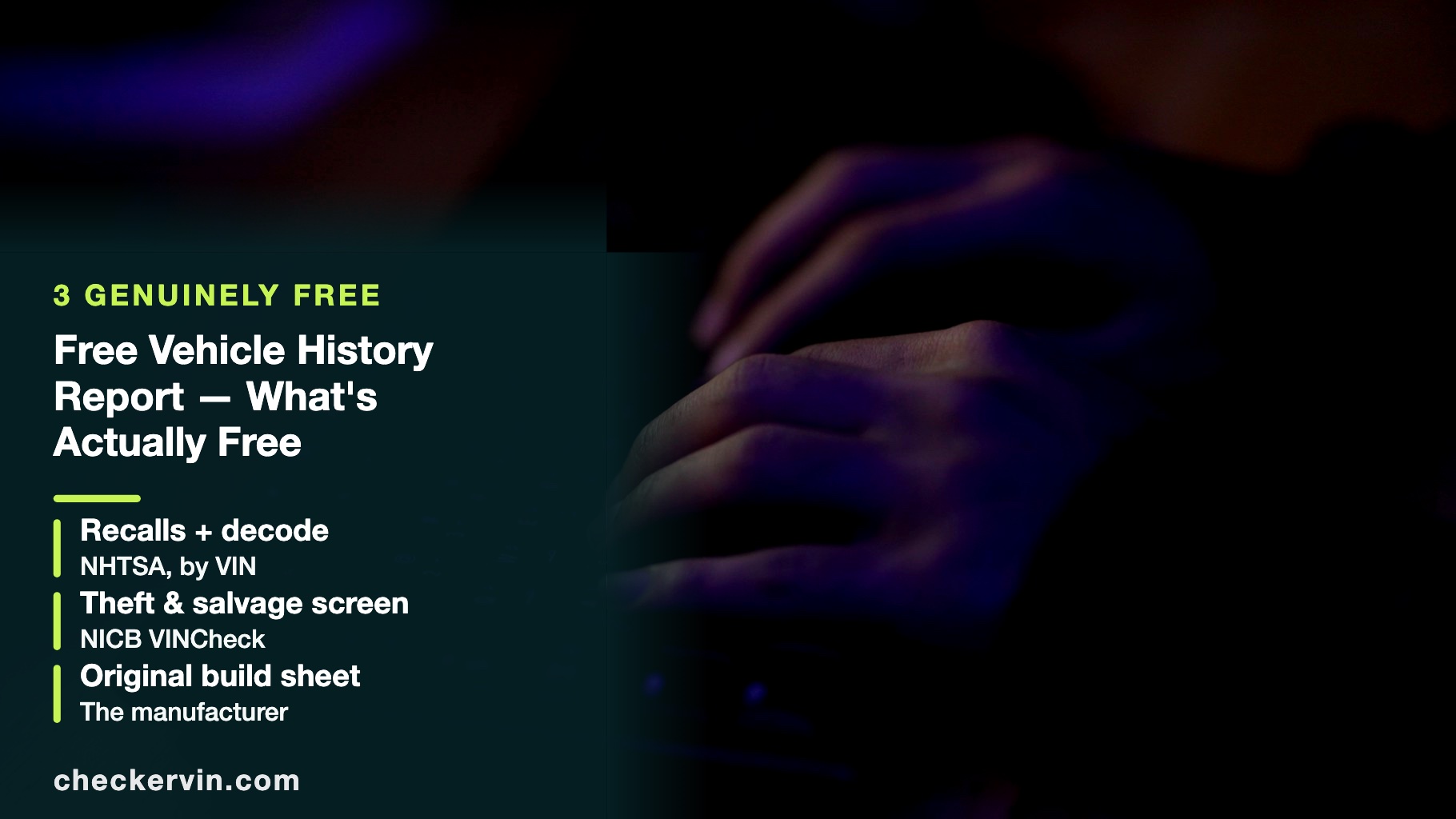
The honest answer first
Vehicle history data is not one thing. It is several separate datasets held by different organizations, and they have very different economics. Government safety data is published free because publishing it is the point. Insurance and auction data is licensed commercially because it was collected commercially.
So “is there a free vehicle history report?” has a precise answer: you can get the government and non-profit pieces free, you can get the federal title record for a few dollars, and the commercial accident and ownership detail is genuinely not available for nothing from anyone.
What is genuinely free, with no catch
| Check | Source, cost and limits |
|---|---|
| Open safety recalls | NHTSA. Free, unlimited, no account. Returns unrepaired safety recalls on that exact VIN. |
| Factory VIN decode | NHTSA vPIC. Free, unlimited, no account. Returns make, model, year, body, engine, drivetrain, restraint system and plant. |
| Theft and salvage | NICB VINCheck. Free, no account, limited to five searches per IP address per day. Covers participating member insurers only. |
| Original window sticker | Several manufacturers publish a free lookup for their own recent vehicles. |
| CPSC recalls | Free. The right place for ATVs, side-by-sides, snowmobiles and equipment, which NHTSA does not cover. |
Recalls and the VIN decode: the two with no catch at all
These are the checks to run first, because they are unlimited, instant and free, and because an open recall is both a safety matter and free to fix.
The recall lookup returns campaigns still unrepaired on that specific VIN. The decoder returns how the vehicle was built. Together they confirm the car is what it is being described as, and whether the manufacturer owes work on it — how recall checks work covers the mechanics, including why the repair costs nothing.
The free records hold more than most people expect
The usual account of the free tier is “recalls and a decode”, which undersells it badly. NHTSA’s complaint database is public, searchable at no cost, and it is not only a list of grievances about trim quality. Owners filing a complaint record whether the failure produced a crash, a fire, or an injury, and those flags are in the free data.
Across the 835 model years we aggregate, that free record holds 18,422 reported crashes, 6,563 reported fires and 15,353 reported injuries. Fires appear in 86.1% of model years and crashes in 98.6%. Those are precisely the categories people assume sit behind a paywall.
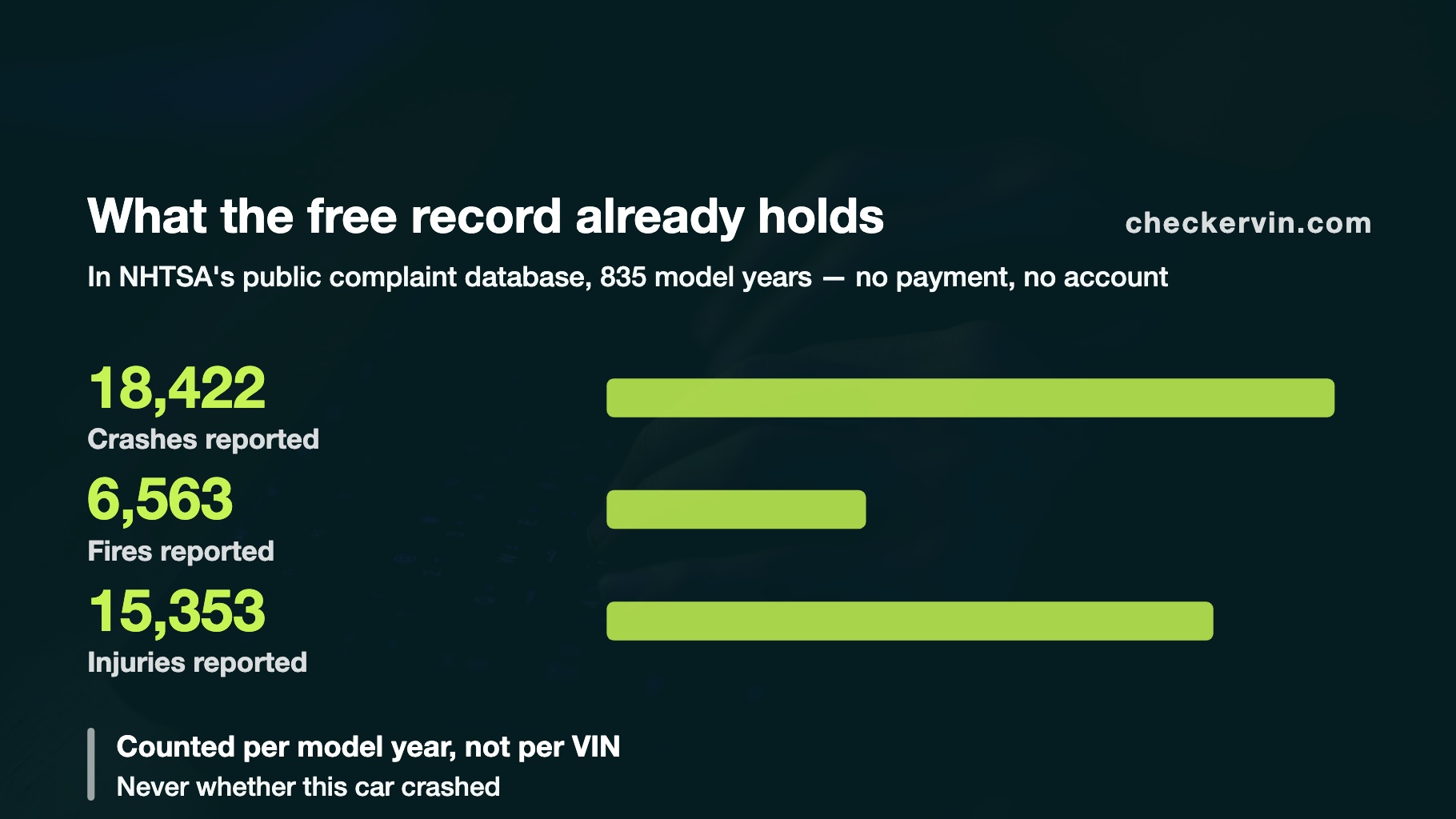
Used for what it is, that is a serious amount of free signal. Before you spend anything, you can learn whether the model year in front of you has a fire pattern, which component owners report most, and whether the failures cluster early or late. That reframes the paid question from “should I buy a report?” to “I already know this year’s weak points — does this specific car carry them?”
It also tells you when to stop reading and walk. A model year with a concentrated fire pattern in a component you cannot inspect is a reason to look at a different car, and that decision costs nothing to reach. The paid tier is for the car you have already decided you want.
The free theft and salvage lookup
The National Insurance Crime Bureau publishes a free VIN lookup showing whether a participating insurer reported a vehicle stolen and unrecovered, or reported it as salvage.
It is genuinely useful and genuinely narrow. The database contains only what member companies submitted, so a car totaled by a non-member insurer or repaired without a claim can return nothing and still have a damaged past — what VINCheck covers and misses goes through it properly.
NMVTIS: the title record, cheap rather than free
The National Motor Vehicle Title Information System is the federal system states report title brands into, created so that a brand applied in one state cannot be shed by moving the vehicle to another. It is the authoritative source for whether a title carries a salvage, flood, junk or odometer brand.
Consumer access runs through approved providers rather than directly, and those providers charge a fee — typically a few dollars per report rather than the price of a full commercial history. The Department of Justice publishes the list of approved providers free.
- Use the published approved-provider list rather than searching for one
- Expect a small per-report fee, not a subscription
- This is the right check for title brands specifically
- It also carries odometer readings recorded at title transfer
- It does not carry detailed accident records — that is a different dataset
What the brands mean once you have them is covered in what is a branded title.
Manufacturer tools: the original build, free
Several manufacturers publish a free window sticker lookup for their own recent vehicles, returning the original Monroney label — every factory option, itemized, with its price.
On a used car this settles trim and equipment claims that badges cannot, and it costs nothing. How to pull a window sticker covers the coverage limits and what to do when the model year falls outside them.
Why the paid reports cost money
People usually arrive at this question in a sharper form: why is Carfax not free? The answer is structural rather than greedy, and no company selling a report has much incentive to spell it out. A vehicle history report is three different datasets stapled together, and they have three different origins.
| Layer | Where it comes from, and why it costs what it costs |
|---|---|
| Safety and build data — free | Recall campaigns and factory build records come from NHTSA. Federal government work product, published openly through the agency's own lookup and its public decoder, with no account and no charge. Free because publication is the purpose. |
| Title brands — a few dollars | States, insurers, salvage yards and junk yards are required to report into NMVTIS. The system is federal, but there is no free consumer portal into it: access runs through the Department of Justice's approved providers, who charge. The data is public in origin; the access is sold. |
| Why that access costs anything at all | 28 CFR § 25.53(f) tells the system's operator to establish and collect user fees from the states and users of NMVTIS to pay for its operation — and then caps them: the operator "may not collect fees in excess of the costs of operating the system." The recoupable expenses are enumerated as labor, data center operations, the cost of providing access, enhancements and technical upgrades. Fees are recalculated every two years and must be approved by the Department of Justice. |
| Accident, service and ownership detail — the expensive layer | Assembled privately, from dealer groups, repair chains, insurers, auction houses and police-report vendors, each licensing what it supplies. Nobody gives away a network they paid to build, which is why no legitimate service hands this layer over for nothing. |
Put plainly: the parts of a history report that come from public records are already free, and you can run them yourself in about five minutes. The parts that are not free were bought. That is the whole of it — and it means a site advertising a complete free history is either showing you the free layer with a paywall behind it, or collecting your details to sell you something.
What only a paid report covers
Being straightforward about this is more useful than pretending otherwise. The following data is licensed from insurers, auction houses, repair networks and fleet operators, and none of it is published free by anyone.
- Detailed accident records, including damage severity and airbag deployment
- Service and repair history from participating shops and dealers
- The number of previous owners and how the vehicle was used — personal, fleet, rental, lease
- Odometer readings between title transfers, rather than only at them
- Auction listings and sale records
- Open lien and finance records
Other routes worth knowing
- Dealers frequently provide a full history report free on their own inventory — ask before paying for one
- Some public libraries offer patrons access to commercial databases
- Your insurance agent can sometimes run a check on a vehicle you are considering
- A seller who has already run a report may share it — verify the VIN on it matches the car
- Some manufacturers include a history report with certified pre-owned vehicles
- State agencies differ: title records usually cost money, but several states publish a free registration-status checker — see our registration lookup guide below
One of those routes deserves separating from the rest, because it is free and most buyers never try it. Several states run their own public checkers that return registration status from a VIN or plate at no cost — a different thing from a title record, which normally does cost. Which states, and what each tool returns, is mapped in our vehicle registration lookup guide.
If you are selling rather than buying, value my car by VIN sets out the difference between a published estimate and an offer somebody is bound by.
The order to run them in
- 1Get the VIN off the vehicle, not the listingWindshield plate and door jamb, checked against the title. Photograph rather than transcribe.
- 2Decode it — free, instantConfirm the vehicle is what it is being described as. Discrepancies here end the process early and cheaply.
- 3Run the recall check — free, instantAn open recall is free to fix but is work you inherit.
- 4Run the theft and salvage lookup — freeBefore any money moves on a private sale.
- 5Pull the title record — a few dollarsThrough an approved provider. This is the authoritative brand check and it is worth the small fee.
- 6Consider a paid report if the car is still a candidateOnce the free checks are clear, the commercial accident and ownership detail is what remains.
- 7Pay for an independent inspectionThe single highest-value step, and the one no report replaces.
Sites promising a free report that is not free
A genuinely free full history report is not commercially possible, because the underlying data is licensed. Any site promising one is doing something else.
- Showing a free summary and charging to reveal the detail — common and not dishonest, but know which you are getting
- Collecting your email or phone number as the real product
- Enrolling you in a subscription described as a one-off report
- Presenting a free decode as though it were a history report
- Asking for payment details before showing you what the report contains
What no report replaces
Every report of every kind describes what was reported. Plenty of what determines whether a used vehicle is a good buy never generates a record at all — repairs paid in cash, damage never claimed, deferred maintenance, and wear that is simply the age of the car.
A pre-purchase inspection by an independent mechanic costs roughly what a paid history report does and answers a different, larger question. If you can only do one, do the inspection.
Where this information comes from
- NHTSA recall lookupFree, unlimited, no account — open safety recalls by VIN
- NHTSA vPIC — public VIN decoderFree, unlimited — the factory build record by VIN
- NMVTIS — approved provider listThe federal title system; consumer access is via approved providers for a small fee
- NICB VINCheckFree theft and salvage lookup, five searches per day
Keep reading
Frequently asked questions
Can I get a completely free vehicle history report?
You can get several genuinely free checks that together cover a lot of ground — open safety recalls, a full VIN decode, and a theft and salvage lookup. What no free source provides is the full accident and ownership detail a commercial report compiles.
Is NMVTIS free?
The system is federal, but consumer access runs through approved providers who charge a small fee — typically a few dollars rather than the price of a commercial report. The list of approved providers is published free by the Department of Justice.
What does the free NICB check actually show?
Two things: whether a participating insurer reported the vehicle stolen and not recovered, and whether one reported it as a salvage vehicle. It covers member insurers only, so a clean result is a good sign rather than a clearance.
Are the free recall and VIN decode checks limited?
No. NHTSA's recall lookup and its public VIN decoder are both free, unlimited, and require no account. They are the two checks with no catch at all.
Why is Carfax not free, and why do some sites promise one anyway?
Because a history report is three datasets with three different economics. Recall and factory build data comes from NHTSA and is free because publishing it is the point. Title brands sit in NMVTIS, which states and insurers must report into but which has no free consumer portal, so access is sold through approved providers for a few dollars. Accident, service and ownership detail is assembled privately from dealers, repair chains, insurers and auctions, each licensing what it supplies — nobody gives that away. A site advertising a complete free history is showing you the free layer with a paywall behind it, or collecting your details to sell you something.
Start with the free checks
Decode any VIN free for the factory build, specifications and open safety recalls. No account, no card.
Run a free VIN check