The short answer
- What does a Carfax report show?
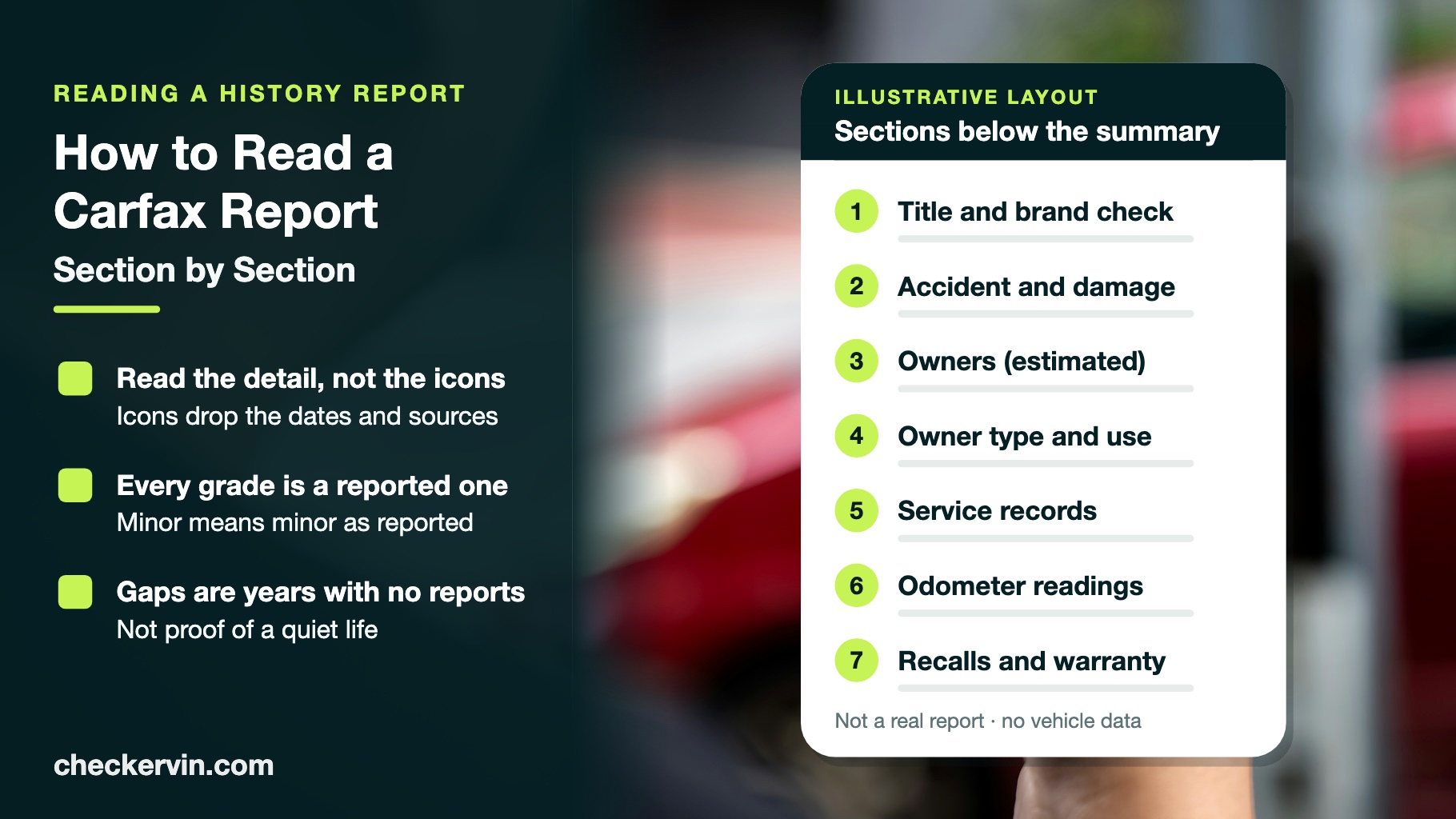
- Reported events by VIN: title and brand records, accidents and damage graded by severity, an estimated owner count, service visits, odometer readings and recalls.
- What does minor damage mean?
- Carfax's glossary calls it generally cosmetic, like dents or scratches, typically not affecting operation or safety. It grades a report, not the repair.
- What can it not tell you?
- Anything nobody reported: a cash repair, a crash with no claim, the car's mechanical condition today. Consumers also cannot get the federal NMVTIS record from Carfax.
Since 1984
Carfax's own start date
From its press releases
3 levels
Damage severity scale
Minor, moderate, severe
Estimated
The owner count
Carfax's word, in its glossary
Reported
What every section holds
Not what happened
What is Carfax?
Carfax is a private company that collects records about vehicles, keyed to the VIN, and sells them as a vehicle history report. Its press releases describe it as “the expert in vehicle history since 1984” and claim the largest vehicle history database in the world. In a release dated May 6, 2026 it put that database at more than 177,000 sources and more than 38 billion records. Those are the company’s own figures; nobody audits them publicly.
The owner changed this year. Carfax’s 2026 releases called it part of S&P Global Mobility. On July 1, 2026, S&P Global announced that it had separated that division into an independent public company, Mobility Global Inc., trading on the New York Stock Exchange, and trade press covering the spin-off listed Carfax among its brands. None of that changes what is on a report, but it explains why older reports and newer ones carry different corporate lines in the footer.
You meet a Carfax report in two ways: a dealer or listing provides one free, or you buy one yourself, either singly or in a multi-report package. We cover when it really is free on free Carfax report, and what the product is good and bad at on our Carfax review. This page is about reading the thing once it is in front of you.
How does Carfax work? Records in, report out
Carfax does not inspect cars. It receives records that other organizations created and attaches them to a VIN. In the report we read, entries were attributed to a state motor vehicle department, dealership service departments, an independent repair shop, a tire retailer, an online listing, dealer inventory records and the manufacturer’s recall notices. Each source covers a slice of a car’s life, and a car that never visits a reporting business leaves fewer entries behind.
Carfax’s 2026 product release frames the report as past, present and future: the past is the ownership, service and damage history; the present is a value estimate based on that history; the future is a reliability forecast. Only the first is a record. The value and reliability figures are models built on top of the records, and they inherit every gap below them. Our page on whether Carfax is accurate explains how those gaps arise and how to dispute a wrong entry, so we do not repeat it here.
The report we read, and why we used it
The obvious source for a reading guide is Carfax’s own sample report and help center. Both returned an access-denied error to us on November 25, 2026, and we did not try to get round that. Instead we read a complete Carfax report that the Hawaii Department of the Attorney General published as a PDF on its website. It covers a vehicle titled in Hawaii, and states that its data was current as of February 2025.
We use that report for its structure and its glossary, which is where Carfax defines its own terms. We do not reproduce the VIN, title numbers, businesses or the price printed on it, and nothing on this page describes that particular car. Two caveats follow. Carfax can change its layout and wording at any time, so a report you buy now may look different. And a report shows sections and badges only when the data supports them, so yours may have items this one did not.
The summary at the top: read it last, not first
The first screen is a row of headline items. In the report we read, they covered the damage result (with the severity named), an open recall, a potential odometer rollback, the count of service history records, the number of previous owners and a retail value estimate. Clean items appear as reassurance; problems appear as warnings.
The summary is useful for triage and poor for decisions. It compresses each section into one phrase, and the phrase cannot carry the date, the place or the source that tell you whether the item matters. A damage icon on a ten-year-old car recorded the week after it was bought new reads very differently from one recorded a month before the current listing. Skim the summary, then read the detailed history below it entry by entry, and come back to the summary to see whether you agree with it.
Title history and the brand check
The title section answers one question: has a state ever branded this title? The report we read grouped the brands Carfax checks into a guaranteed section with two rows. The first listed 7 title problems:
- Salvage
- Junk
- Rebuilt
- Fire
- Flood
- Hail
- Lemon
The second covered odometer brands: Not Actual Mileage and Exceeds Mechanical Limits. Each showed “No Problem” or a problem, once per owner. The section notes that the guarantee applies to title problems reported by a U.S. state Department of Motor Vehicles and points to separate terms. We discuss what that kind of guarantee does and does not cover on our Carfax review; the reading tip here is simpler. A clean row means no state brand reached Carfax. For what each brand means in law and how states differ, see what a branded title is.
The title section is also where the federal record question comes up. Carfax is not on the consumer side of the Department of Justice’s list of NMVTIS data providers. The department’s page, which we re-read on November 25, 2026, says consumers cannot receive NMVTIS reports from Carfax, which supplies that data to dealers. A Carfax title check and an NMVTIS report are therefore two different records, and on a car that has moved between states you may want both. The NMVTIS report guide explains the federal record.
Accident and damage entries: minor, moderate, severe
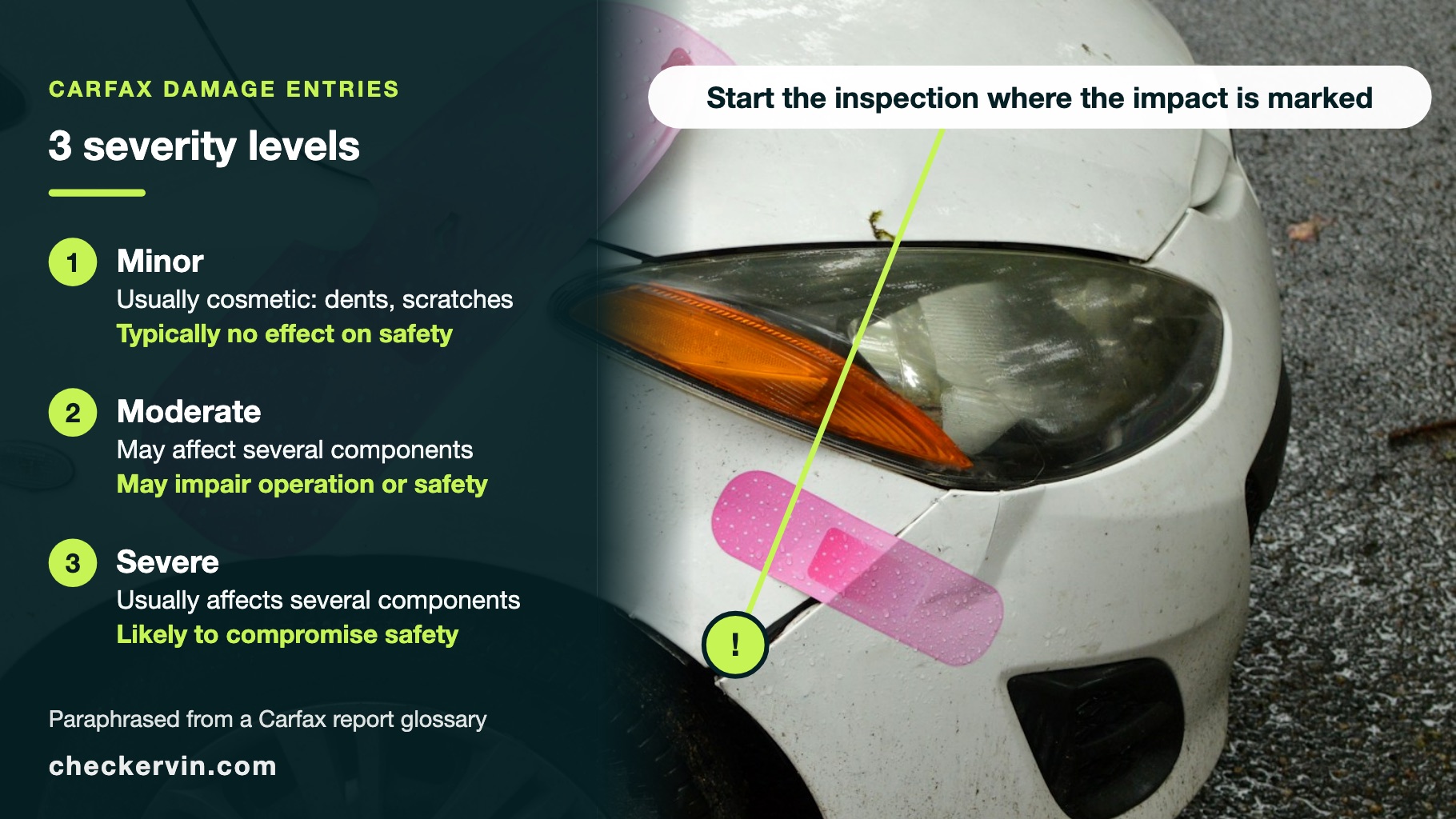
This is the part most buyers mean when they say “Carfax accident report.” Each event in the report we read appeared in the detailed history as a dated damage report with the area of the car affected, a three-step severity bar, and a front, rear, left and right diagram marking the point of impact. Separate summary lines said whether a total loss or an airbag deployment had been reported. Carfax said in a February 2021 release that most reports detail where the impact was and how severe the damage was.
The glossary at the end of the report defines the three severity levels. In paraphrase:
| Severity on the report | How Carfax's glossary describes it |
|---|---|
| Minor | Generally cosmetic, such as dents or scratches; may need only reconditioning; typically does not compromise operation or safety |
| Moderate | May affect several components of the vehicle and may impair its operation or safety |
| Severe | Usually affects several components and is likely to compromise operation or safety; Carfax recommends a pre-purchase inspection at a certified collision repair facility |
The same glossary says damage can come from many kinds of event, including contact with other cars, trees, signs or road debris, vandalism and weather. It adds that not every damage event is reported to Carfax, and that more detail is added to the report as it becomes available. So an entry can start thin and fill in later.
How to read a Carfax damage report entry, then: take the severity as the reporting source’s characterization, take the impact diagram as a map for the inspection, and take the date as context. A minor front entry tells a mechanic to check the bumper cover, headlamp mounts and paint on that corner. A moderate or severe entry, or any airbag line, is a reason to have the structure measured, not just looked at. Our page on what a damage reported line can and cannot tell you covers how the label gets there and the legal thresholds behind a salvage brand.
Owners, and what one owner on Carfax means
The ownership section in the report we read gave each owner a column: the year purchased, the type of owner, the estimated length of ownership, the states the car was kept in, the estimated miles driven per year and the last odometer reading. Above the columns was one short line that matters more than any of them: the number of owners is estimated.
The glossary explains why. Carfax defines an owner as an individual or business that possesses and uses a vehicle, and says not every title transaction is a change of ownership. Its proprietary analysis looks at all the events in the history to produce the estimate. It also states two limits worth knowing before you trust the number:
- Estimated ownership is available only for vehicles made after 1991 and titled solely in the U.S., including Puerto Rico
- Dealers take ownership of vehicles, by choice or because they must, in 7 states the glossary names: Maine, Massachusetts, New Jersey, Ohio, Oklahoma, Pennsylvania, South Dakota
- Each title or registration record does not necessarily mean a new owner
So a “one owner” Carfax result means the analysis found one, not that a single person held the car. A car imported from Canada or titled outside the U.S. may show no estimate at all. A car that passed through a dealer in one of those states may show an extra owner who never drove it. Our previous owners by VINpage explains why every service’s count is an inference and what to ask instead.
Carfax added a related badge this year. Its May 2026 release introduced a “Homegrown” badge for a vehicle sold new and consistently serviced by the same dealership. Like the owner count, it describes reported records, so it is a reason to ask that dealership for the invoices.
Personal, commercial, rental: the owner type
Each owner column carries a type. The report we read showed two values, Personal and Commercial, and its detailed history recorded lines such as a vehicle being titled or registered as a commercial vehicle and registered for business purposes. We could not load Carfax’s help pages, so we cannot list every owner type it uses; other reports may show different labels where a source recorded rental, fleet or lease use.
Read the owner type alongside the miles per year. A commercial or fleet period with high annual mileage tells you how the car was used, and a rental history changes what you should check, starting with recalls and wear items. Our page on buying a used rental car covers the federal recall rule for rental fleets and what an ex-rental history looks like. One more caution: the type reflects how the car was titled or registered, which is not always how it was driven.
Service records: what a long list proves
Service entries in the report we read gave a date, an odometer reading, the business, and short work lines such as an oil and filter change, a maintenance inspection, tires rotated, or a part replaced. Most came from dealer service departments; the rest from tire retailers and an independent repair shop.
A long service list is good evidence the car was looked after by businesses that report. A short one is weak evidence of anything, because plenty of independent shops send records to nobody and owners who do their own maintenance leave no trace. Look at the work lines more than the count: repeated visits for the same system, a replaced part that has a known failure pattern, or a gap of years followed by a burst of repairs before a sale are all worth a question. For building or checking a real service history, see our vehicle maintenance report guide.
Odometer readings and the rollback flag
Almost every entry in a Carfax report carries a mileage, because service visits, title transfers and inspections record one. The report’s glossary defines its warning simply: if a more recent reading is less than an older one, the odometer may have been tampered with, and Carfax analyzes the mileage history and its sources to indicate a potential rollback. In the report we read, the flag sat beside the entry where a lower reading followed a higher one, with a note telling the buyer to verify the mileage with the seller.
The flag is an alert, not a finding. It fires on a keying error as readily as on fraud, and it cannot fire at all on a rollback done between two reporting visits. Treat it as a request for paperwork: service invoices with mileage printed on them, and the odometer statement on the title. The title section’s odometer brands, Not Actual Mileage and Exceeds Mechanical Limits, are a different and much more serious thing: a state has branded the reading itself. Our odometer rollback check walks through the physical signs.
Recalls and the warranty estimate
Recall entries in the report we read gave the manufacturer, the NHTSA campaign number, the manufacturer’s own recall code, a short description and a status such as “Remedy Available.” The summary counted open recalls, and the glossary reminds readers that manufacturer recalls are repaired at no cost to the owner.
Recalls are the one section you can check yourself for free at the source. NHTSA’s lookup searches by VIN and shows whether a recall is still unrepaired on that specific car, and our recall check by VIN explains how to read the result. The warranty line in the report we read was an estimate, worded as the original warranty being estimated to have expired. Confirm warranty status with a franchised dealer for the brand, because coverage depends on in-service date and mileage, not on the model year alone.
A Carfax sample report, annotated (illustrative)
Here is a Carfax report example laid out section by section, with the question each line should prompt. Use it as a template for annotating a real one.
| Invented entry, in report order | The question to ask |
|---|---|
| Summary: minor damage reported · no open recalls · several service records · two owners | Which entry produced each headline, and when? |
| Title: no salvage, junk, rebuilt, fire, flood, hail or lemon problem reported, for each owner | Has the car ever been titled in a state outside the U.S. or brought in from abroad? |
| Owner 1: personal · bought new [year] · [state] · estimated [miles] per year | Was this one person, or a dealer in a state where dealers take title? |
| Service: [date] · [mileage] · dealer service department · oil and filter changed | Do the invoices exist, and do their mileages match? |
| Damage report: [date] · damage to front left · severity bar at Minor | Was it repaired at a shop, and can I see the invoice? |
| Owner 2: commercial · [state] · titled or registered as commercial vehicle | What was the business use, and how hard was the car driven? |
| Odometer: last reported reading [mileage] at [date] | Does the dashboard reading follow on sensibly from this? |
| Recall: NHTSA campaign [number] · status: remedy available | Has it been fixed? Check NHTSA by VIN |
Notice what the invented report does not say: whether the front-left repair used new or aftermarket parts, whether the second owner’s business was deliveries or a law office, or whether anything happened between the reported visits. Those answers come from the seller, the paperwork and an inspection. For how a CarCheckerVIN report lays out the same ground, see our own sample report.
What no section of a Carfax report can tell you
- An accident that produced no insurance claim, no police report and no record at a reporting shop
- A repair paid in cash at a business that shares data with nobody
- Today's mechanical condition: worn brakes, a slipping transmission, a leak
- The quality of a repair that was reported, including parts used and how well panels were aligned
- The federal NMVTIS title record, which the DOJ says consumers cannot get from Carfax
- Anything that happened after the date the report was generated
Carfax itself recommends an inspection alongside its reports, in its press releases and in the report text we read. The reason is in the first item: a record of an event and the event are different things. Our pre-purchase inspection guide explains what to ask a mechanic to look at once the report has told you where the risks are.
A ten-minute routine for reading any Carfax report
- 1Match the VIN before reading a wordCompare the VIN on the report with the dashboard plate, the door-jamb label and the title. A report on the wrong car is perfectly accurate and completely useless.
- 2Read the detailed history in date orderSkip the summary icons for now. Follow the car from new: where it lived, who owned it, how it was used and when each event was recorded.
- 3Mark every damage, title and odometer lineFor each one note the date, the source, the severity and the area of the car. These are the lines you will ask the seller about and hand to the inspector.
- 4Look at the gapsYears with no entries are years with no reporting. Ask what happened then, especially just before a damage entry or a sale.
- 5Check the free parts at the sourceRun the VIN through NHTSA for open recalls and decode it for the factory build, so the report's equipment and recall lines can be checked against something independent.
- 6Get the federal title record separatelyIf the title matters to you, and it always should, buy an NMVTIS report from one of the 12 consumer providers on the Department of Justice list.
- 7Book the inspectionTake the marked report to an independent mechanic and ask them to start where the impact diagram points.
The Department of Justice’s consumer-tier list of NMVTIS providers, as we read it on November 25, 2026, has 12 names:
- Bumper.com
- Carsforsale.com
- Carvertical.com
- Checkthatvin.com
- Clearvin.com
- EpicVin.com
- GoodCar.com
- Titlecheck.us
- Vinaudit.com
- Vindata.com
- VinReport
- Vinsmart.com
The department says the list is alphabetical and implies no preference. If you are deciding whether a second commercial report is worth it as well, AutoCheck vs Carfax and Carfax alternatives cover that choice.
What our free scan returns today, before you open any paid report:
- Factory build and specifications decoded from the VIN
- Factory warranty terms
- Open NHTSA safety recalls
- Photos filed against the VIN
- Market and listing prices
Decode the VIN and check recalls first
Decoded from official manufacturer and NHTSA records
Where this information comes from
- A Carfax Vehicle History Report (PDF, February 2025) published by the Hawaii Department of the Attorney General, Asset Forfeiture ProgramThe report layout and glossary used throughout; data current as of February 2025; read November 25, 2026. We link the program's page rather than the PDF because the file name carries that vehicle's VIN.
- Carfax press release, February 23, 2021 (PR Newswire)Most reports detail where the impact was and how severe the damage was; inspection recommended
- Carfax press release, April 7, 2026, corrected August 14, 2026 (PR Newswire)Past, present and future framing of the report; since 1984; part of S&P Global Mobility
- Carfax Homegrown badge release, May 6, 2026 (CBT News)More than 177,000 sources and 38 billion records; what the Homegrown badge means
- S&P Global completes separation of Mobility Global Inc., July 1, 2026The Mobility division became an independent public company
- Repairer Driven News — Mobility Global, CarFax parent company, separates from S&P GlobalNames CarFax among Mobility Global's brands
- NMVTIS — approved data providers (DOJ / BJA)Consumer-tier provider list and the statement that consumers cannot get NMVTIS reports from Carfax; read November 25, 2026
- NHTSA recall lookupOpen safety recalls by VIN, free
- How we made this pageWritten by the CarCheckerVIN editorial team with AI assistance from a Carfax report published by the Hawaii Attorney General, Carfax press releases, S&P Global and DOJ NMVTIS pages and other public records; facts checked November 2026.
Keep reading
Frequently asked questions
What is Carfax?
Carfax is a commercial vehicle history company that has compiled records by VIN since 1984. In May 2026 it said its database draws on more than 177,000 sources. Its 2026 press releases described it as part of S&P Global Mobility; that division became the separate public company Mobility Global Inc. on July 1, 2026. A Carfax report is a list of the records those sources sent in about one car.
How does Carfax work?
Businesses and agencies report events against a VIN: a motor vehicle department issues a title, a shop records an oil change with the mileage, an insurer or police department records a collision, a manufacturer issues a recall. Carfax matches those records to the VIN and arranges them by date and by owner. It only knows what was reported to it, which its own report says on the first page.
What does minor damage mean on a Carfax report?
In the report glossary we read, Carfax describes minor damage as generally cosmetic, such as dents or scratches, possibly needing only reconditioning, and typically not compromising the car's operation or safety. It is a grading of what was reported, not an inspection of the repair, so a minor entry still tells you which corner a mechanic should look at.
What does a Carfax report show?
The report we read showed a summary of headline items, title and brand checks, accident and damage events with a severity scale and point of impact, an estimated owner count with owner type and length of ownership, service visits with mileage, odometer readings with a rollback flag, manufacturer recalls with their status, and a warranty estimate. Each comes with the condition that only reported events appear.
Does one owner on Carfax mean the car had one owner?
It means Carfax's analysis estimated one. The report glossary says the number of owners is estimated, that not every title transaction is an ownership change, and that estimates are only available for vehicles made after 1991 and titled solely in the U.S. A genuine one-owner car is a good sign, but ask for the title history and service paperwork rather than relying on the label.
Where can I see a Carfax sample report?
We could not load Carfax's own pages in November 2026, so we cannot point you to its official sample. This page includes an annotated example built from invented entries, laid out in the order of a real report we read, and clearly marked as illustrative. Our own sample report shows how a CarCheckerVIN report is organized.
Is a Carfax accident report the same as a police report?
No. The accident and damage section of a Carfax report summarizes records that reached Carfax, which can include police and insurance records. It does not reproduce the police report itself. For the full account of a crash you would request the police report from the department that took it, where your state allows that.
Read the report, then check the car
Decode any VIN free for the factory build, specifications, open safety recalls and market prices. Full vehicle history reports are launching soon.
Run a free VIN check