The short answer
- Is Carfax accurate?
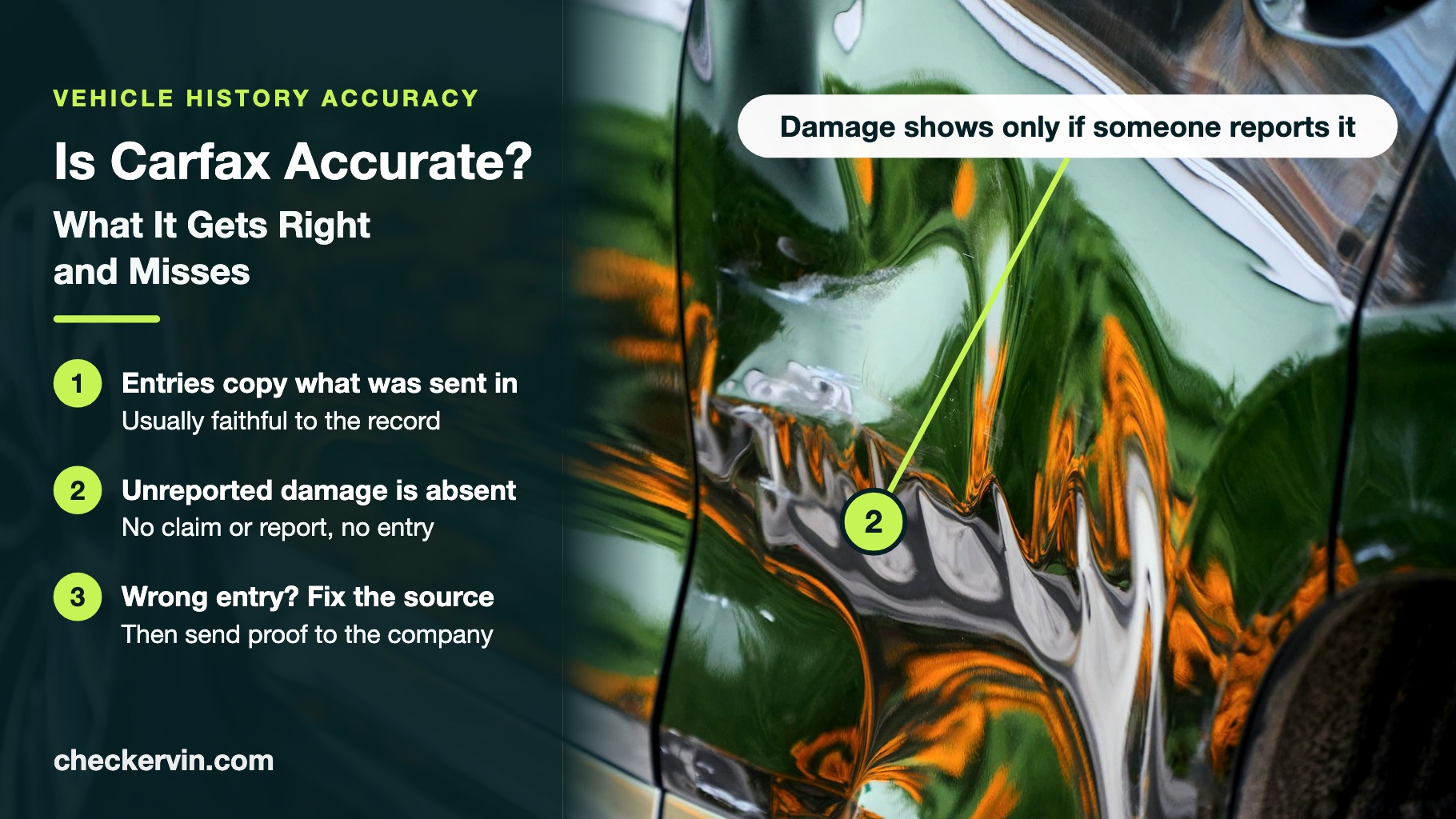
- Its entries are usually faithful copies of what was reported to it. What it cannot be is complete: an event nobody reported never reaches any history report.
- Can an accident be missing?
- Yes. A crash repaired with no insurance claim, no police report and no reporting shop leaves no record to find, at any price.
- What if an entry is wrong?
- Correct it at the source that reported it, then send the proof to the report company. Federal credit-report dispute rules may not apply.
Reported
What any history report can hold
Records of events, not events
87%
U.S. vehicles in NMVTIS, per the DOJ
The government's own coverage figure
Source
Where a correction starts
Fix the record, then the report
Not a substitute
FTC on reports vs inspection
Get a mechanic as well
The short answer
“Is Carfax accurate?” bundles two questions that have different answers. Are the entries on a report correct? Usually, because each one is a copy of a record that a business or agency sent in, and copying is the easy part. Is the report a complete account of the car’s life? Never, and not because of anything Carfax does badly. A history report is a list of things somebody told a database. It cannot list what nobody told it.
That is why both camps in every forum thread about Carfax are right. The person whose report matched every service visit saw the first half working. The person who bought a “clean” car with a repainted fender met the second half. The rest of this page is about telling those two situations apart before you pay for a car, and about what to do when a report says something that is simply wrong.
Accurate and complete are different questions
Almost every complaint that a Carfax report was wrong fits one of four shapes. Naming the shape tells you where the error came from, and so who can fix it.
| What went wrong | Where it usually comes from |
|---|---|
| Missing: a real event is absent | Nobody reported it, or the business that knew about it does not share data with that company |
| Wrong: an entry does not match reality | A keying error at the source, such as a mistyped VIN or odometer reading, copied faithfully into the report |
| Late: the event is real but not there yet | Reporting runs on each source's schedule; a recent event may simply not have arrived |
| Misread: the entry is right but thin | A line such as damage reported that records an event without saying how serious it was |
Only the second shape is an error in the everyday sense, and it is the only one a dispute can fix. The other three are limits of the method. If an entry looks alarming but vague, our guide to what a damage reported line can and cannot tell you is the place to start.
A history report only knows what was reported to it
The Department of Justice, which runs the federal title system, describes the difference between its system and private history companies in plain terms. Information in NMVTIS comes from state motor vehicle agencies and from whole industries the Anti-Car Theft Act covers, and those entities “are required to provide specific information to NMVTIS in a specific format.” Federal law requires 3 groups to report regularly:
- State motor vehicle titling agencies
- Insurance carriers
- Junk yards, salvage yards and auto recyclers
A private company is in a different position. Nobody is obliged by federal law to send Carfax anything, so its coverage is whatever its network of data relationships delivers. The department says private providers “offer beneficial information to the public that is not intended to be included in NMVTIS, such as vehicle repair histories, recall information, and other care and maintenance data.” That is the strength of a commercial report and the source of its uneven coverage at once: service and accident detail exists on it only where some business chose to share it.
Even the compulsory side has edges written into it. The department’s own who-reports page notes limited exceptions: some recyclers may not be able to identify VINs for reporting, and junk or salvage yards handling fewer than 5 salvage vehicles a year are exempt. And states do not all report on the same clock. Some update NMVTIS in real time as title transactions happen; others, the department says, send updates once every 24 hours or within a period of days. A record can be correct and still not be there on the afternoon you look.
Can a car be in an accident and not show on Carfax?
Yes, and this is the version of the accuracy question that matters most to a buyer. For a crash to appear on any history report, a record of it has to travel from somebody who knew about it to the company compiling the report. The common carriers are an insurance claim, a police report, and a repair at a shop that shares its data. Take all three away and the crash is invisible to every database, Carfax included.
That does not take an elaborate cover-up. An owner who pays a body shop directly to avoid a claim, a minor collision settled between two drivers without calling the police, or a repair at an independent shop that sends its records nowhere: each produces a fixed car and no paper trail. The report that comes back afterwards is not inaccurate. It accurately says that nothing was reported.
We cover how to look for those repairs on the car itself, panel by panel, in our VIN accident check guide, so we will not repeat it here. The short version is that the records tell you where to look and the inspection tells you what is there.
The federal record admits its own false negatives
If you want an official statement of how far to trust a clean history result, the most candid one comes from the government’s own system. On its page for consumers, the Department of Justice says that 87 percent of the U.S. vehicle population is currently in NMVTIS, and that more than half of the states report data to it. It then spells out the consequence: a search may yield a false negative indication, such as “no junk or salvage history.”
The next sentence is the one that answers this page’s question. The department says “these same gaps can exist in other, private vehicle history databases,” and that consumers should educate themselves on those issues as well. That is not a remark about any one company. It is the agency responsible for the national title record pointing out that every history database inherits the gaps of the reporting behind it.
When Carfax is wrong: the entry itself is in error
The rarer and more frustrating case is an entry that is plainly false: a collision on a car that never had one, an owner count that is off, a service visit in a state the car has never been to. These are real, and the mechanism is usually dull. Someone at the source keyed something wrongly and the error was copied faithfully downstream.
The federal system treats this as a known event rather than a hypothetical. Its FAQ has a standing question on how a reporting entity corrects a VIN that was entered incorrectly, and the answer is that each reporting service offers a process for amendments or corrections, obtained through the data consolidator that accepted the record. A VIN is seventeen characters typed by people at insurers, auctions, salvage yards and shops; a single transposed character can attach one car’s event to another car’s history.
| The error you see | One possible explanation |
|---|---|
| An accident or service visit for a car you do not recognize | A VIN mis-keyed at the source, attaching another car's event to this one |
| One mileage reading far out of line | A typo in the odometer field at a service or inspection visit |
| More owners than the seller describes | A dealer, lender or fleet that held the car between private owners, counted as an owner |
| A location the car never visited | An event recorded where the paperwork was processed, or another car's event under a mis-keyed VIN |
None of those is proof the entry is wrong; each is a reason to ask. The seller, the previous owner’s paperwork, or a call to the shop or insurer named in the entry will usually settle it in minutes.
Is Carfax mileage accurate?
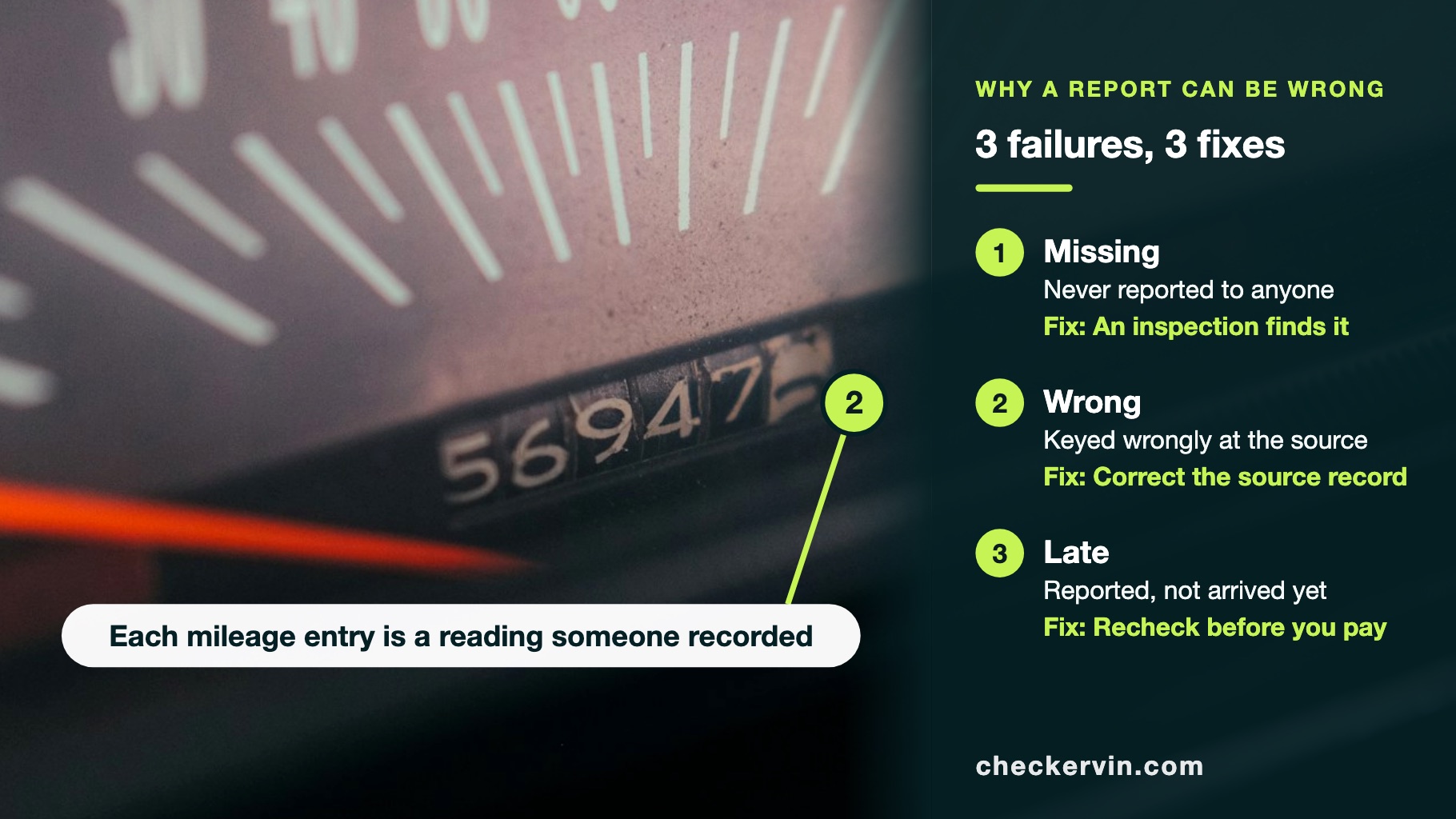
A mileage figure on a history report is not measured by the report company. It is a reading that someone recorded at an event: a service visit, an emissions inspection, a title transfer, an auction. The report is as accurate as each of those recordings, and as dense as the car’s visits to places that share data.
The federal record carries one of those readings too. The Department of Justice lists the most recent odometer reading as one of the five indicators in an NMVTIS report, and says checking it helps consumers identify discrepancies in a vehicle’s history. Read the mileage entries on any report as a sequence rather than one at a time:
- Readings that climb steadily, with gaps where the car had no reporting visits, are the normal pattern
- One reading far above its neighbors, with later readings back on trend, can point to a keying error
- A drop that stays down in every later reading is the pattern worth taking seriously
- A long silence followed by a much lower figure than expected deserves a question to the seller
- Compare the latest entry with the dashboard and with the odometer statement on the title
A report can flag an inconsistency; it cannot prove what the odometer actually read on any day. Service invoices with dates and mileage printed on them are the strongest corroboration, and wear on pedals, seat bolsters and the steering wheel is the physical sanity check a mechanic will make anyway.
Is the Carfax value accurate?
A value figure is a different kind of thing from the rest of a history report. Everything else on it is a record of something that happened. A value is an estimate produced by a model from data about sales of similar cars, adjusted for what the report knows about this one. We could not read how Carfax builds its estimate, because its pages refused our request in November 2026, so we will not characterize the method.
What holds for any value estimate is that it starts from the same records as the report. If an accident is missing from the history, the value cannot account for it; if a wrong entry is on it, the value may be dragged down by an event that never happened. Treat any single estimate as one data point and set it beside local listings for the same trim and mileage, then let the inspection adjust it. Our free scan shows current market and listing prices for a VIN, which is a useful second reading.
Reading a report so errors cannot hurt you
You do not need to dispute anything to protect yourself from a wrong or missing entry. You need to read the report as a set of claims to check, not a verdict. Five minutes with the report and the car side by side catches most problems:
- Confirm the VIN on the report against the dashboard plate, the door-jamb label and the title
- Check that the year, make, model and trim on the report match the car in front of you
- Read every entry's date and place and ask whether it fits what the seller told you
- Look at the gaps as well as the entries: years with no record are years with no reporting, not proof of a quiet life
- Ask the seller about each damage or ownership entry and see whether the paperwork agrees
- Rerun the check shortly before you pay if the first one was weeks earlier
The last point covers the late shape. A total loss declared last week may not have reached any database yet, given the reporting schedules the department describes, so a report pulled at first contact and a report pulled on the day of sale are not the same evidence.
How to dispute a Carfax report
We tried to read Carfax’s own help center so we could describe its correction process step by step. The site returned an access-denied error to us on November 24, 2026, and we did not try to get round it. So what follows is the general route that applies to any history report, not Carfax’s specific form, phone line or turnaround. Check its website for those before you start.
- 1Identify where the entry came fromLook for any indication of who reported the line: a police department, an insurer, a service facility, a motor vehicle agency, an auction. If the report does not say, ask the report company. That organization is the one whose record has to change.
- 2Get the correction at the sourceAn amended police report, a letter from the insurer stating no claim was paid on this VIN, a corrected title record from the state, or a dated repair invoice with the right mileage. A report company can only be as right as the record it holds.
- 3Send the proof to the report companyUse the company's own customer support channel and include the VIN, the specific entry, and the correcting document. Keep copies and note the date you sent it.
- 4For the federal title record, go to the providerThe Department of Justice's FAQ says that if you believe an NMVTIS record is wrong you should contact the service provider directly. Reporting entities correct their own submissions through the data consolidator that accepted them.
- 5Pull the report again to confirmA correction is only finished when a fresh report shows it. If you are selling, keep the correcting documents with the car's paperwork so a buyer can see them either way.
Does the Fair Credit Reporting Act apply?
Many people assume a history report works like a credit report, with the same legal right to a reinvestigation. Be careful with that assumption. The Fair Credit Reporting Act defines a consumer as “an individual,” and a consumer report as information bearing on a consumer’s credit worthiness, credit standing, credit capacity, character, general reputation, personal characteristics or mode of living, used for purposes such as eligibility for credit, insurance or employment. Its dispute section requires a consumer reporting agency to reinvestigate an item in a consumer’s file, free, within a 30-day period.
A vehicle history report describes a car, not a person. We looked for an official source, from the FTC, the CFPB or a court, applying the Act to vehicle history reports and did not find one. That is not the same as a ruling that it never applies, and we are not lawyers. The practical upshot is narrower: do not plan around a statutory 30-day clock. Use the source-first route above, and if a wrong entry is costing you a sale or a trade-in, put it in front of a consumer attorney who can read the company’s terms and your state’s law.
What the FTC and the Justice Department tell buyers to do
Two federal agencies answer the accuracy question in the same way, without naming any company: a report is one input, never the decision. The FTC’s guide to buying a used car from a dealer says a vehicle history report “is not a substitute for an independent vehicle inspection,” and that while a report may list accidents and flood damage, “typically it will not list mechanical problems.” The Buyers Guide that dealers must display tells shoppers both to get a history report and to ask to have the car inspected by an independent mechanic before buying.
The Justice Department’s used-car tips go further, saying consumers are strongly encouraged to obtain an independent vehicle inspection, get an NMVTIS report, and consult other vehicle information resources. Its FAQ adds that NMVTIS does not contain a vehicle’s repair history. Read together, the advice is a sequence, not a choice between products.
| The question | What answers it |
|---|---|
| Has the title been branded salvage, junk or flood anywhere? | An NMVTIS report from a listed provider |
| What service and accident records were shared about it? | A commercial history report such as Carfax |
| Has an insurer reported it stolen or a total loss? | The free NICB VINCheck |
| Was it damaged and repaired with nobody told? | Only an independent inspection |
| Are there open safety recalls? | NHTSA, free, by VIN |
Our pre-purchase inspection guide covers what a good inspection includes and what to ask the mechanic to look at once the reports have told you where the risks are.
A second source for the title layer, and where we fit
When accuracy is the worry, the cheapest improvement is a second, independent source for the part of the history that matters most: the title. The Department of Justice states that consumers cannot receive NMVTIS reports from Carfax, which provides that data only to dealers; we set out what that means in our Carfax review and do not repeat it here. On November 24, 2026, the department listed 12 businesses approved to sell the federal record to the public:
- Bumper.com
- Carsforsale.com
- Carvertical.com
- Checkthatvin.com
- Clearvin.com
- EpicVin.com
- GoodCar.com
- Titlecheck.us
- Vinaudit.com
- Vindata.com
- VinReport
- Vinsmart.com
The title data is the same federal record whichever of them you use, and the department says the list implies no preference. Our NMVTIS report guide explains each indicator, and AutoCheck vs Carfax covers when a second commercial report earns its fee.
What our free scan returns today:
- Factory build and specifications decoded from the VIN
- Factory warranty terms
- Open NHTSA safety recalls
- Photos filed against the VIN
- Market and listing prices
Decode the VIN and check recalls first
Decoded from official manufacturer and NHTSA records
Where this information comes from
- NMVTIS — information for consumers (DOJ / BJA)The 87 percent coverage figure, the false-negative warning, and the note that private databases share the same gaps
- NMVTIS — frequently asked questionsRepair history not in NMVTIS, how discrepancies and mis-keyed VINs are corrected, and how often states update
- NMVTIS — understanding a vehicle history reportThe five indicators, who must report by law, and what private providers add
- NMVTIS — who reports to NMVTIS?Reporting exceptions, including yards handling fewer than 5 salvage vehicles a year
- NMVTIS — approved data providersConsumer-tier provider list and the Carfax restriction; retrieved November 24, 2026
- NMVTIS — used car buying tipsInspection, NMVTIS report and other resources recommended together
- FTC — buying a used car from a dealerA history report is not a substitute for an independent inspection
- 15 U.S.C. § 1681a — FCRA definitionsHow the Act defines a consumer and a consumer report
- 15 U.S.C. § 1681i — FCRA dispute procedureThe 30-day reinvestigation duty and who owes it
- NICB VINCheckFree theft and insurer total-loss screen
- How we made this pageWritten by the CarCheckerVIN editorial team with AI assistance from the Department of Justice's NMVTIS pages, the FTC, the U.S. Code and other public records; facts checked November 2026.
Keep reading
Frequently asked questions
Is Carfax accurate?
Mostly accurate about what it holds and never complete. A Carfax report is a compilation of records that businesses and agencies sent to Carfax, so an entry is usually a faithful copy of something that was reported. An event nobody reported cannot be on it, and an entry keyed wrongly at the source arrives wrong. Treat a clean report as the absence of records, not proof of an uneventful car.
Can a car be in an accident and not show on Carfax?
Yes. A history report only shows an accident if a record of it reached the company: typically an insurance claim, a police report or a repair at a shop that shares its data. A crash repaired privately with no claim and no police report leaves nothing for any report to find. Only a physical inspection reaches that damage.
How do I dispute a Carfax report?
Start where the entry came from. Get a correcting document from that source, such as an amended police report, an insurer's letter, a title record or a repair invoice, then send it to the report company through its own customer support. We could not load Carfax's help pages in November 2026, so check its site for its current correction process.
Is Carfax mileage accurate?
Each mileage entry is a reading someone recorded at an event such as a service visit, inspection or title transfer, so it is only as accurate as that recording. One reading far out of line with the readings either side of it can be a simple keying error. A sequence that steps down and stays down deserves a closer look and a physical check of the car.
How can I check if a car has been in an accident?
Combine records with an inspection. Run the free NICB VINCheck for insurer total losses, get an NMVTIS title report for brands, add a commercial history report on an expensive car, then have an independent mechanic examine the car. The inspection is the only step that finds damage nobody reported.
Does the Fair Credit Reporting Act apply to Carfax reports?
We found no official source saying it does. The Act defines a consumer as an individual and a consumer report as information bearing on a person's credit, character or mode of living, and its 30-day reinvestigation duty is owed to consumers about their own files. A vehicle history report describes a car. If a wrong entry is costing you money, ask a consumer attorney.
Check the car, not just the paperwork
Decode any VIN free for the factory build, specifications, open safety recalls and market prices. Full vehicle history reports are launching soon.
Run a free VIN check