The short answer
- What is the main difference between AutoCheck and Carfax?
- The reporting relationships behind them. Each compiles records from sources that report to it, and those networks are not identical — so an accident, service visit or auction sale in one report can be absent from the other on the same vehicle.
- Which should I buy?
- If you are checking one car and want the widest service-record coverage, Carfax is generally the stronger single choice. If you are comparing several vehicles or want auction history, AutoCheck's score and auction coverage suit that better. On a high-value purchase, both.
- What do both sit on top of?
- The federal NMVTIS title system, which records title brands and is available separately through approved providers for a few dollars. Everything above that is each provider's own licensed data.
Different
Reporting networks
Not the same sources
Both paid
Neither is free
The data is licensed
NMVTIS
The shared foundation
Federal title records
Neither
Is a superset of the other
Gaps run both ways
The short answer
If you are buying one car and want the broadest coverage of service and repair records, Carfax has historically had the wider network of participating shops and dealers reporting into it. If you are screening several vehicles quickly, or the car has been through auction, AutoCheck's score and auction coverage make that easier.
On a purchase where the stakes justify it, running both is the answer that actually works, because the gaps go in both directions and you cannot know in advance which service received the record that matters.
What both are built on
Both services draw on the National Motor Vehicle Title Information System, the federal database states report title brands into. That is the layer covering salvage, flood, junk and odometer brands, and it is the same underlying record regardless of which report you buy.
It is also available directly. NMVTIS approved providers sell title-record checks for a few dollars, which is worth knowing if brands are the specific thing you are trying to establish — what costs what maps the whole hierarchy.
Where they actually differ
| Area | How the two compare |
|---|---|
| Service and repair records | Carfax has historically maintained a broad network of participating repair facilities and dealers reporting service visits, which tends to produce a fuller maintenance picture. |
| Auction history | AutoCheck is an Experian product, and auction coverage is generally its stronger area — useful on a vehicle that has moved through wholesale channels. |
| Presentation | AutoCheck summarizes a vehicle with a proprietary numeric score for quick comparison. Carfax presents a record timeline without a single headline number. |
| Accident records | Both carry them, sourced from insurers, police reports and repair facilities that report to each service. Coverage overlaps but is not identical. |
| Title brands | Both draw on the same federal system, so this layer is broadly consistent between them. |
| Multi-report use | AutoCheck's packaging has traditionally suited buyers checking many vehicles; Carfax is more often bought per-report. |
What happened when someone ran both on the same car
A comparison written from feature lists tells you what each company says it holds. A comparison written from a test tells you what actually came back. Edmunds published the second kind, running both products against the same vehicles, and the results are more instructive than any table of promises.
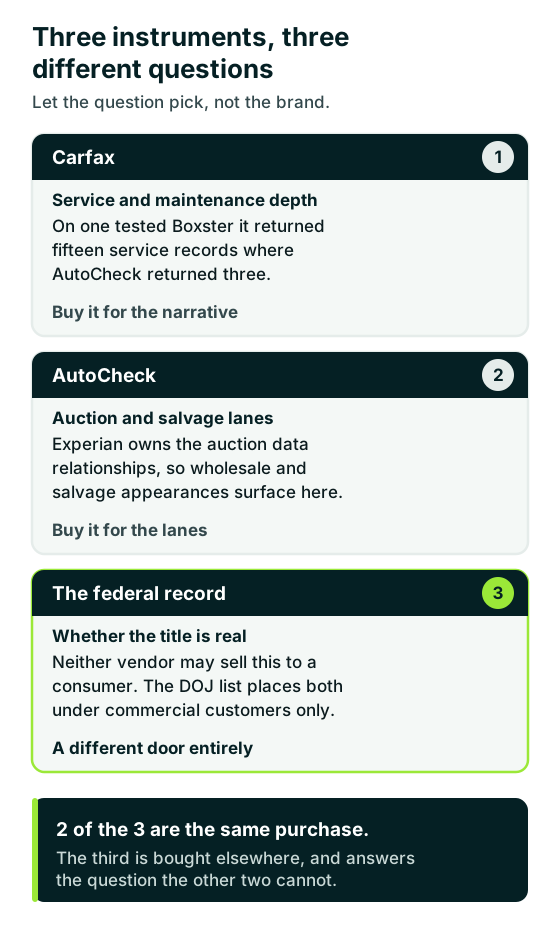
On a 2014 Porsche Boxster that had spent most of its life in Florida, Carfax returned fifteen service records going back to 2014 and AutoCheck returned three. The same pair disagreed about ownership — five owners on one, three on the other — and the explanation is procedural rather than sinister: Carfax counted dealerships that took possession of the car between private owners, and AutoCheck counted only the people who bought it.
Their second example matters more for a buyer. On a 2017 Honda Accord carrying a salvage title, AutoCheck held two accidents including an insurer’s total-loss entry. Carfax held both of those and also front-end damage recorded in November 2024. Running the reports in early December 2024, the most recent incident AutoCheck showed was from July 2022.
| What the test showed | What it means for your purchase |
|---|---|
| Fifteen service records against three, one car | Maintenance depth is the clearest difference between them |
| Five owners against three, same car | They count owners differently; neither figure is wrong |
| Recent damage on one and not the other | Reporting lag is real, and the newer the event the likelier it shows on one only |
| Neither report was a superset of the other | A clean report is the absence of records, not the absence of history |
The record neither of them can sell you
Both companies are compared endlessly against each other, and the comparison hides a third option that answers a different question entirely — one neither can supply to you directly.
The Department of Justice publishes the list of businesses approved to sell reports from the national title system. Checked on August 17, 2026, that list places CARFAX.com under a heading for commercial customers only, with a note that it offers the data to commercial customers in California only. Experian, which owns AutoCheck, appears in the same commercial-only section. The page carries a standing statement that consumers cannot receive those reports from Carfax, DMVDesk or Experian, because those entities provide the information only to car dealerships.
This is not a criticism of either product. It is a statement about which door the federal record comes through, and the answer is neither of these two. Our guide to that record covers what it holds; our alternatives guide lists who may sell it to a member of the public.
What the federal record answers that both of these do not
Because the third option is usually mentioned as a cheap afterthought, it is worth being specific about what it is for. Federal rule requires the national system to let a user establish five things instantly and reliably, and reading them explains why it is not competing with the two products on this page.
Four of those five are about paperwork — whether the title document is real and current, which state holds the record, whether a brand exists, and whether an insurer or salvage yard reported the car. The fifth is the odometer disclosure taken at the titling event. Our guide to that record sets out each capability and the rule behind it.
Four of those five are about paperwork and the fifth is about the odometer. Neither commercial report is trying to do that job, and the federal record is not trying to reconstruct a service history. The sensible reading is not which of the two is better, but that the pairing most buyers actually want is one commercial report for the narrative and the federal record for the title — bought once, in that order.
Which report suits which car, decided by the car
The choice is usually framed as a preference between two companies. It is more useful to let the vehicle decide, because for some cars a commercial report is close to decisive and for others it cannot reach the question at all.
Owners file complaints with the federal safety regulator, and each carries the date of the incident, so a model year can be described by how old those cars typically were when the trouble started. That figure tells you whether a paper trail is the right instrument at all.
| When the model year's main complaint arrives | Which report earns its fee |
|---|---|
| Very early — a 2010 Prius's service-brake reports run to a median vehicle age of 0.1 years, 72% of them inside three years | Neither. Any used example has already lived through that window, so an inspection settles it |
| Mid-life | A commercial report starts to help, because the repair either was documented or was not |
| Late — a 2016 Honda Pilot's engine reports run to a median of 7.4 years, only 8% inside three | Service depth decides it, and that is the axis on which these two differ furthest |
Read that way the comparison resolves itself. On a car whose known weakness appears in the first year or two, spend the money on a mechanic rather than a second report. On one whose weakness appears late, buy whichever report carries the deeper maintenance record and read the service entries rather than the summary. Our reported-problems index carries the per-year figures free, before you decide which report to buy.
The AutoCheck score, and what it is not
AutoCheck assigns a numeric score intended to place a vehicle against comparable ones of similar class and age. It is genuinely useful for triage — screening a shortlist of candidates quickly rather than reading several full reports end to end.
What it is not is an independent quality rating. It summarizes that provider's own data, so a good score means the records that service holds look unremarkable. It cannot reflect an event nobody reported to them, and it says nothing about mechanical condition.
Buyback guarantees
Carfax has offered a guarantee covering certain circumstances where a report failed to show a title brand that was present in the underlying records. Terms, eligibility and the claim process are set by the provider and change over time.
If a guarantee is a factor in your decision, read the current terms on the provider's own site rather than a summary elsewhere. What is generally true of such programs is that they cover specific documented failures rather than acting as a warranty against anything the report missed.
When running both is worth it
Two reports cost roughly what a modest repair does, so the calculation is straightforward on anything expensive.
- The purchase price is high enough that a missed accident would hurt materially
- The car has moved between states, where brand and reporting patterns get patchy
- The vehicle appears to have been through auction — one service may see it, the other may not
- One report looks unusually clean for the vehicle's age and mileage
- The seller's account and the report do not quite line up
- You are buying remotely and cannot inspect thoroughly yourself
What neither one has
Both services can only report what was reported to them. A large amount of what happens to a used car never enters any database.
- Damage repaired privately and paid in cash, with no insurance claim
- Accidents where no police report was filed and no claim was made
- Maintenance performed by an independent shop that reports to neither service
- Deferred maintenance, which is an absence rather than an event
- Current mechanical condition, wear and the state of consumables
- Rust and structural corrosion, which no record captures
This is why an independent pre-purchase inspection costs about the same as a report and answers a bigger question. If you can only do one, do the inspection.
Run the free checks before you pay for either
Several checks cost nothing and can end the process before you spend anything. There is no reason to buy a report on a car that fails one of them.
- 1Decode the VINFree and unlimited through NHTSA. Confirms the vehicle is what it is described as. A mismatch here ends it cheaply.
- 2Check open recallsFree and unlimited. An unrepaired safety recall is free to fix but is work you inherit.
- 3Run the theft and salvage lookupNICB VINCheck, free, five per day. Covers participating insurers only, so a clean result is a good sign rather than a clearance.
- 4Then decide whether to buy a reportIf the car is still a candidate after all three, the paid accident and service detail is what remains unanswered.
How to avoid paying twice
- Dealers frequently supply a full report free on their own inventory — ask before buying one
- Some public libraries provide patrons with access to commercial databases
- A seller who has already run a report may share it
- Some manufacturer certified pre-owned programs include a report
- Check the VIN on any shared report matches the vehicle, character for character
- Check the date it was run — a report from last year does not describe this year
Choosing one, if you are only buying one
| Your situation | The more useful choice |
|---|---|
| Checking a single car, want maximum service history | Carfax |
| Screening several candidates quickly | AutoCheck, for the comparative score |
| The car has auction history you want visibility into | AutoCheck |
| You only need to know about title brands | Neither — an NMVTIS approved provider, for a few dollars |
| You only need recalls and factory specification | Neither — the free federal checks cover it |
| High-value purchase, buying remotely | Both, plus an independent inspection |
Where this information comes from
- NMVTIS — approved data providers (U.S. Department of Justice)Places CARFAX.com and Experian.com under commercial customers only, and states that consumers cannot receive those reports from either. Read August 17, 2026
- 28 CFR 25.53 — what the national record must let a user establishThe five capabilities, including the title-document validity check that neither commercial report performs
- NMVTIS — National Motor Vehicle Title Information SystemThe federal title system both services draw on, with the approved provider list
- NHTSA recall lookupFree, unlimited open-recall check by VIN
- NICB VINCheckFree theft and salvage lookup from participating insurers
Keep reading
Frequently asked questions
Which is better, AutoCheck or Carfax?
Neither is a superset of the other. They compile records from different reporting relationships, so an event recorded by one may be absent from the other. Which is better depends on the specific vehicle, which is why serious buyers on an expensive car run both.
Why do the two reports show different things on the same car?
Because each compiles data from sources that report to it. A repair shop, insurer or auction that feeds one service may not feed the other. Neither is wrong — each is showing what it received.
What is the AutoCheck score?
A proprietary numeric score AutoCheck assigns to compare a vehicle against similar ones of the same class and age. It is a summary of that provider's own data rather than an independent rating, and it is most useful for quick comparison across several candidates.
Do I need a paid report at all?
For accident detail, service history and ownership counts, yes — that data is licensed and not published free. For recalls, a factory decode, and a theft and salvage lookup, no. Run the free checks first and see whether they already answer your question.
Can I get one of these reports without paying?
Frequently. Dealers often provide a full report free on their own inventory, some public libraries offer patrons database access, and sellers who have already run one may share it. Verify the VIN on any shared report matches the vehicle.
Start with the free checks
Decode any VIN free for the factory build, specifications and open safety recalls. No account, no card.
Run a free VIN check