The short answer
- What is a pre-purchase inspection?
- An hour or two of a mechanic's time, spent on a car you do not own yet, by someone with no stake in the sale. You get a written list of what is wrong and what it costs to fix.
- What does it cost?
- There is no national price. It is a local service on local labor rates, and the top result for that query is a discussion thread precisely because no honest single number exists.
- What should the inspector look at first?
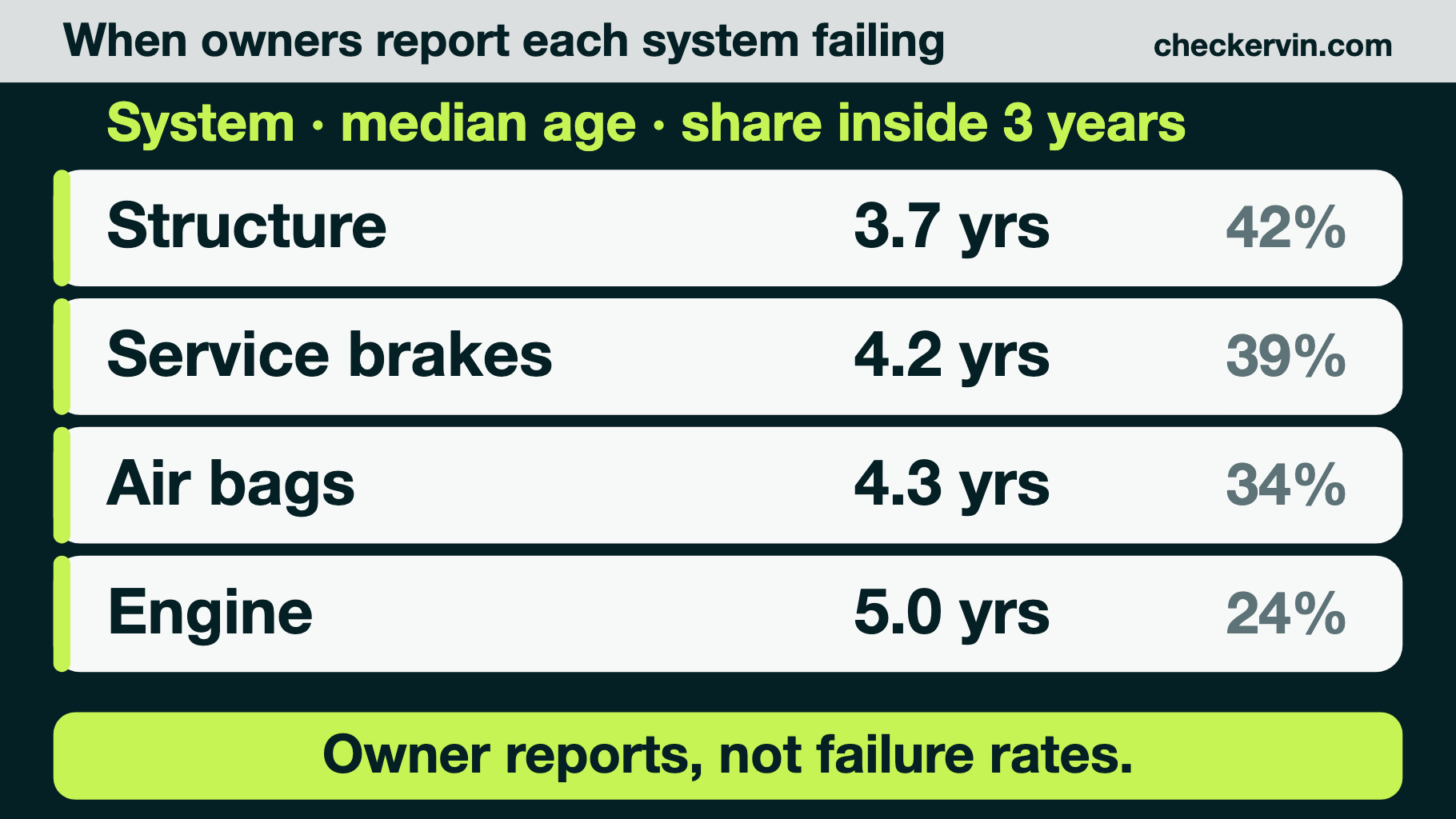
- The systems owners report failing earliest. In our federal complaint data that is structure at a median 3.7 years, brakes at 4.2 and air bags at 4.3 — before the engine at 5.0.
What it actually is, stripped of the sales language
A pre-purchase inspection is a mechanic examining a specific used vehicle, at your request and on your behalf, before you buy it. The defining feature is not the checklist. It is the absence of a conflict of interest: the person forming the opinion does not get paid more if you buy the car.
That is the whole product. Everything else — the lift, the scan tool, the road test, the written report — is the means. When a seller offers you their own inspection, or a dealer shows you a certificate produced by the shop attached to the dealership, you are being handed the checklist without the thing that made it worth having.
3.7 yrs
Structure
Median age at which owners report structural problems — the earliest of any system
42%
Inside three years
Share of structural complaints filed on cars under three years old
63,160
Complaints analyzed
Federal consumer complaints across 73 model years
The rest of this page is organized around a question the ranking results mostly skip: given limited time and money, what should the inspection prioritize? We can answer that from data rather than opinion, because we hold the federal complaint record and it says when each system tends to give trouble.
What it costs, and why nobody will give you a number
Search for the price and the highest-ranking result is a discussion thread of people comparing what they paid. That is not a failure of the internet. It is the honest shape of the answer.
A pre-purchase inspection is a local service billed against local labor rates, and those vary by a factor most national guides quietly average away. What you are buying is a block of a mechanic’s time, so the price moves with the same things that move any labor bill: how long you book, what the shop charges an hour, and whether someone drives to the car or the car comes to them.
| What changes the price | Why |
|---|---|
| Mobile inspector versus a shop | A mobile inspector saves you persuading a private seller to release the car for half a day, and gives up the lift. A shop gets it in the air, which is where structural repair and corrosion actually become visible. |
| How much diagnostic time you book | A visual and road test is a different job from an hour of scan-tool work chasing an intermittent fault. Ask for the second only if the first turns something up. |
| Local labor rates | The same inspection is not the same price in two different metros, and no national figure survives that. This is the single largest driver and the reason a quoted average is close to meaningless. |
| The vehicle itself | An exotic, a diesel truck or an EV takes specialist knowledge and specialist tools. A common sedan does not. |
Set against the cost of the thing you are considering buying, this is the cheapest information in the transaction. It is also the only information in it that is being produced by someone who does not want the sale to happen.
What actually fails, and at what age
Every complaint filed with the federal safety database carries the date the owner says the failure happened. Measured against the model year, that gives the age of the vehicle when it broke. Pooled across 63,160 complaints and 73 model years, the pattern is consistent enough to plan an inspection around.
| System | Median age at reported failure |
|---|---|
| Structure | 3.7 years · 42% of reports filed inside the first three years · 3,474 reports |
| Service brakes | 4.2 years · 39% of reports filed inside the first three years · 7,584 reports |
| Air bags | 4.3 years · 34% of reports filed inside the first three years · 3,679 reports |
| Power train | 4.4 years · 33% of reports filed inside the first three years · 10,505 reports |
| Steering | 4.7 years · 33% of reports filed inside the first three years · 6,242 reports |
| Electrical system | 4.8 years · 31% of reports filed inside the first three years · 11,906 reports |
| Engine | 5.0 years · 24% of reports filed inside the first three years · 14,353 reports |
Two things in that table are worth pausing on. Structure has both the earliest median and the highest share of early complaints — 42% filed on vehicles under three years old. Structural problems are not a high-mileage phenomenon; they show up early, and on a used car most of them are the consequence of a repair rather than of age.
The engine sits at the other end. It carries the most reports of any system by a wide margin, and the latest median at 5.0 years. Engine trouble is common and it arrives late, which is precisely the profile of a problem that is somebody else’s when the car is sold and yours shortly afterwards.
Ordering the checklist by evidence rather than habit
A conventional inspection works through the car by geography — front to back, top to bottom. That is a reasonable way to avoid missing anything and a poor way to spend a limited hour. The data above suggests a different priority, and it is worth handing to the inspector when you book.
- 1Structural evidence firstEarliest median at 3.7 years and 42% of reports inside three years. On a used car this is the finding that ends a purchase rather than adjusting its price, so it belongs at the start while attention is fresh. It also needs the lift, which is the part a mobile inspection gives up.
- 2Restraints and brakes nextAir bags at 4.3 years and service brakes at 4.4, with roughly a third of reports inside three years for each. Both are safety-critical, both are checkable, and brake work is a predictable near-term cost that belongs in your offer.
- 3Steering and drivetrain on the road testBoth sit at a 4.9-year median. These are the faults that reveal themselves in motion and hide at idle, which is why a road test long enough to reach operating temperature is not optional.
- 4Electrical and stored codes5.1-year median, and the system where a scan tool earns its keep — a cleared code and a genuinely healthy car look identical in the driveway.
- 5Engine last, and hardestLatest median at 5.0 years and the most reported system of all. Last in order, not last in importance: it is where the expensive surprises live, and it deserves whatever time the earlier steps did not consume.
None of this replaces the inspector’s judgment. It gives them a starting order derived from what tens of thousands of owners actually reported, rather than from the sequence printed on a generic form.
What happens during the two hours
Knowing the shape of the appointment makes it easier to tell a thorough inspection from a quick look.
- The car goes on a lift, where the underbody, suspension mounts, exhaust and evidence of structural repair are visible — this is the step a driveway inspection cannot perform.
- Fluids are checked for level, color and contamination, and the engine bay is examined for active leaks as opposed to old staining.
- Brakes and tires are measured rather than eyeballed, giving you a number for remaining life instead of an impression.
- The stored and pending fault codes are read, including codes recently cleared, which is a different question from whether a warning light is on now.
- A road test long enough to bring the drivetrain to operating temperature, because the faults that matter often appear only when it is warm.
- A written report listing what is wrong, what it will cost, and what can wait — the deliverable you are actually paying for.
If a quoted inspection does not include the lift, the code scan and the written report, it is a different and lesser product wearing the same name.
What an inspection cannot see
An inspection is an assessment of condition on one day by one person. That is its strength and it bounds what it can tell you.
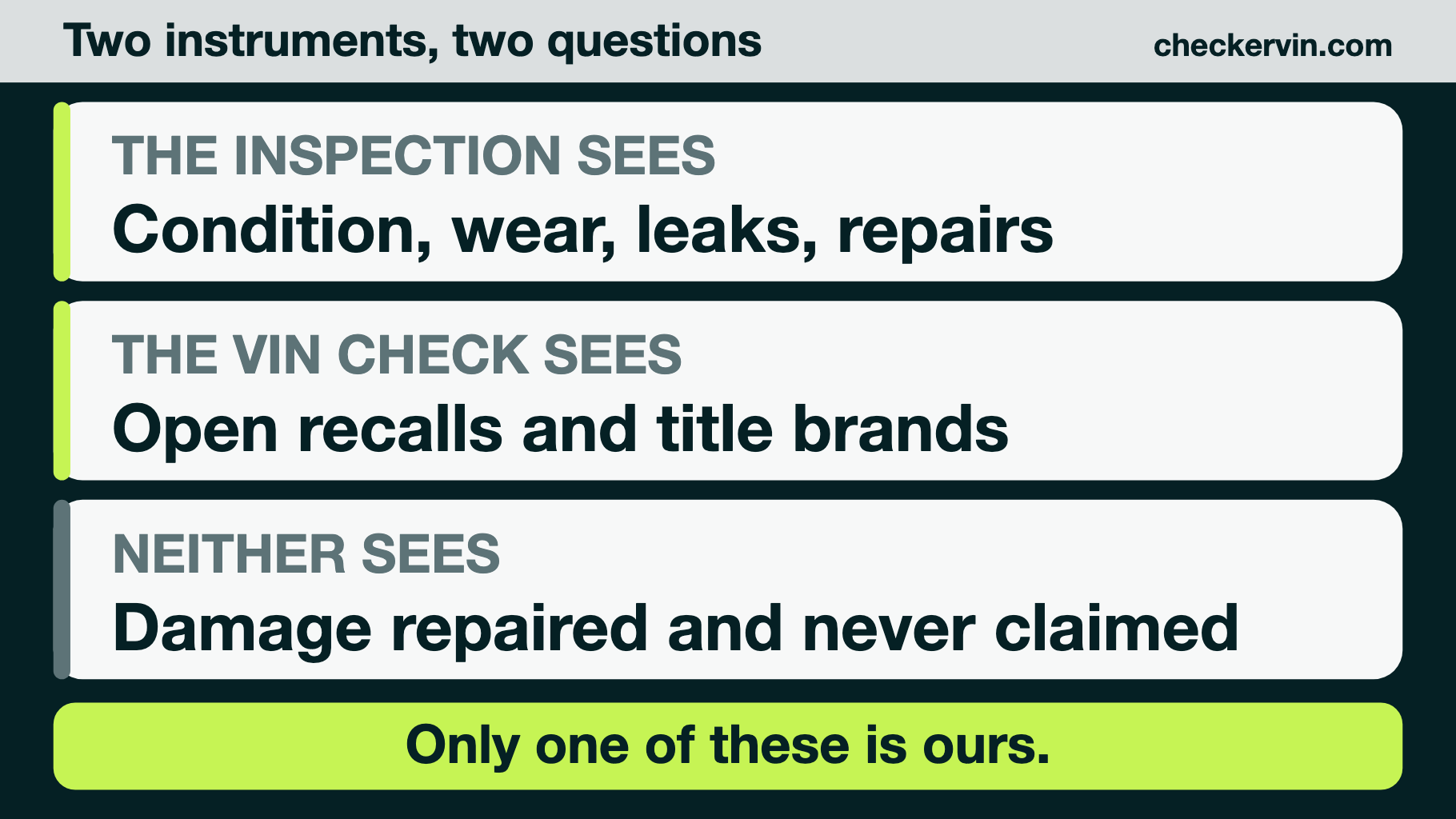
It does not see the past. Damage that was repaired competently and paid for in cash leaves no record anywhere and, once the work has settled, often leaves nothing an inspector can reliably identify either. It does not see the future: a component sound on the ramp can fail the following month, and no inspection carries a warranty against that.
It also does not see the paperwork. Whether the vehicle carries a salvage or flood brand in another state, whether a recall campaign is open against that specific VIN, whether a lender still holds an interest — none of that is visible under a car, and all of it is checkable in minutes from records. That is the division of labor in the figure above, and it is why the two checks are complements rather than alternatives.
The federal recall search is free, takes a VIN, and returns campaigns the manufacturer must remedy at no charge — which means it can be worth real money before you have spent anything at all. Running it before you book the inspection is the correct order, because an open recall is a fact about the car you can establish for nothing.
This is not the DMV VIN inspection
Two different procedures share the word inspection and are constantly confused, sometimes expensively.
| Procedure | What it establishes |
|---|---|
| Pre-purchase inspection | The condition of the vehicle, assessed by a mechanic you hire. Voluntary, priced by the market, and has no role whatsoever in registering the car. |
| DMV VIN inspection or verification | That the VIN on the vehicle matches the VIN on the paperwork. Performed by an authorized official, required by some states in defined circumstances, and says nothing at all about condition. |
A verification will not tell you the transmission is failing, and a pre-purchase inspection will not satisfy a state that wants the number confirmed. Depending on where and what you are buying you may need both. We keep the registration procedure on its own page rather than summarizing it here, because the rules are state-specific and a summary is how people end up doing the wrong one.
Who to use, and the conflict to avoid
The single rule is that the inspector must have no relationship with the seller. Everything else is preference.
- An independent shop you chose, not one the seller recommended — a recommendation from the person selling the car is the conflict this whole exercise exists to remove.
- A marque specialist where the vehicle warrants it, since a familiar model's known weak points get checked without being asked for.
- A mobile inspector where the seller will not release the car, accepting that you are trading away the lift for access.
- Never the dealership's own service department on a car that dealership is selling. The report may be perfectly honest and you have no way to establish that, which defeats the purpose.
Book it yourself, pay for it yourself, and have the report sent to you rather than to the seller. A report the seller receives first is a negotiating document they have had time to prepare for.
Reading the result without over-reading it
Almost every used car returns a list of findings. A clean report is rare enough that it should prompt a question about how hard anyone looked, and a long list is not by itself a reason to walk away.
Sort what comes back into three piles. Findings that end the purchase — structural repair, a failing drivetrain, evidence the car has been in deep water. Findings that change the price, which is most of them: brakes, tires, a leaking gasket, deferred service. And findings that are simply the age of the vehicle, which belong in your expectations rather than your offer.
Then use the second pile. A written estimate from a mechanic who does not want your business either way is the strongest negotiating instrument available to a private buyer, and it is worth more than the inspection cost on most cars where anything at all was found.
When it is reasonable to skip one
There are cases where the answer is genuinely no, and pretending otherwise would be the same overselling this page objects to elsewhere.
A car under a manufacturer’s warranty that transfers to you carries its own remedy for mechanical failure, which is much of what an inspection is looking for. A vehicle being bought for parts, or one cheap enough that the inspection is a meaningful fraction of the price, fails a simple arithmetic test. And a purchase with a genuine return window shifts the risk in a way that changes the calculation, though those windows are rarer and narrower than they sound and are worth reading closely rather than assuming.
Outside those, the case for skipping it is almost always a case about inconvenience, and it is being made at the exact moment when inconvenience is cheapest to accept.
Where this information comes from
- NHTSA recall lookupOpen safety recalls by VIN, free — run this before you book anything
- NHTSA complaint databaseThe federal consumer complaint record this page's failure-age figures are aggregated from
- FTC — buying a used carFederal consumer guidance on used purchases, including the Buyers Guide a dealer must display
- NHTSA vPIC VIN decoderThe factory build for that VIN, free and without an account
Keep reading
Frequently asked questions
What does a pre-purchase inspection actually include?
A road test and a lift inspection by a mechanic who is not selling you the car: fluids and leaks, brakes and tires, suspension and steering, the exhaust and underbody, evidence of structural repair, and a scan of the stored fault codes. It is an assessment of condition on the day, delivered as a written list of what is wrong and roughly what it costs to put right.
How much does a pre-purchase inspection cost?
There is no national price, which is why the top-ranking result for that question is a discussion thread rather than a number. It is a local service priced by local labor rates, and it varies with whether a mobile inspector comes to the car or the car goes to a shop, and with how much diagnostic time you ask for. Get a quote from two places near the car before you book, and read any flat-rate point count as marketing rather than a specification.
Is a pre-purchase inspection the same as a DMV VIN inspection?
No, and confusing them costs people money. A DMV VIN inspection or VIN verification confirms that the number on the car matches the paperwork, for registration purposes. It says nothing about condition. A pre-purchase inspection assesses condition and has no role in registering the vehicle. You may need both, for different reasons, and one is never a substitute for the other.
Can I skip the inspection if the vehicle history report is clean?
No, because they answer different questions. A records check reports what was filed — open recalls, title brands, reported events. An inspection reports what is physically there today. A car can have an unblemished record and a failing transmission, because nobody files a report when a part is merely worn out.
What if the seller refuses to allow an inspection?
Treat it as an answer rather than an obstacle. A seller with nothing to hide loses two hours; a seller with something to hide loses the sale. Refusal is not proof of a problem and it is a strong enough signal that most experienced buyers walk at that point rather than negotiate around it.
Run the VIN before you book
Open safety recalls and the factory build, free and without an account — the half of the picture an inspector cannot see.
Run a free VIN check