The short answer
- Is there a free vehicle maintenance report by VIN?
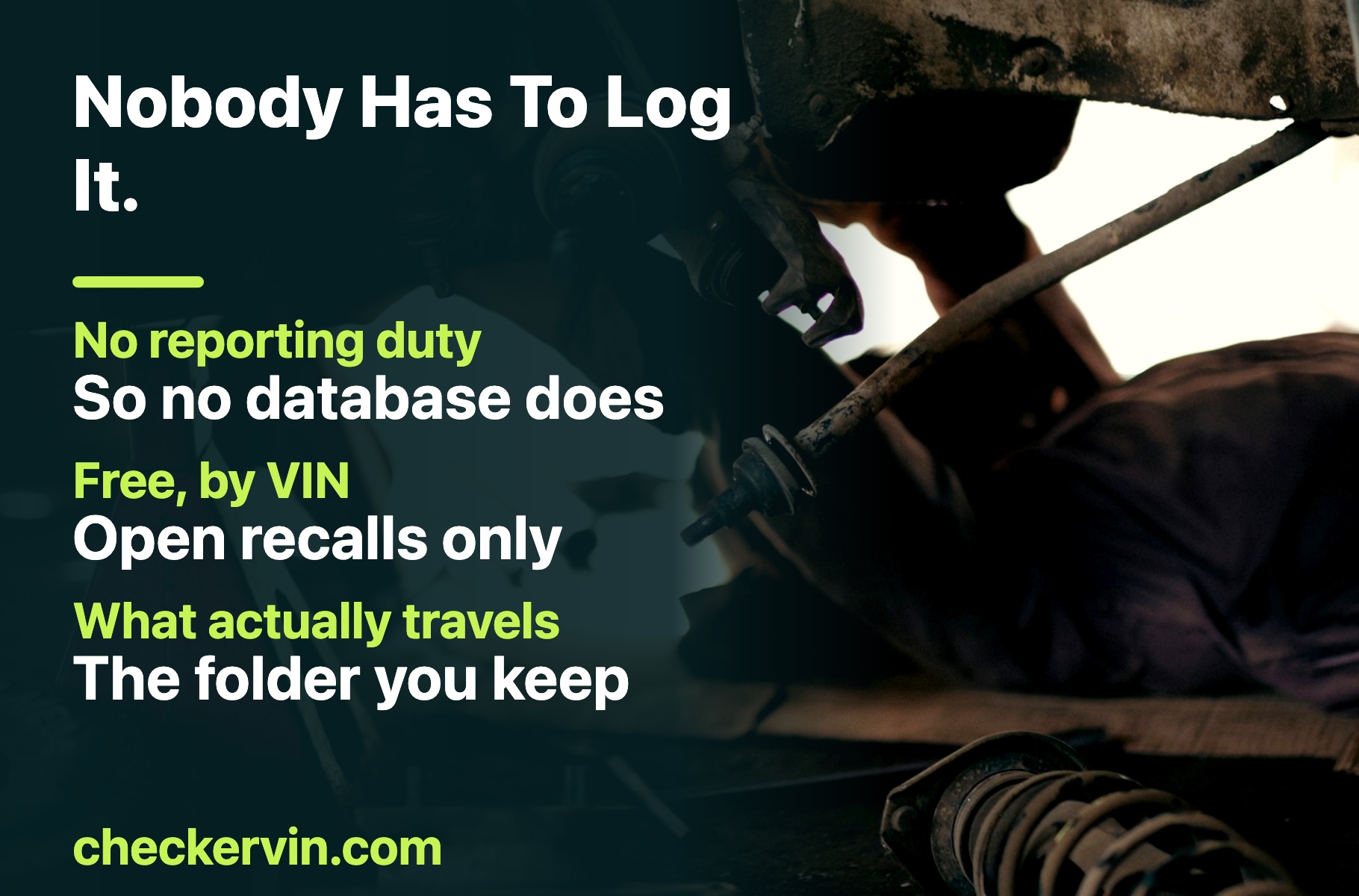
- Not a complete one. No law requires routine servicing to be reported anywhere, so there is no national database to search. Open safety recalls are the exception — those are public and free, because manufacturers must report campaigns to NHTSA.
- Who actually has my service records?
- Whoever did the work. A franchised dealer logs into the manufacturer's system, a chain keeps its own customer records, and an independent shop keeps a paper or local file. None of them are connected to each other.
- Does using an independent shop void the warranty?
- No. Federal law prohibits conditioning warranty coverage on your use of authorized service or branded parts for non-warranty maintenance, unless the warrantor supplies them free of charge.
None
National service-records database
No reporting duty exists
Recalls
The part that is public
Reported to NHTSA by campaign
700.10
The anti-tying rule
Where you may have work done
Receipts
The record you control
Dated, with mileage and parts
What a vehicle maintenance report actually is
The phrase is used loosely, and it covers three quite different things. Separating them saves a lot of disappointment.
| What people mean | What it really is |
|---|---|
| A full service history | A list of every oil change, brake job and repair. No such compiled record exists for most vehicles |
| A dealer service record | What one manufacturer's franchised network logged, retrievable by VIN — and blind to everything done elsewhere |
| A history report's service section | Whatever a commercial data broker has licensed from participating chains, which is partial by construction |
| An open recall check | Genuinely complete, genuinely free, and the only one of the four backed by a federal reporting duty |
The distinction matters because the first is what people search for and the last is what they can actually get. Everything in between is a commercial product whose completeness depends entirely on which businesses agreed to share their records.
Why service history by VIN is so thin
Compare maintenance with the other things a VIN can retrieve, and the gap explains itself. Title brands travel between states because federal law built a system to move them. Safety recalls are public because manufacturers must report campaigns and their progress. Odometer readings appear at title transfer because federal disclosure rules attach to that moment.
Routine maintenance has no equivalent. There is no statute requiring a shop to report an oil change to anyone, no federal database to receive it, and no reason for an independent garage to send its customer records to a data broker. The absence is structural, not a gap somebody forgot to fill.
Who actually holds the records
Your car's service history is not missing. It is scattered, and it sits with whoever performed the work.
- The franchised dealer network logs work into the manufacturer's system, searchable by VIN
- National service chains keep their own customer records, usually by phone number or plate
- Independent shops keep invoices, often on paper or in local shop software
- You keep whatever you were handed, which is the only copy that follows the car
- Nothing joins these together, and no rule says it should
This is why a car with a thick folder of receipts sells better than an identical car without one. The folder is not sentimental. It is the only version of the record that exists in one place.
The rule that decides where you may have the work done
Here is the part of this subject that carries real money, and it is not about reports at all. It is about whether you are free to choose who services your car without losing the warranty — and the answer has been settled federal law since 1975.
The Magnuson-Moss Warranty Act contains an anti-tying provision at section 102(c), 15 U.S.C. 2302(c). The FTC's interpretation of it lives at 16 CFR 700.10, and it is unusually direct.
| 16 CFR 700.10 | What it establishes |
|---|---|
| (a) | Tying arrangements that condition warranty coverage on using an article or service identified by brand, trade or corporate name are prohibited — unless that article or service is provided free of charge |
| (b) | Under a parts-only limited warranty, the warrantor may not require that only its identified service install those parts, or supply parts in a way that impedes your choice of who does the labor |
| (c) | No warrantor may condition the continued validity of a warranty on using only authorized service or authorized parts for NON-warranty service and maintenance |
Paragraph (c) is the one that answers the question people actually ask. Routine maintenance — the oil changes, the filters, the brakes, the scheduled services — is non-warranty work you are paying for. A manufacturer cannot make your warranty depend on having that work done in its own network.
Why a void-if-serviced-elsewhere clause breaks the law twice
The regulation goes further than prohibiting the practice: it explains why such a clause is unlawful on two independent grounds, and the second is the more interesting.
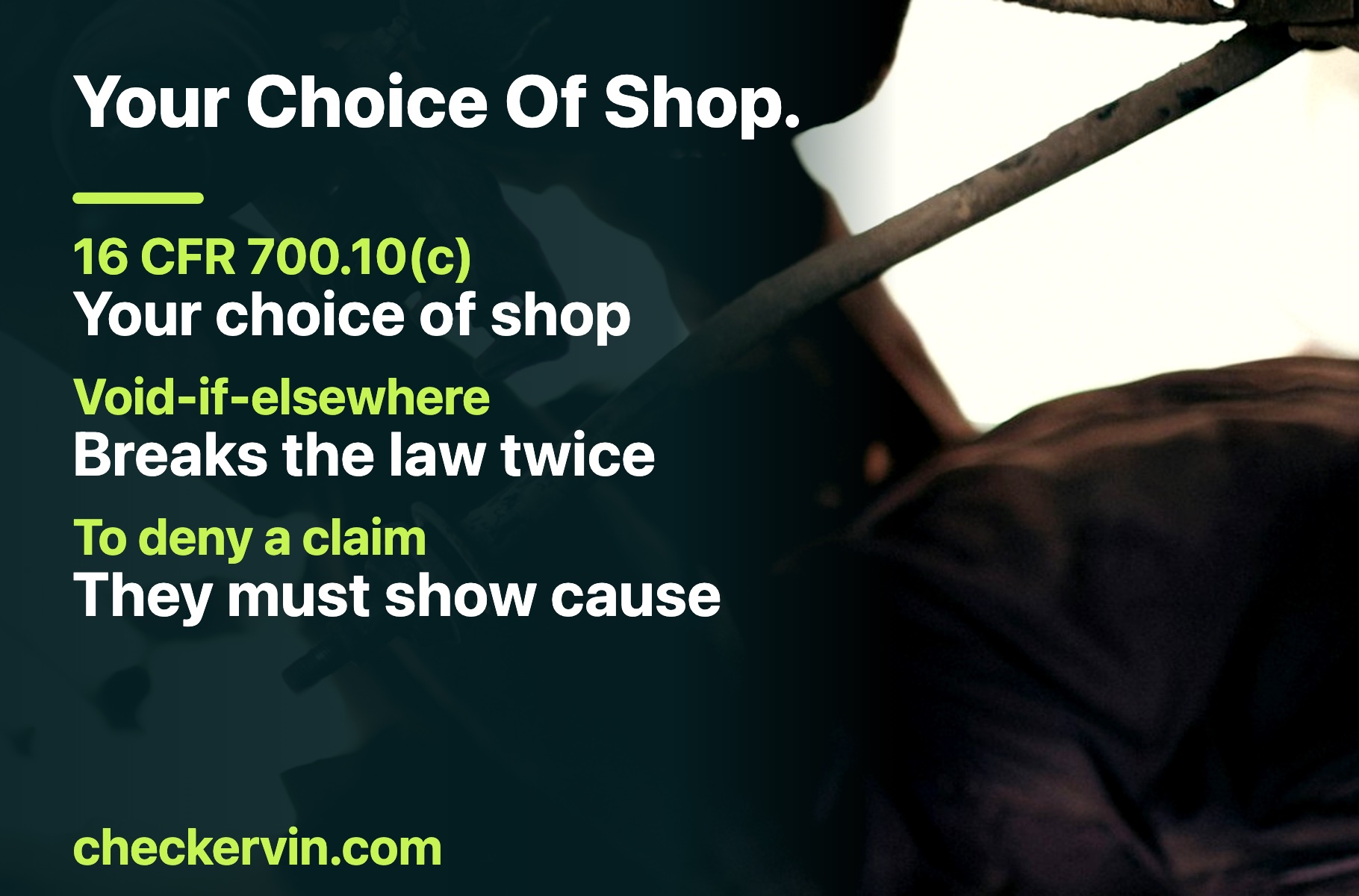
First, it is a prohibited tying arrangement under section 102(c). Second, the FTC treats it as deceptive under section 110 of the Act, 15 U.S.C. 2310, on a reasoning worth reading twice: a warrantor cannot, as a matter of law, avoid liability under a written warranty where the defect is unrelated to the consumer's use of unauthorized articles or service. A clause claiming otherwise is not merely unenforceable. It misstates the law to the person reading it.
The regulation also reaches softer wording. Language that implies to a consumer acting reasonably that coverage requires buying a branded article or service is treated the same way — the examples given are phrasings along the lines of “use only an authorized dealer” or “use only our replacement parts” where those are not supplied free under the warranty.
Who has to prove what, and the honest limit
This is where a lot of confident internet advice overshoots, so it is worth stating the limit precisely. The rule does not make a warranty unconditional, and it does not mean nothing you do to a car can ever affect a claim.
What 700.10(c) preserves for the warrantor is narrow and specific. It does not preclude a warrantor from expressly excluding liability for defects or damage caused by unauthorized articles or service. And it does not preclude the warrantor from denying liability where the warrantor can demonstrate that the defect or damage was so caused.
And the warrantor does not get the last word
One more provision belongs here, because it disposes of a line people meet in warranty booklets and service contracts.
Under 16 CFR 700.8, a warrantor may not indicate, directly or indirectly, that its own decision — or that of a service contractor or any designated third party — is final or binding in a dispute about the warranty. Nor may it state that it alone decides what counts as a defect. The FTC calls such statements deceptive, because section 110(d) of the Act, 15 U.S.C. 2310(d), gives state and federal courts jurisdiction over suits for breach of warranty and service contract.
Read alongside the anti-tying rule, the picture is consistent: the party writing the warranty does not get to decide where you service the car, and does not get to decide the argument about it either.
Which paperwork duties a warrantor may put on you
There is a related question that comes up whenever maintenance records do, and it has a partial federal answer: how much administrative work can a warrantor require of you before it will honor its own warranty?
For fullwarranties the Act is strict. Section 104(b)(1), 15 U.S.C. 2304(b)(1), says a warrantor offering a full warranty may not impose any duty on the consumer beyond notifying it of a defect as a condition of getting that defect remedied — unless the warrantor can demonstrate the additional duty is reasonable.
The FTC applies that directly to a familiar piece of paper at 16 CFR 700.7. Requiring the return of a warranty registration card as a condition of performance under a full warranty is an unreasonable duty. Wording along the lines of “this warranty is void unless the registration card is returned” is not permissible in a full warranty, and it is not permissible to imply the condition either.
What remains allowed is the sensible version. A warrantor may suggest the card as one possible way to put proof of the purchase date on file. The difference is between an offer of convenience and a precondition to coverage, and the regulation only forbids the second.
Even where 700.7 does not reach, the direction of travel is useful. The Act's instinct throughout is that a warrantor may ask you to tell it about a defect, and has to justify anything more onerous than that. A demand that you produce a perfect documentary trail before it will look at a failure is exactly the kind of additional duty the statute treats with suspicion.
The document that is not a warranty, and plays by other rules
One distinction decides whether any of the above applies to your situation, and a great deal of confident advice online skips it entirely.
16 CFR 700.11 separates a written warranty from a service contract. The defining feature of a written warranty, drawn from section 101(6) of the Act, is that it is conveyed at the time of sale and the consumer gives no consideration beyond the purchase price of the product in order to benefit from it. If you paid extra for the coverage, at any point, it is not the same instrument.
The regulation goes further still. Some agreements meet the statutory definitions but are sold and regulated by states as contracts of insurance — the FTC gives automobile breakdown insurance policies as its example, regulated in many jurisdictions as a form of casualty insurance. Because of the McCarran-Ferguson Act, 15 U.S.C. 1011 and following, federal statutes including Magnuson-Moss are not construed to invalidate, impair or supersede a state law enacted to regulate the business of insurance.
Building the maintenance record yourself
Since no system will assemble it for you, the practical move is to assemble it yourself. It costs nothing and it is worth real money at sale.
- 1Keep every invoice, not just the big onesDated, with the mileage, the work performed and the parts and fluids used. The mileage is the part people leave off and the part that proves the schedule was followed.
- 2Photograph them the day you get themThermal receipts fade to blank within a few years, which is roughly when you will want them.
- 3Ask the shop what specification it usedWhere the schedule calls for a particular oil or fluid specification, having it written on the invoice closes off a causation argument before it starts.
- 4Keep the recall repairs with the restThose are the records that are also held publicly, so they corroborate the timeline in your folder.
- 5Hand the folder over at saleIt is the only assembled service history that exists for the car, and it transfers with it.
Reading somebody else's maintenance record
Buying is the other side of the same problem. You are being shown a partial record and asked to treat it as complete, and the gaps are not evidence of neglect on their own.
- Check the mileages on the invoices run forward without impossible jumps
- Look for the expensive scheduled services, not just the oil changes
- Treat a gap as a question for the seller rather than a verdict
- Match the receipts to the car — the VIN or plate should appear on them
- Run the free recall check yourself rather than trusting a printout
- Remember an absent record may only mean the work was done somewhere that never reported it
The last point is the one worth holding onto. Because no reporting duty exists, a thin record is genuinely ambiguous. It is a reason to inspect the vehicle more carefully, not a reason to conclude the car was neglected.
Where this information comes from
- 16 CFR 700.7 — use of warranty registration cardsWhy a returned registration card cannot be a condition of coverage under a full warranty
- 16 CFR 700.10 — prohibited tyingThe FTC's interpretation of the Magnuson-Moss anti-tying provision, and the narrow causation exception
- 16 CFR 700.8 — warrantor's decision as finalWhy a warrantor may not present its own decision as final or binding
- FTC — Auto warranties and routine maintenanceFederal consumer guidance on warranties, servicing and what a dealer may require
- NHTSA recall lookupThe one maintenance-adjacent record that is complete, public and free by VIN
Keep reading
Frequently asked questions
Can I get a car's service history by VIN for free?
Usually not in any complete form. There is no national service-records database, no federal requirement that repairs be reported anywhere, and the partial records that do exist are held privately by manufacturers, franchised dealers and repair chains. Sites advertising a free service history report generally return recalls, title records and specifications instead.
Does servicing my car at an independent shop void the warranty?
No. Under 16 CFR 700.10(c), a warrantor may not condition the continued validity of a warranty on your using only authorized service or authorized parts for non-warranty service and maintenance, unless those are provided free of charge or the FTC has granted a waiver.
Can the manufacturer ever refuse a claim over outside service?
Yes, but narrowly. The rule does not stop a warrantor excluding liability for damage actually caused by unauthorized parts or service, and it can deny a claim where it can demonstrate the defect was so caused. The burden of showing that sits with the warrantor, not with you.
Do I need to keep receipts for maintenance?
Yes, and it is the single most useful thing you can do. Since no public database records your maintenance, your own dated receipts showing the work, the mileage and the parts used are the evidence that the schedule was followed if a warranty claim is ever disputed.
What does a VIN actually return about maintenance?
The factory build and specifications, and any open safety recall on that specific vehicle. Recalls are the one maintenance-adjacent record that is genuinely public and free, because manufacturers report campaigns to NHTSA. Routine servicing is not reported to anyone.
Check the VIN for open recalls
The one maintenance record that is complete, public and free. Enter a VIN for the factory build, the specifications and any open safety recall. No account needed.
Run a free VIN check