The short answer
- What is the best Carfax alternative?
- It depends on the question. For title brands, an NMVTIS approved provider for a few dollars. For a full commercial history, AutoCheck is the closest direct equivalent. For recalls, factory specification and a theft check, the free federal and NICB tools cover it completely.
- Is there a genuinely free full history report?
- No, from anyone. The accident, service and ownership data is licensed from insurers, auctions and repair networks, which is why no provider gives it away. Sites promising otherwise are usually showing a summary and charging for the detail.
- What should I run first?
- The free checks — a VIN decode, a recall lookup and a theft and salvage search. They cost nothing, take five minutes, and frequently end the process before you spend anything.
Three
Tiers of option
Free, few dollars, paid
$0
Recalls, decode, theft check
Federal and NICB
A few $
Federal title record
NMVTIS approved providers
None
Free full history reports
The data is licensed
First, what are you actually trying to find out?
People arrive at this question from very different places, and the cheapest correct answer differs completely depending on which one you are in.
| What you want to know | What you actually need |
|---|---|
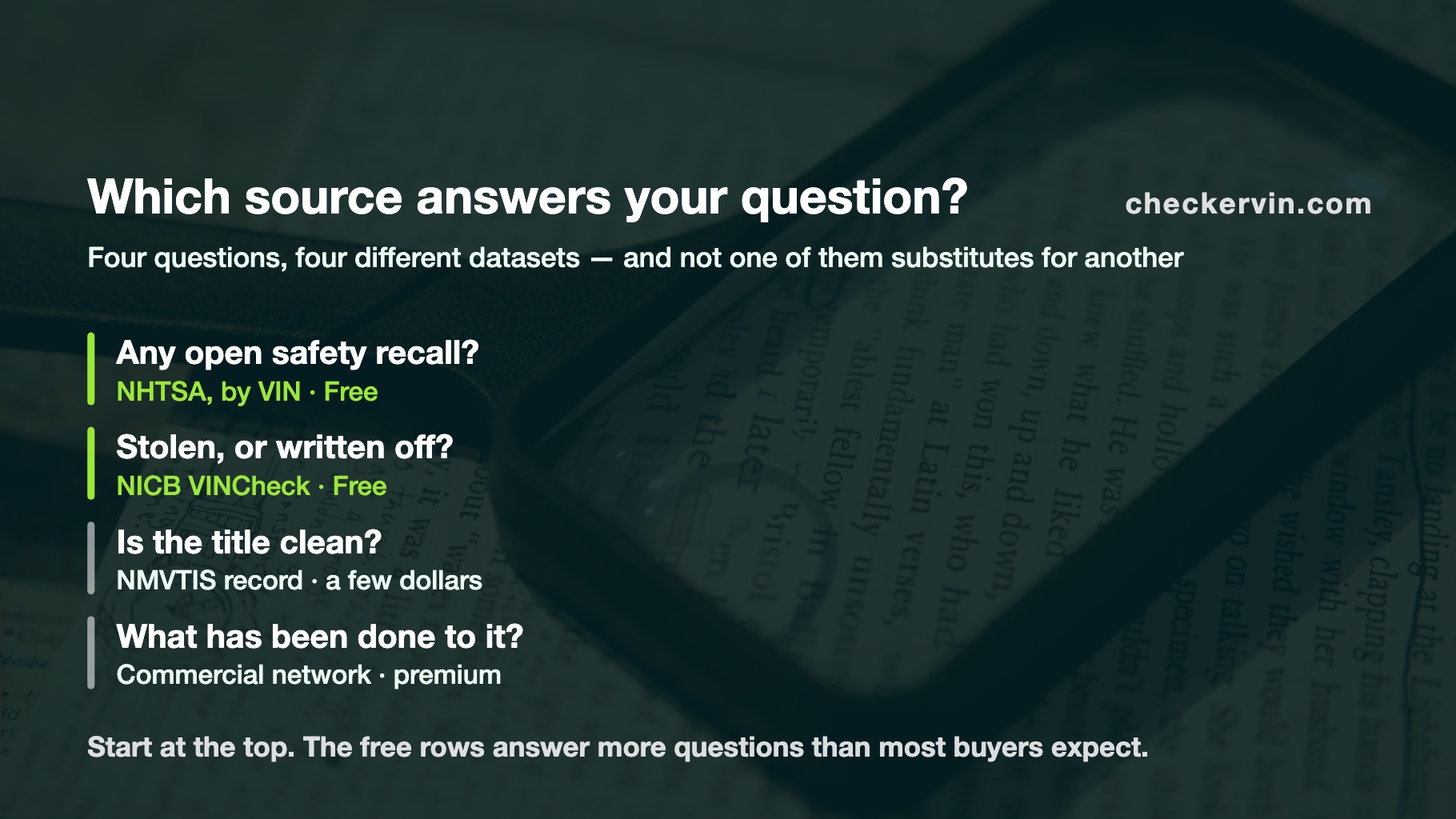
| Is this car what the seller says it is? | A free VIN decode. Nothing else required. |
| Does it have unrepaired safety recalls? | The free NHTSA lookup. Unlimited, no account. |
| Was it stolen or written off? | The free NICB VINCheck, plus an NMVTIS title record for a few dollars. |
| Is the title branded? | An NMVTIS approved provider. This is the authoritative source. |
| Has it been in accidents? | A paid commercial report. No free source carries this. |
| How many owners, and what service history? | A paid commercial report. |
| Is it mechanically sound? | None of the above. An independent inspection. |
The three tiers, in one paragraph
Alternatives sort into three tiers that stack rather than compete. Free federal and non-profit checks answer whether the car is what it claims and whether anything is outstanding on it. The few-dollar NMVTIS record answers the title question. Paid commercial reports add accident, service and ownership detail assembled from licensed private sources — the tier Carfax and AutoCheck occupy. A commercial report contains the title layer; a title record does not contain accidents, so working upward means paying only for what the cheaper tiers could not answer.
What each tier costs and when a purchase justifies moving up is worked through in what a vehicle history report costs. This page is about choosing between the named products once you have decided to spend.
Before any alternative: run the free checks
The free layer is not a consolation prize. NHTSA’s decoder and recall lookup, the NICB theft and salvage screen, CPSC recalls for powersports, and several manufacturers’ own window-sticker tools together establish whether a car is what it claims to be, whether work is owed on it, and whether an insurer has written it off — at no cost and with no account.
Run those first, because they change which paid alternative you need, or whether you need one at all. What is genuinely free, what is not, and why covers each source and the economics behind the paywall.
The few-dollar tier: NMVTIS
This is the tier most people skip, and it is frequently the one that answers their actual question. The National Motor Vehicle Title Information System is the federal database states report title brands into, created so a brand applied in one state cannot be shed by moving the vehicle.
Consumer access runs through approved providers, who charge a small per-report fee. The Department of Justice publishes the approved provider list free, which is the right place to start rather than searching.
- Use the published approved-provider list rather than a search result
- Expect a small per-report fee, not a subscription
- This is the authoritative source for title brands specifically
- It also carries odometer readings recorded at title transfer
- It does not carry detailed accident or service records
Among the approved providers, GoodCar bundles the federal title record with sales history and valuation rather than selling the title alone.
An alternative is a different dataset, not a cheaper one
The word “alternative” quietly assumes the products are the same thing at different prices. They are not, and the reason is structural rather than commercial. The federal title system is fed by reporting that the law requires — state titling agencies, insurers and the salvage trade report into it because they must. Commercial history networks are fed by garages, dealers and auctions that choose to participate, and coverage is the result of who signed up.
That is why no service is simply a discounted version of another. One dataset is complete in a narrow field by force of law; the other is broad but voluntary, and its gaps are invisible from the outside because a report cannot show you the shop that never reported. The mechanics of who must report, and what the federal record does and does not hold, are set out on our NMVTIS page.
The practical consequence is the one worth carrying into every comparison below. You are not shopping for a cheaper version of one product. You are deciding which dataset answers your particular question, and then paying the least you can to reach that dataset.
Who may sell you the federal record, and who may not
A claim repeated across the pages that rank for this search is that every well-known service is a federally approved NMVTIS provider drawing on the same title data. That is worth checking rather than believing, because the Department of Justice publishes the list and it does not read that way.
Checked on August 17, 2026, the list places CARFAX.com in a section headed Approved NMVTIS Data Provider’s Links for Commercial Customers Only, with the parenthetical note that CARFAX offers NMVTIS data to commercial customers in California only. Experian.com appears in that same commercial-only section. The page also carries a standing note stating that consumers cannot receive NMVTIS Vehicle History Reports from Carfax, DMVDesk or Experian, because those entities provide information only to car dealerships.
We are describing what the federal list records, not what any company does or sells generally. Carfax sells a great deal that has nothing to do with NMVTIS. The narrow, checkable point is which businesses that list clears to sell the federal title record to a member of the public — and the answer differs from what the search results say.
| Service | What the DOJ list records, checked August 17, 2026 |
|---|---|
| Carfax | Commercial customers only, California only, per the list's own parenthetical |
| AutoCheck (Experian) | Experian.com is in the commercial-customers-only section |
| Bumper | Public and commercial; the list also records it operating BeenVerified.com |
| VinAudit | Public and commercial; the list also records VinCheck.Info |
| EpicVIN | Public and commercial; also records VinGurus.com and Vininspect.com |
| GoodCar | Public and commercial; also records InfoTracer, Recordsfinder.com and StateRecords.org |
| carVertical, ClearVin, CheckThatVin | Public and commercial |
| Titlecheck.us, Vindata, Vinsmart, Carsforsale.com | Public and commercial |
Whether a paid report is worth it depends on the car, and you can tell in advance
The tier advice above stops one step short of the decision most people are actually making, which is not “which report” but “is any report worth buying for this particular car.” There is a free way to get most of the way to an answer, and no comparison article uses it.
A commercial report describes what has been reported about the one copy in front of you. The federal complaint record describes what owners of that entire model year have reported, and — because every complaint carries an incident date — how old those cars typically were when the problem showed up. That second number is what tells you whether a report can still help you.
The logic is simple. Where a model year’s dominant complaint arrives in the first couple of years, any used example has already lived through that window: the car either developed the fault or it did not, and an inspection settles it far more cheaply than a history report. Where the dominant complaint arrives late in a car’s life, a well-kept service record matters more, and that is what a paid report is good at.
| Model year and the component owners report most | Median vehicle age when reported |
|---|---|
| 2016 Hyundai Tucson — power train, 516 reports | 1.1 years, with 69% inside the first three. Already settled on any used example. |
| 2017 Honda CR-V — engine, 525 reports | 2.0 years, 66% inside three. Same early pattern; inspect rather than buy history. |
| 2013 Ford Edge — electrical system, 851 reports | 3.3 years. Mid-life onset, where a service record starts earning its price. |
| 2009 Nissan Murano — service brakes, 269 reports | 8.8 years, and only 1% inside three. Late onset that no report predicts. |
| 2013 Hyundai Elantra — service brakes, 282 reports | 10.7 years, 17% inside three. A younger example has not reached the window. |
Those are owner complaints filed with NHTSA rather than verified failure rates, and the median is taken only where a component carries enough dated reports to mean something. Used that way they are a sound guide to when a known weakness tends to appear, which is exactly the input the buy-or-skip decision needs. Our model year index carries this breakdown per vehicle, free, with no report purchase involved.
The paid tier
If you need accident records, service history or ownership counts, you need a commercial report. AutoCheck is the closest direct equivalent to Carfax — an established provider compiling the same categories of data from its own reporting network.
The two are not interchangeable and neither contains everything the other does, because the sources reporting into each differ. The detailed comparison covers where they diverge and when running both is justified.
Smaller and lower-cost providers
A number of smaller services sell VIN reports at prices below the established providers. Quality and sourcing vary, and it is worth understanding what you are buying rather than comparing on price alone.
Many resell NMVTIS data with their own presentation layer. That is entirely legitimate and can be good value if title brands are what you need — but it is the few-dollar tier with a different interface, not the paid commercial tier. A provider sourcing only NMVTIS cannot show you accident records that were never in NMVTIS.
- Ask what the provider actually sources before paying
- Check whether it is an NMVTIS approved provider, which is verifiable on the federal list
- Be cautious of any service that describes its coverage only after payment
- Watch for subscriptions presented as one-off reports
- A sample report published openly is a good sign; a sample available only after purchase is not
- Compare against the free tier first — some paid reports contain little the free checks do not
The report you do not have to buy
Before buying any alternative, ask whether one already exists. Dealers routinely provide a full report free on their own inventory, sellers who have already run one will often share it, and certified pre-owned programs sometimes include one. The free routes are set out in full here.
Matching the option to the question
- 1Decode the VIN — freeConfirms the vehicle matches its description. A discrepancy ends the process at zero cost.
- 2Check recalls — freeUnrepaired safety recalls are free to fix but are work you inherit.
- 3Run the theft and salvage lookup — freeBefore any money moves on a private sale.
- 4Pull the title record — a few dollarsThrough an NMVTIS approved provider. Authoritative on brands.
- 5Buy a commercial report — only if still a candidateFor accident and service detail the cheaper tiers cannot reach.
- 6Book an independent inspectionThe step with the highest value per dollar, and the one no report replaces.
Things that are not alternatives
- A free VIN decode — useful, but it describes the car as built, not what happened since
- A seller's assurance, however confident
- A clean NICB result, which covers participating insurers only
- A report the seller ran on a different vehicle or a year ago
- An inspection sticker, which certifies a moment rather than a history
- A low price, which is not evidence of anything except a low price
Test an alternative on a car you already know
Every recommendation on this page, including ours, asks you to trust a service you have not used on a car you cannot verify. There is a way out of that, and it costs nothing but a few minutes.
Run a VIN whose answer you already know.Your own car, a relative’s, the one you sold last year — a vehicle whose history you can check the output against. You know whether it was in a wreck, roughly what it read on the odometer when it changed hands, whether it ever carried a brand. Put that VIN through the service before you put through the one that matters.
What you are looking for is not a perfect match. Records are genuinely incomplete and a service can be honest and still miss things. You are looking for whether it can find anything at all on a car you know has a history, and whether what it does report is consistent with what you know to be true. A service that returns a confident, clean-looking report on a car you know was rear-ended is telling you exactly how much its silence is worth on any other car.
- Check the DOJ approved-provider list first — if a service claims federal title data and is not on it, that claim is doing work it has not earned
- Run a VIN you can verify independently before you run one you cannot
- Read what it says about a car you know has history, not only whether it returns something
- Look for a stated data source rather than only a polished output
- Prefer a per-report price to a subscription when you are buying one report
Red flags on sites promising free reports
A genuinely free full history report is not commercially possible. Any site offering one is doing something else, and knowing the patterns saves both money and personal data.
- A free summary that requires payment to reveal any detail
- An email or phone number demanded before anything is shown
- Enrollment in a recurring subscription described as a single report
- A free VIN decode presented as though it were a history report
- Payment details requested before the coverage is described
- No published sample report anywhere on the site
The alternative nobody markets
Every report of every tier describes what somebody reported. A great deal of what determines whether a used vehicle is a good buy never generates a record — cash repairs, unclaimed damage, deferred maintenance, corrosion, and the ordinary wear of age.
An independent pre-purchase inspection costs roughly what a commercial report does and answers a substantially larger question. If your budget only stretches to one of the two, the inspection is the better purchase — and combined with the free checks, it covers more ground than a report alone.
Where this information comes from
- NMVTIS — approved data provider list (U.S. Department of Justice)The page itself, not the site root — it names which providers may sell to the public, places CARFAX.com under commercial customers in California only, and carries the consumer note. Read August 17, 2026; status can change, so check the date against today's
- NHTSA complaint databaseThe public complaint record behind the model-year figures above, including the incident dates the median ages are derived from
- NHTSA recall lookupFree, unlimited open-recall check by VIN
- NHTSA vPIC — public VIN decoderFree, unlimited factory build data by VIN
- NICB VINCheckFree theft and salvage lookup, five searches per day
Keep reading
Frequently asked questions
Is there a free alternative to Carfax?
For parts of what it does, yes. NHTSA covers recalls and the factory decode free and unlimited, and NICB covers theft and salvage free. For the accident, service and ownership detail, no free equivalent exists — that data is licensed commercially.
What is the most reliable VIN check site?
Reliability is not one property, so match the source to the claim. For title brands, the reliable source is the federal NMVTIS record bought from a provider the Department of Justice lists for public customers. For open recalls it is NHTSA directly. For theft and salvage it is NICB VINCheck. A site is reliable to the extent you can name where its data came from, which is why the approved-provider list is more useful than any review.
Is AutoCheck a good alternative to Carfax?
It is the closest direct equivalent — a paid commercial report from an established provider. The two compile from different reporting networks, so neither contains everything the other does. Which suits you depends on whether you value service records or auction coverage more.
Can I get a free VIN check from Carfax?
Not a full report. Carfax publishes some free lookups and dealers routinely provide a report on a car they are selling, which is the usual way to read one without paying. What you cannot do is buy the federal NMVTIS title record from Carfax as a consumer: the Department of Justice list, checked August 17, 2026, records CARFAX.com for commercial customers in California only and states that consumers cannot receive NMVTIS reports from it.
What does no alternative replace?
A pre-purchase inspection by an independent mechanic. Every report describes what was reported; an inspection describes the car in front of you. It costs roughly the same as a report and answers a larger question.
Start with the free tier
Decode any VIN free for the factory build, specifications and open safety recalls. No account, no card.
Run a free VIN check