The short answer
- Where do I check?
- NHTSA's recall lookup at nhtsa.gov/recalls. It takes the 17-character VIN, it is free, it needs no account, and it reports recalls left unrepaired on that specific vehicle.
- Why do other tools show different results?
- Because the public federal data API is model-level. It answers 'what was ever recalled for this model year', which is a much longer list than 'what is still open on this car'.
- What does a clean result prove?
- That no recall is currently outstanding. It does not prove the repairs were done well, and it says nothing about defects that never became recalls.
Free
Official VIN recall lookup
nhtsa.gov/recalls, no account
400
HTTP status when the API gets a VIN
The public API is model-level
33
Recalls on one 2020 model
Another that year has 3
$0
Cost of the remedy to any owner
The duty follows the vehicle
The short answer
Go to NHTSA's recall lookup, enter the seventeen characters, and read what comes back. It is free, it is the federal government's own tool, and nothing sold by anybody improves on it for this specific question. We are not going to pretend otherwise — a page that buries the official free answer in order to sell something is the reason people distrust this category.
What this page adds is the part the tool does not explain: which of the two federal recall datasets you are actually looking at, what the answer means, and the specific things a clean result does not tell you.
Model-level and VIN-level are different questions
NHTSA publishes recall information two ways, and the gap between them explains most of the confusion around this topic.
| What you use | What it answers |
|---|---|
| The VIN lookup on nhtsa.gov | Does this specific vehicle have a recall that has not yet been remedied? A question about one car |
| The public recall data API | What recalls were ever issued for this make, model and model year? A question about a population |
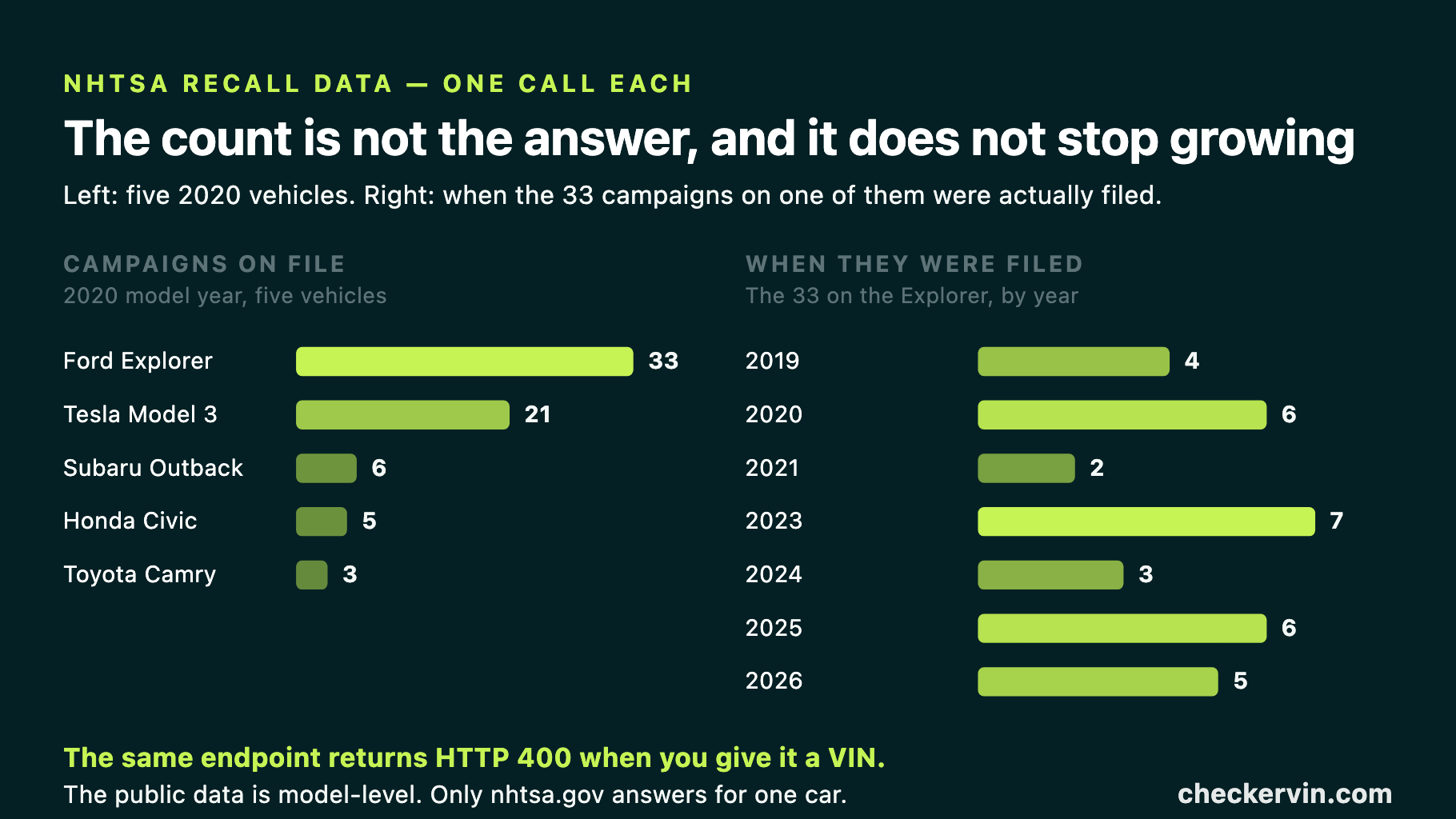
We tested the second one. Passing a make, model and model year returns the full campaign list for that combination. Passing a VIN to the same endpoint returns HTTP 400 — the parameter is not accepted at all. The public data interface is model-level by design, and only the web tool resolves an individual vehicle.
So the practical rule is simple. If a result shows a long list of campaigns for a car that has had several owners and regular servicing, you are almost certainly looking at the model-level list. The VIN-level answer on a well-maintained used car is usually short, and often empty.
How much recall counts differ between models
To show what the model-level list looks like in practice, we queried the federal API for five ordinary 2020 vehicles on the same day. Same model year, same endpoint, one call each.
| 2020 model year | Recall campaigns on file |
|---|---|
| Ford Explorer | 33 |
| Tesla Model 3 | 21 |
| Subaru Outback | 6 |
| Honda Civic | 5 |
| Toyota Camry | 3 |
A spread of about 11× within a single model year. Two things follow. The first is that “this model has recalls” is a nearly meaningless statement on its own, because almost every model does and the counts vary enormously for reasons that include how many units were built and how thoroughly the manufacturer reports.
The second is that a high count is not automatically a warning. A campaign is evidence that a defect was found and a free remedy was ordered, which is the system working. The number that should concern a buyer is not how many recalls a model has had — it is how many are still open on the specific car in front of them, which is a number the model-level list cannot produce.
A recall check has a shelf life, and it is shorter than people assume
The most common mistake with recall checking is treating it as a one-time task performed at purchase. The federal data shows why that fails, and the evidence is in the same 2020 vehicle we queried above.
Its 33 campaigns were not all filed when the car was new. Grouping them by the year each campaign was issued gives this.
| Campaign filed in | Campaigns |
|---|---|
| 2019 | 4 |
| 2020 | 6 |
| 2021 | 2 |
| 2023 | 7 |
| 2024 | 3 |
| 2025 | 6 |
| 2026 | 5 |
A vehicle built for the 2020 model year was still collecting recall campaigns in 2026 — 5 of them. Defects surface as a fleet ages and as failures accumulate in the field, so the recall list for any given car is not a fixed property of the car. It grows.
It also reframes what a clean result at the point of sale is worth. It is a true statement about that day, not a property of the vehicle you are buying, and a seller who produces a printout from last year is showing you a document that has aged.
Reading a campaign number
Every campaign carries an identifier that looks opaque and is not. All 33 on the vehicle we queried follow one pattern, and once you can read it the number tells you two useful things before you open the record.
| Part of the number | What it means |
|---|---|
| First two digits | The year the campaign was filed — 19 is 2019, 24 is 2024 |
| The letter in the middle | The campaign type. V is a vehicle campaign, which is what a recall on the car itself will be |
| The final six digits | A sequence number, not a severity or a priority |
So a campaign beginning 19V is a vehicle recall filed in 2019, and one beginning 26V was filed this year. On a used car that leading pair is the fastest way to see whether you are looking at something long-standing that previous owners had years to address, or something new that nobody has acted on yet.
Quote the whole number when you call a dealer. It is the reference their system uses, and it removes any ambiguity about which of several campaigns you mean.
What a recall record actually contains
Each campaign in the federal data carries a fixed set of fields, and knowing them makes the result far easier to act on.
| Field | What it gives you |
|---|---|
| Campaign number | The manufacturer's and NHTSA's shared reference — quote it to a dealer and they know exactly which job you mean |
| Component | The system affected, often very specific — the fuel delivery lines rather than just the fuel system |
| Summary | What is wrong, in plain terms |
| Consequence | What the defect can cause, which is where severity actually lives |
| Remedy | What the manufacturer will do about it, at no charge |
| Report received date | When the campaign was filed, which tells you how long it has been outstanding |
The Consequence field is the one to read first. Recalls are not ranked by severity in the data, so two campaigns that look alike in a list can differ enormously in what they can do to you — and the consequence text is where that difference is stated.
What actually gets recalled
Taking all 68 campaigns across the five 2020 vehicles above and grouping them by the system involved produces a picture that surprises most people.
| System recalled | Campaigns across the 68 |
|---|---|
| Back over prevention | 11 |
| Electrical system | 10 |
| Power train | 9 |
| Seat belts | 6 |
| Fuel system | 6 |
| Air bags | 6 |
The leader is back over prevention — rear visibility systems, which on a modern car means the reversing camera and the software behind it. Together with electrical system campaigns, that is roughly a third of the sample, and it reflects what modern vehicles now are: the recalls follow the electronics because the safety-critical function increasingly lives there.
This has a practical edge for a buyer. A camera or software campaign is usually quick, sometimes deliverable over the air, and almost never a reason to walk away from a car — while a fuel system or seat belt campaign is a different conversation. Reading the component before the count is what separates those two situations, and a raw recall total does not distinguish them at all.
The two flags that mean stop driving it
Buried in the recall data are two boolean fields that almost nothing surfaces, and they are the most important values in the record.
- Park It — the vehicle should not be driven at all until the remedy is performed
- Park Outside — the vehicle should not be parked in a garage or near a structure, because the defect can cause a fire when parked
- Over-the-air update — the remedy can be delivered as software, without a workshop visit
The second one is the reason a recall notice sometimes tells owners to keep a car away from the house. If either flag is set on an open recall for a vehicle you are about to buy, that is not a negotiating point — it is a reason not to drive the car home.
None of the five 2020 vehicles we queried carried either flag on any campaign, which is the normal case. They exist for the exceptions, and the exceptions are the ones worth catching.
Why the repair costs nothing, whoever you are
A manufacturer that determines a safety defect or a noncompliance exists must remedy it without charge, and that duty attaches to the vehicle rather than to the person who bought it new. A third owner has the same entitlement as the first.
This is worth stating plainly because it is the single most under-used right in used-car buying. An open recall on a car you are considering is free to fix, at a franchised dealer for that marque, regardless of where you bought the car or how many owners it has had. Our page on buying a car with an open recall covers how to treat one in a negotiation.
Why the manufacturer's lookup exists at all, and who has none
The carmaker's own VIN recall page is not a courtesy. It is a requirement, and the rule is specific about what the tool has to do.
49 CFR 573.15 obliges qualifying manufacturers to publish recall information for the vehicles they made on the internet, in a format searchable by make and model and by VIN, that preserves consumer privacy, and that covers each recall that has not been completed for each vehicle.
The duty attaches above a size line. It applies to manufacturers that made, sold, offered for sale, introduced into interstate commerce or imported 25,000 or more light vehicles, or 5,000 or more motorcycles, in the current or prior calendar year.
If you already paid to fix it, you may be owed the money back
Here is the provision almost nobody knows about, and it is the reason a recall check can be worth money rather than merely worth doing.
Under 49 CFR 573.13, made under 49 U.S.C. 30120(d), every manufacturer must maintain a plan to reimburse owners and purchasers for what the regulation calls a pre-notification remedy— defined as a repair performed on a vehicle “for a problem subsequently addressed by a notification” of a safety defect or noncompliance. In plain terms: you paid to fix something, and the manufacturer later recalled it for exactly that problem.
| What the rule establishes | What it means for an owner |
|---|---|
| A claimant is a person seeking reimbursement for a pre-notification remedy they paid for | The right belongs to whoever actually paid, which on a used car may be a previous owner or may be you |
| The manufacturer's plan must specify a period for reimbursement | There is a window, it is set by the plan rather than by you, and it is why acting promptly matters |
| Plans may be general, and must be updated every two years | The plan is not invented per recall; there is a standing one behind each manufacturer |
| Remedy programs and reimbursement plans are available for public inspection at NHTSA | The terms are not a trade secret you have to take on trust |
So the sequence worth knowing is this. If a repair bill in the service history matches the component of a recall campaign filed afterwards, that is not merely an interesting coincidence — it is the fact pattern the regulation was written for. Ask the manufacturer about reimbursement, quoting the campaign number and the invoice.
How far back reimbursement reaches, and the conditions a plan may impose
The window above is defined rather than left to the manufacturer, and the beginning date depends on how the recall came about.
| 49 CFR 573.13(c) | The date |
|---|---|
| Begins — noncompliance | The date of the first test or observation, by NHTSA or the manufacturer, indicating that a noncompliance may exist |
| Begins — defect after an Engineering Analysis | The date the EA was opened, or one year before the manufacturer's 573.6 notification, whichever is earlier |
| Begins — defect with no EA opened | One year before the manufacturer's notification to NHTSA under 573.6 |
| Ends — vehicles | No earlier than 10 calendar days after the manufacturer mailed the last of its owner notifications under Part 577 |
In the ordinary case that means a repair paid for in the year before the manufacturer told NHTSA about the problem is inside the window. That is a longer reach than most owners assume when they decide the timing has ruled them out.
A plan may carry conditions, and here the drafting is unusually helpful. Section 573.13(d) says the plan shall provide for reimbursement subject to the conditions established in it, and then adds that the following conditions and no others may be established. It is a closed list: a condition that does not appear in the rule is not one the plan may impose.
What may not be sold while it is under recall
Two prohibitions in the same part answer a question buyers ask constantly, and the pair is the opposite shape to what most people expect.
49 CFR 573.11 binds dealers holding a new vehicle or new replacement equipment. Once the manufacturer has notified them about a defect in something in their possession, they may sell or lease it only if the defect is remedied as required by 49 U.S.C. 30120 before delivery.
49 CFR 573.12 is broader. Subject to its exceptions, no person may sell or lease any new or used item of motor vehicle equipment — the rule says including a tire — for installation on a vehicle, where that item is the subject of a recall, in a condition in which it may reasonably be used for its original purpose.
There is a list with your VIN and your remedy status on it
A campaign is not only notices going out. It is a maintained record, and its contents are specified.
Under 49 CFR 573.8, each vehicle manufacturer keeps a list of registered owners — from state registration records or other sources, or the most recent purchasers where the registered owner is unknown — for every vehicle in a campaign. The list must carry the VIN for each vehicle and the status of remedy for each vehicle, updated at the end of each quarterly reporting period, and it is retained for five years.
That is the record a manufacturer lookup reads from, which is why it answers per vehicle rather than per model. It also explains the common complaint that the notice went to somebody else: the addresses come from registration records, so they follow whoever was registered at the time rather than whoever is driving it now.
One further provision is worth knowing when a remedy stalls. Under 49 CFR 573.14, the Administrator may require a manufacturer to run an accelerated remedy program — expanding parts sources, repair facilities, or both — on three findings together: risk of serious injury or death without acceleration, that acceleration can reasonably be achieved, and that the manufacturer's program is unlikely to complete within a reasonable time. It is a discretionary power rather than something an owner can invoke, but it makes a stalled remedy a legitimate thing to raise rather than simply a queue.
Checking one properly, in order
- 1Take the VIN off the car, not the advertRead it from the windshield plate and confirm it against the driver's door jamb label. A VIN typed from a listing reproduces the listing's typos, and a mismatch between those two locations is a much bigger problem than any recall.
- 2Run it through NHTSA's own lookupnhtsa.gov/recalls, seventeen characters, no account. This is the VIN-level answer, and it is the one worth having.
- 3Read the consequence, not the countOne campaign whose consequence is a fire risk matters more than six that do not. The number of results tells you very little on its own.
- 4Check for the park-it flagsIf a recall says do not drive or do not park indoors, act on it before anything else, including before the test drive.
- 5Ask the dealer to confirm by VINA franchised dealer for that marque can see the manufacturer's own record of what was performed on that vehicle. This catches the case where a campaign was completed but the federal record lags.
What a clean recall result does not prove
A clear result is good news about one narrow question. It is routinely over-read, so here is what it does not cover.
- That the recall repairs were performed correctly — the record shows completion, not quality
- That the vehicle has no defects, only that none has become a recall campaign
- Anything about problems handled through a technical service bulletin instead
- Accident history, title brands, odometer accuracy or lien status, none of which appear in recall data
- That a recall will not be issued next month for a defect already present today
The last one is worth sitting with. Recall campaigns are filed after a defect is identified, which means a vehicle can be carrying a fault that is entirely real and simply has not been recognized yet. A clean result is a statement about the record as it stands, not a warranty on the machine.
Our free decode returns what a vehicle was built as, with recall information for that model year from federal sources. It does not return accident, title-brand or odometer history, and nothing here should be read as a promise that it does.
Recall checks by manufacturer
The federal tool is marque-agnostic and works for everything. Where a manufacturer runs its own VIN lookup, or has campaign patterns worth knowing about, we cover it separately.
- Toyota, Honda and Ford each run their own VIN-level owner portals alongside the federal tool
- A franchised dealer can always see more than a public tool can, because they query the manufacturer's own system
- Marque pages are the place for model-specific campaign history; this page is the general method
Start with Toyota, Honda, Ford, Chevrolet, Nissan, Jeep, Subaru, BMW, Hyundai, Mazda, Ram, Tesla, Volkswagen or tires, which follow different rules entirely.
Where this information comes from
- 49 CFR 573.15 — public availability of recall informationThe VIN-searchable duty and the 25,000 light vehicle / 5,000 motorcycle thresholds
- 49 CFR 573.12 — prohibition on sale of defective equipmentNo person may sell new or used recalled equipment, including a tire, for installation
- 49 CFR 573.8 — lists of owners and remedy statusThe per-VIN remedy status behind every manufacturer lookup, retained five years
- NHTSA recall lookup — by VINThe official free VIN-level tool, and the one this page points to
- NHTSA recalls API — recallsByVehicleThe model-level public endpoint tested here; it rejects a VIN parameter
- 49 CFR 573.13 — reimbursement for pre-notification remediesThe rule requiring manufacturers to reimburse repairs that predate a recall
- NHTSA vPIC — public VIN decoderFederal build data behind a free decode, no account required
- NICB VINCheckFree theft and salvage lookup contributed by participating insurers
Keep reading
Frequently asked questions
How do I check a recall by VIN for free?
Use NHTSA's own recall lookup at nhtsa.gov/recalls, which takes a 17-character VIN and reports recalls that remain unrepaired on that specific vehicle. It is free, official, and no account is required — and it is the tool we point people to rather than trying to replace.
Is the free federal recall data searchable by VIN?
The web tool is. The public data API is not — it accepts a make, model and model year and returns every recall for that combination, and a request carrying a VIN is rejected outright. That is why third-party recall pages usually show model-level results even when they invite you to enter a VIN.
What is the difference between a recall existing and a recall being open?
A recall exists for a model year if the manufacturer ever issued one. It is open on a particular vehicle only if that vehicle has not yet had the remedy performed. The first is a fact about a population and is nearly always yes; the second is a fact about one car and is the one that matters when buying.
Does a recall repair cost the owner anything?
No. A manufacturer must remedy a safety defect or noncompliance without charge, and that duty follows the vehicle rather than the original buyer, so a second or fifth owner is entitled to the same free repair.
Do recalls expire if the car is old?
The obligation to remedy without charge is not open-ended in every case, and very old campaigns can fall outside it, but in practice manufacturers routinely perform long-standing recall work at no cost. The way to find out for a specific vehicle is to give the VIN to a franchised dealer for that marque and ask.