The short answer
- What is NMVTIS?
- The National Motor Vehicle Title Information System — the federal database state titling agencies, insurers and salvage businesses must report into. It is where title brands, junk and salvage reports, and title-event odometer readings live.
- How do you get a report?
- Through an approved provider, for a few dollars. There is no free consumer portal — the report fee is the entire cost of the national title record.
- Why does it matter?
- Because reporting is mandatory. A flood brand issued in Louisiana reaches NMVTIS even if no commercial report provider ever bought the record — which is exactly how washed titles get caught.
Federal
Whose system it is
Run under the Department of Justice
$2–20
Typical report price
Via approved providers
Mandatory
Reporting by law
States, insurers, salvage businesses
Title
What it covers — and only that
Brands, chains, title odometers
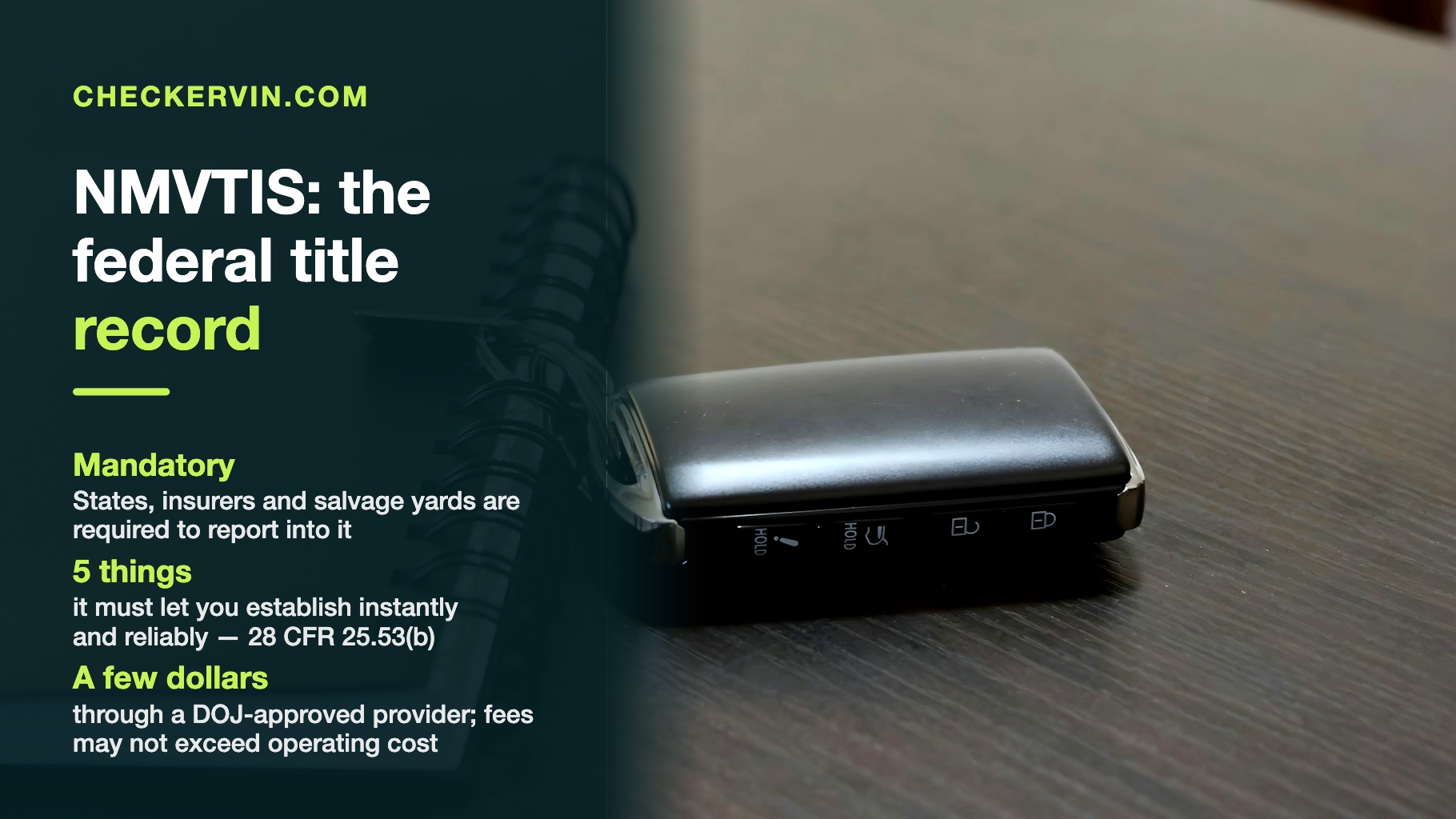
What NMVTIS is — the mandate, not the marketing
The National Motor Vehicle Title Information System exists because title washing used to work: brand a car salvage in one state, retitle it clean in another, and the paper trail broke at the border. Federal law closed the loop by requiring state titling agencies, insurance carriers and junk/salvage businesses to report into one national system — with civil penalties for silence. The Department of Justice oversees it, and consumer access flows through approved providers rather than a government portal.
The mandate is the point. Commercial history products buy data where they can; NMVTIS receives it because the law says so. When a title brand seems to have vanished between states, this is the system that still remembers it.
What a report shows
| Field | What you learn |
|---|---|
| Title chain | Which states titled the vehicle and when — the geography of its life |
| Brand history | Salvage, flood, junk, rebuilt and the rest, from every reporting state |
| Odometer at title events | The mileage sworn at each transfer — a rollback tripwire |
| Total-loss reports | Insurer write-offs, even when no state brand followed |
| Junk & salvage reports | Auction and dismantler entries from the businesses that must file |
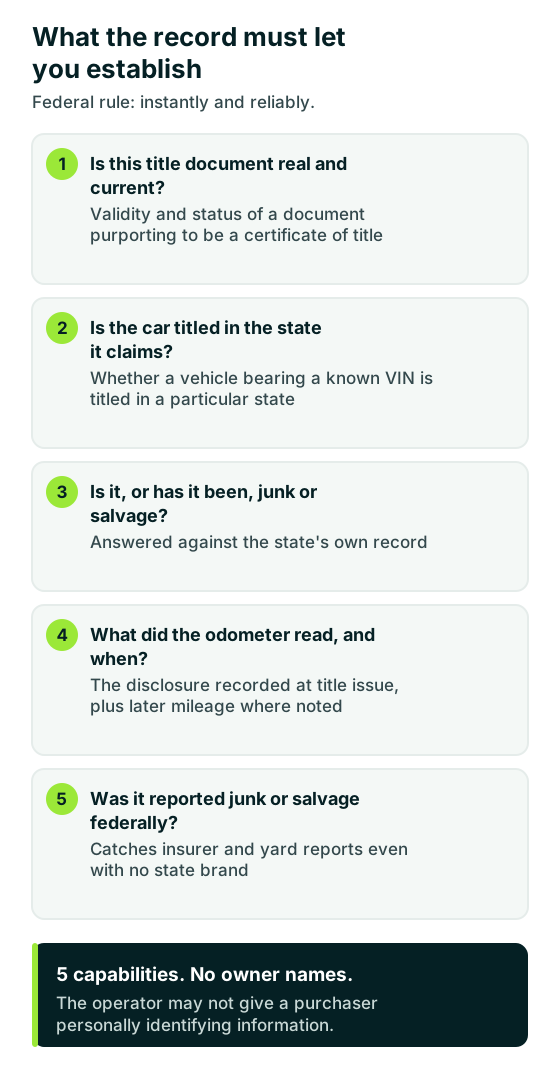
The five things the system must let you establish
Most descriptions of this report, including the ones written by people who sell it, describe what tends to appear on it. The regulation is more useful than that, because it sets out what the system is requiredto let a user establish — and it uses the words “instantly and reliably.”
| What you must be able to establish | Why it is the one that matters |
|---|---|
| The validity and status of a document purporting to be a certificate of title | The check against a forged or superseded title — the one no commercial report performs |
| Whether a vehicle bearing a known VIN is titled in a particular state | Places the car in a state system, which is where the authoritative record lives |
| Whether a vehicle titled in a state is or has been a junk or salvage automobile | The brand question, answered against the state's own record rather than a reseller's copy |
| The odometer disclosure recorded when the title was issued, plus later mileage where noted | A mileage figure with a date attached to it, which is what makes a rollback visible |
| Whether a vehicle has been reported junk or salvage under federal law | Catches the insurer and salvage-yard reports even where no state brand followed |
Read them together and the shape of the product becomes clear. This is a title and disposal record, built to be checked against, not a narrative of a car’s life. Four of the five are about the paperwork and the fifth is about the odometer. Nothing in that list is a service history, a photograph or an accident description, which is exactly why the comparison further down this page is not a like-for-like one.
The regulation names you specifically
There is a short passage worth knowing about, because it settles a question people ask in a roundabout way: am I actually allowed to have this, or am I buying a copy of something meant for the trade?
The rule listing the operator’s duties requires it to make information available on request to four categories: a participating state, a government or law enforcement official, a prospective or current insurer, and a prospective purchaser of an automobile, about that automobile. You are not an incidental beneficiary of a system built for someone else. You are one of the four named parties.
The check nobody else can run: is this title real?
Of the five capabilities, the first is the one with no commercial equivalent, and it is badly underexplained everywhere. The system has to let a user establish the validity and status of a document purporting to be a certificate of title.
Consider what that phrasing admits. The document in the seller’s hand is, until checked, merely purporting to be a title. It might be genuine and current. It might be genuine but superseded, because a duplicate was issued or the vehicle was retitled in another state. It might be a forgery. A commercial history report does not answer this, because it describes events reported about a vehicle rather than adjudicating the piece of paper you are being shown.
- A title that was valid when printed but has since been replaced by a duplicate
- A title from a state where the vehicle is no longer titled, because it moved
- A title showing an owner who has since transferred the vehicle
- A document that never corresponded to a state record at all
- A brand recorded in the state system that the printed document predates
This is why the sequence matters more than the purchase. Establishing that a title is current, in the state it claims, naming the person trying to sell you the car, is a different act from reading a list of past events — and it is the act most likely to stop a bad purchase before money moves.
Why the mandatory reporting is the whole argument
The claim you will see repeated is that this is the only vehicle history system every state, insurance carrier and salvage yard is required by federal law to report into. That is accurate, and it is worth knowing which rule imposes each duty rather than taking the sentence on trust.
| Who reports | What the rule requires |
|---|---|
| States | Titling information for all automobiles, in electronic form, once every 24 hours |
| Insurance carriers | A monthly inventory of vehicles they took as junk or salvage, or determined a total loss |
| Junk and salvage yards | A monthly inventory of what they obtained, with named fields, unless the state already passes it on |
Our damage reported guide works through the insurer and salvage-yard duties in detail, and our lien check guide covers what the state duty does and does not include. The point for this page is narrower: a commercial database gets what its partners choose to send, while this one gets what the law compels. That difference is the reason a cheap federal record can beat an expensive commercial one on the specific questions above, and lose to it on everything else.
How to get one — approved providers, a few dollars
Consumer reports come from the system’s approved data providers — the official list lives on the NMVTIS site — at prices that run from about two dollars to twenty depending on the reseller and packaging. The data underneath is the same system; paying more buys interface, not extra federal records. Buy from the official list, skip anything that arrived via a search ad promising a “free NMVTIS report,” and expect the report in minutes.
Why you go through a provider instead of querying it yourself
A reasonable question, once you know the rule names you as someone the operator must serve: why is there a middleman at all? The answer is in the same set of duties, and it is more deliberate than it looks from outside.
The means by which the operator provides access to users has to be approved by the Department of Justice. The operator must also develop and maintain a privacy policy covering the information in the system and how personal information is protected, and that policy is itself reviewed and approved by the Department. Access is not simply switched on; it is a channel somebody signed off.
There is a second channel that has nothing to do with consumers. With departmental approval, the operator may let the public and private entities that supplyinformation to the system also query it — but only where that access assists efforts to prevent stolen vehicles and parts entering or re-entering interstate commerce. A salvage yard checking what it has been offered is doing the thing the system was built for.
| Who is querying | On what basis |
|---|---|
| A state | As a participant, on request |
| Law enforcement | About a vehicle, or about a junk or salvage yard |
| An insurer | About a vehicle it insures or is considering |
| You | About one vehicle, through a DOJ-approved access channel, with no personal data attached |
| A reporting business | Only where it helps keep stolen vehicles and parts out of commerce |
So the approved provider is not a reseller who inserted themselves into a public resource. It is the approved access channel, which is also why the list of who may sell you one is published rather than left to the market — our alternatives guide works through that list and what it does and does not tell you about a given service.
The practical consequence is small but worth stating: shop on price and presentation among approved providers, because the underlying answer to those five questions comes from the same system regardless of whose logo is on the page. Where reports differ is in what each provider adds around that core, not in the federal record itself.
What you are not allowed to get, and why it is not free
Two boundaries sit in the same paragraph of the rule, and between them they answer the questions people most often ask after reading about the system.
The first is a hard limit on identity. The operator may not make personally identifying information held in the system — the rule gives the name or address of a vehicle’s owner as its examples — available to an individual prospective purchaser. It is also barred from collecting social security numbers at all. So the record answers questions about the vehicle and refuses questions about the person, by design rather than by omission.
The second boundary explains the price. The operator is required to establish user fees biennially and collect them at least annually from states and users to pay for running the system — and it may not collect fees in excess of the costs of operating it. Fees have to be approved by the Department of Justice, and state fees must be set at least a year before they take effect.
That is why a federally mandated record still costs a few dollars rather than nothing, and it is also why it costs a few dollars rather than a lot. A cost-recovery ceiling written into the rule is an unusual thing to find behind a consumer product, and it is the reason this sits in a different price tier from the commercial reports it gets compared to.
NMVTIS vs commercial reports — different animals
The commercial products — Carfax, AutoCheck and their competitors — are aggregation businesses: dealer records, service chains, police reports, auction photos, whatever their partnerships reach. NMVTIS is narrower and harder: titling events only, but from everyone who is legally required to file. Each catches what the other misses. A service history proves maintenance NMVTIS never sees; a junkyard report reaches NMVTIS even when no commercial provider bought that yard’s data. Our AutoCheck vs Carfax comparison covers the commercial side; the honest sequence for a buyer is the federal record first, the commercial extras second.
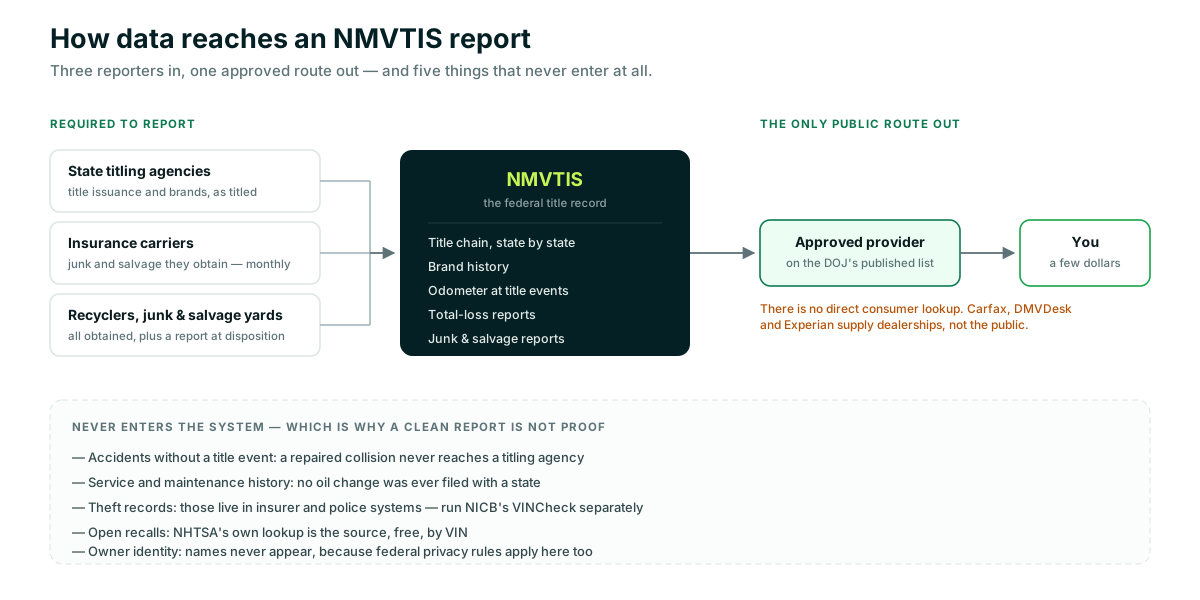
Who reports into it, and how often
NMVTIS is not a voluntary industry pool. Federal rules oblige specific businesses to feed it, which is why it holds records no commercial service can decline to buy.
| Who | What they must report |
|---|---|
| State titling agencies | Title issuance and brands as vehicles are titled |
| Insurance carriers | Junk and salvage automobiles they obtain, reported monthly |
| Auto recyclers, junk and salvage yards | All salvage or junk vehicles obtained, including on behalf of insurers |
| Salvage yards, on disposition | A supplemental report at final disposition, or within 30 days of it |
The disposition rule exists because a yard may hold a vehicle for months or years before its fate is settled. The obligation follows the car rather than the calendar.
A total loss reaches the record even if nobody paid out
This is the detail worth carrying into any used purchase, and almost nobody knows it.
An insurance carrier’s determination that a vehicle is salvage or a total loss must be reported to NMVTIS regardless of whether a claim is actually paid. The trigger is the assessment, not the settlement.
Who is allowed to sell you one
Access is not open. The Department of Justice publishes the list of businesses approved to provide NMVTIS vehicle history reports to consumers, and only those businesses may supply the federal record to the public.
The same page carries a sentence that reframes the whole category: consumers cannot receive NMVTIS reports from Carfax, DMVDesk or Experian, because those entities provide the information to car dealerships only. The best-known name in vehicle history is not a route to the federal title record for a private buyer.
Some approved providers also have affiliated businesses operating under their approval, listed beneath them on the same page. So a service you have not heard of may be legitimate — and one making confident federal-data claims while appearing nowhere on that page is worth a second look.
Two services worth reading against that list: VinCheckPro and VinCheckUp both advertise federal-looking data, and neither appears on the approved-provider page.
The gaps, honestly
- Accidents without title events — a repaired fender-bender never reaches a title system
- Service and maintenance history — no oil change has ever been filed with a titling agency
- Theft records — run NICB's VINCheck separately; theft lives in insurer and police systems
- Open recalls — NHTSA's lookup is the source, free, by VIN
- Owner identity — names never appear; the federal privacy rules apply here too
Reading a report like a pro
- 1Walk the state chain firstEach state transition is a question: why did the car move? Auction corridors and flood states in the chain set your inspection agenda.
- 2Match odometer readings in orderTitle-event mileages should climb. A backwards step is documentary rollback evidence — walk away or get the explanation in writing.
- 3Treat total-loss without a brand as a brandAn insurer write-off that never became a state brand is the classic washed-title shape. Price it like the brand it should carry.
- 4Finish with the free layersNHTSA recalls, NICB theft, and the decode — the VIN's free records complete what the title system starts.
Decode any VIN free
Decoded from official manufacturer and NHTSA records
Where this information comes from
- 28 CFR 25.53 — responsibilities of the NMVTIS operatorNames a prospective purchaser as an entitled requester, lists the five things the system must let a user establish instantly and reliably, bars personally identifying information to individual purchasers, and caps user fees at the cost of operating the system
- NMVTIS — official consumer siteThe system, the mandate, and the approved provider list
- Bureau of Justice Assistance — NMVTIS programThe federal program behind the database
- NMVTIS — who reports, and on what scheduleInsurer, recycler and salvage-yard obligations, including the disposition rule
- NICB VINCheckThe theft-and-salvage screen NMVTIS does not replace
- NHTSA recall lookupOpen recalls, free, by VIN
Keep reading
Frequently asked questions
What is an NMVTIS report?
A vehicle history pulled from the National Motor Vehicle Title Information System — the federal database that state titling agencies, insurers and junk/salvage businesses are required by law to report into. It shows the title's state-by-state chain, brand history, odometer readings at title events, and salvage or total-loss reports.
How much does an NMVTIS report cost?
A few dollars — approved providers sell reports in the $2 to $20 range depending on the reseller. There is no free federal portal for consumers; the modest fee is the whole price of the national title record.
Is NMVTIS better than Carfax?
Different, and complementary. NMVTIS is the legally mandated title system — brands, junk and salvage reports reach it even when no commercial provider bought the data — but it carries no accident narratives, service records or listing photos. Commercial reports add those layers and miss some brands. A careful buyer reads NMVTIS for the title truth and treats commercial extras as context.
What does NMVTIS not show?
Accidents that never generated a title event, service and maintenance history, ownership counts by name, theft records (check NICB separately), and open recalls (check NHTSA). It is a title system, and its authority ends where titling paperwork ends.
Who is required to report to NMVTIS?
State titling agencies, insurance carriers that total vehicles, and junk, salvage and self-insured businesses — under federal law with civil penalties for failure. That mandate is why brands from one state resurface when a washed title crosses into another.
The title record costs $2 — start with the free decode
Decode any VIN free for the factory build, specifications and open safety recalls. No account, no card.
Run a free VIN check