The short answer
- What is Carfax built from?
- A large proprietary database aggregating reports from service facilities, insurers, agencies and auctions. Its strength and its limits both follow from who reports in.
- Can consumers get NMVTIS from Carfax?
- No. The Department of Justice states that Carfax supplies NMVTIS reports to car dealerships only. Consumers buy the federal record from approved providers instead.
- What does no report cover?
- Damage that was never reported. A collision repaired privately and paid in cash leaves no record with anyone, so it appears on no report at any price.

Private
The database model
Coverage follows who reports
Dealers
Who gets NMVTIS from Carfax
Consumers cannot, per the DOJ
Records
What a report contains
Records of events, not events
Free
Recalls and theft screening
Before you pay anyone
What Carfax actually is
Carfax is a commercial vehicle history service built on a proprietary database. That sentence sounds unremarkable and it is the key to reading everything the service produces. A proprietary database is not a public register with a legal duty behind it; it is a large private aggregation, and its value is a direct function of how many organizations send it information and how consistently they do so.
Carfax has been at this a long time and the aggregation is genuinely large, which is why the name became shorthand for the whole category. But “large private database” and “complete record” are different claims, and the gap between them is where most buyer disappointment lives. Nothing here is a criticism of the company. It is a description of what the product is, which the marketing in this category rarely supplies.
Where the data comes from, and why that governs everything
Commercial history reports are assembled from reporting relationships: repair and service facilities, state agencies, insurers, auction houses, inspection stations, fleet and rental operators. Each relationship is a channel, and each channel covers a slice of what can happen to a car.
Two consequences follow, and they explain nearly every surprising report you will ever see. First, a vehicle serviced its whole life at businesses that report will produce a detailed history, while an identical vehicle maintained by an independent shop that reports to nobody will look thinly documented despite being well cared for. A sparse report is not evidence of neglect. Second, when two services have different reporting relationships, they return different reports on the same car — Edmunds tested both against one 2014 Porsche Boxster and got fifteen service records from Carfax against three from AutoCheck, with the two even disagreeing on the number of owners. Our AutoCheck review sets out what that test found.
The federal record you cannot buy from Carfax
Here is the fact that almost never appears in any discussion of Carfax, and it is published by the U.S. Department of Justice on the site that administers the National Motor Vehicle Title Information System. Consumers cannot receive NMVTIS Vehicle History Reports from Carfax, DMVDesk or Experian. Those entities provide the information only to car dealerships.
NMVTIS is the federal system that states report titles into, and it is the authoritative national record of title brands, junk and salvage events, and insurance total losses. It reaches consumers through a published list of approved providers — names like VinAudit, EpicVIN, ClearVIN, carVertical and Bumper, several of which we have assessed individually. Carfax is not on the consumer side of that list.
It is worth having the department’s exact words rather than a summary of them, because it makes the statement twice, in two places on the same page, in two different forms.
The second line is the more precise of the two and is almost never quoted anywhere. Carfax is not simply absent from the consumer side; it appears in the commercial tier with a geographic qualifier attached. Read together, the two say that a private buyer anywhere in the country cannot obtain the federal title record from Carfax, and that even the commercial access is bounded.
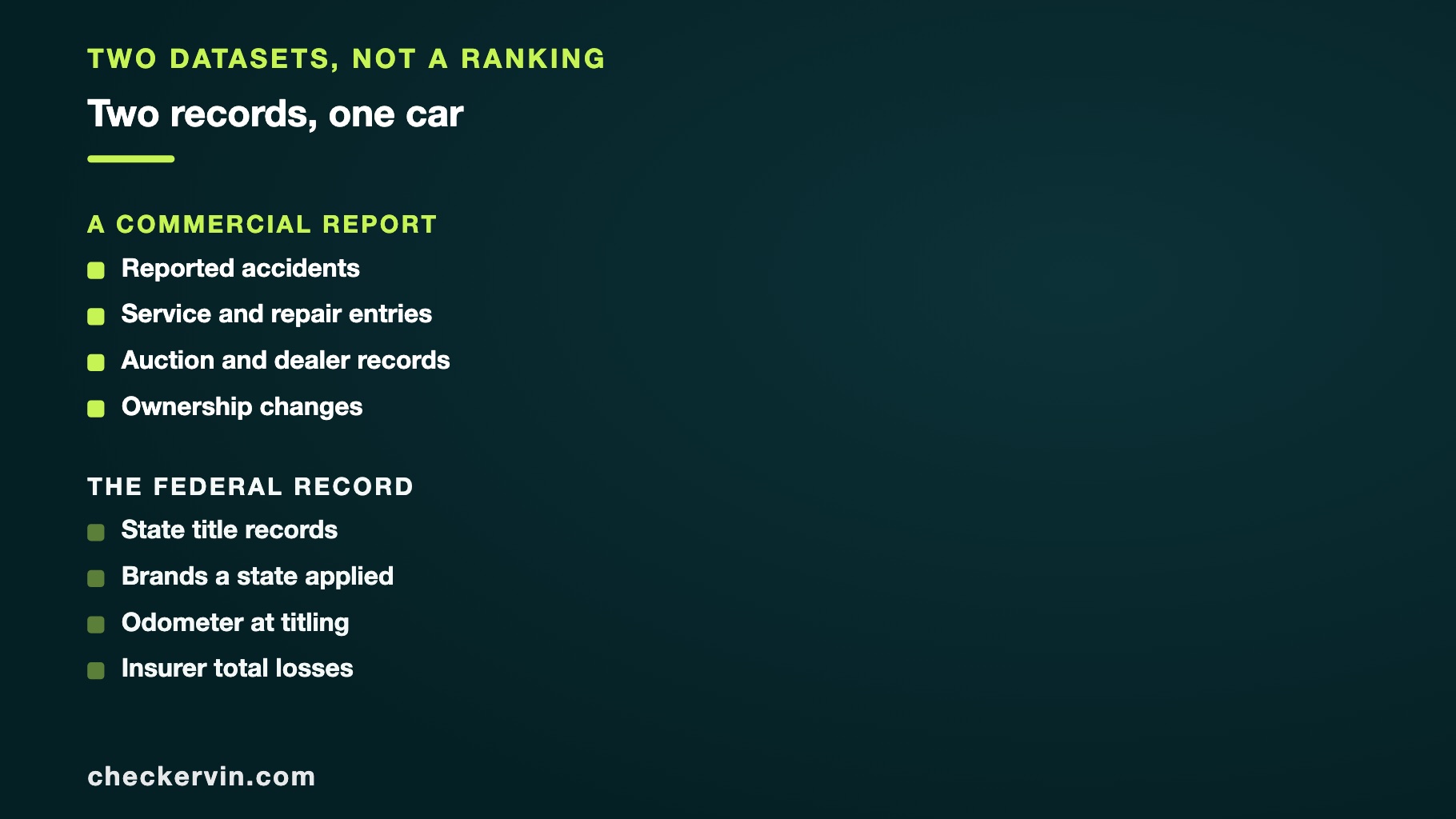
Two datasets, not one ranked list
The natural reaction to the paragraph above is to read it as a scoreboard, and that would be the wrong lesson. Carfax reports title brands from its own sources and often reports them accurately. The point is not that Carfax lacks title data — it is that the federal record and a commercial database are two different things, and buying one does not deliver the other.
| If your question is | The tool that answers it |
|---|---|
| Has this car been branded salvage, junk or a total loss anywhere? | The NMVTIS record, from an approved consumer provider |
| What service and event history has been reported on this car? | A commercial database such as Carfax |
| Are there open safety recalls? | NHTSA, free, and no paid report improves on it |
| Has it been reported stolen or as a salvage total loss to insurers? | NICB VINCheck, free |
| Was it damaged and repaired without anyone being told? | Nothing. Only a physical inspection reaches this |
Read that table as a routing guide rather than a ranking. Most buyers who feel let down by a history report asked it a question it was never built to answer.
What Carfax genuinely does well
A fair assessment has to include the case in favor, and there is one. Scale matters in aggregation: a service with decades of reporting relationships holds maintenance records, ownership changes, registration events and reported accidents that smaller operations simply do not have. On a late-model vehicle with a dealer-service history, that depth is real and it is the strongest argument for the product.
The presentation is also genuinely good, which is not a trivial point when the audience is a private buyer standing in a driveway making a decision under time pressure. And the brand’s ubiquity has a practical benefit at resale: many buyers expect one, and a clean report from the name they recognize removes friction from your own future sale.
The gap no report closes, at any price
Every vehicle history service shares one structural limitation, and it is worth stating plainly because the category’s marketing works hard to obscure it. A report contains records of accidents. It does not contain accidents.
When a car is damaged and the owner decides not to involve an insurer — a common, entirely legal choice, especially on older vehicles or with a large deductible — and takes it to a shop that does not report, the repair happens and no record is created anywhere. No database has it. Paying more does not surface it. The only instrument that reaches unreported damage is a physical inspection by someone competent, which is why our accident check guide ends where it does.
Reading a buyback guarantee for what it is
Vehicle history services often attach a buyback guarantee, and buyers read it as a warranty on the car. It is not. A guarantee of that kind is a promise about the accuracy of specific data the service holds — typically that a qualifying brand present in a particular government record did not appear on your report — subject to its own terms, time limits and claim procedures.
Read the actual terms before assigning it any weight in your decision. What these guarantees do not cover is the category that actually harms buyers: unreported damage, which by definition is not in any record and therefore cannot trigger a data-accuracy promise. A guarantee is a reason to trust the reported data slightly more. It is not a reason to skip the inspection.
Who a private buyer can buy the federal record from
The useful half of that restriction is the other side of the same list. These businesses are approved to provide the record to all interested parties, consumers included:
- Bumper.com
- Carsforsale.com
- Carvertical.com
- Checkthatvin.com
- Clearvin.com
- EpicVin.com
- GoodCar.com
- Titlecheck.us
- Vinaudit.com
- Vindata.com
- Vinsmart.com
11 names, and the federal title data in each of their reports is the same underlying record. So choosing between them is a choice of presentation and price rather than of data, which is a considerably simpler decision than the market usually presents.
The department adds that the list is alphabetical and indicates no preference of one provider over another. We reproduce both tiers in full, with the shared-ownership lines, on how to choose a VIN check.
What this does not mean about a Carfax report
It would be easy to turn the paragraphs above into a verdict, and it would be the wrong one. The restriction concerns a specific federal dataset, not the quality of what Carfax sells.
| The claim | Whether it follows |
|---|---|
| Carfax reports are inferior | No — it holds service, auction and reported-accident data no government system has |
| Carfax is not legitimate | No — the restriction is about which dataset it distributes, and to whom |
| A Carfax report contains the federal title record | Not for a consumer, on the department's own statement |
| You should buy a cheaper report instead | Only if the federal record is what you need — they answer different questions |
The honest framing is that these are two datasets and you may want both. A commercial report can show servicing the federal record will never hold; the federal record can show a brand or a total loss no commercial database was told about. Buying one and assuming it covered the other is the actual mistake, and it is the one this page exists to prevent.
Using Carfax well, and what to run alongside it
- 1Run the free checks firstRecalls through NHTSA, theft and salvage screening through NICB, and a VIN decode for the factory build. No paid report improves on any of these.
- 2Decide which question is still openA title-brand question routes to the federal record. A service and event history question routes to a commercial database. They are not substitutes.
- 3Get the NMVTIS record from an approved providerEspecially on a car that has crossed state lines, where a brand applied elsewhere is exactly what you are trying to find.
- 4Ask the dealer for the report they already holdDealerships commonly subscribe. A report you do not have to buy is worth asking for before you buy your own.
- 5Inspect the car regardless of what comes backThe unreported-damage gap is the one category no report covers, and it is the one that costs buyers the most.
Decode the VIN free to start
Decoded from official manufacturer and NHTSA records
- Free recall and theft checks run before any payment
- Question identified as a title question or a history question
- Federal NMVTIS record obtained from an approved consumer provider
- Dealer's existing report requested rather than duplicated
- Guarantee terms read rather than assumed
- Independent pre-purchase inspection booked on anything worth buying
Where this information comes from
- NMVTIS — approved data providers and consumer accessThe DOJ's own statement that consumers cannot get NMVTIS reports from Carfax, and the list of providers who do serve consumers
- TxDMV — Title Check: Look Before You BuyA state agency stating the same dealership-only restriction independently
- NHTSA recall lookupOpen safety recalls by VIN, free, and never improved on by a paid report
- FTC — buying a used carFederal consumer guidance on used purchases and the Buyers Guide
Keep reading
Frequently asked questions
Can I buy an NMVTIS report from Carfax?
No. The U.S. Department of Justice site that administers NMVTIS states it directly: consumers cannot receive NMVTIS Vehicle History Reports from Carfax, DMVDesk or Experian, because these entities provide information only to car dealerships. If you want the federal title record, it comes from one of the approved providers on the DOJ's public list instead.
Is a Carfax report the same as a title check?
They overlap without being the same thing. Carfax is a commercial database that reports title brands among many other events, and its coverage depends on what has been reported into it. NMVTIS is the federal system that states are required to report titles into. Running one does not give you the other, and on a car that has crossed state lines that difference can matter.
Does Carfax catch every accident?
No report does, and this is structural rather than a failing of any one service. A report contains records of accidents, not accidents. Damage repaired privately, settled in cash, and never reported to police, an insurer or a participating shop creates no record anywhere — so it appears on no report at any price. That is why an inspection is not an optional extra.
Is Carfax worth paying for?
It depends on what you are trying to establish. For a late-model car with a long dealer-service life, a large commercial database has a real chance of holding maintenance and event history that free sources do not. For a straightforward title-brand question, the federal record costs a fraction as much. Match the tool to the question rather than defaulting to the most familiar name.
What should I run before paying for any report?
The free checks, because they cost nothing and cover ground no paid report improves on: NHTSA for open safety recalls, NICB VINCheck for theft and salvage screening, and a VIN decode for the factory build. Those establish a baseline. Then decide whether your remaining question is a title question or a history question, and buy accordingly.
Start with what costs nothing
Decode any VIN free for the factory build, specifications and open safety recalls. No account, no card.
Run a free VIN check