The short answer
- Can I get a Carfax report free?
- Not from us or any third-party site. It is a paid product, so a free one means somebody else already paid — nearly always the dealer selling the car.
- So what decides whether one reaches me?
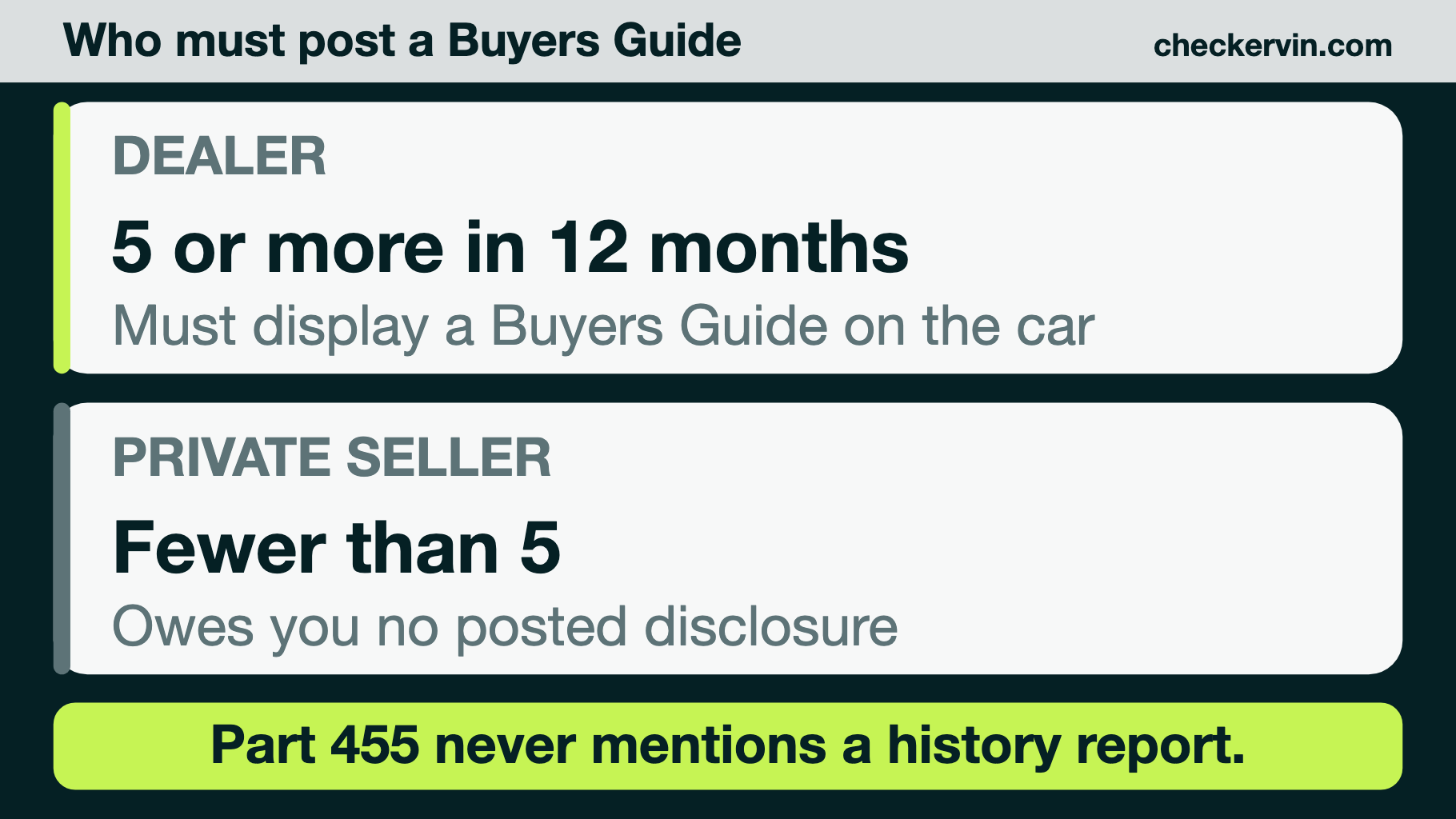
- Who is selling. Federal law draws the line at five vehicles in twelve months: above it the seller is a dealer and must post a Buyers Guide, below it you are owed no disclosure at all.
- What can I actually get for nothing?
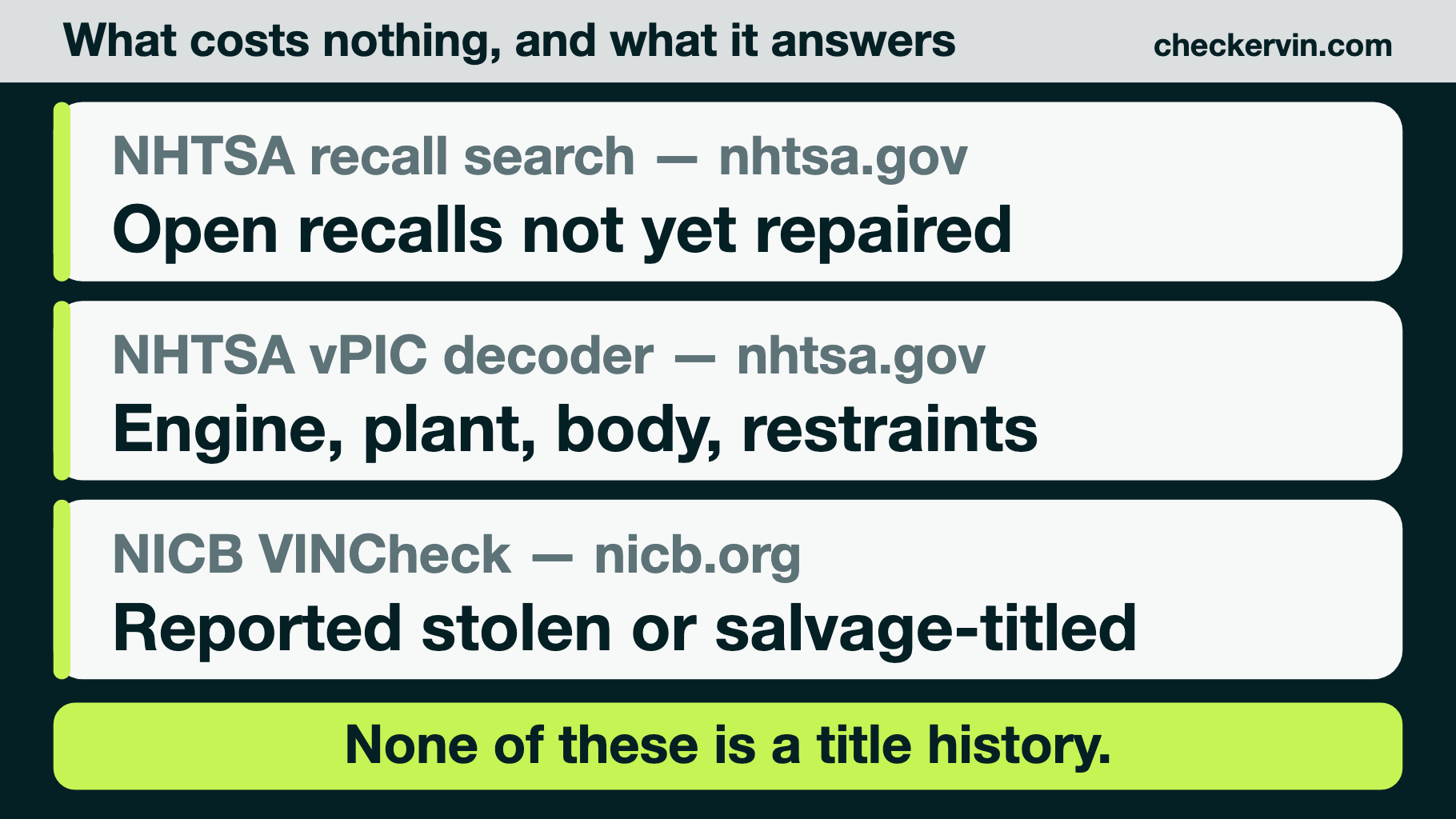
- Open safety recalls and the factory build from NHTSA, and a theft and total-loss screen from NICB VINCheck. None of the three is a title history.
The short answer, before the detail
People searching for a free Carfax report are usually in one of two situations, and the useful answer is different in each. Either you are looking at a car on a dealer’s lot or listing, in which case a report very often already exists and the whole task is getting the dealer to hand it over. Or you are buying from whoever owns the car, in which case no report has been bought, nobody is going to buy one for you, and the sites promising otherwise are selling something else under that name.
What follows sorts the question by seller, because that is the variable that actually changes the answer. It is also the one piece of this that federal law has already settled, in a rule most buyers have never read and most dealers know by heart.
5+ vehicles
The dealer test
Offered for sale in the previous twelve months — 16 CFR 455.1(d)(3)
Buyers Guide
What a dealer must post
Displayed on the vehicle before it is offered — 16 CFR 455.2(a)
None
History reports in the rule
Part 455 does not mention them anywhere
When a report is free, somebody paid for it
This is not a cynical observation, it is just how the product works. A vehicle history report is compiled from data that costs money to license and aggregate, and the company selling it prices accordingly. Nothing about that changes because you would prefer not to pay. So any route to a report at no cost to you is a route where the cost landed on somebody else, and there are only a few of those.
The dominant one is a dealer. Dealers buy reports in bulk at rates no individual is offered, and publishing one on a listing is a sales tool rather than a courtesy — a car with a clean report attached sells faster and argues less about price. The report is free to you in the same sense that the coffee in the showroom is free.
The second is a listing platform that bundles reports into what it charges sellers. The third, much rarer, is a seller who bought a report themselves to answer questions before they were asked, which tends to happen with enthusiast cars and well-kept examples where the seller expects scrutiny.
What does not exist is a fourth route where a third-party website gives you the branded product for nothing. Sites offering that are either selling a different report and using the better-known name to get you in the door, or collecting a card number for a trial. Knowing which of the three real routes applies to your car is most of the work, and the seller tells you which.
The federal five-vehicle test
The FTC’s Used Car Rule, at 16 CFR Part 455, is the piece of federal law that governs what a used vehicle seller must tell you before you buy. Its scope is set by a definition rather than a judgment call. Under § 455.1(d)(3), a dealer is “any person or business which sells or offers for sale a used vehicle after selling or offering for sale five (5) or more used vehicles in the previous twelve months.”
Five, in twelve months. Not a lot, a license or a sign — a count. Someone running cars through their driveway at that pace is a dealer for the purposes of this rule whether or not they describe themselves as one, and that is deliberate: the rule is aimed at the practice, not the job title. The definition carves out banks and finance companies, a business selling a car to its own employee, and a lessor selling to the lessee.
The rule also bounds which vehicles it covers. Under § 455.1(d)(1) a vehicle here means a motorized vehicle other than a motorcycle, with a gross vehicle weight rating under 8,500 lbs, a curb weight under 6,000 lbs, and a frontal area under 46 sq ft. Ordinary cars, trucks and SUVs sit inside that. Motorcycles sit outside it entirely, which surprises people buying a used bike from a dealership and finding no Buyers Guide on it.
Where the test lands changes what you should do next, so it is worth establishing before you go any further.
| If the seller is | What that means for a free report |
|---|---|
| A franchised or independent dealer | Almost certainly has reports available, or can pull one in minutes. A Buyers Guide must be posted on the car before it is offered for sale. |
| Someone moving five or more cars a year | A dealer under the rule even if they present as a private seller. The missing Buyers Guide is itself a signal worth reading. |
| A genuine private seller | No report exists unless they bought one. No federal disclosure is owed. The free checks below carry the whole load. |
| An auction or salvage yard | Different footing again, and the sale terms rather than Part 455 govern what you are told. |
What the Buyers Guide actually covers — and what it does not
Since the Buyers Guide is the one document federal law puts in front of you, it is worth being precise about what is on it, because it is routinely mistaken for something it is not.
Section 455.2(a) sets the duty plainly: “Before you offer a used vehicle for sale to a consumer, you must prepare, fill in as applicable and display on that vehicle the applicable Buyers Guide.” Not on request, not at signing — displayed on the car, before it is offered. A dealer lot without Buyers Guides in the windows is not complying with the rule.
What the form communicates is warranty position. Whether the vehicle is being sold “as is” with no dealer warranty, or with implied warranties only, or with a written warranty and what fraction of repair costs the dealer will bear. Those boxes decide who pays when the transmission fails three weeks later, which is genuinely important and entirely separate from history.
That absence is the practical heart of this page. The Buyers Guide is a real protection and it is not the protection people assume they are getting. It tells you who pays for the next repair. It tells you nothing about whether the car was in a flood, wore a salvage brand in another state, or has an unrepaired recall sitting against its VIN.
Buying from a dealer: ask, and read the refusal
On a dealer’s car the report usually exists, so the task is straightforward and the interesting information is in how the request is received.
- 1Look at the listing firstMany dealer listings carry a report link directly, because it is a selling point. Check before asking — a link on the listing costs you nothing and no conversation.
- 2Ask plainly, by VINAsk for the report on that specific VIN rather than for a report in general. It is a normal request that dealers field constantly, and a stocked dealer can produce one in about a minute.
- 3Read the Buyers Guide in the windowWhile you wait, read the form on the glass. As-is versus warranty is the single most consequential thing disclosed at that point in the transaction, and it is disclosed in a box most buyers walk past.
- 4Run the free checks yourself anywayA report the seller chose, paid for and handed you is worth having and is not an independent check. The recall search and theft screen below take a couple of minutes and answer to nobody.
- 5Treat a refusal as data, not a dead endA dealer with reports on tap who will not show you one for this car has told you something useful. It is not unlawful under Part 455, and it is a reason to spend the inspection money before the deposit.
One more thing worth knowing about a dealer-supplied report: it is a snapshot the seller controls the timing of. A report pulled three months ago, printed and left in the folder does not include anything filed since. If the copy is not dated today, the date is the first thing to look at.
Buying privately: nobody owes you a disclosure
A private seller does not meet the five-vehicle test, so Part 455 does not touch them. No Buyers Guide, no warranty box, no posted anything. Almost always no history report either, because buying one to sell one car is an expense most people never consider.
This is the situation where searching for a free branded report is most tempting and least useful, and it is worth being blunt about why. There is no report attached to that car for anyone to release to you. The question is not how to unlock it; it is what else will answer the same worry.
- Photograph the VIN yourself from the dash and the door jamb — do not work from a number the seller typed into a message.
- Confirm the two VIN locations match each other, and match the title document in the seller's hand.
- Check the seller's name on the title is the name of the person you are talking to. A mismatch here is the single most common sign of a sale that will not transfer cleanly.
- Run the free federal checks on the VIN before you drive out to see it.
- Budget for an independent inspection. On a private sale it replaces every protection a dealer sale would have carried.
If the seller turns out to have several cars in the yard and a story about selling them for friends, the five-vehicle test is worth remembering. Someone operating as a dealer while presenting as a private seller avoids the Buyers Guide, the warranty disclosure, and the paper trail that goes with them. That practice has a name and its own page on this site.
What is genuinely free, with no card and no trial
Three checks cost nothing, ask for no payment details, and are not a preview of something you will be billed for later. They do not add up to a history report and they cover ground a paid report does not improve on.
| Check | What it answers |
|---|---|
| NHTSA recall search | Open safety recalls against that VIN that have not been repaired. The manufacturer owes the remedy at no charge, so this one can be worth real money on the spot. |
| NHTSA vPIC decoder | The factory build: engine, assembly plant, body style, restraint systems and the rest of what the manufacturer filed for that VIN pattern. |
| NICB VINCheck | Whether the vehicle has been reported stolen and not recovered, or declared a total loss by a participating insurance company. |
The distinction between those sources matters more than it looks. NHTSA is a federal agency and its data is the government’s own record. The National Insurance Crime Bureau is an industry non-profit, and VINCheck reflects what participating insurers have reported — which is a large share of the market and not all of it. A clean VINCheck means no participating member filed a theft or total loss, not that neither happened.
Run all three before you spend anything. If one of them returns something, you have saved yourself the price of a report and quite possibly the price of a car.
What none of the free routes will give you
Being straight about the ceiling is the only way the rest of this page is worth reading. The free checks do not include the federal title record. That record is NMVTIS, it is built from what states are required to report, and it is the one place a salvage or junk brand applied in another state reliably surfaces. It is not free, though it is inexpensive, and it is sold through providers approved by the U.S. Department of Justice rather than by us.
Nor do they include what most people picture when they say history: the ownership chain, the service record, the accident that was settled in cash and never reported. That last category is not a gap in any particular product. An accident nobody filed a claim on generates no record at any provider, at any price, which is why an inspection outranks a report on any car you are serious about.
We have separate pages on each of those rather than a summary here, because they are decisions in their own right: what a genuinely free report can and cannot contain, what the federal title record costs and who may sell it to you, and how the commercial services compare on the questions they actually answer.
Offers that use the word free and mean something else
Searching this phrase puts you in front of the least trustworthy category of vehicle site there is, so it is worth naming the patterns before you meet them.
- A free report that asks for a card number before showing you anything. Free things do not need payment details.
- A one-dollar or trial report that becomes a recurring subscription — the charge is disclosed, usually somewhere you were not looking when you agreed.
- A site using the Carfax name in its title or advertising while selling an entirely different report. The name gets the click; the product is not the one you searched for.
- A result page that shows you a summary and asks for payment to reveal the detail. That is a paid report with a free teaser, which is a legitimate business model and is not a free report.
- Any site promising the owner's name and address from a VIN or plate. That data is restricted by federal law and a site offering it is either lying or inviting you into something you do not want.
The subscription pattern in particular has federal rules attached to how it must be disclosed and how easily you must be able to cancel. We set out what those rules require, and how to read a checkout against them, on our billing transparency page rather than repeating it here.
What CheckerVIN gives you free, stated exactly
We would rather write this in plain terms than let a page about the word free be vague at the one point where it is describing us.
Enter a VIN on this site and you get a decode of the factory build and vehicle specifications, plus open safety recall data for that vehicle. No account, no card, no trial that converts. That is the product, and it is genuinely free rather than free-for-now.
What we do not have is a title history, an ownership chain, an odometer record or an accident record, and we are not going to imply otherwise on the page where you arrived asking about a report that contains those things. If that is what your car needs, the honest routes are the federal title record through a DOJ-approved provider, or one of the commercial services — and our comparison pages exist to help you pick between them rather than to talk you out of them.
Where this information comes from
- 16 CFR Part 455 — FTC Used Car RuleThe Buyers Guide duty at 455.2(a) and the five-vehicle dealer definition at 455.1(d)(3)
- NHTSA recall lookupOpen safety recalls by VIN, free, and never improved on by a paid report
- NHTSA vPIC VIN decoderThe federal decode of the factory build, free and without an account
- NMVTIS — U.S. Department of JusticeThe federal title record and the list of providers approved to sell it to consumers
- FTC — buying a used carFederal consumer guidance on used purchases and the Buyers Guide
Keep reading
Frequently asked questions
Can I get a Carfax report for free?
Not from us, and not from any site that is not Carfax. It is a paid commercial product, so when one reaches you at no cost it is because somebody else has already paid for it — almost always the dealer selling the car, who buys reports in bulk and publishes them on listings to close sales. If you are buying privately there is usually no such report in existence, and no site can conjure one.
Does federal law make a dealer give me a vehicle history report?
No. The FTC Used Car Rule at 16 CFR Part 455 requires a dealer to display a Buyers Guide on the vehicle before offering it for sale, and that form is about warranty terms — whether the car is sold as is or with a warranty, and who pays for repairs. The regulation does not mention vehicle history reports at all. Asking for one is reasonable, but it is a request rather than a right.
Who counts as a dealer under the rule?
16 CFR 455.1(d)(3) sets a numeric test: anyone who sells or offers for sale five or more used vehicles in the previous twelve months. That is the line that decides whether a Buyers Guide must be posted. Someone selling their own car does not meet it, which is exactly why a private sale carries no posted disclosure and why the free checks matter more there.
What can I check for free without paying anyone?
Three things, and none of them is a trial. NHTSA's recall search returns open safety recalls that have not been repaired. NHTSA's vPIC decoder returns the factory build — engine, plant, body style, restraint systems. NICB VINCheck screens for vehicles reported stolen or declared a total loss by a participating insurer. The first two are federal; VINCheck is run by an industry non-profit.
If the free checks come back clean, is the car safe to buy?
No, and treating a clean result as clearance is the mistake these checks invite. They report records, not condition. Damage repaired privately and never claimed creates no record anywhere, so it appears on nothing at any price. A clean set of free checks means no one has filed the specific problems those systems track — it is a good sign and not an inspection, which is still the money best spent.
Start with what costs nothing
Decode any VIN free for the factory build, specifications and open safety recalls. No account, no card, no trial.
Run a free VIN check