The short answer
- What does damage reported mean?
- That some source tied to the VIN told a commercial database damage existed. It is the vendor's own label, with no statutory definition, no dollar threshold and no required standard of proof behind it.
- Is it the same as a salvage or total loss?
- No. Those are defined in federal regulation and reported by entities the law names. A damage line is a commercial database entry and carries none of that weight — which cuts both ways, since it is also easier to create.
- What should I do about it?
- Treat it as a pointer to a panel, not a verdict on a car. Check the federal title record for a brand, then have the area inspected. The phrase itself will not get more specific no matter how long you stare at it.
None
Legal definition of the phrase
It is vendor vocabulary
Monthly
How often insurers must report salvage
28 CFR 25.55
4 years
Model years an insurer's duty covers
Current plus four prior
5 fields
What a salvage yard must report
28 CFR 25.56
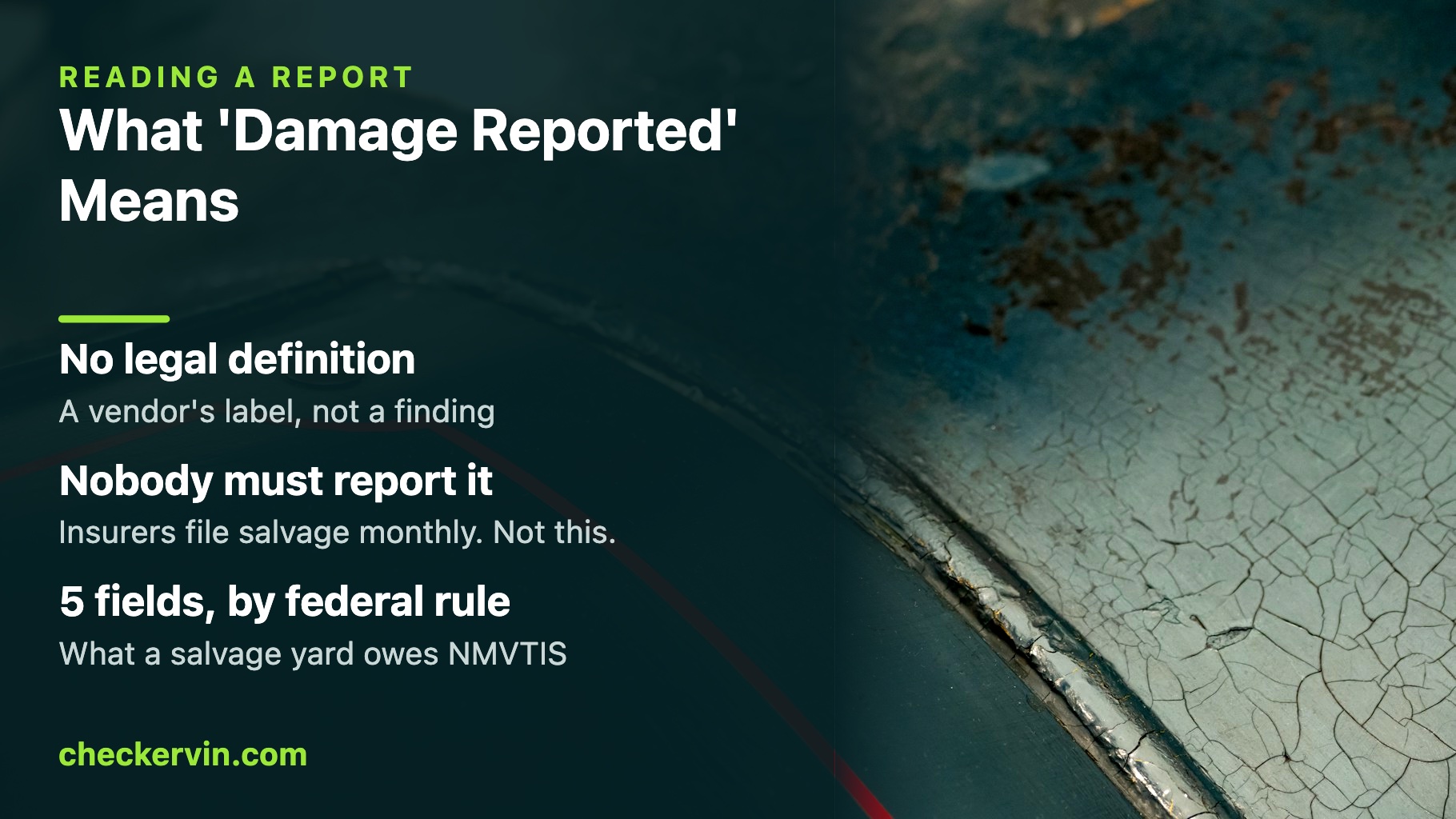
It is a label applied by a company, not a finding by an authority
Start with the thing almost nobody says plainly. “Damage reported” is a phrase a commercial vehicle history company chose, prints in its own documents, and defines in its own help pages. No statute uses it. No regulation sets a threshold for it. No agency audits whether it was applied correctly to your car.
That is not an accusation. Commercial databases are useful precisely because they collect things no law requires anyone to collect, and a system that only recorded legally defined events would miss most of what happens to a used vehicle. But it does mean the phrase cannot be read the way people instinctively read it, as a judgment handed down after review.
The practical consequence is that identical wording can sit behind wildly different events. A scraped bumper cover a body shop logged, an auction inspector noting a dent on arrival, and a repaired structural hit can each surface as a damage line. The label is the same because the label is not measuring anything.
Who can put the line there
A commercial history database is fed by whoever has agreed to feed it. That set is large, commercially negotiated, and not published in full by anyone.
- Collision and repair facilities that report into a data network
- Insurance companies, on claims they process
- Auctions, whose condition reports describe the car as it arrived on the lot
- Fleet and rental operators reporting damage on vehicles they own
- State agencies, where a title event or inspection produces a record
- Police departments in jurisdictions that share crash data
Two things follow. First, whether a given event is recorded depends less on how serious it was than on whether whoever touched the car happens to report. An independent shop with no data relationship can straighten a genuinely significant repair and generate nothing at all. Second, the reporter is often invisible in the finished report — you see the entry, and frequently not the entity behind it.
Damage reported against accident reported
Carfax and AutoCheck both keep these as separate lines, buyers routinely read them as synonyms, and the difference is worth holding onto because it changes what a clean line means.
| The entry | What generally sits behind it |
|---|---|
| Accident reported | A collision record — commonly a police report or an insurance claim tied to a crash |
| Damage reported | Any source describing damage: a repair order, an auction condition note, an inspection |
| Structural damage reported | That the damage reached load-bearing structure or frame, which is the entry that moves price hardest |
| Airbag deployment | A restraint system that fired, which is a proxy for collision force rather than a damage measurement |
A car can carry a damage entry and no accident entry, and that pairing is ordinary rather than sinister — it usually means damage was documented somewhere in the repair chain while no crash record was created. The reverse also happens: an accident line with no damage detail, because the collision record existed but nothing described what the impact did.
Structural, functional and minor — the severity words
Most reports grade the entry, and the gradings are where the searching usually starts. People arrive looking for structural damage reported, functional damage reported, or simply whether a minor entry matters. These gradings help, and they are also the part buyers most often over-read.
| The wording you are likely looking at | How to read it |
|---|---|
| Minor damage reported | The reporting source characterized it as minor. It is a pointer to a panel, not a measurement of the repair |
| Moderate or severe damage reported | A stronger characterization from the same kind of source, with the same absence of any inspection behind it |
| Functional damage reported | Wording used to indicate the damage affected something the vehicle needs to work, rather than appearance alone |
| Structural damage reported | The entry that moves price hardest and permanently, because it says the damage reached load-bearing structure rather than panels |
| Airbag deployment | Not a damage measurement at all — a proxy for collision force, since restraints fire at a threshold |
The grading describes what was reported, not an assessment of the repair. A minor entry says the reporting source characterized the damage as minor. It does not say the repair was done well, that the panel was replaced rather than filled, or that a hidden component escaped. Nothing in the pipeline inspects the finished work.
Severity language is best used to decide where to look. A minor rear entry tells an inspector which corner deserves a paint gauge and a look at the trunk floor. That is a real contribution to a used-car purchase, and it is a smaller contribution than the words appear to make.
The words that do carry legal force
Here is the contrast that makes the whole page worth reading. While “damage reported” is undefined, the vocabulary of a branded title is defined tightly, in federal regulation, for the national title system.
A salvage automobile is defined as one damaged by collision, fire, flood, accident, trespass or other event to the extent that its fair salvage value plus the cost of repairing it for legal operation on public roads would be more than its fair market value immediately before the event. The definition also sweeps in any vehicle determined a total loss under the law of the applicable state, or designated a total loss by an insurer under its own policy terms, whether or not ownership ever transferred to the insurance company.
A junk automobile is defined separately and more harshly: incapable of operating on public roads, and holding no value except as a source of parts or scrap.
Who federal law actually compels to report
The other half of the contrast is obligation. Nobody is required to report damage to a commercial database. Several parties are required by federal rule to report salvage and junk vehicles into the national title system, on a schedule, with named fields.
Insurance carriers must report monthly, covering vehicles they took possession of and decided were junk or salvage, plus anything they determined to be a total loss under state law or designated a total loss under their policies. The report carries the carrier's own identifying details, the VIN, the date the vehicle was obtained or designated, and who it came from.
Junk yards, salvage yards and auto recyclers report monthly as well, on everything obtained in the prior month, in five specified fields: their own contact details, the VIN, the date obtained, who it came from, and a statement of whether the car was crushed or disposed of, to whom it went, and whether it is bound for export. Yards that already report the same information to their state, where the state passes it on, are not required to report twice.
Read those two paragraphs against a damage line and the asymmetry is the point. One system names the reporter, the fields and the deadline. The other records whatever arrives from whoever chose to send it.
The four-model-year gap nobody mentions
There is a limit inside the insurer rule that matters enormously on older cars, and it is almost never mentioned in guidance about reading reports.
The monthly insurer obligation covers automobiles of the current model year or any of the four prior model years. A vehicle older than that window, totaled by an insurer, is not swept up by that particular duty.
It does not follow that older total losses are invisible — state title systems, salvage yards and the vehicle's own paperwork all still generate records, and a state that brands the title creates the most durable record of all. What follows is narrower and worth knowing: on a fifteen-year-old car, the federal reporting obligation that catches insurer total losses on nearly new vehicles is not the mechanism protecting you. Inspection and title history carry proportionally more weight the older the car gets.
The state test that actually decides the title
Whether damage becomes a permanent brand is decided by state law, and states disagree with each other more than buyers expect. The same wrecked car can brand in one state and not in the one next door.
The tests are structurally different, not just numerically different. Some states use a percentage of value, and set it anywhere across a wide range. Some measure what the insurer actually paid rather than an estimate. At least one uses no percentage at all and asks whether the vehicle is uneconomical to repair. Several apply a dollar figure. Our state title pages work through each one against the state's own documents: Michigan, California, Texas and Wisconsin are four genuinely different systems.
The reason this belongs on a page about a damage line: the line itself is silent about all of it. A car with a damage entry and a clean title in a strict state has passed a harder test than the same entry in a lenient one, and the report will not tell you which situation you are in. The title record and the state rule will.
When it says damage reported and nothing else
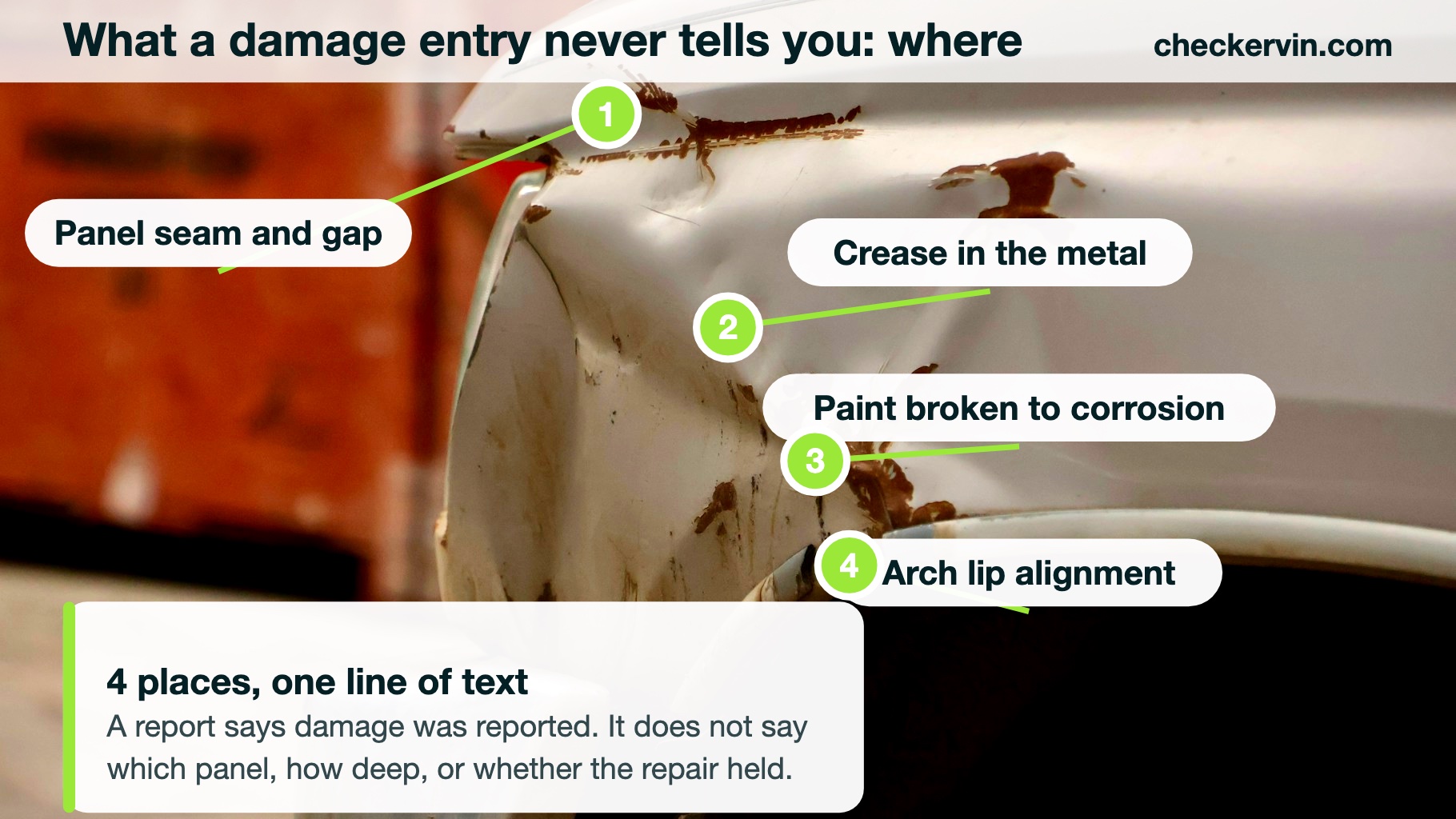
The most common complaint about this entry is not that it exists but that it is empty — a line saying damage was reported, with no date detail, no location on the car, no severity and no source. Buyers reasonably conclude the report is being cagey.
Usually it is not. The vendor prints what the reporting source sent. When a feed carries a VIN, a date and a damage flag and nothing more, a fuller line cannot be manufactured from it. Sparse entries are most common where the reporter is a party whose own record is thin: an auction noting a condition, or a shop transmitting minimal fields.
- Ask the seller directly what the entry refers to, before you inspect
- Ask whether they still hold the repair invoice, which is the document the report is a shadow of
- Check whether a title brand exists, since that is the record with a legal test behind it
- Have the area inspected regardless of what you are told
- Compare a second commercial report, which is compiled from a different network
A seller who produces the invoice has converted a vague entry into a documented repair, which is frequently the best outcome available and sometimes better for you than a car with no entry and no paperwork.
Getting an entry corrected when it is genuinely wrong
Owners do find entries describing events that did not happen to their car, and the honest answer about fixing one is neither “impossible” nor “just ask”.
The major vendors operate correction processes and will investigate a disputed entry against the source that supplied it. What they will not do is delete a record because its subject dislikes it, which is the correct behavior for a document whose value depends on not being editable by the person selling the car.
Where the entry originates outside the vendor, the correction has to happen at its origin. A record that came from a state title cannot be rewritten by a company that received it, and neither can a federally mandated report from an insurer or a salvage yard — those flow into the national system from entities the regulation names. Going to the reseller in those cases wastes the time you need to spend at the source.
- 1Get the report yourself rather than working from a screenshotYou need the exact entry, its date, and whatever source detail is printed alongside it.
- 2Establish which system it came fromA title brand traces to a state. A total loss traces to an insurer. A repair entry traces to a facility or a network. Each has a different correction path.
- 3Gather the documents that contradict itRepair invoices, a police report showing a different vehicle, or the title itself. A dispute without documents is an assertion.
- 4File with the vendor's published process, and with the sourceThe vendor can annotate or remove what it controls; only the originating system can fix what it sent.
- 5Keep the correspondenceIf the entry persists into a sale, a documented dispute is what you show a buyer.
Why a clean line proves much less than it seems to
The mirror image of over-reading a damage entry is over-trusting its absence, and this is the costlier mistake of the two.
A report with no damage line means no source that reports to that database sent anything. Repairs paid in cash to avoid a claim, work done by a shop with no reporting relationship, and damage nobody documented all leave the line clean. None of that is exotic; the incentive to settle privately rises with every insurance premium increase.
This is also why comparing two commercial reports on one vehicle is a genuinely useful exercise rather than a redundant one. The networks differ, so the reports differ, and a record present in one and absent from the other is normal rather than evidence of a mistake. What neither can show you is the repair that was never reported to anybody.
The damage record nobody sells you
There is a second damage signal that no vehicle history report contains, it is free, and it answers a different question: not what happened to this car, but what has been happening to cars exactly like it.
Owners file complaints with the federal safety regulator, and those complaints record whether the incident involved a crash, a fire or an injury. Aggregated by model year, they describe a pattern that no per-VIN document carries. Fire reports are the clearest example, because a fire is unambiguous in a way that “damage” is not.
| Model year | Owner-filed reports involving fire |
|---|---|
| 2013 Kia Optima | 114 fire reports among 1,427 complaints, with 37 injuries recorded |
| 2012 Jeep Grand Cherokee | 104 fire reports among 1,638 complaints |
| 2014 Ford Escape | 103 fire reports among 2,074 complaints, with 41 injuries recorded |
| 2013 Hyundai Sonata | 101 fire reports among 2,007 complaints, with 86 injuries recorded |
Read these carefully, because they are owner-submitted reports rather than verified incidents, and a high count can reflect one investigated defect campaign rather than a model year's general condition. Used properly they answer the question a damage line raises and cannot settle: whether the thing you are looking at is a one-car event or a pattern this model year is known for. Our reported-problems index carries the per-year breakdown, and it costs nothing.
What the entry should do to the price
A damage entry has a market effect whether or not it describes anything serious, because the next buyer will see the same line and apply the same discount. That is worth separating from the mechanical question.
| What you are looking at | How it usually bears on price |
|---|---|
| A minor entry with an invoice that matches it | Modest and negotiable — the documentation is doing useful work |
| A minor entry with no explanation available | Larger, because you are pricing the uncertainty rather than the damage |
| Structural or frame damage reported | Substantial and permanent; it follows the car through every future sale |
| A damage entry plus a branded title | A different market entirely — see our rebuilt title guidance before negotiating |
Where an entry is real but small and the repair is documented, the discount the market applies can exceed the actual harm, which is occasionally an opportunity rather than a warning. Where the entry is vague and the seller cannot explain it, you are being asked to absorb a risk nobody has measured, and that is the situation to price hardest or walk away from.
The order to work through it
- 1Decode the VIN and confirm the car is what the listing saysFree, immediate, and it settles year, make, model, engine and body before you spend anything on history.
- 2Run the free federal recall checkOpen safety recalls are unrelated to the damage entry and are free to check from the regulator directly.
- 3Get the federal title record from an approved providerThis is the one with legal definitions and mandated reporters behind it, and it costs a few dollars from a provider on the Department of Justice's published list.
- 4Ask the seller to explain the entry and produce the invoiceThe answer, and the willingness to answer, are both information.
- 5Inspect the area the entry points atPaint depth readings across the panel, panel gaps, and a look underneath at what the report cannot describe.
- 6Price the uncertainty that remainsIf nobody can tell you what the entry refers to, the discount should reflect that rather than the best-case interpretation of two words.
Where this information comes from
- 28 CFR 25.52 — NMVTIS definitionsThe federal definitions of salvage automobile and junk automobile — the precise language a damage entry conspicuously lacks
- 28 CFR 25.55 — responsibilities of insurance carriersMonthly reporting of junk, salvage and total-loss vehicles, and the current-plus-four-model-year scope
- 28 CFR 25.56 — responsibilities of junk and salvage yardsThe five fields a yard must report monthly, and the exemption where a state already passes the data on
- NMVTIS — approved data providers (U.S. Department of Justice)Where a consumer buys the federal title record; the list names which providers may sell to the public
- NHTSA — file or search vehicle safety complaintsThe owner-complaint record behind the fire and injury figures above, free and searchable by model year
Keep reading
Frequently asked questions
Should I worry about minor damage reported on Carfax?
Not on the phrase alone. A minor entry can be a parking-lot scrape a body shop logged, and it can also be the only trace of a larger repair that was paid privately. It means a source connected to that VIN told a commercial database damage existed — there is no statutory definition, no dollar threshold and no required standard of proof behind the label. Treat it as an instruction to inspect that area closely, not as a verdict on the car.
What is the difference between damage reported and accident reported?
The split is deliberate on the vendors' part, and Carfax and AutoCheck both keep the two as separate lines. An accident entry generally traces to a collision record such as a police report or an insurance claim. A damage entry can come from a repair facility, an auction condition report or an inspection, with no collision recorded anywhere. A car can carry a damage line and no accident line, and that combination is common rather than suspicious.
What does structural damage reported mean?
That the damage was reported as reaching the load-bearing structure — the frame or unibody — rather than bolt-on panels. It is the entry that moves price hardest and follows a car through every future sale, and it is the one entry where an independent structural inspection is worth paying for before you commit to anything.
Can I get damage removed from a report if it is wrong?
Only at the source that reported it, and only if it is genuinely wrong. Commercial vendors publish correction processes and will investigate, but they do not simply delete an entry a customer dislikes. Where the record originates in a state title or a federally mandated report from an insurer or salvage yard, the correction has to happen at that origin — a reseller cannot rewrite a record it merely received.
Does no damage reported mean a car has never been damaged?
No. It means nothing was reported into that database by a source that reports to it. Repairs paid in cash, work done by a shop with no reporting relationship, and damage nobody ever documented all leave a report clean. This is the single most misread line in the whole document, and an inspection is what answers the question it cannot.
Start with what a free decode settles
Before paying for history, confirm the car is what the listing claims and check open safety recalls. Both are free here, take seconds, and narrow what you actually need to buy.
Run a free VIN check