The short answer
- How do you catch a rollback?
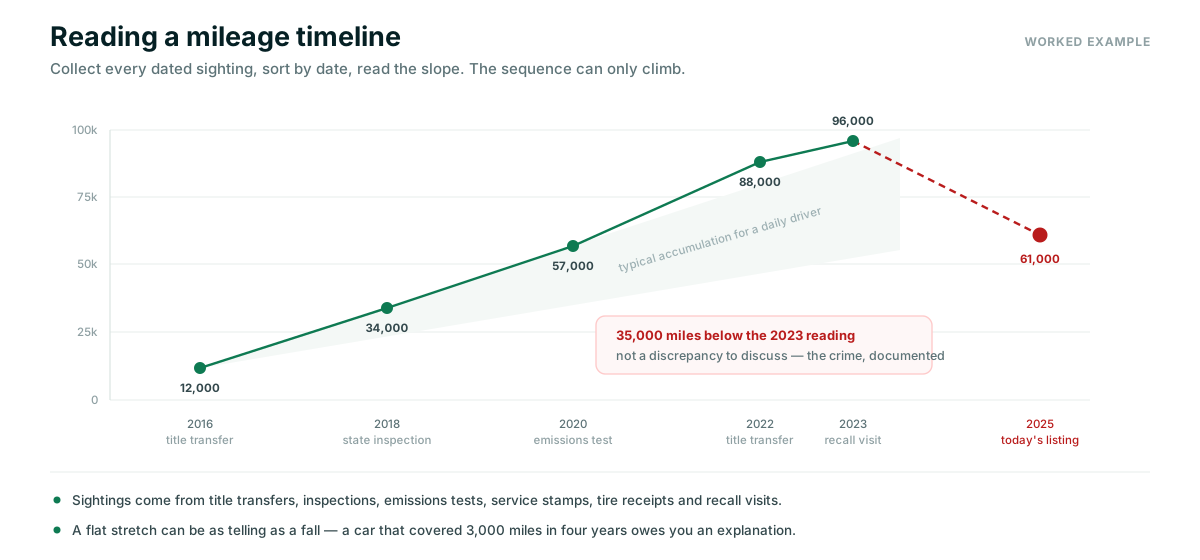
- Sequence, not display: line up every recorded mileage — title events, inspections, emissions tests, service stamps — by date. The numbers must climb. A backwards step or an impossible gap is documentary evidence no seller can talk away.
- Aren't digital odometers safe?
- No — correction tools rewrite them in minutes. Cheap jobs leave other modules disagreeing; good jobs leave only the records to catch them.
- What does the law give you?
- Federal odometer law: tampering and knowing sale are crimes, and defrauded buyers can recover treble damages or $10,000 minimum, plus attorney fees.
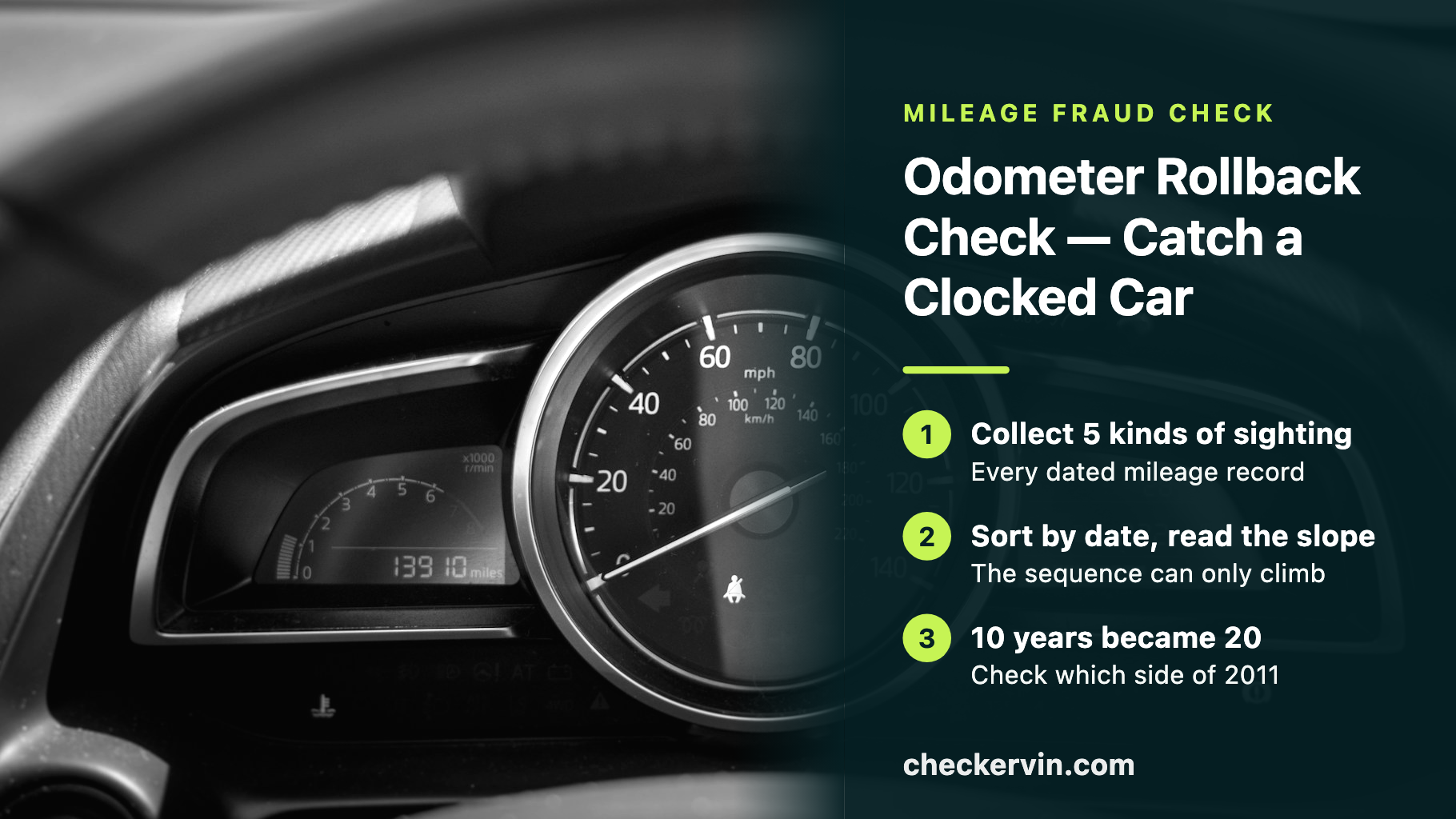
Minutes
What a digital rewrite takes
Correction tools are sold openly
Sequence
The test that catches it
Recorded mileages must climb
3×
Federal civil damages
Or $10,000 minimum, plus fees
TMU
The honest unknown label
True Mileage Unknown
Rollback went digital — and got easier
The classic image of clocking — a coat hanger spinning a mechanical drum — belongs to the past. Modern odometers are software, and the mileage-correction tools sold for legitimate instrument-cluster repair rewrite them in minutes through the OBD port. Some vehicles mirror mileage into other control modules, and a lazy rollback leaves those copies disagreeing where a scan tool can see; a careful one syncs the story. The economics are brutal: tens of thousands of dollars of paper value for minutes of work, which is why federal estimates put clocked vehicles on the road in the hundreds of thousands every year.
The record crosscheck — mileage as a timeline
Every car accumulates dated mileage sightings its whole life: the odometer disclosure sworn at each title transfer (and preserved in the NMVTIS record), the reading captured at every inspection in states that inspect, every emissions test in smog-program states, service stamps, tire receipts, recall visits. Collect them, sort by date, and read the slope. The sequence must climb; annual gaps should look like a life the car could have lived. A 2019 title event at 88,000 miles above today’s 61,000-mile display is not a discrepancy to discuss — it is the crime, documented.
That the federal record carries mileage at all is not a courtesy — it is a design requirement. 28 CFR § 25.53(b)obliges NMVTIS to let a user establish “instantly and reliably” the odometer mileage disclosure required under 49 U.S.C. § 32705 for a titled vehicle on the date the certificate of title was issued, plus “any later mileage information, if noted by the state.”
Read that second clause carefully, because it explains something people find confusing in a title record. The reading tied to the title event is required; anything after it depends on whether that state chose to note it. So one vehicle’s record may show a single dated reading per transfer while another shows several, and the difference reflects state recording practice rather than anything about the car. A thin record is not evidence of an uneventful history — it is evidence of a state that noted less.
Mileage carries this much weight because it drives the price — car value by VIN sets out what actually moves the number and why the VIN alone cannot.
Some states hand you a dated reading for free. Massachusetts returns the last inspection date and its result from a public lookup, which is exactly the kind of third-party timestamp a rollback has to contradict.
Wear that contradicts the miles
- Pedal rubber and steering wheel — polished smooth at '45,000 miles' is a contradiction; rubber outlasts that
- Driver's seat bolster and carpet heel-wear — the body count of every entry and exit
- Tire date codes — four matching recent tires on a 'low-mile' car means the originals wore out; originals should survive 40K
- Brake rotor lips and suspension bushings — consumables that keep their own mileage log
- Module mismatch on a scan — mileage stored outside the cluster that disagrees with the dash
The federal law behind it
Federal odometer law — the Motor Vehicle Information and Cost Savings Act, carried forward at 49 U.S.C. § 32701 and following — makes tampering a federal crime, makes knowingly transferring a clocked vehicle one too, and arms buyers with a private right of action: treble damages or $10,000, whichever is greater, plus attorney fees. The odometer disclosure on every title transfer exists because of this law, and it is why the title chain doubles as a mileage ledger. NHTSA investigates; state attorneys general prosecute; and civil recovery makes documented rollbacks genuinely worth pursuing.
The exemption doubled, and most write-ups never caught up
For decades the federal rule was straightforward: once a vehicle reached ten years old, odometer disclosure stopped being required at transfer. A great deal of advice online still says exactly that, and for newer cars it is now wrong.
NHTSA amended the requirement so that vehicles become exempt after twenty years rather than ten. The change took effect on January 1, 2021 and applies to model year 2011 and newer vehicles. The reasoning was blunt: the average vehicle on American roads is close to twelve years old, so a ten-year cutoff was stripping disclosure protection from a large and growing share of the fleet exactly where fraud pays best.
Which side of 2011 the car falls on
The transition created a hard edge rather than a gradual phase-in, and it is worth knowing which side of it a car sits on before you rely on paperwork.
| Model year | Disclosure status |
|---|---|
| 2010 and older | Exempt — the ten-year clock ran out under the old rule |
| 2011 and newer | Covered until twenty years old |
| Practical effect | A 2010 and a 2011 are treated completely differently |
| What that means | On an older car, a missing disclosure is lawful, not suspicious |
So the absence of an odometer statement tells you nothing on its own. On a 2009 it is simply how the law works; on a 2015 it is a question worth asking. Neither case replaces the record crosscheck above — an exempt car still leaves a mileage trail at inspections, service visits and title events.
The cluster is not the only thing that counts
Rolling back a modern car means changing a number held in electronic memory, and the practical difficulty for whoever does it is that the instrument cluster is not the only place mileage lives. Contemporary vehicles distribute functions across many networked control modules, and more than one of them may retain a mileage value for its own purposes — service intervals, emissions readiness, transmission adaptation, restraint system records.
That matters because a rollback performed on the cluster alone leaves those other stored values untouched. The dashboard says one thing; a module that nobody thought to alter still says another. Reading them is not a driveway job — it needs a diagnostic tool with manufacturer-level access, which in practice means a franchise dealer or an independent specialist for that make.
- Ask a dealer or specialist to compare stored mileage across modules, not just the cluster
- A disagreement between modules is evidence a database will never hold
- It costs a diagnostic hour, which is trivial against the price of a clocked car
- Do it on any vehicle whose paper trail already looks thin or inconsistent
Treat this as the step after the record crosscheck rather than instead of it. The dated sightings above are free and will catch most rollbacks on their own; the module read is what you spend money on when the records are ambiguous, when a car sat unregistered for a stretch, or when the seller’s account and the timeline do not quite line up. The two are complementary, and neither replaces looking at the wear.
TMU — when mileage is officially unknown
Odometers break, clusters get replaced, five-digit drums roll over. The honest outcome is a TMU disclosure — True Mileage Unknown — noted at transfer and carried by auction listings ever after. TMU caps value, but it is not fraud; the fraud is the car that should say TMU and instead wears a confident number. When a seller mentions a replaced cluster, ask for the repair order showing the mileage at swap — the legitimate path documents itself, and the absence of that paper is itself an answer.
If you find a rollback
- 1Before purchase: walk away, keep the evidenceScreenshot the listing and records. You owe the seller nothing; the next buyer's search results may benefit from your report.
- 2After purchase: document the sequenceTitle records, test logs, the listing's claims — the dated contradiction is the whole case.
- 3Report itNHTSA's vehicle safety hotline and your state attorney general take odometer-fraud complaints; both act on patterns.
- 4Consider the civil claimTreble damages or $10,000 minimum plus fees makes consumer attorneys take these cases — the federal statute did that on purpose.
Decode the VIN and start the record trail
Decoded from official manufacturer and NHTSA records
Where this information comes from
- NHTSA — changes to odometer disclosure requirementsThe move from a ten-year to a twenty-year exemption, effective January 1, 2021
- NHTSA — odometer fraudThe federal program, estimates and complaint route
- 49 U.S.C. Chapter 327 — odometer lawTampering prohibitions, disclosure duty and the civil remedy
- 28 CFR § 25.53 — responsibilities of the operator of NMVTISThe duty behind the record: NMVTIS must establish the 49 U.S.C. § 32705 disclosure as of the title issue date, plus later mileage where the state noted it
- NMVTIS — national title recordTitle-event mileages, the spine of the crosscheck
- California BAR — Smog Check historyPublic test-day mileage for every California-tested vehicle
Keep reading
Frequently asked questions
How do I check a car for odometer rollback?
Crosscheck the number against every recorded sighting: title-event mileages in the NMVTIS record, inspection and emissions logs where states keep them, service records, and tire dates. The displayed number is one data point; the recorded sequence is the test. Any step backwards — or a gap that implies impossible annual mileage — is your evidence.
Can digital odometers be rolled back?
Easily, which surprises people. Mileage-correction tools sold openly for legitimate cluster repairs rewrite the displayed value in minutes. Some vehicles store mileage in multiple modules, and a cheap job leaves the copies disagreeing — a scan tool can read them — but a thorough job leaves the dashboard lying cleanly. That is why records beat electronics as evidence.
Is odometer rollback a federal crime?
Yes. Federal odometer law makes tampering, and knowingly selling a tampered vehicle, a crime with civil liability on top — buyers can sue for three times their damages or $10,000, whichever is greater, plus fees. Odometer disclosure at transfer is the paper trail that federal rule creates.
What does TMU mean?
True Mileage Unknown — the label a title or listing carries when the odometer is known to be broken, replaced or beyond its rollover. TMU is honest; the danger is the car that should say TMU and instead shows a tidy five-digit story.
What mileage is suspicious on a used car?
Nothing by itself — the average American car adds roughly 12,000 miles a year, but fleets run triple that and garage queens a tenth. Suspicion comes from contradiction: a 40,000-mile display on a car whose records, pedals, seats and tires describe 140,000. Check the sequence, then the wear.
The dash is an opinion — records are testimony
Decode any VIN free for the factory build, specifications and open safety recalls. No account, no card.
Run a free VIN check