The short answer
- Is the owner count a real record?
- No. States send title issuances with one name each. The count is derived from those events by whoever wrote the report.
- Why do reports disagree?
- Each vendor decides differently whether a lease buyout, a dealer transfer or an out-of-state retitling counts as a new owner.
- What should I ask instead?
- How long each period lasted, where the car was kept, and what the service and mileage records show across the gaps.
Zero
Owner-count fields
Not in the required data
24 hrs
How often states send
Titling information, per 25.54(a)
One name
Per certificate issued
Not a list of everyone before
Withheld
That name, from you
Privacy law, and reasonably so
There is no owner-count field
Start with the thing that makes every other section on this page follow. When people imagine how a report knows a car had two owners, they picture a field somewhere holding the number two. There is no such field, in any system, at any level of government.
What exists instead is a record of titles being issued. A state issues a certificate of title to somebody; that fact is transmitted; later another certificate is issued to somebody else. The federal system holds a stream of those events, keyed to the VIN. A report reads the stream and produces a number from it.
That is not a criticism of the reports. It is the only thing anybody could do with the data that exists. But it does mean the number is a conclusion rather than an observation, and conclusions can be drawn differently by different people looking at identical facts.
What states actually send
The requirement is specific, which makes the absence easy to demonstrate rather than merely assert.
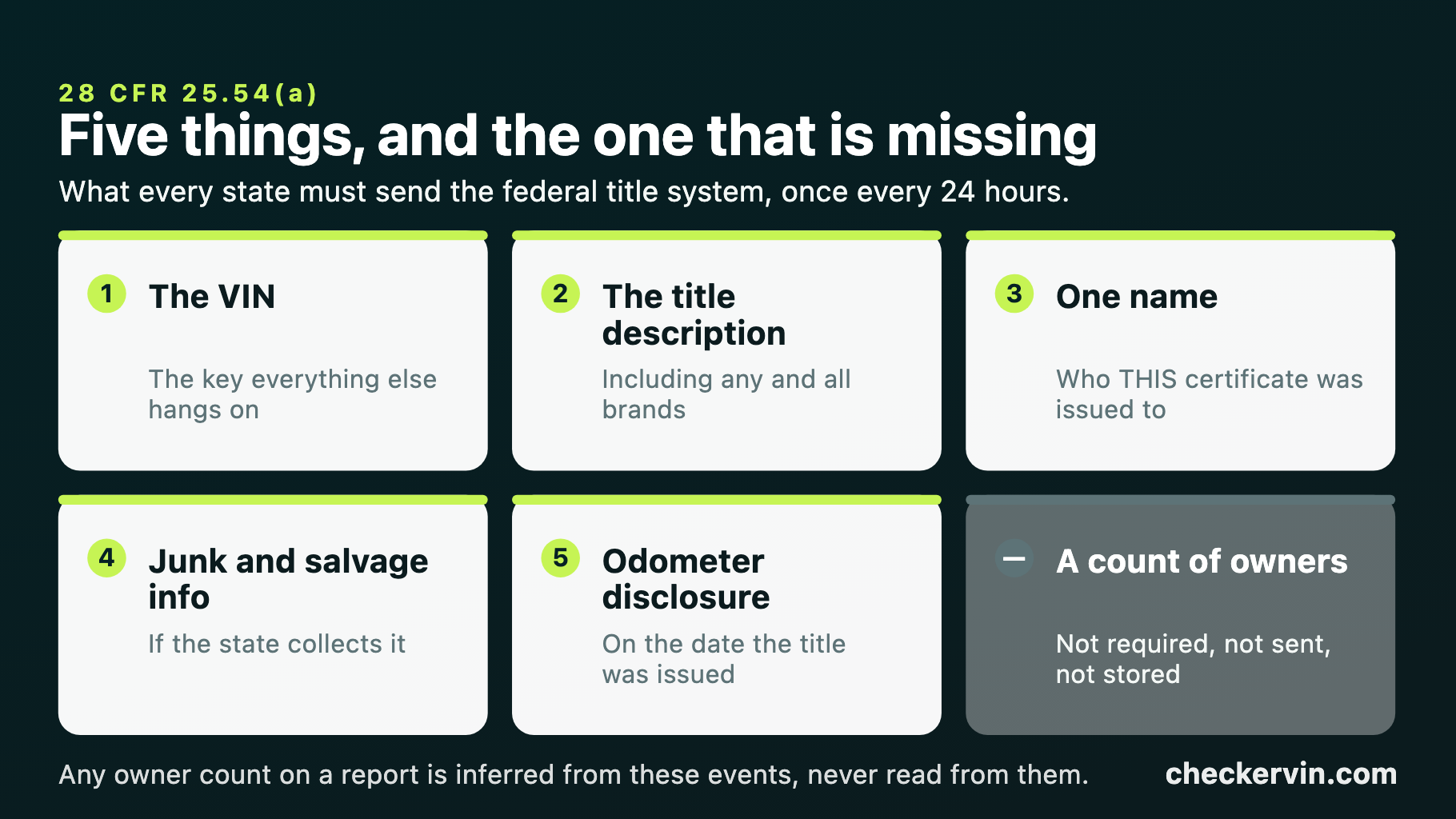
Each state must provide titling information for all automobiles it maintains, in an electronic format, at a frequency of once every 24 hours. The information must include five things:
- The VIN
- Any description of the automobile included on the certificate of title, including any and all brands associated with the vehicle
- The name of the individual or entity to whom the certificate was issued
- Information from junk or salvage yard operators or insurance carriers about acquiring junk or salvage automobiles, if the state collects it
- The odometer mileage disclosure required by federal law on the date the certificate was issued, and any later mileage if the state noted it
Read the third item carefully. It is the name on this certificate — the current one — not a history of everyone who held the car before. Each issuance contributes one name. Nothing in the list is a count, and nothing in the list is a chain.
How the number gets made
Given a stream of title issuances, producing an owner count means deciding which issuances represent a genuine change of owner and which do not. That decision is a rule somebody wrote, and reasonable rules differ.
Consider what a title issuance actually means. It means a state produced a certificate. A state produces a certificate whenever the paperwork calls for one — a sale, a lease buyout, a move across a state line, a lien satisfied and a clean title reissued, a lost title replaced, a name change after a marriage, a transfer into or out of a trust or an estate.
Some of those are a new owner in the sense a buyer cares about. Several plainly are not. Every vendor has to decide, and the deciding is where the numbers separate.
Four ways the count runs high
These are the common cases where the certificate stream shows more events than a buyer would call owners.
| What happened | Why it inflates the count |
|---|---|
| A lease that was bought out at the end | The finance company held title during the lease; the lessee took title at buyout. Two certificates, one person who ever drove it. |
| A move to another state | The new state issues its own certificate — to the same person. Nothing changed except the jurisdiction. |
| A dealer taking title between two private sales | Some dealers title the car to the dealership rather than assigning it straight through, which adds an entry that never had a driver. |
| A paperwork event with no sale at all | A replacement for a lost title, a reissue after a lien was satisfied, a name change, or a transfer into a trust. Real certificates, no new owner. |
None of that is anybody behaving badly. It is what a titling system does, and it is exactly why the same car can be a one-owner car in one report and a three-owner car in another.
Two ways it runs low
The error runs the other way as well, and this direction is the one that matters more, because it hides things rather than exaggerating them.
- A car used by several people under one registered owner — a household, a small business fleet, or a company car — appears as one owner however many hands it passed through
- A car that spent time in a state or period with weaker reporting can have gaps in the stream, and a count built on an incomplete stream comes out low
The first is worth dwelling on because it is common and entirely invisible. A vehicle titled to a business for five years and driven by whoever was on shift is a one-owner car by any counting rule anybody uses. So is a car titled to one parent and driven by three teenagers. The count describes the paperwork, not the driving.
The field that would fix it
Here is the part that makes this genuinely unfixable rather than merely imperfect, and it is worth stating plainly because it explains why the situation will not improve.
Every one of the ambiguous cases above could be resolved instantly if you could see the names. Two certificates issued to the same person after a move is obviously one owner. A finance company followed by an individual is obviously a lease and a buyout. A dealership in the middle is obviously a dealer. The name is the field that collapses title events into actual owners.
So the count is derived from a sequence of events with the disambiguating field removed for good reason. A vendor is inferring owners from title issuances while unable to show you whether two issuances went to the same person. That is not a gap in their product. It is the shape of the problem.
Why two reports disagree
If you have ever run the same VIN through two services and got different owner counts, this is the whole explanation, and it is more mundane than it feels.
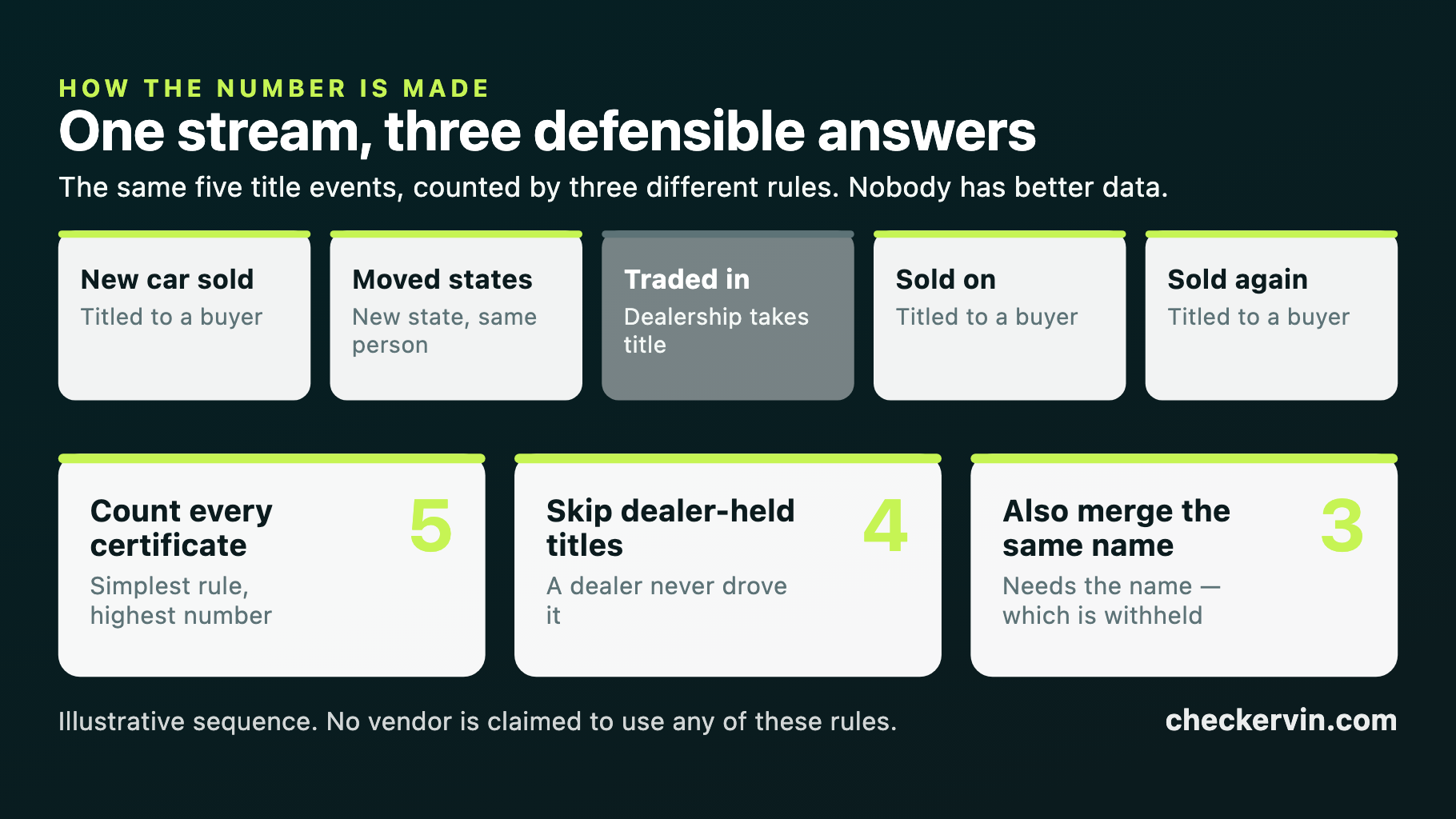
Neither vendor has better data in these cases. They have the same title events and different rules for turning events into owners. When the numbers differ, the difference is telling you about the rules, not about the car.
Our comparison of Carfax alternatives covers what the paid products differ on more broadly, and what a report costs covers the pricing models.
What a one-owner claim is worth
Less than it feels like, and still not nothing. Both halves of that matter.
A genuine single-owner car, kept a long time by somebody who serviced it, is a real thing and a good sign. Long ownership correlates with the car having been satisfactory, and a consistent service history under one name is easier to follow than a scattered one.
But the claim as it appears in a listing carries none of that context. It says a counting rule returned the number one. It does not say the owner was careful, that the car was garaged, that it was serviced, or even that only one person drove it. A fleet vehicle and a cherished commuter can both be one-owner cars.
Better questions than the count
Since the count is soft, spend the same attention on questions whose answers can actually be checked.
| Ask this instead | Why it is better |
|---|---|
| How long did each ownership period last? | Duration is visible in the title dates and is far more informative than the number of periods. Three long ones read very differently from six short ones. |
| Where was the car titled, and when did it move? | The state sequence tells you about climate and road treatment, and is the input for spotting a brand that did not survive a state line. |
| What does the mileage do across the transfers? | Odometer readings are captured at title issuance, so the transfers are exactly where you can check the series climbs. |
| Was it ever titled to a business or a rental company? | This changes how it was probably used far more than the count does, and it is often visible in the record type rather than the name. |
| Is there service history, and does it follow one pattern? | Continuity of maintenance is the thing owner count is used as a proxy for. Ask for the real thing rather than the proxy. |
How to get the real chain
If the count matters to you for a specific reason, the route to something firmer is the title record itself rather than a summarized number.
- 1Buy the federal NMVTIS record from an approved providerIt draws on the state titling data described above, so you see title events, dates, states and brands rather than a single vendor's headline count.
- 2Read the dates and states, not the totalThe sequence is the useful part. Look for short gaps, quick flips, and a state appearing once with no other connection to the car.
- 3Line the odometer readings up against the transfersEach certificate carries a mileage disclosure. Our odometer guide covers how to read the series and what a dip means.
- 4Ask the seller to fill the gaps with documentsService invoices and registration documents carry names and dates the report cannot show you, and a seller may share their own freely.
- 5Treat any remaining ambiguity as ambiguityWhere the record cannot distinguish a lease buyout from a sale, neither can you, and pricing it as certain is the mistake.
What the count does tell you
It would be a poor page that spent this long on the limitations and left you with nothing. The count is genuinely useful for one thing.
A high number on a young car is a real signal, because none of the over-counting cases above produce many events quickly. A three-year-old car with five title issuances has either moved states repeatedly, passed through several dealers, or been sold on by several people in quick succession — and all three are worth asking about.
Used that way, as a flag on a pattern rather than a measurement of a quantity, it earns its place. It is when the number is treated as a fact about how many humans owned the car that it starts misleading people.
The check sequence
Decode the VIN free for the factory build and specifications. Check open recalls through NHTSA at no cost. Screen for theft and total-loss records through the NICB. Buy the federal NMVTIS record and read the title sequence rather than the headline count. Line the odometer readings up against the transfers. Then inspect the car.
Where this information comes from
- 28 CFR 25.54 — responsibilities of the StatesThe five elements of titling information states must send every 24 hours, including the name of the individual or entity to whom the certificate was issued — and no owner count
- NMVTIS — official vehicle history recordThe federal title record built from that state data, and the list of approved consumer access providers
- NHTSA recall lookupOpen safety recalls by VIN, free, and repaired regardless of how many times the car has changed hands
- NICB — VINCheckFree screen for theft and total-loss records reported by participating insurers
Keep reading
Frequently asked questions
Can I find out how many owners a car has had from its VIN?
Not as a recorded fact, because no system stores that number. What exists is a sequence of title issuances, and any owner count you see has been inferred from that sequence by whoever wrote the report. The federal rules require states to send NMVTIS the name of the individual or entity a certificate was issued to — one name per certificate — with no tally of owners anywhere in the required data.
Why do two vehicle history reports give different owner counts?
Because each vendor makes its own judgment about which title events represent a change of owner. A lease bought out by the lessee, a dealer holding title between two private sales, and a retitling after a move to another state all create certificates that may or may not be counted. Different rules, different totals, from the same underlying data.
Does one owner mean the car was owned by one person?
It means the vendor's rules produced the number one from that car's title events. It is often true and worth having, but it is not a guarantee, and it is a weaker signal than most buyers treat it as. Ask instead who that owner was, how the car was used and where it was kept, which are questions with checkable answers.
Is a car with many owners a bad buy?
Not by itself. A high count can indicate a car people kept trying and disliking, or it can reflect an older vehicle, a cheap one that changed hands often, or simply a counting rule that treats a lease buyout and a dealer transfer as separate owners. Look at how long each period lasted and what the service and mileage records show across them.
Does CheckerVIN show previous owners?
No. Our free lookup returns the factory build, specifications and open safety recalls, and accident, title and odometer history are launching soon. Owner names are personal information that consumer vehicle reports do not carry, for privacy reasons covered on our motor vehicle records guide.
Start with the VIN
Decode any VIN free for the factory build, specifications and open safety recalls. No account, no card.
Run a free VIN check