The short answer
- What does a free lookup give me?
- The factory build: make, model, year, body, engine configuration, plant and the safety equipment fitted, from NHTSA's own database.
- What does it not give me?
- Owners, accidents, title brands and mileage. Those are not manufacturing facts and are not in that database at any price.
- What answers the rest?
- NICB's free theft and total-loss screen, and the federal NMVTIS title record for a few dollars from an approved provider.
17
Characters, 1981 onward
Shorter numbers are normal on older vehicles
144
Fields in the federal decoder
Manufacturing and safety equipment
$0
Cost of a decode and a theft screen
Both are official, both are free
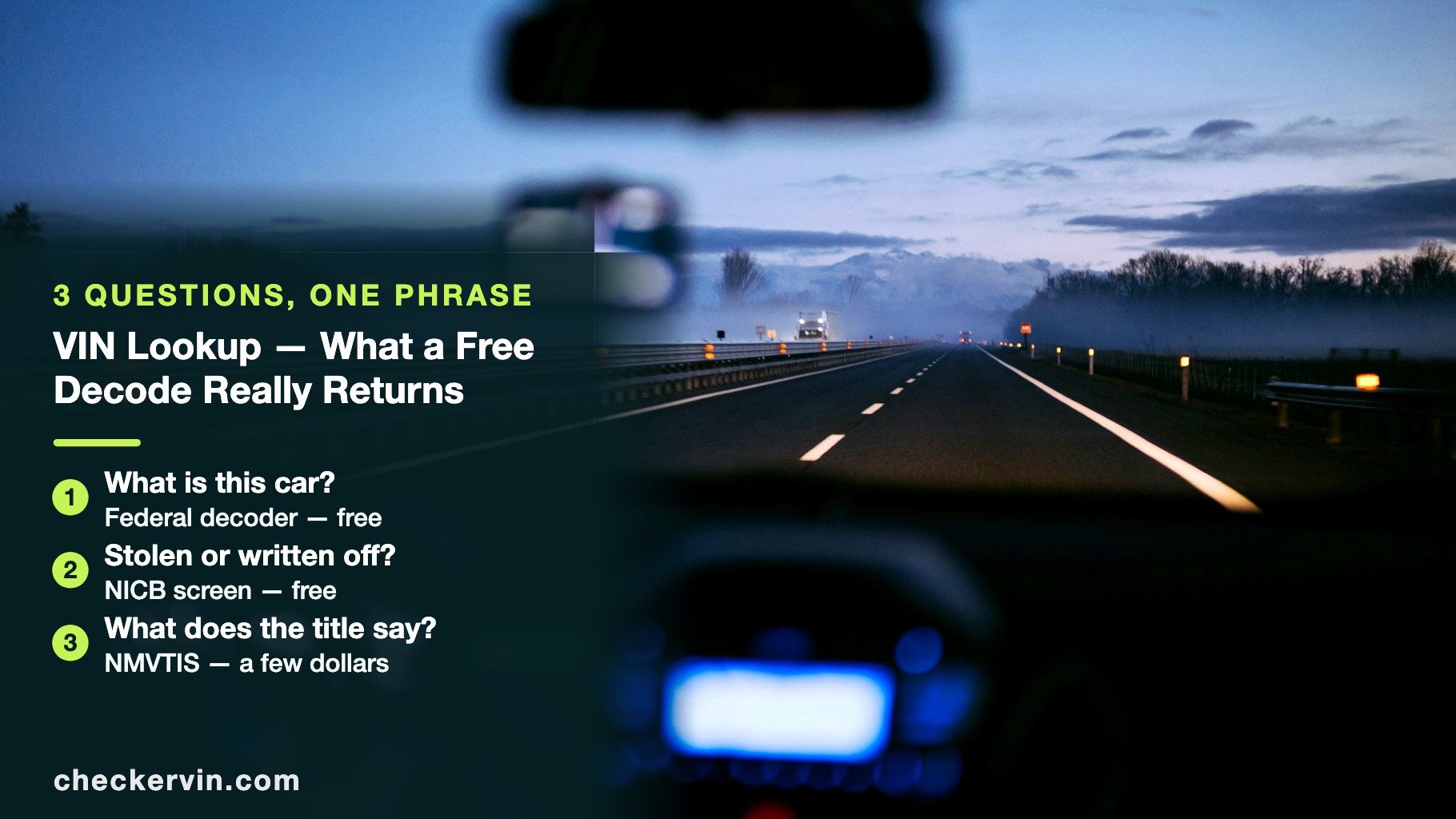
Three questions, one phrase
“VIN lookup” is a search term rather than a product. The people typing it are asking one of three quite different questions, and the reason the answers feel inconsistent across the internet is that different sites quietly answer different ones.
| The question actually being asked | What holds the answer, and what it costs |
|---|---|
| What is this car? Trim, engine, where it was built | The federal vPIC decoder at NHTSA — free, complete, and instant |
| Is it stolen, or was it written off? | NICB VINCheck — free, and limited to what participating insurers reported |
| What does its title say, and where has it been titled? | The federal NMVTIS record, through an approved provider — single-digit dollars |
| Who owned it, what was it repaired for, what did it sell for? | Commercial history networks, at premium prices, and only what somebody reported |
Notice that the four rows are not degrees of the same product. They are four different databases, built by four different kinds of organization for four different reasons, and a service that sells you one is not withholding the others.
The first two rows are free and official. The third is cheap and authoritative on one narrow subject. Only the fourth is expensive, and it is also the only one where the answer depends on whether a garage or an insurer chose to file a record. That ordering is worth carrying through everything below, because most people spend money on the fourth row before they have exhausted the first three.
The same three questions, under eight different names
If the phrase were the only problem this would be easy. It is not — people arrive at these three questions using a whole vocabulary of near-synonyms, and every one of them produces a slightly different set of results from a search engine while wanting the same thing.
| What people type | What they almost always want |
|---|---|
| VIN checker, VIN check | Usually question two or three — is something wrong with this car — rather than the specs |
| VIN decoder, decode this VIN | Question one. The characters translated into make, model, engine and plant |
| VIN lookup, look up VIN number | Genuinely ambiguous. This is the phrase that hides all three |
| VIN search, find a car by VIN | Usually question one, sometimes an attempt to find where a car is now, which no public tool does |
| VIN finder, free VIN finder | Often not a lookup at all — the searcher has lost the number and wants to know where it is on the car |
| Verify a VIN, VIN verification | Two different things, which is why it has its own section below |
| VIN number info, car information by VIN | Question one, phrased by someone who does not yet know a decode is free |
| VINCheck | A specific free service from the National Insurance Crime Bureau, not a generic term |
The last row is worth pausing on because it is the one people get wrong in a way that costs them. VINCheck is a proper noun. It is the free lookup run by the National Insurance Crime Bureau covering theft and salvage reported by participating insurers, and typing it as a generic phrase lands people on paid services that are not it. If that is the question you have, our guide to NICB VINCheck covers what it does and does not include.
The fifth row is the other one that surprises people. A large share of “VIN finder” searches are not asking a database anything — they are asking where the number is physically located on the vehicle, which is a question about metal rather than records. Our page on where the VIN is answers that one, and it is free and instant in a way no lookup can be.
Verify is the one word that means two different things
Every phrase above is a rewording. “Verify” is not — it splits into two genuinely separate needs, and answering the wrong one wastes a trip.
| What someone means by verify | What actually answers it |
|---|---|
| Is this number real, and does it belong to this car? | Checks you can do yourself in a few minutes, for nothing, standing at the vehicle |
| I need an official VIN verification for the state | A physical inspection by an authorized person, on a state form — a process, not a lookup |
The second is a real administrative procedure, usually triggered when a vehicle arrives from out of state, when a title is being rebuilt, or when paperwork and metal disagree. It is not something a website performs, and our VIN verification guide covers who is authorized to do it and what they look at.
The first is the one most people actually mean, and it is entirely within your power at the roadside.
- 1Read the number in two places and compareThe plate at the base of the windshield and the label inside the driver's door frame. They must match each other character for character. A disagreement here outranks everything else on this page.
- 2Check that it is seventeen characters, with no I, O or QThose three letters are excluded from the standard because they are too easily confused with one, zero and zero. A number containing them is not a modern VIN.
- 3Confirm the check digit computesThe ninth character is arithmetic, derived from the other sixteen. A VIN whose check digit does not compute has been mistyped or invented — and this is the single fastest way to catch a fabricated number.
- 4Decode it and see whether the answer matches the carThe free federal decoder returns the body style, engine and plant. If it describes a four-cylinder sedan and you are standing in front of a V6 truck, the number does not belong to that vehicle.
- 5Compare all of it to the titleThe number on the paperwork has to match the number on the metal. Where it does not, stop — that is the point at which a purchase becomes somebody else's problem to explain.
Those five steps are what “verifying a VIN” means for a buyer, and none of them costs anything. Our guide to reading a VIN character by character works the check digit arithmetic in full.
What the federal decoder is, and why it is authoritative
The free decode on this page runs against vPIC, the Vehicle Product Information Catalog maintained by the National Highway Traffic Safety Administration. It is not a commercial database with a free tier. It is the federal record of what manufacturers reported about the vehicles they built, and manufacturers report into it because they are required to identify their vehicles under federal rule.
That origin is what makes a decode trustworthy in a way that a scraped specification site is not. When vPIC says a vehicle has a particular engine configuration or a particular restraint system, that is the manufacturer’s own submission about its own product, not an inference from a model brochure. It is also why the decoder is free: you are not being sold access to somebody’s proprietary compilation.
The same origin explains its limits, which we will come to. A database built from manufacturer submissions knows everything about how a car left the factory and nothing whatsoever about what happened to it afterward.
One hundred and forty-four fields, and the one that comes back empty
It is worth looking at the shape of the decoder rather than only its output, because the shape tells you what kind of instrument it is. vPIC publishes its own field list, and that list runs to 144 variables. They are not evenly spread.
| Where the decoder's fields are concentrated | How many |
|---|---|
| Engine — configuration, displacement, cylinders, fuel, power | 20 fields |
| Safety systems — air bags, stability control, collision avoidance, lane assist | 25 fields |
| General identity — make, model, year, series, trim, plant | 17 fields |
| Dimensions, body and exterior | 13 fields |
| Price | 1 field, and it returns empty |
Read that distribution as a statement of purpose. Nearly a third of the federal decoder is engine and safety equipment, because the agency that built it regulates safety equipment. There is exactly one price field in the whole catalog, and on a real decode it comes back null — the field exists in the schema and the data is not there.
What a decode cannot tell you, at any price
This is the part most guides skip, and it is the part that saves money. A VIN decode is silent on every one of the following, and the silence is structural rather than a limitation of the free version.
- Who has owned the car, or how many owners it has had
- Whether it has been in a collision, and how severe
- What its title says, and whether that title carries a brand
- What the odometer read at any point in its life
- Whether it has ever been reported stolen
- What service or repair work has been carried out
Every item on that list is an event rather than a specification. Events are recorded by the party the event happened to — a state titling agency, an insurer, a police department, a garage — and reach a database only when that party reports them. None of them pass through the manufacturer, so none of them reach vPIC.
Owner identity is a special case worth naming separately, because people expect a paid service to unlock it. It is not a data availability problem. The federal Driver’s Privacy Protection Act restricts personal information in motor vehicle records to enumerated permitted uses, so the constraint applies to every service equally and no fee removes it. That is why even premium reports describe ownership in counts and dates rather than names.
Be clear about what CheckerVIN itself offers today, because the distinction runs through this whole page. We provide the free decode, the specifications and open safety recall data. We do not supply accident, title, odometer or theft history. Where those are what you need, the routes below are the honest ones, whoever you end up buying from.
The theft and total-loss question, answered free
The second of the three questions has a free official answer that a surprising number of buyers never use. The National Insurance Crime Bureau publishes VINCheck, a public screen that reports whether a VIN appears in its members’ records as a theft that was never recovered, or as a vehicle an insurer declared a total loss.
Two things to hold in mind. It is genuinely free and takes about two minutes, so there is no reason to skip it on any car you are seriously considering. And it is bounded by participation: it holds what participating insurance carriers reported, which is a large share of the market but not all of it. A clean VINCheck result is meaningful and it is not a guarantee.
Our guide to the NICB check covers what the screen holds, how to read a hit, and the daily search limit that catches people running many cars at once.
The title question, and the only database built to answer it
The third question — what the title says, and how many states have issued one — is the one worth spending on, and the amount is small. The National Motor Vehicle Title Information System is the federal database that state titling agencies, insurers and the salvage trade are required by law to report into. That compulsion is the whole point: a brand applied in one state cannot be shed by retitling the vehicle in another.
Consumer access runs through providers the Department of Justice approves, and the approved list is published. A report costs single-digit dollars. On a car worth thousands it is the highest-value few dollars in this entire process, because title washing is the fraud that costs used-car buyers most and this is the system built specifically to defeat it.
Our NMVTIS guide explains what the record contains and where its authority ends, and the cost guide sets it against the premium products.
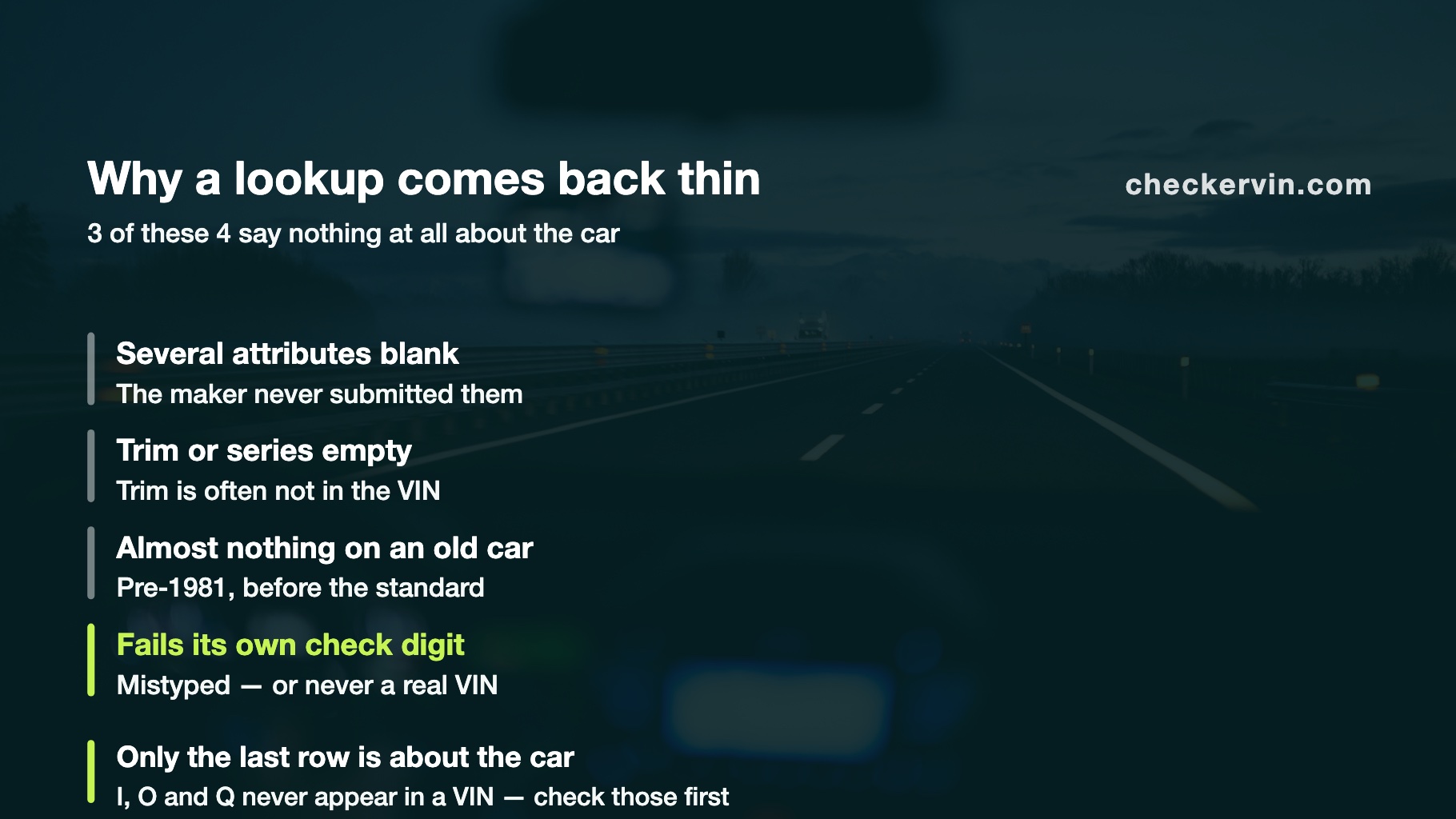
When a result comes back thin, and what that means
A decode that returns fewer fields than you expected is the most common source of confusion with any VIN lookup, and it is almost never a sign of a problem with the vehicle.
| What you see | What it usually means |
|---|---|
| Several attributes blank | The manufacturer never submitted them for that vehicle line |
| Trim or series empty | Common — trim is frequently not encoded in the VIN at all |
| Almost nothing returned on an old vehicle | Pre-1981 numbers predate the 17-character standard |
| An error rather than a thin result | Check the characters — I, O and Q are never used in a VIN |
That last row is the one worth pausing on. The letters I, O and Q do not appear in a seventeen-character VIN, precisely so they cannot be confused with the digits one and zero. If you have transcribed one of them from a plate, the lookup will fail and the fault is in the transcription. Position nine is a check digit calculated from all the others, which means a mistyped character usually announces itself rather than quietly returning the wrong car.
The reverse situation deserves suspicion. A number that is the right length, uses valid characters, and still fails its check digit has either been copied wrong or was never a real VIN. On a car you are about to buy, that is worth resolving before anything else.
Finding the number itself
Two locations settle almost every case. The dashboard plate is visible through the windshield on the driver’s side, and the certification label sits on the driver’s door jamb. A third copy lives on the title and registration documents, and on the insurance paperwork.
Locations vary by vehicle type — motorcycles carry the number on the steering head, trailers on the tongue or frame rail, and older machines vary considerably. Our guide to VIN locations covers each of them, and how to read a VIN works through the seventeen characters position by position.
Why two sites return different answers for the same VIN
Run one VIN through several decoders and the results will not match. This alarms people, and it usually should not. There is one authoritative source underneath, and the differences come from what each site does on top of it.
The federal catalog holds what manufacturers submitted, and manufacturers submit different amounts of detail. A commercial decoder that wants to show trim, factory options or paint code on every lookup cannot get all of that from vPIC, so it fills the gap from its own sources — a parts catalog, a build-data feed, a licensed manufacturer connection, or an inference from the model and year. Those additions are often correct. They are not the same kind of fact as the federal record, and the site rarely tells you which is which.
| Where the discrepancy usually comes from | How much to trust it |
|---|---|
| Trim or package differs between sites | Trim is frequently not in the VIN at all — treat both as inferred |
| One site shows options, another shows none | Option data comes from build sheets, not from the VIN's own characters |
| Engine described differently | Same engine, different vocabulary — compare displacement and cylinders, not names |
| One site returns nothing at all | Check the characters first; a single mistyped digit fails the whole lookup |
The practical rule is to treat the federal decode as the baseline and anything richer as a claim that needs a second source. Where a difference actually matters to a purchase — a towing package, a drivetrain, an engine variant that changes the value — the resolution is not another decoder. It is the window sticker, the build sheet, or the car itself.
What to do with the answer: match the decode to the metal
A decode is only worth running if you do something with it, and the thing to do takes about five minutes. Read the result next to the actual car and the actual advertisement, and look for disagreement.
This is the cheapest fraud check available and almost nobody performs it. A listing that says one thing while the federal record of that VIN says another is either a mistake in the advertisement or a car being described as something it is not. Both are worth knowing before you drive anywhere.
- Model year — against the listing, and against the tenth character of the VIN
- Engine configuration — cylinders and displacement, against what is under the hood
- Body class and doors — against the vehicle in front of you
- Drive type — a decode saying two-wheel drive on a car advertised as four is a real finding
- Plant of manufacture — against any claim about where the car was built
- Restraint systems — against a car whose air bag lights behave oddly
Most of the time everything agrees and you have spent five minutes buying confidence. When something does not agree, you have found it before spending anything else, which is the entire economic argument for starting with the free layer.
One caution on the check itself. A mismatch is a reason to ask a question, not an accusation. Advertisements are written quickly and often by people who did not build the listing from the VIN. The finding that matters is a mismatch the seller cannot explain, or one between the VIN on the dashboard, the VIN on the door jamb and the VIN on the title — and that last one is the check that should stop a purchase outright.
The order to run them in
Sequence matters because it decides what you spend. Run the free layers across every car you are considering, and reserve anything paid for the one or two you are serious about.
- 1Decode the VIN — freeConfirms the car is what the listing claims. A decode that disagrees with the advertisement is the cheapest red flag you will ever find.
- 2Check open safety recalls — freeNHTSA's recall lookup runs on the same number and reports campaigns that have not been closed out on that vehicle.
- 3Run the NICB theft and total-loss screen — freeTwo minutes, and it catches the cars that should end the conversation.
- 4Buy the federal title record — a few dollarsOnce a car is a serious candidate. This is the check that catches title washing.
- 5Consider a premium report only if the car warrants itExpensive, late-model, or where documented service history genuinely changes the valuation.
- 6Then pay a mechanicNo lookup at any price sees a worn transmission or a repaired structure. The inspection is the purchase that pays.
Step one, free: decode the VIN
Decoded from official manufacturer and NHTSA records
Where this information comes from
- NHTSA vPIC — VIN decoder and variable listThe federal specification database a free decode runs against
- NHTSA — recalls by VINOpen safety campaigns on a specific vehicle, free
- NICB VINCheckFree theft and total-loss screen from participating insurers
- NMVTIS — approved data providersThe federal title record, and the Department of Justice list of who may sell it
Keep reading
Frequently asked questions
Is a VIN checker different from a VIN lookup?
Not as a product, only as a phrase. People who type VIN checker are usually asking whether something is wrong with the vehicle — stolen, salvaged or branded — while people who type VIN decoder usually want the specifications. Both land on the same three underlying questions, and the free tools that answer them are the federal decoder, NICB VINCheck and the national title record.
How do I verify a VIN myself?
Read it in two places on the car and confirm they match, check it is seventeen characters with no I, O or Q, confirm the ninth character computes as a check digit, decode it and see whether the result describes the vehicle in front of you, then compare all of it against the title. That costs nothing. A formal VIN verification for a state is a different thing entirely — a physical inspection by an authorized person.
What does a free VIN lookup actually return?
The factory build. A free decode run against NHTSA's vPIC database returns what the manufacturer reported about that vehicle when it was built — make, model, year, body class, engine configuration, plant, restraint systems and the safety equipment fitted. It does not return owners, accidents, title brands or mileage, because none of those are manufacturing facts and none of them are in that database.
Is a VIN lookup the same as a vehicle history report?
No, and the difference is the single most useful thing to understand here. A lookup decodes the number itself against a specification database. A history report assembles records created after the car left the factory — title events, insurance claims, service entries. They come from different systems, they answer different questions, and one is free while the complete version of the other is not.
Can I check if a car is stolen from the VIN for free?
Partly. The National Insurance Crime Bureau publishes a free VINCheck screen covering theft records reported by participating insurers and vehicles those insurers declared a total loss. It is genuinely free and worth the two minutes. It is not a complete theft database, because it only holds what participating carriers reported.
Why did my VIN lookup come back with blank fields?
Because the manufacturer never reported that attribute for that vehicle line. vPIC holds what each manufacturer submitted, and submissions vary by make, by model year and by how relevant an attribute was to that vehicle. A blank field is usually silence from the manufacturer rather than an error in the lookup or a problem with the car.
Can I look up a VIN from a license plate?
Not as a member of the public, and not because the technology is missing. Motor vehicle records are governed by the federal Driver's Privacy Protection Act, which restricts personal information in those records to a list of permitted uses that does not include curiosity. Some states publish a plate-to-vehicle tool that returns the car without the owner, and a seller can simply give you the VIN. Any site promising a plate-to-owner lookup is either selling stale scraped data or describing something it cannot legally do.
Will a VIN lookup tell me who owned the car?
No, and no legitimate service will. Owner identity sits inside the same federal privacy restriction, which is why even paid history reports describe owners in counts and periods rather than names. What you can establish from the records is how many title events there were, which states issued them and roughly when — enough to spot a car that has moved suspiciously often without ever naming a person.
How many characters should a VIN have?
Seventeen, on any vehicle built for United States roads from the 1981 model year onward. Shorter numbers are normal on older vehicles and on some off-highway machines, which were never brought under the seventeen-character standard. A seventeen-character number that fails its own check digit is a different matter and is worth treating as a transcription error until proven otherwise.
Look up any VIN free
Factory build, specifications and open safety recalls, decoded from official manufacturer and NHTSA data. No account, no card.
Run a free VIN check