The short answer
- Where is the VIN on a car?
- Look at the base of the windshield on the driver's side, from outside the car. A small metal plate sits where the glass meets the dashboard. The second location is a sticker inside the driver's door frame, visible with the door open. Both should read identically.
- Where else is it stamped?
- Commonly on the firewall or strut tower under the hood, on the engine block, on the frame rail, inside the trunk under the spare wheel, and on the rear wheel well. Manufacturers vary, and older vehicles carry fewer stampings.
- Where is it on paperwork?
- On the title, the vehicle registration, the insurance card and policy documents, and on dealer and service invoices. Paperwork is convenient but not proof — always confirm against the vehicle itself.
17
Characters since 1981
Shorter formats before that
2+
Locations on every modern car
Windshield and door jamb
Never
The letters I, O and Q
Too easily read as 1 and 0
Fixed
The VIN never changes
Unlike the license plate
The short version: look here first
If you only remember one location, remember the driver's side windshield. Stand outside the car, look down through the glass at the corner of the dashboard nearest the driver, and you will see a small plate carrying seventeen characters. It is placed there deliberately so it can be read without opening the vehicle.
Everything below is either a second opinion on that number or a fallback for vehicles where the windshield plate is missing, obscured or does not apply.
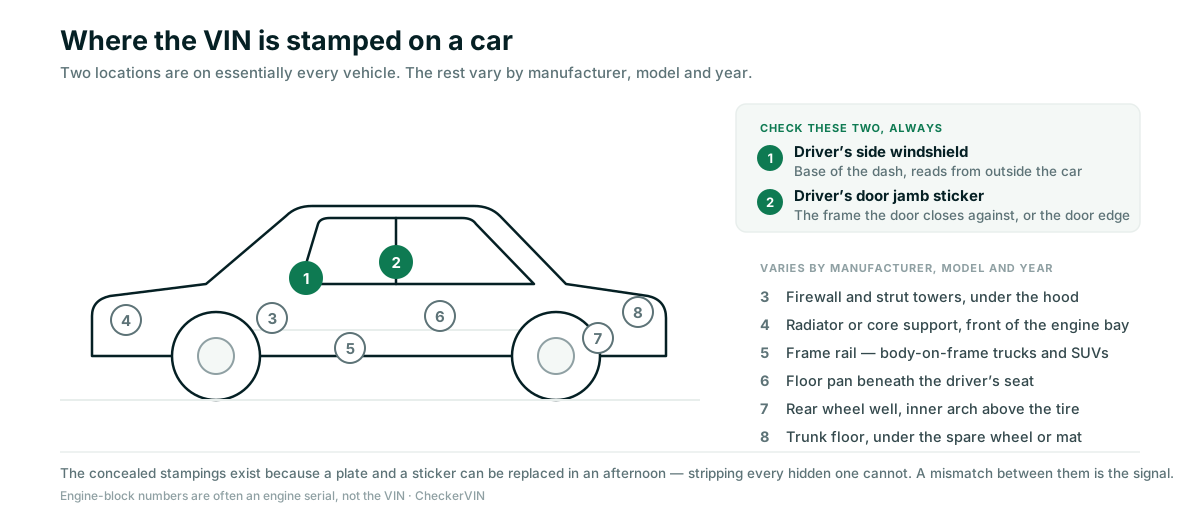
The windshield plate
This is the reference location on essentially every car, truck and SUV sold in the United States. The plate sits under the glass on the driver's side, angled so that it reads correctly from outside the vehicle.
Two practical notes. Dashboards accumulate clutter and sun shades, and a plate can be hidden under either — move things before concluding it is missing. And glass replacement occasionally disturbs the plate, so a car with a recently replaced windshield and a missing plate has an innocent explanation available, which you should still verify against another location.
The driver’s door jamb sticker
Open the driver's door and look at the frame the door closes against, or the edge of the door itself. The label there carries the VIN alongside a set of information that is useful in its own right.
| On the label | Why it matters |
|---|---|
| VIN | Your second independent reading, to check against the windshield plate |
| Build date | Month and year of manufacture — often different from the model year |
| Gross vehicle weight rating | The maximum the vehicle is rated to weigh, loaded |
| Gross axle weight ratings | Front and rear limits, relevant if you tow or haul |
| Tire size and pressures | The factory specification, not whatever is fitted now |
| Paint and trim codes | For ordering matching paint and interior parts |
Under the hood
Open the hood and look at the firewall — the panel separating the engine bay from the cabin — and at the strut towers on either side. Many manufacturers place a stamping or a sticker in one of those positions.
The engine block itself often carries a stamped number, but be careful here: on many vehicles that is an engine serial number rather than the VIN. They are different things, and confusing them is one of the most common mistakes people make when a number does not match what they expected.
Other places manufacturers stamp it
Beyond the two primary locations, coverage varies by manufacturer, model and year. Work through these when the obvious spots are unavailable.
- The frame rail, usually on the driver's side, on body-on-frame trucks and SUVs
- Inside the trunk, under the spare wheel or the trunk floor mat
- The rear wheel well, on the inner arch above the tire
- The radiator support or core support at the front of the engine bay
- The base of the driver's seat or the floor pan beneath the carpet
- The transmission housing, on some manufacturers
These hidden stampings exist for exactly one reason: a thief can replace a windshield plate and a door sticker in an afternoon, but stripping every concealed stamping is impractical. That is why investigators check them, and why a mismatch between a visible plate and a hidden stamping is so significant.
Some vehicles have no VIN to find at all — golf cart VIN lookup explains why federal law does not treat a cart as a motor vehicle until it passes 20 mph.
Where the VIN appears on paperwork
When you cannot get to the vehicle, the documents carry it. Each of these should show the identical seventeen characters.
| Document | Notes |
|---|---|
| Certificate of title | The legal ownership document. Also where any brand appears. |
| Vehicle registration | Carried in the car in most states, renewed periodically. |
| Insurance card and policy | Both the wallet card and the full policy documents. |
| Dealer purchase paperwork | Bill of sale, finance agreement and the window sticker. |
| Service and repair invoices | Most shops record the VIN on every job. |
| Vehicle history reports | Any prior report you or the seller has run. |
Where the VIN is on a motorcycle
Motorcycles carry a 17-character VIN under the same federal standard as cars, but the locations are different because there is no windshield or door frame to use.
- 1The steering headThe frame tube the front forks pass through, at the front of the bike below the handlebars. This is the primary location on most motorcycles — turn the bars and look at the right side of the neck.
- 2The frame downtubeSome manufacturers stamp the frame lower down instead. Look along the main tubes near the engine mounts.
- 3A frame labelMany bikes also carry a certification label with the VIN printed on it, often on the frame near the steering head or under the seat.
- 4Not the engineThe engine cases carry their own number. On a motorcycle it is normal for the engine number and the VIN to differ — but on some makes a portion should correspond, which is worth checking when buying.
Trailers, campers and RVs
Towable trailers, travel trailers and fifth wheels carry their own VIN, separate from the vehicle towing them. Look on the tongue or A-frame at the front of the trailer, on the frame rail on the left side, or on a certification label near the front left corner.
Motorhomes are a special case worth understanding. A motorhome built on a commercial chassis has a chassis VIN from the chassis manufacturer and separate identification from the coach builder. When a lookup returns a chassis manufacturer rather than the RV brand you expected, that is usually why — not an error.
Why you should always check two locations
This is the habit that separates a careful buyer from a hopeful one, and it costs ten seconds. Read the windshield plate. Open the door and read the jamb sticker. Confirm they are the same seventeen characters.
The reason is straightforward. VIN cloning — putting a legitimate vehicle's identity onto a stolen one — depends on the buyer checking one location, or none. Two independent readings that agree, checked against the title, make the deception substantially harder to sustain.
Signs a VIN plate has been tampered with
Factory VIN plates are applied to a consistent standard. Deviations are worth treating as questions that need answers.
- Rivets that look new, are mismatched, or are the wrong type for the vehicle
- Scratches, tool marks or adhesive residue around the plate edges
- Characters with inconsistent spacing, depth or font
- A plate that sits unevenly, is bent, or looks like it has been removed and refitted
- A door jamb sticker with peeling edges, bubbling, or an obviously different finish
- Any disagreement between two locations, or between the vehicle and the title
- Paint overspray on or around the plate
If the VIN is damaged, corroded or unreadable
Age, road salt and accident damage all take their toll. Before concluding a number is gone, work through the alternatives.
- 1Try every other locationConcealed stampings survive conditions that destroy exposed plates. Check the firewall, frame rail, trunk and wheel well.
- 2Pull the documentsTitle, registration and insurance all carry it. If the vehicle is yours, this is usually the fastest route.
- 3Ask a dealer or your insurerA franchise dealer can often retrieve it from service records, and your insurer holds it on the policy.
- 4Check with the state motor vehicle agencyFor a vehicle you own, the state can supply the VIN from its title record.
- 5If it is a car you are buying, stopA vehicle with no readable VIN anywhere is not a vehicle you can verify, insure or reliably title. That is the seller's problem to resolve, not yours to inherit.
Photograph it — do not transcribe it
Most VIN errors are not fraud, they are typing. Seventeen characters read through glass at an angle, in poor light, then copied by hand, produce mistakes at a predictable rate.
Take a photograph instead. Get close, use the flash, and take a second shot of the door jamb sticker where the characters are printed rather than stamped and are usually easier to read. Then zoom in to read it rather than working from the original angle.
Three letters a VIN never contains
The letters I, O and Q are excluded from the VIN standard entirely, because they are too easily confused with the digits 1 and 0. This is genuinely useful when reading a worn plate.
If a character looks like the letter O, it is a zero. If it looks like an I, it is a one. And if you have typed a VIN that a decoder rejects, one of those three substitutions is the most likely cause — worth checking before you conclude the VIN itself is wrong.
What to do once you have the VIN
Having the number is the start. What it unlocks is the reason to go looking for it in the first place.
- Decode it to confirm the vehicle matches how it is being described
- Check open safety recalls — free, and the repair costs you nothing
- Run a theft and salvage check before any private-sale money moves
- Look up the original factory build and window sticker
- Check the title record for brands such as salvage, flood or rebuilt
- Give it to your insurer for an accurate quote on the specific vehicle
Where this information comes from
Keep reading
Frequently asked questions
Where is the VIN number located on a car?
The primary location is a small plate at the base of the windshield on the driver's side, readable from outside the car looking in. The second is a sticker inside the driver's door frame, visible when the door is open. Federal rules require the windshield VIN to be readable from outside the vehicle.
Can I find a car's VIN without being at the car?
Yes. The VIN appears on the title, the registration document, the insurance card and insurance policy paperwork, and on most repair and service invoices. Just be aware that paperwork can be wrong or belong to a different vehicle, so confirm against the car itself before money changes hands.
Is the VIN the same as the license plate number?
No. A license plate is assigned by the state and changes when the car is sold, moved or re-registered. The VIN is assigned by the manufacturer, is 17 characters long, and never changes for the life of the vehicle.
Why doesn't my VIN have 17 characters?
Vehicles built before the 1981 model year used shorter manufacturer-specific formats, commonly 11 to 13 characters. If a vehicle from 1981 or later shows fewer than 17, you are probably reading a partial stamping, an engine number, or a plate that has been altered.
What do I do if the VIN plate is missing?
Treat it as a serious warning and do not buy until it is explained. Check the other stamping locations first, since plates do occasionally go missing during windshield replacement. If no location carries a readable VIN, walk away and consider reporting the vehicle to local law enforcement.
Got the VIN? See what it says
Decode any VIN for the factory build, specifications and open safety recalls. Free, no account.
Run a free VIN check