The short answer
- How do you read a Ford VIN?
- Characters one to three identify Ford and the country and vehicle class — 1FA for US-built cars, 1FT for US-built trucks, 1FM for US-built SUVs. Four to eight describe the vehicle, including model line at position five and engine at position eight. Nine is a check digit, ten is the model year, eleven is the assembly plant, and twelve to seventeen are the production sequence.
- What can a free Ford VIN decode tell me?
- Model year, model, body class, engine displacement and cylinder count, fuel type, drivetrain, restraint system, manufacturing plant and country, plus any open safety recalls on that specific vehicle.
- Where is the VIN on a Ford?
- On a plate at the base of the windshield on the driver's side, visible from outside, and on a sticker inside the driver's door frame. It also appears on the title, registration and insurance documents.
17
Characters since 1981
Model year 1981 onward
1FA
US-built Ford car
1FT trucks, 1FM SUVs
10th
Character is the model year
Letter or digit, 30-year cycle
Free
Ford data via NHTSA vPIC
Public, no account needed
What a Ford VIN actually tells you
A VIN is not a history file. It is an identity — a description of the vehicle as designed and built, permanently attached to that one car. Decoding it settles questions of fact that sellers often get wrong and listings often get wrong twice.
- Model year, model and body style as recorded by the manufacturer
- Engine displacement, cylinder count and fuel type
- Drivetrain configuration and, on many models, transmission family
- Restraint system type fitted at the factory
- Country of manufacture and the specific assembly plant
- Which safety recalls Ford has issued against this exact vehicle
Where to find the VIN on a Ford
- 1The windshield plateStand outside the car on the driver's side and look at the base of the windshield. A small metal plate carries the VIN, readable through the glass. This is the primary location on every modern Ford.
- 2The driver's door jambOpen the driver's door and check the sticker on the door frame or the door edge. It carries the VIN alongside tire pressures, gross vehicle weight rating and the build date.
- 3The paperworkTitle, registration and insurance documents all carry the VIN. Verify all three read identically to the plate on the car — a mismatch is a serious warning sign.
The 17 characters, position by position
| Position | What it encodes |
|---|---|
| 1 | Country of manufacture — 1 for the United States, 2 Canada, 3 Mexico, W Germany, M India |
| 2–3 | Manufacturer and vehicle class — FA for Ford cars, FT trucks, FM multipurpose vehicles |
| 4 | Restraint system, and on trucks the brake type and gross vehicle weight rating class |
| 5 | Model line or series — the character that separates a Fusion from a Mustang |
| 6–7 | Body style, cab configuration and series detail |
| 8 | Engine code — displacement, configuration and fuel type |
| 9 | Check digit, mathematically derived from the other sixteen characters |
| 10 | Model year |
| 11 | Assembly plant |
| 12–17 | Sequential production number, unique to that vehicle at that plant |
Positions one to three form the World Manufacturer Identifier. Positions four to eight are the Vehicle Descriptor Section, where Ford's own coding lives — five characters, with position nine sitting outside it as the check digit. Positions ten to seventeen are the Vehicle Identifier Section — the part that makes this VIN unique rather than merely descriptive.
Those boundaries are not Ford's to choose. They are fixed in federal regulation — 49 CFR Part 565, the rule that tells every manufacturer selling in the United States where each block starts and stops. That is why the same arithmetic works on a Transit and a Mustang, and why a decoder written for one marque does not fall over on another. What Ford controls is the contentof positions four through eight. Section 565.15(b) is worth quoting closely, because it is more precise than the folklore: the second section “shall consist of five characters, which occupy positions four through eight,” and the characters used and their placement within it “may be determined by the manufacturer” — but the specified attributes “must be decipherable with information provided by the manufacturer.” Ford chooses the code and is obliged to make it readable. That is the most useful thing to understand about VIN decoding: the skeleton is public and universal, the meat is proprietary but not permitted to be secret.
The same section carries a detail almost no decoder mentions. For passenger cars, and for multipurpose passenger vehicles and trucks rated at 4,536 kg (10,000 lb) or less, the fourth character of the descriptor section — position 7 of the VIN — must be alphabetic. A letter sitting in position seven of an ordinary Ford car or light truck is required rather than incidental, and a digit there is a sign you have miscounted the characters or misread one.
Ford WMI codes: the first three characters
Ford uses different world manufacturer identifiers for different countries and vehicle classes. The first three characters therefore tell you a surprising amount before you decode anything else.
| WMI | Meaning |
|---|---|
| 1FA | Ford Motor Company, United States — passenger car |
| 1FB | Ford, United States — bus or passenger van |
| 1FC | Ford, United States — incomplete vehicle (chassis supplied for upfitting) |
| 1FD | Ford, United States — incomplete vehicle, heavier gross vehicle weight class |
| 1FM | Ford, United States — multipurpose passenger vehicle (Explorer, Expedition, Escape) |
| 1FT | Ford, United States — truck (F-Series, Ranger) |
| 2FA / 2FM / 2FT | Ford of Canada — car, multipurpose vehicle and truck respectively |
| 3FA | Ford of Mexico — passenger car |
| 3FE | Ford of Mexico — incomplete vehicle |
| WF0 | Ford-Werke, Germany — vehicles built for European markets |
| MAJ | Ford India |
| NM0 | Ford Otosan, Turkey — Transit and Transit Connect vans, filed as truck |
| 1ZV | AutoAlliance International, Flat Rock, Michigan — passenger car |
Every code in that table was checked one at a time against NHTSA's vPICDecodeWMI endpoint rather than copied from a decoder site, and the exercise repaid itself twice. The first correction: 1FC and 1FD do not return “truck.” They return incomplete vehicle — a chassis or cab shipped to a body builder to be finished as an ambulance, box truck, motorhome or utility body. If you are looking at a VIN that opens 1FD, the vehicle in front of you was completed by a second company whose work is not described anywhere in the VIN at all.
The second is stranger. 1ZV does not resolve to Ford. vPIC returns the manufacturer as Auto Alliance— AutoAlliance International, the Flat Rock joint venture Ford ran with Mazda, which assembled Mustangs. A Mustang with a 1ZV VIN is a Ford in every sense that matters to a buyer, and it is not filed under Ford's manufacturer identifier. A lookup table that assumes every Ford VIN begins 1F will simply fail on it.
Position 5: the model line character
The fifth character is where Ford identifies which model you are looking at. It is manufacturer-specific — the same letter means different things on a Ford VIN and a Toyota VIN — and Ford has reused codes across generations as the lineup changed.
Because the mapping shifts by model year and vehicle class, reading position five in isolation is unreliable. It has to be interpreted together with the WMI and the model year, which is exactly what a decoder does when it queries the manufacturer build record rather than a static lookup table.
Position 8: the engine code
The eighth character identifies the engine the vehicle was built with — displacement, configuration and fuel type. On a used Ford this is one of the most practically useful characters in the VIN, because engine choice drives everything from parts pricing to towing capacity to known failure modes.
As with position five, the code is Ford-specific and changes across generations. The same letter can mean a naturally aspirated V6 in one era and a turbocharged four in another. Decode it against the model year rather than assuming.
Position 9: the check digit that catches typos
The ninth character is not descriptive. It is a checksum, calculated from the other sixteen characters using a weighting scheme defined in the federal standard. Every letter is converted to a number, each position is multiplied by a fixed weight, the products are summed, and the remainder after division by eleven produces the check digit — with ten represented as the letter X.
The practical value is immediate: a VIN whose check digit does not compute has almost certainly been mistyped or transcribed wrongly, and occasionally has been fabricated. Verifying it before you act on a decode costs nothing.
One Ford VIN, decoded end to end
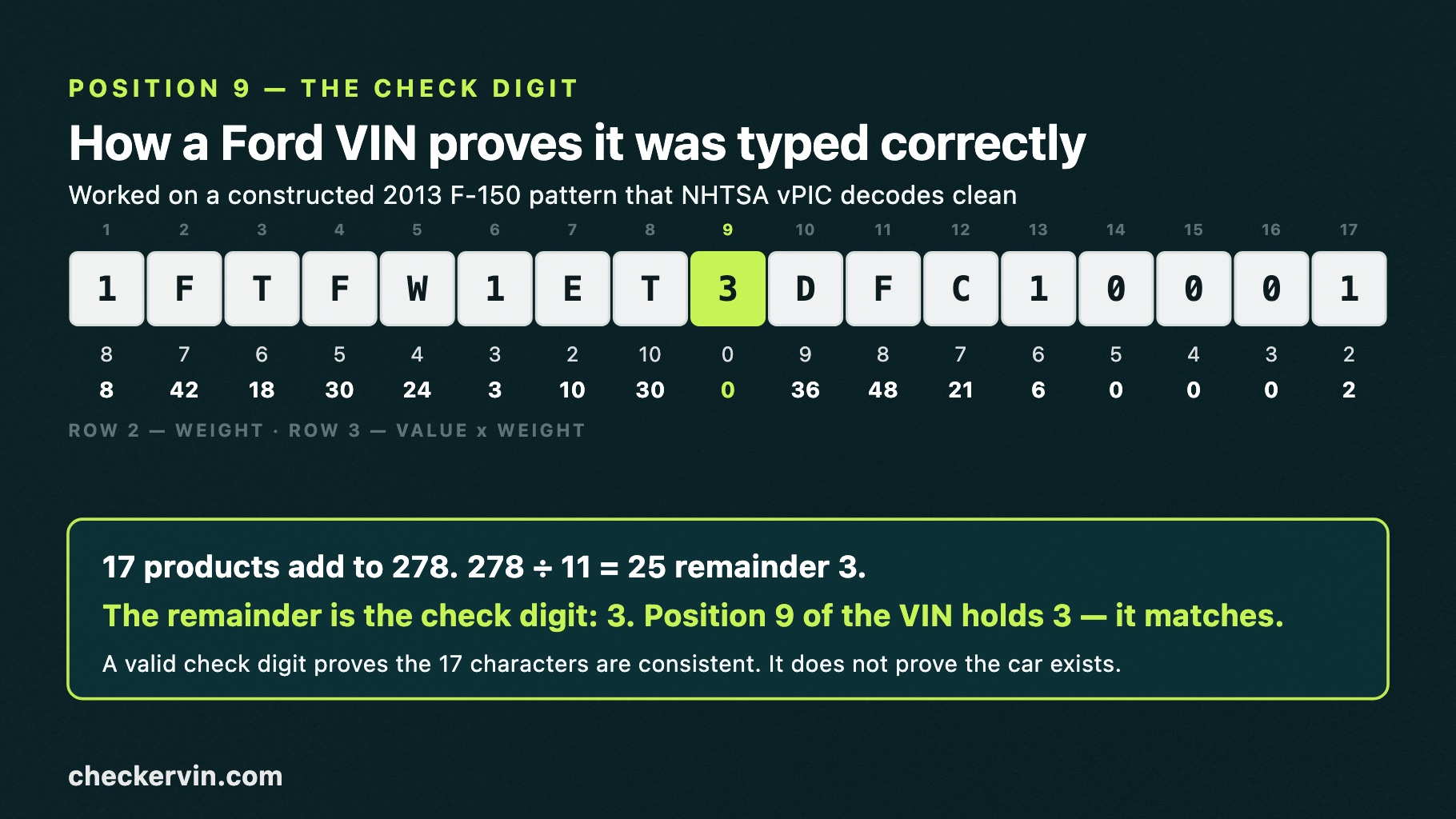
Structure explained in the abstract is easy to nod along to and hard to use. So here is a complete decode of a single VIN — 1FTFW1ET3DFC10001 — with every character accounted for and the result checked against the federal database rather than asserted.
| Position and value | What it resolves to |
|---|---|
| 1 → 1 | Built in the United States |
| 2–3 → FT | Ford Motor Company, truck class |
| 4 → F | Restraint system and GVWR class for this cab and drivetrain |
| 5 → W | Model line — F-150 SuperCrew |
| 6–7 → 1E | Body style and series detail |
| 8 → T | Engine — 3.5-liter V6, gasoline |
| 9 → 3 | Check digit, computed below |
| 10 → D | Model year 2013 |
| 11 → F | Dearborn Truck Plant, Michigan |
| 12–17 → C10001 | Sequential production number |
Feed that VIN to NHTSA's public decoder and it returns: Ford F-150, 2013, pickup, 3.5-liter six-cylinder gasoline, four-wheel drive, plant city Dearborn, plant state Michigan — and an error code of zero, whose text reads that the VIN decoded clean and the check digit in the ninth position is correct. Every line of the table above is the federal database's answer, not ours.
Working the Ford check digit by hand
The ninth character is the one people skip, and it is the only character that can tell you a VIN is wrong before you spend anything. The arithmetic fits in a paragraph. Convert each letter to a number under the federal scheme — A through H are 1 to 8, J through N are 1 to 5, P is 7, R is 9, S through Z are 2 to 9, and digits are themselves. The letters I, O and Q never appear, which is why they have no values. Multiply each of the seventeen positions by its fixed weight — 8, 7, 6, 5, 4, 3, 2, 10, 0, 9, 8, 7, 6, 5, 4, 3, 2 — and add the products.
For 1FTFW1ET3DFC10001 the products sum to 278. Divide by eleven: 278 is 25 elevens with 3 left over. The remainder is the check digit, and the ninth character of the VIN is 3. It matches, so the VIN is internally consistent. Had the remainder come out as ten, the character would be the letter X — the one case where a digit position holds a letter, and the reason X in position nine is normal rather than suspicious.
Position 10: reading the model year
The tenth character encodes model year on a thirty-year cycle. The letters I, O, Q, U and Z are never used, because they are too easily confused with digits and with each other.
| Code | Model year |
|---|---|
| A | 2010 |
| B | 2011 |
| C | 2012 |
| D | 2013 |
| E | 2014 |
| F | 2015 |
| G | 2016 |
| H | 2017 |
| J | 2018 |
| K | 2019 |
| L | 2020 |
| M | 2021 |
| N | 2022 |
| P | 2023 |
| R | 2024 |
| S | 2025 |
| T | 2026 |
The digits 1 through 9 covered model years 2001 to 2009. Before that, the same letter sequence ran from A for 1980 through to Y for 2000. A letter alone is therefore ambiguous across a thirty-year span — you resolve it using the vehicle's generation and the plant code, which is another reason to decode rather than eyeball.
Position 11: which plant built it
The eleventh character identifies the assembly plant. Ford operates plants across the United States, Canada, Mexico and Europe, and each carries its own code — F for the Dearborn Truck Plant in Michigan and K for Kansas City Assembly in Claycomo, Missouri, are two of the most commonly seen on F-Series trucks.
Plant codes have been reassigned over the decades as facilities opened, closed and changed products, so a static table is a poor guide. A decode resolves the character against the model year and vehicle line, which is the only reliable way to name the plant correctly.
Why care? Plant of origin occasionally matters for parts sourcing, and it matters for recalls — Ford frequently scopes a recall to vehicles built at a specific plant between specific dates.
Why position 10 is the character that costs the most
Of the seventeen characters, one moves the price of a used Ford more than the rest combined, and it is the model year. Two cars can share a nameplate, a body, an engine code and a plant, and differ by a single character in position ten — and that character can separate one of the calmest years in the model's history from one of the worst.
That is not a figure of speech. We hold NHTSA complaint records for 7 Ford nameplates across 99 model years. Comparing each model year against the median for its own nameplate — which is the only fair comparison, since a nameplate that sells in volume collects more complaints than a niche one no matter how well built it is — the spread inside a single badge is wide enough to be the whole story.
| Nameplate and years held | Worst model year against its own median, and the calmest |
|---|---|
| FUSION (2008–2020) | 2010: 4.4× median, 5,917 complaints — calmest 2020, 228 |
| FOCUS (2008–2018) | 2012: 4.2× median, 3,793 complaints — calmest 2011, 113 |
| EDGE (2008–2022) | 2013: 3.3× median, 2,437 complaints — calmest 2021, 103 |
| EXPLORER (2008–2022) | 2016: 3.0× median, 2,460 complaints — calmest 2009, 39 |
| F-150 (2008–2022) | 2013: 2.3× median, 2,796 complaints — calmest 2009, 324 |
| MUSTANG (2008–2022) | 2012: 1.7× median, 469 complaints — calmest 2020, 117 |
| ESCAPE (2008–2022) | 2013: 1.6× median, 2,748 complaints — calmest 2021, 356 |
Read the first and last columns together. Every one of these nameplates has a year that attracted several times the complaints of its own typical year, and in most cases the calmest year sits in the same generation — sometimes directly adjacent to the worst one. The single character at position ten is what separates them, and it is the character a listing photograph will not show you.
A caution on how to read that table, because it is easy to over-read. These are complaint counts, not failure rates: NHTSA publishes what owners reported, and nobody publishes how many of each year were built, so a high count reflects some combination of how many cars are on the road, how bad the problem was, and how much press it received. Counts also accumulate — an older model year has had longer to collect them. That is precisely why we compare each year against its own nameplate's median instead of against other nameplates, and why the table shows the ratio rather than leaving you to weigh raw numbers against each other.
The honest summary is narrow and still useful: within one Ford nameplate, some model years generated far more owner complaints than others, the VIN tells you for free which one you are looking at, and it is worth knowing that before you negotiate rather than after. What the complaint record cannot tell you is anything about the individual car — for that you need its own history, which is a different record entirely.
Ford VINs and Lincoln VINs are not the same
Lincoln is Ford Motor Company's luxury division, but its vehicles carry their own world manufacturer identifiers rather than Ford's. A Lincoln VIN will not begin 1FA or 1FM, even where the vehicle shares a platform with a Ford. vPIC returns Ford Motor Company as the manufacturer behind 1LN for Lincoln passenger cars and 5LM for Lincoln multipurpose passenger vehicles — the corporate parent is the same, the identifier is not.
This trips people up on cross-shopped models. If you are looking at what you believe is a Lincoln and the VIN opens with a Ford WMI, something is wrong with either the badge or the paperwork — and it is worth resolving before money changes hands.
Decoding a pre-1981 Ford
The 17-character standard became mandatory for the 1981 model year. Fords built before that use shorter manufacturer-specific formats, typically eleven to thirteen characters, encoding model year, plant, body style and engine under Ford's own scheme rather than the international one.
Modern decoders — including NHTSA's public database — generally do not cover them. For a classic Ford you are looking at marque-specific references and owner club documentation rather than a VIN lookup, and the data blocks described on this page do not apply.
Checking Ford recalls by VIN
Safety recalls attach to specific VIN ranges, not to models in general, which is why “was this model recalled?” is the wrong question. The right one is whether this vehicle has an open recall against it.
NHTSA publishes open recalls by VIN free of charge, and manufacturers are required to perform recall repairs at no cost to the owner regardless of how many owners the vehicle has had. On a used purchase, an unrepaired open recall is both a safety matter and a negotiating point.
What a Ford VIN decode will not tell you
A VIN describes the vehicle as built. Everything that happened afterwards lives in separate records, and no amount of decoding will surface it.
- Accident history, insurance claims and structural repairs
- Title brands — salvage, rebuilt, flood, lemon
- Odometer readings and rollback evidence
- Number of previous owners and how the vehicle was used
- Service and maintenance history
- Outstanding liens or theft records
Where this information comes from
- NHTSA vPIC — public VIN decoderThe federal database manufacturers file their VIN structure with
- 49 CFR Part 565 — Vehicle Identification Number requirementsThe federal rule fixing the three sections, the check digit and the year code
- NHTSA recall lookupFree open-recall check by VIN, repaired at no cost by the manufacturer
- NICB VINCheckFree theft and salvage lookup from participating insurers
Keep reading
Frequently asked questions
How do I decode a Ford VIN for free?
Enter the 17-character VIN into a decoder. Ford's build data is published through NHTSA's public vPIC database, so a free decode returns the make, model, model year, body style, engine, drivetrain, restraint system and manufacturing plant without any charge or account.
What does 1FT mean on a Ford VIN?
1FT is Ford's world manufacturer identifier for trucks built in the United States — the F-Series, Ranger and similar. The leading 1 marks US assembly, F identifies Ford Motor Company, and T designates the truck vehicle class.
Which character is the model year on a Ford VIN?
The tenth character. Letters and digits run on a 30-year cycle: A is 2010 through Y for 2030, with I, O, Q, U and Z never used. The digits 1 to 9 covered 2001 to 2009, and the same letters covered 1980 to 2000.
Can a Ford VIN tell me the trim level?
Partially. The descriptor section encodes model line, body style and series, which usually narrows the trim considerably. Exact trim names and optional packages are more reliably recovered from the vehicle's factory build record than from the VIN characters alone.
Do all Ford VINs have 17 characters?
Every Ford built for the 1981 model year onward does — that is when the 17-character standard became mandatory. Earlier Fords use shorter manufacturer-specific formats, typically 11 to 13 characters, which follow different rules entirely.
Decode your Ford in seconds
Enter any Ford VIN for the full factory build, assembly plant and open safety recalls. Free, no account.
Run a free VIN check