The short answer
- What is NICB VINCheck?
- NICB VINCheck is a free VIN lookup from the National Insurance Crime Bureau that shows whether a vehicle has been reported stolen and not recovered, or reported as a salvage vehicle, by an NICB member insurance company. It is free, needs no account, and is limited to five searches per IP address per day.
- Is it enough on its own?
- No. VINCheck only sees records submitted by participating insurers. It carries no title brands from state DMVs, no odometer readings, no accident claims below a total loss, and no ownership history — so a clean VINCheck result is a good sign, not a clearance.
- What should you run alongside it?
- Check open safety recalls at NHTSA, pull the federal title record through an NMVTIS-approved provider, and decode the VIN itself to confirm the car in front of you matches the paperwork.
$0
Cost to run a VINCheck
No account required
5
Searches per IP address
Per 24-hour period
2
Record types returned
Theft and salvage only
Members
Coverage is insurer-submitted
Not all carriers participate
What NICB VINCheck actually is
The National Insurance Crime Bureau is a not-for-profit organization funded by property and casualty insurance companies to fight insurance fraud and vehicle theft. Its members feed theft and salvage records into a shared database, and VINCheck is the small public window onto that database.
That funding model explains both the strength and the limit of the tool. The records come from insurers who have every commercial reason to report accurately, which makes a positive hit meaningful. But the database contains only what member companies chose to submit — it was never built to be a complete national history of every vehicle.
The two things it will tell you
VINCheck answers exactly two questions, and it is worth knowing them precisely before you rely on the result.
| Record | What it means |
|---|---|
| Theft | A participating insurer reported this vehicle stolen, and it has not been reported recovered. A live theft record is the single most serious finding in a used-car check. |
| Salvage | A participating insurer reported this vehicle as a salvage vehicle — typically after declaring it a total loss. The car may since have been repaired and retitled. |
Both records carry the reporting date and, for salvage records, the loss type where the insurer supplied one. Neither tells you how badly the car was damaged, what was repaired, or who owns it now.
What it does not cover — the part that matters
Most buyers who run a VINCheck and see nothing assume the car is clean. That inference is the single most common mistake made with this tool, because the following are all outside its scope entirely:
- Accident claims that did not total the vehicle
- Title brands issued by a state DMV — flood, lemon, junk, rebuilt
- Odometer readings recorded at each title transfer
- How many owners the car has had, and for how long
- Damage repaired privately with no insurance claim filed
- Open safety recalls the manufacturer has issued
- Liens held by a lender against the vehicle
- Auction records from salvage sales
What federal rule actually compels, and where it goes
The useful way to understand any free check is to ask who is obliged to feed it. For one system that question has a precise answer written in federal regulation, and setting the two side by side explains the gap this page keeps returning to.
Three classes of reporter are compelled by rule, on a schedule, into the national title system. Insurance carriers must report monthly on vehicles they took as junk or salvage or determined to be a total loss. Junk yards, salvage yards and auto recyclers must report monthly on what they obtained, in named fields. States must send titling information for all automobiles electronically, once every 24 hours.
| Who is compelled | On what schedule, and to which system |
|---|---|
| Insurance carriers | Monthly, into the national title system — junk, salvage and total-loss determinations |
| Junk and salvage yards, auto recyclers | Monthly, into the same system, unless the state already forwards it |
| States | Every 24 hours, titling information for all automobiles |
| Anyone, into a free industry lookup | No federal obligation of any kind |
The last row is the one that matters here. No rule requires any of those parties to feed a free industry database, which is not a criticism of the free tool — it was never designed to be the compelled system. Our guide to damage entries works through the insurer and salvage-yard field lists in detail; what matters on this page is simply that the obligation runs somewhere else.
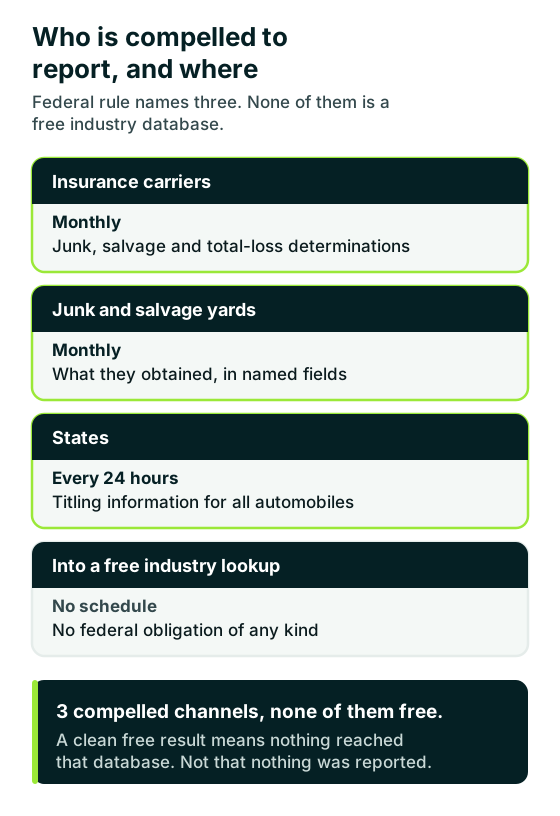
Why a free check can come back clean on a car the federal record would flag
This is the mechanism behind the warning further up, and it is worth stating plainly rather than as a caution. A clean free result and a flagged federal record are not a contradiction. They are two systems with different inputs answering as designed.
- A total loss determined by an insurer that reports where the rule sends it, and not elsewhere
- A salvage yard acquisition captured in a monthly filing that a free lookup never receives
- A state title brand that travels in the twenty-four-hour titling feed
- An older vehicle outside the model-year window of the insurer duty
- A car whose damage produced no claim, which is invisible to every system at once
Only the last of those is a genuine blind spot shared by everything. The others are routing: the record exists, and it exists somewhere a free industry check was never plumbed to read. That is why the sequence this page recommends puts the free checks first and treats a clean result as a reason to continue rather than a reason to stop.
On an older car, the compelled channel is not the one protecting you
One limit inside the insurer obligation changes how much weight any of this carries, and it lands hardest on exactly the cars people run free checks against.
The monthly duty on insurance carriers covers automobiles of the current model year and the four model years before it. A vehicle older than that window, taken as a total loss, is not swept up by that particular obligation. State titling and salvage-yard reporting still run, and a state that brands a title creates the most durable record there is — but the insurer channel, the one that catches a total loss fastest, thins out with age.
| The car in front of you | What the compelled channels are doing |
|---|---|
| Within five model years | All three channels live; a total loss is likely to surface somewhere |
| Older than that | State titling and yard reporting continue; the insurer duty no longer reaches it |
| Never insured for the damage | No claim, so no determination for any channel to report |
| Repaired privately | Invisible to every system described on this page |
The practical reading is proportional rather than alarming. The older the vehicle, the more the weight shifts from records to inspection — and the less a free lookup returning nothing should reassure you. Our damage guide covers that model-year limit and the reporting fields in full.
How to run an NICB VINCheck
- 1Find the VIN on the car, not in the advertRead it off the plate at the base of the windshield on the driver's side, or the sticker inside the driver's door frame. A VIN copied from a listing is a VIN you have not verified.
- 2Open the NICB VINCheck pageThe service lives on nicb.org. There is no app, no account and no paid tier — anything charging you for an NICB lookup is reselling a free service.
- 3Enter all 17 charactersVINCheck rejects partial VINs. Remember that a VIN never contains the letters I, O or Q, so anything that looks like one is a 1 or a 0.
- 4Accept the terms and submitThe result returns immediately. Note the date shown against any record — a theft record from last month reads very differently from one from a decade ago.
Reading the result properly
A VINCheck result is a list, and an empty list is the usual outcome. When a record does appear, read the date and the record type together. A salvage record from 2019 on a car being sold today means the vehicle was totaled, repaired and retitled somewhere in between — that is not disqualifying on its own, but it changes the price, the insurability and the questions you should be asking.
A theft record with no recovery is different in kind. It means the vehicle is, on the insurer's books, still stolen property. Do not hand over money and do not take possession; the buyer of a stolen vehicle generally does not acquire good title to it no matter how convincing the paperwork looked.
Why “no record found” is not a clean bill of health
The result you almost always get is silence, and silence has three possible meanings that VINCheck cannot distinguish between: the vehicle genuinely has no theft or salvage history; it does, but the insurer involved is not an NICB member; or it does, but the loss was never filed with an insurer at all.
Cars are written off without insurance involvement more often than people expect — an uninsured owner, a cash sale after a flood, a repair done by a friend with a body shop. Every one of those leaves a car with a damaged past and a clean VINCheck.
The five-search limit, and what to do about it
NICB caps use at five VIN searches from one IP address in any 24-hour period. For a private buyer comparing a handful of cars that is rarely a constraint. If you are shopping seriously and hit the ceiling, the honest options are to wait out the window or to use a service that draws on the broader record set — not to hunt for a proxy.
VINCheck versus a full vehicle history report
| Question | Where the answer lives |
|---|---|
| Is this car reported stolen? | NICB VINCheck — its core purpose |
| Did an insurer declare it salvage? | NICB VINCheck, for member carriers |
| Does the title carry a brand? | State DMV records via NMVTIS |
| What has the odometer read over time? | Title transfer records via NMVTIS |
| Was it in a non-total-loss accident? | Insurance and auction filings |
| Are there open safety recalls? | NHTSA, free, by VIN |
| What was it built with? | Manufacturer VIN decode |
The sensible reading is that VINCheck is one instrument on a panel. It answers its own question well and says nothing about the others, which is why buyers who rely on it alone get surprised.
The other free checks worth running
Three more cost nothing and take about a minute between them. Running all of them gets you most of the way to a considered decision before you pay for anything.
- NHTSA recall lookup — open safety campaigns by VIN, repaired free by any franchised dealer
- NMVTIS consumer portal — the federal title system every state reports into
- Your state DMV's title or registration status tool
- A manufacturer VIN decode to confirm trim, engine and assembly plant
If the VIN comes back stolen
Stop the transaction. Do not pay a deposit, do not take the keys, and do not tell the seller you have found the record while you are standing in their driveway — you have no way to know who you are dealing with.
Report it to local law enforcement with the VIN, the address where you saw the vehicle, and any listing details you have. If the record turns out to be stale because a recovery was never filed, the seller can resolve it through the insurer and their state DMV, and you can revisit the purchase afterwards.
If the VIN comes back salvage
A salvage record is not automatically a walk-away, but it moves the burden of proof firmly onto the seller. Ask for the repair invoices, the name of the shop, and the state inspection paperwork that supported the rebuilt title. Ask why the car was totaled — a hail write-off and a front-end structural collision are both salvage records and are not remotely the same purchase.
Then price it accordingly and check with your insurer before committing. Coverage on a rebuilt-title vehicle is often restricted, and financing can be harder to arrange than the seller suggests.
Verify the VIN before you trust any result
Every check on this page is only as good as the VIN you typed. Compare the plate at the base of the windshield with the sticker in the driver's door frame and with the title document. All three should match exactly.
If one has been disturbed, or the characters look inconsistent in font or depth, treat the whole vehicle as suspect. VIN swapping is precisely how a stolen or written-off car is made to look like a clean one, and it defeats every database in the world.
A few states build that verification into titling. Kentucky has a sheriff physically read the VIN on every vehicle arriving from out of state — identity rather than condition, and the check a database query cannot perform because a query trusts the number it is handed.
Where this information comes from
- 28 CFR 25.55 — insurance carrier reporting dutyMonthly reporting of junk, salvage and total-loss vehicles, covering the current model year and the four before it
- 28 CFR 25.54 — what states must report, every 24 hoursTitling information for all automobiles, including every brand associated with the vehicle
- NICB VINCheck — National Insurance Crime BureauThe official free lookup, its terms, and the search limit
- NMVTIS consumer portal — U.S. Department of JusticeThe federal title system every state reports into
- NHTSA recall lookup by VINOpen safety campaigns, free, repaired at no cost by dealers
Keep reading
Frequently asked questions
Is NICB VINCheck really free?
Yes. The National Insurance Crime Bureau provides VINCheck to the public at no cost and does not ask for payment or an account. You are limited to five VIN searches from one IP address in any 24-hour period.
Does NICB VINCheck show accidents or mileage?
No. VINCheck reports only two things: whether a participating insurer reported the vehicle stolen and not recovered, and whether one reported it as a salvage vehicle. Accident claims, odometer readings, ownership history and title brands are outside its scope.
Why did NICB VINCheck find nothing on a car I know was wrecked?
Because the database only contains records submitted by NICB member insurance companies. A car totaled by a non-member insurer, repaired privately, or written off without an insurance claim can return a clean VINCheck result and still have a damaged past.
Is NICB VINCheck the same as an NMVTIS report?
No. NMVTIS is the federal title system every state reports into, and it carries title brands, odometer readings at title transfer, and junk or salvage declarations. VINCheck is a narrower insurance-industry theft and salvage flag. They answer different questions.
Can a seller fake a clean VINCheck result?
They can hand you a screenshot of a different vehicle's result. Run the check yourself against the VIN stamped on the car — the windshield plate and the driver's door jamb — rather than a VIN the seller typed into a listing.
Run the checks NICB can't
Decode the VIN, pull open safety recalls, and see the full factory build — free, with no account and no card.
Run a free VIN check