THE SEVENTEEN CHARACTERS
VIN structure — what each position means
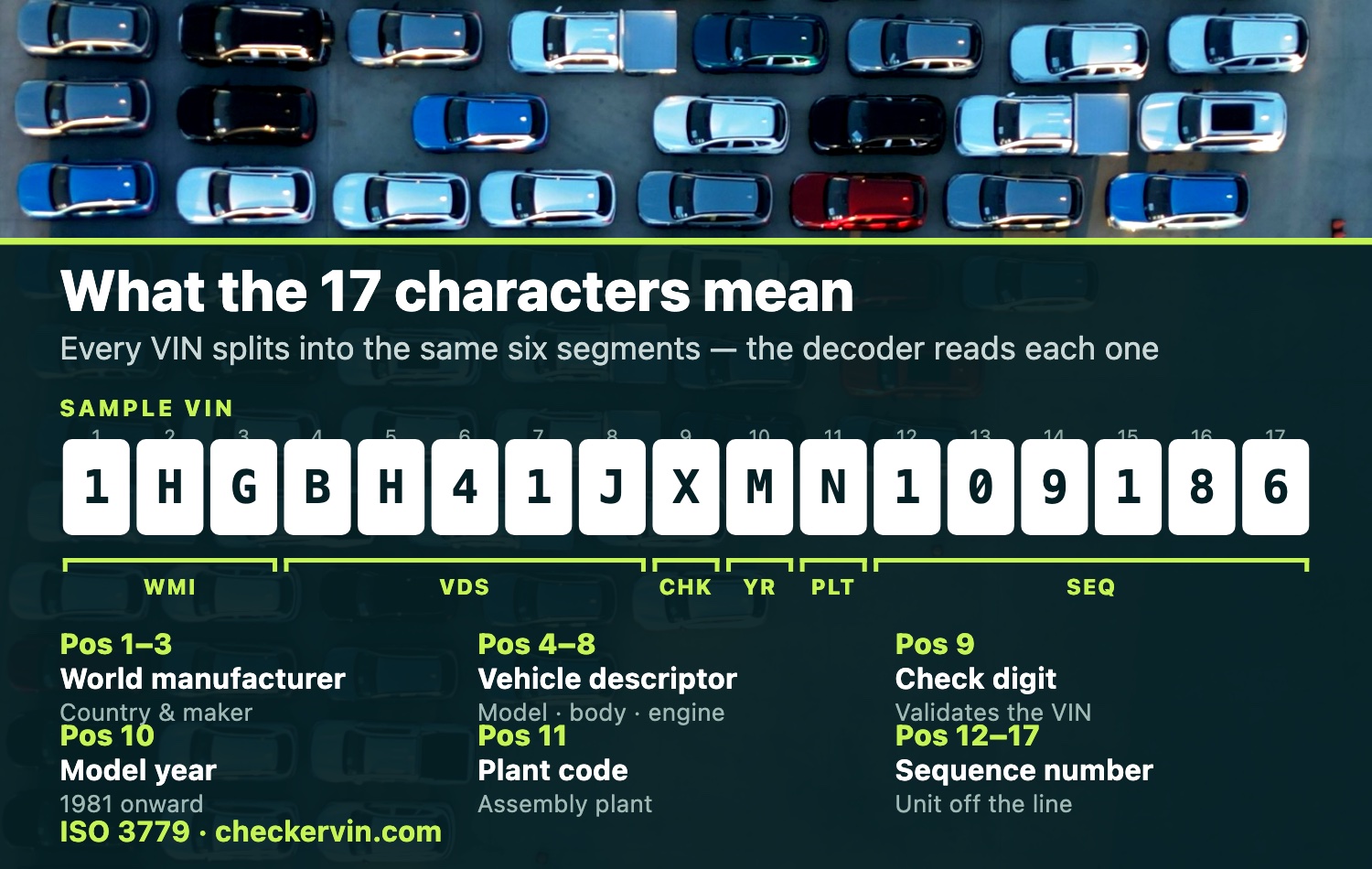
Every VIN built to the modern standard splits into three blocks: who made it, what it is, and which exact one it is. Read left to right, the seventeen characters go from the broadest fact to the narrowest.
The seventeen characters are not a random serial. They are a fixed grammar, set by ISO 3779 and codified in the United States as 49 CFR 565, and every manufacturer that sells here files its VIN scheme against it. That is why a decode is deterministic: the same VIN returns the same build today, next year and a decade from now, because the standard behind it does not move.
Read the number in three blocks. The first three characters are what the rule actually governs, and it is worth being exact about what it says: 49 CFR 565.15(a) requires them to “uniquely identify the manufacturer and type of the motor vehicle.” Not the country. The word “country” does not appear anywhere in Part 565, and neither does the phrase “World Manufacturer Identifier” — that name and the country mapping below come from the ISO and SAE assignment convention layered on top of the federal rule, not from the rule itself. The next five, the Vehicle Descriptor Section, describe what it is: model line, body style, engine family and restraint system. The final block places and serializes the exact unit, with a check digit at position nine, the model-year letter at ten, the assembly-plant code at eleven, and a sequential production number closing it out. The table below breaks each position out in full.
A VIN encodes how a vehicle was built — it does not carry the paint color, the options added at the dealer, or anything about the vehicle's later history. Those come from other records, not the number.
POSITION 1
Common country codes
The first character places where the vehicle was built. It is only the opening of the World Manufacturer Identifier — the first three characters together — but on its own it already narrows the origin to a region.
The full manufacturer identity lives in the first three characters, not the first alone. Decode the whole VIN rather than reading a single letter — the region is a starting point, not the answer.
The first character is only the opening of the World Manufacturer Identifier; characters two and three finish naming the maker and the broad vehicle type. Small-volume manufacturers are treated differently, and the threshold has a qualifier people drop. 565.12 defines a low-volume manufacturer as one building “fewer than 1,000 vehicles of a given type each year” — per type, not per company, so a builder making several hundred each of four types is low-volume on all four. For those makers, positions 12 to 14 carry the rest of the identity. Either way the region is a starting point, and the full first three characters are the answer.
WHO ISSUES THE CODE
NHTSA does not hand out manufacturer codes — SAE does
The first three characters look like a government-issued identifier. The rule that requires them is federal; the office that assigns them is not.
49 CFR 565.14 states it plainly: the National Highway Traffic Safety Administration “has contracted with the SAE International to coordinate the assignment of manufacturer identifiers to manufacturers in the United States,” and those identifiers are “supplied by SAE at no charge.” A private standards body operates the registry that the federal rule depends on.
That division explains something people run into constantly. A decode can return a manufacturer name that does not match the badge on the car, because the identifier belongs to the legal entity that built the vehicle rather than the brand it was sold under. Marques change owners, plants get sold, and a code assigned years ago keeps pointing at whoever held it then. The VIN is not wrong when this happens; it is recording a fact about manufacture that the marketing never mentioned.
NHTSA does publish the assignments — the same section notes the agency “offers access to manufacturer identifier assignments via its search engine.” So the registry is public even though the agency is not the one maintaining it.
POSITION 3
A 9 in the third position is a flag, not a code
Most decoders read positions one to three as the whole manufacturer identity. For a small share of vehicles that is not enough, and the VIN tells you so.
565.15(a) sets a rule that almost no consumer decoder surfaces: “A 9 shall be placed in the third position of the VIN if the manufacturer identifier is six characters. A 9 in the third position always indicates the presence of a six-character manufacturer identifier.”
Read that carefully, because the word “always” is doing real work. The 9 is not a value to be looked up in a table. It is a marker saying the identity you are trying to read does not fit in three characters and continues at positions 12 to 14. A decoder that treats those first three characters as the complete answer will name the wrong maker, or none at all, on exactly these vehicles.
Both thresholds are counted per vehicle type, not per company — the regulation says 'of a given type each year' in both definitions. A builder producing several hundred each of four types is low-volume on all four.
This is why specialist and low-run vehicles decode poorly on general-purpose tools. Nothing is broken and the VIN is not unusual; the identity is simply stored in two places, and most decoders only read one of them.
HOW LONG IT LASTS
A VIN is guaranteed unique for 60 years — and the clock started in 1980
People describe a VIN as a permanent fingerprint. The regulation is more specific than that, and the specificity has an end date.
565.13(d) sets the guarantee: “The VINs of any two vehicles subject to the Federal motor vehicle safety standards and manufactured within a 60-year period beginning with the 1980 model year shall not be identical.”
Sixty years from the 1980 model year runs to model year 2039. Inside that window no two vehicles share a VIN, which is what makes a VIN usable as a key for a title record, a recall campaign or an insurance claim. The regulation does not promise anything beyond it. That is not a defect — a seventeen-character alphanumeric has finite room, and the rule bounded the promise rather than pretending otherwise — but it does mean the uniqueness everyone relies on is a defined term with a horizon, not a law of nature.
For anyone buying a used vehicle today the practical effect is nil: every car you can currently buy falls inside the window. The reason to know it is that it reframes what a VIN is. It is not a fingerprint the vehicle was born with. It is an assigned key, issued under a rule, guaranteed unique for a stated period, and administered by a standards body under contract to a federal agency.
The same section is equally specific about where the number has to live. 565.13(e) requires the VIN to appear “clearly and indelibly” on a part of the vehicle that is not designed to be removed except for repair, or on a permanently affixed plate or label — and it expressly excludes the glazing. Etchings on the glass, whatever a dealer calls them, are not the VIN the regulation is talking about.
POSITION 9
The check digit — how a VIN validates itself
The ninth character is not part of the description. It is a checksum, calculated from the other sixteen, that lets a decoder catch a mistyped VIN before it returns the wrong car.
To compute it, each of the other sixteen characters is turned into a number — digits keep their value, letters map to fixed values set by 49 CFR 565 — and multiplied by a weight that depends on its position. The sixteen results are added together, divided by eleven, and the remainder becomes the check digit. A remainder of ten is written as the letter X, which is the only place an X legitimately appears in a VIN.
When the decoder above flags a check digit as invalid, the arithmetic did not balance. The overwhelmingly common cause is a single mistyped character — a 0 read as O, a 1 read as I, an 8 read as B. Re-read the number against the windshield plate or the door-frame sticker. A handful of vehicles built for markets outside North America do not enforce the check digit, so a mismatch there is a prompt to look twice, not proof the VIN is fake.
POSITION 10
Model-year letters
The tenth character is the model year. It runs on a repeating cycle that skips the letters that read as numbers, so a code alone is only unambiguous once you know roughly how old the vehicle is.
The cycle skips I, O, Q, U and Z, and reuses each letter every thirty years — the same letters covered 1980–2000, and digits 1–9 covered 2001–2009. Position 11, the plant, is what separates a 1996 letter from its 2026 twin.
Because the tenth character cycles every thirty years, the letter on its own is ambiguous — an S covers both 1995 and 2025. The eleventh character, the assembly-plant code, is what tells the two apart in practice, and the body style and equipment a full decode returns settle any doubt that remains. This is why reading a single position by hand is a rough guide and a full decode is the reliable one.
You know the structure — now read a real one
Paste a VIN and the decoder returns the factory build in seconds. Seventeen characters is the whole ask.
Decode any VIN free
Decoded from official manufacturer and NHTSA records
WHAT A DECODE CAN AND CANNOT SHOW
Decode vs. the full vehicle report
A decode and a report answer different questions. The decode reads the number; the report gathers records the number was never meant to hold.
A VIN decode is the factory build, and it is complete on its own: model year, make, model, body, engine, drivetrain and plant, returned free and identical every time because the seventeen characters never change. It is the right tool for confirming a listing matches the car, or for reading a number you are holding in your hand.
What a decode cannot show is everything that happened after the vehicle left the line. Title brands, the odometer trail, reported accidents and ownership changes are not encoded in the VIN — no decoder anywhere reads them from the number, because they are not in it. Those live in separate records keyed to the VIN, which is what the full vehicle report is for: it adds every open safety recall filed against that exact VIN, the complete specification list, and the vehicle's records as our data sources come online.
Decode by make
Each manufacturer uses the same seventeen characters differently — its own WMI codes, its own engine characters, its own option stickers. These guides cover the quirks make by make.
Decode by vehicle type — and read the number yourself
Not every VIN is a car built after 1981. These cover the vehicles that decode differently, and the guides for reading and finding the number by hand.
Data sources
VIN decoder — frequently asked questions
Is this VIN decoder free?
Yes. Decoding a VIN here is free, with no account and no card. The decode is drawn from the NHTSA vPIC database, which every manufacturer selling in the United States files its VIN structure with, so the factory build comes back at no charge.
What is a VIN?
A VIN, or vehicle identification number, is the 17-character code that uniquely identifies one vehicle. Since 1981 it has followed a fixed format set by ISO 3779 and 49 CFR 565: the first three characters identify the manufacturer, the next five describe the vehicle, and the last eight place and serialize it.
What does a VIN number tell you?
Decoded, a VIN tells you how the vehicle left the factory: model year, make and model, body class, engine, drivetrain, restraint system and the assembly plant. It does not encode color, added options, or anything about the vehicle's history — a decode describes the build, not the life.
Where do I find my VIN?
Look at the base of the windshield on the driver's side, and on the sticker inside the driver's door frame. It is also on your title, registration and insurance card. The two locations on the car should match each other and the paperwork.
What is the difference between a VIN decode and a full vehicle report?
A decode reads the seventeen characters and returns the factory build — free, instant, and the same for that VIN forever. A full vehicle report adds what the number cannot carry: every open safety recall filed against that exact VIN, the complete specification list, and the vehicle's records as our data sources come online.
Why does my VIN's check digit show as invalid?
The ninth character is a check digit calculated from the other sixteen. If it does not match, the most common cause is a mistyped character — re-read the VIN, watching for 0 versus O and 1 versus I. Some vehicles built for markets outside North America do not enforce the check digit, so a mismatch is a prompt to double-check rather than proof the VIN is fake.
Free forever · No credit card · No account
Decode your VIN now
Enter any 17-character VIN for the factory build, specifications and open safety recalls. Free, no account, no card.
Decode any VIN free
Decoded from official manufacturer and NHTSA records