The short answer
- What is a VIN verification?
- A person authorized by the state physically inspects the vehicle and confirms the VIN on it matches the VIN on the paperwork. It is about identity, not history.
- What usually triggers one?
- Registering a vehicle that arrived from another state, titling a rebuilt or reconstructed vehicle, or correcting a VIN that was recorded wrongly.
- What is the inspector comparing against?
- Your documents, and a federal standard that dictates the VIN's length, characters, position, size and legibility. Most guides describe the process and never mention the standard.
17
Characters, exactly
49 CFR 565.13(b), no blanks
4 mm
Minimum character height
On the windshield VIN
20/20
The readability test
Daylight, through the glazing
60 yrs
Before a VIN may repeat
From model year 1980
What a VIN verification actually is
Three different jobs share the phrase “VIN lookup,” and confusing them is the reason people arrive at a state office with the wrong document. Separating them takes one table and saves a wasted trip.
| The task | What it involves |
|---|---|
| A VIN check | A records search. Somebody queries databases for title brands, recalls or theft records against the number |
| A VIN decode | A specification read. The characters are translated into make, model year, plant, engine and body |
| A VIN verification | A physical inspection. A person stands at the vehicle and compares the number on it against the number on your paperwork |
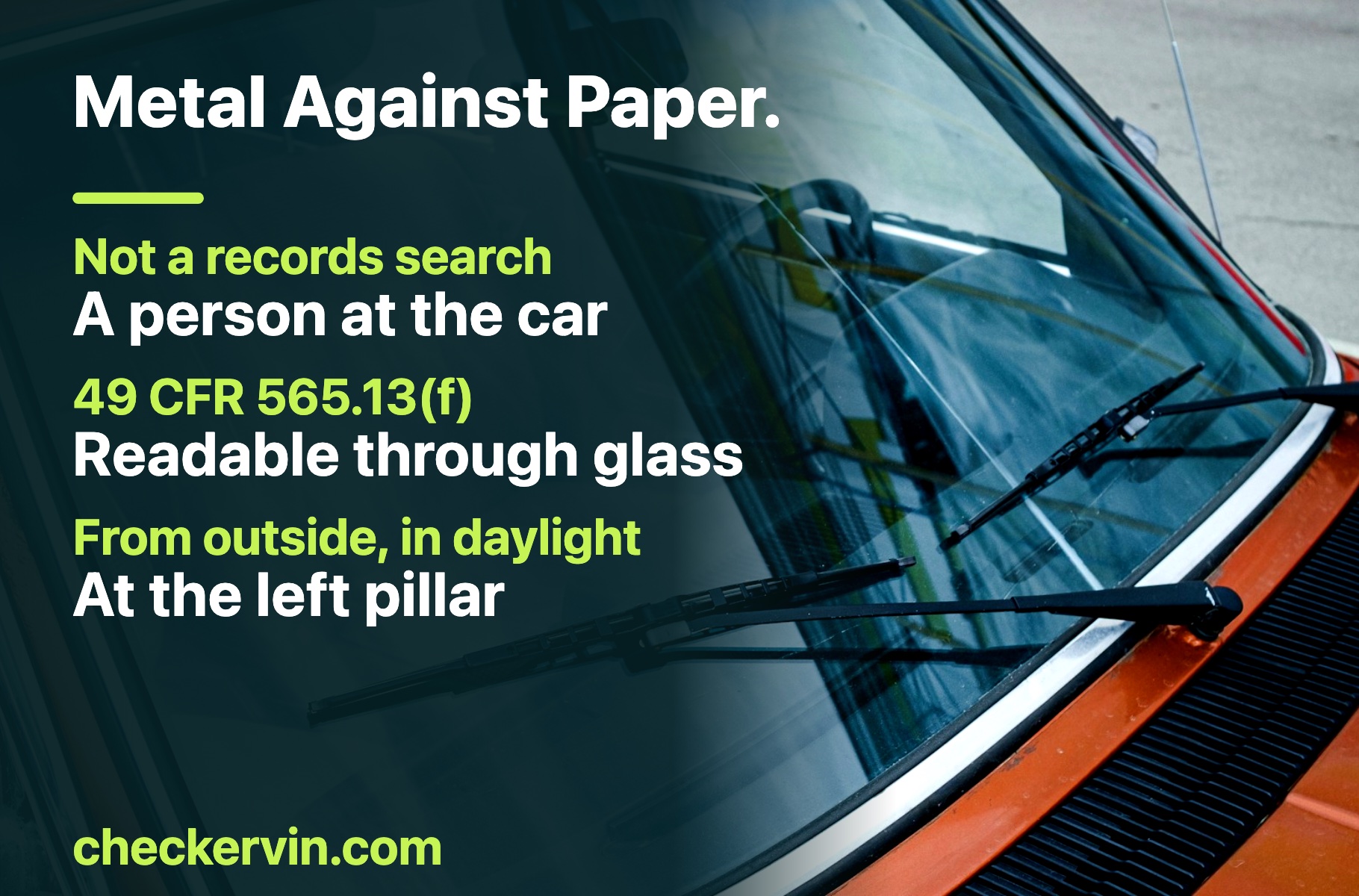
The distinction matters because the three fail in different ways. A records search comes back thin when nobody reported anything. A decode comes back thin when the manufacturer filed little. A verification fails when the car and the paperwork disagree — and that disagreement is the entire point of performing one.
When a verification is required
The triggering situations vary by state, and this page is not going to pretend otherwise or invent a national rule that does not exist. What recurs across states is a pattern: verification is demanded whenever the paper trail changed hands, changed form, or arrived from somewhere the state cannot see.
- Registering a vehicle previously titled in another state
- Titling a rebuilt or reconstructed vehicle after repair
- Correcting a VIN that was recorded incorrectly on a title or registration
- Titling a vehicle assembled from parts, or a specially constructed vehicle
- Titling a vehicle through a route other than an ordinary transfer, where the state wants the car seen
- Registering an imported vehicle for the first time in the United States
Check your own state's requirement before you drive anywhere, because the list above describes a tendency rather than a statute. Some states verify almost every incoming vehicle; others verify very few.
Who is allowed to perform one
Again this is state-determined, and the categories rather than the names are what transfer. The people authorized are generally those the state can hold accountable: its own motor vehicle staff, law enforcement officers, licensed dealers, and in some states a separately licensed class of verifier.
The common thread is that you cannot verify your own vehicle, and neither can the person selling it to you. The value of the inspection lies entirely in its being performed by somebody with nothing to gain from the answer.
The standard the inspector is measuring against
Here is the part that the guides to this subject leave out, and it is the part that makes the inspection intelligible rather than bureaucratic. The VIN is not an arbitrary string the manufacturer chose. It is built to a federal specification, and that specification reads almost exactly like a checklist for the person inspecting it.
The rules live in 49 CFR 565.13, and they are worth reading in the inspector's voice.
| 49 CFR 565.13 | What it requires of the number |
|---|---|
| (a) | Assigned by the manufacturer — and on a multi-stage vehicle, by the incomplete vehicle manufacturer. An alterer must use the original manufacturer's VIN |
| (b) | Exactly seventeen characters |
| (c) | A check digit in position nine, appearing on the vehicle AND on transfer documents the manufacturer prepares for the first owner |
| (d) | No two VINs identical within a 60-year period beginning with model year 1980 |
| (e) | Clearly and indelibly on a part not designed to be removed except for repair, or on a plate permanently affixed to such a part |
| (g) and (h) | Every character from a defined set, and every space occupied — no blanks anywhere in the number |
Read as a checklist, that is most of a verification. Count seventeen. Check position nine against the documents. Confirm the plate has not been disturbed. Confirm every character belongs to the permitted set. The inspector is not exercising discretion; they are comparing a physical object against a published specification.
The readability test, which is unusually specific
One subsection deserves separating out, because it is the most precise piece of drafting most people will ever encounter about a car, and it explains why the inspector approaches from where they do.
Section 565.13(f) covers passenger cars, multipurpose passenger vehicles, low speed vehicles and trucks of 4,536 kg GVWR or less. On those vehicles the VIN must be located inside the passenger compartment, and it must be readable without moving any part of the vehicle, through the vehicle glazing, under daylight lighting conditions, by an observer having 20/20 vision whose eye-point is located outside the vehicle adjacent to the left windshield pillar. Each character must have a minimum height of 4 mm.
It also explains a practical thing worth knowing before you go. If the dash pad has been replaced, if a windshield sticker or a parking permit sits over the plate, or if the glazing above it is crazed or heavily tinted, you have a readability problem before anybody looks at the characters themselves. Clear the glass and remove anything covering the plate first.
The characters, and why there is no letter O in your VIN
Paragraph (g) sets out the permitted character set, and it is shorter than the alphabet. A VIN character must be one of the letters A B C D E F G H J K L M N P R S T U V W X Y Z, or a numeral 0 through 9.
The letters I, O and Q are absent, and their absence is deliberate: they are the three that a person reading a stamped number could confuse with the numerals 1 and 0. On a page about verification that detail earns its place, because it converts an ambiguity into a rule. If you think you are looking at a letter O in a VIN, you are looking at a zero. If you think you see an I, it is a 1.
Paragraph (h) adds that all spaces provided for in the VIN must be occupied. There are no gaps and no padding to interpret. And paragraph (i) requires the type face to be capital, sans-serif characters — which is why a VIN in a script or serif font on a plate is something to look at twice rather than to admire.
- Seventeen characters, every space filled
- No letter I, O or Q anywhere in a compliant VIN
- Capital sans-serif type on the plate
- Position nine is the check digit, and it should match your documents
- A number that satisfies the format is not automatically genuine — format is necessary, not sufficient
The second place the inspector looks, and why it is built to be destroyed
A verification that consulted one location would prove very little, because the whole concern is a number that has been changed. So the inspector compares the windshield plate against the certification label — the sticker on the door area — and that label has its own federal specification worth knowing.
49 CFR 567.4 requires the label to be riveted or permanently affixed in such a manner that it cannot be removed without destroying or defacing it. That is a deliberate design choice rather than a durability note: the label is built so that tampering leaves evidence.
Paragraph (c) fixes where it goes on most vehicles — the hinge pillar, the door-latch post, or the door edge that meets the door-latch post, next to the driver's seating position, with the left side of the instrument panel and then the inward-facing door surface as fallbacks. Wherever it ends up, it must be easily readable without moving any part of the vehicle except an outer door. Trailers carry theirs on the forward half of the left side, readable from outside; motorcycles carry theirs as close as practicable to where the steering post meets the handlebars.
Two more details help you read one. Paragraph (f) requires the lettering to contrast with the label background, and paragraph (g) requires the statements to be in English, in block capitals and numerals not less than three thirty-seconds of an inch high, in a specified order beginning with the manufacturer's name preceded by “Manufactured By” or “Mfd By.”
The 60-year rule, and what it means for an old car
Paragraph (d) contains a quiet promise that is easy to skim past: the VINs of any two vehicles subject to the Federal motor vehicle safety standards, manufactured within a 60-year period beginning with the 1980 model year, shall not be identical.
Sixty years from 1980 is a long guarantee, and it is the reason a VIN can be treated as a unique key at all. It is also, read carefully, a bounded one. The uniqueness commitment attaches to vehicles inside that window and to vehicles subject to the federal standards. Vehicles from before the modern 17-character system are a different world, with shorter numbers and manufacturer-specific schemes, which is exactly why titling a genuinely old vehicle so often involves an inspection rather than a database.
Imported vehicles, and a plate worth knowing on sight
There is one artifact a verification can turn up that tells you a great deal about a car's history in a single glance, and almost nobody outside the trade knows to look for it.
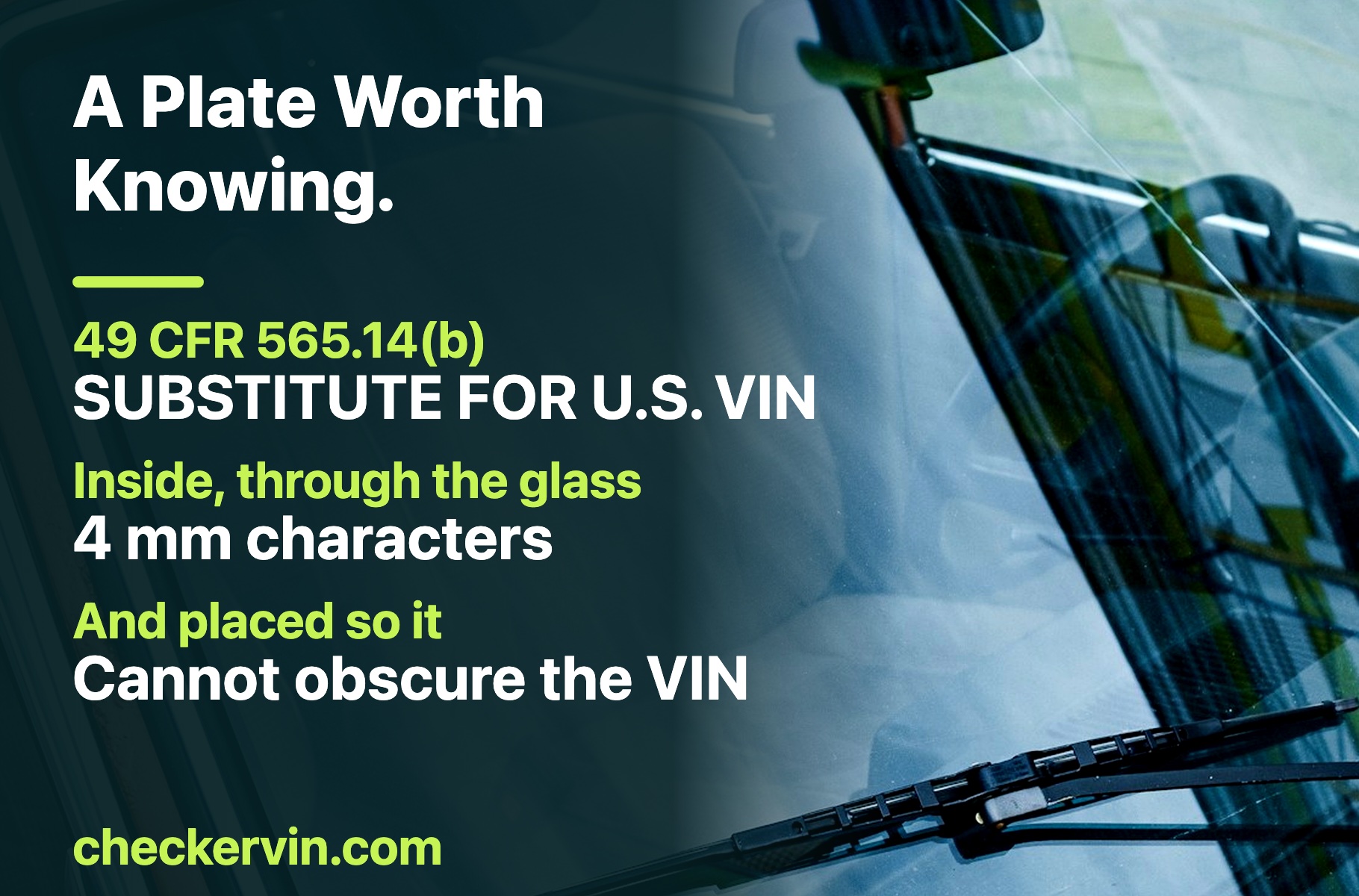
49 CFR 565.14 starts simply: importers must use the VIN assigned by the vehicle's original manufacturer. But paragraph (b) covers the case where that number does not comply with the American standard. A passenger car, multipurpose passenger vehicle, low speed vehicle or truck of 4,536 kg GVWR or less, certified by a Registered Importer under 49 CFR part 592, must then carry a plate or label bearing this statement, with the original manufacturer's number filled into the blank:
SUBSTITUTE FOR U.S. VIN: __________ SEE 49 CFR PART 565
The requirements around it are as specific as the readability rule. Characters at least 4 mm high. Permanently affixed inside the passenger compartment. Readable through the glazing in daylight by an observer with 20/20 vision at the left windshield pillar. And positioned so that it does not cover, obscure or overlay any part of any identification number affixed by the original manufacturer.
If you find one of those plates in a car you are considering, nothing is wrong — it is the mark of a vehicle that came in through the Registered Importer route and was brought into compliance. But it tells you the car was not originally built for this market, which is worth knowing before you agree a price, and worth asking the seller about directly.
What actually makes a verification fail
Most verifications are uneventful. The ones that are not tend to fail for a small number of reasons, and knowing them lets you check for the problem yourself first.
- The characters on the vehicle and the characters on the title do not match
- The VIN plate looks disturbed — rivets that do not match, a plate sitting proud, cut or lifted edges
- The number is unreadable through the glazing because something covers it or the glass is damaged
- A door-jamb label and the windshield plate disagree with each other
- An imported vehicle carries a substitute plate that does not meet the wording or placement rules
- Paperwork names a different vehicle description from the one the characters decode to
Preparing for the inspection
The appointment goes faster when the car makes the inspector's job easy, and every item below is something the standard already told you they need.
- 1Clean the windshield and clear the plateRemove parking permits, toll transponders and stickers sitting over or near the VIN. The readability test is performed through the glass from outside.
- 2Find the second location yourself firstCheck the door jamb label as well as the windshield plate and confirm they agree, character for character, before anyone else does.
- 3Bring the paperwork the number has to matchThe title or out-of-state ownership document, and anything else your state names. The comparison is against the document, so the document has to be there.
- 4Decode the VIN in advanceConfirm the characters decode to the vehicle you are actually standing next to — the right year, body and engine. A mismatch found now is a question; found at the counter it is a delay.
- 5Photograph both VIN locations before you goIf a dispute arises later about what was on the car, dated photographs of the plate and the label are the cheapest evidence you will ever collect.
Our own free check is a decode and a recall lookup, not a verification — nobody online can perform one, because the whole point is that a person looks at the vehicle. But running the number first tells you whether the characters describe the car in front of you, which is the one part of the inspection you can do yourself.
Where this information comes from
- 49 CFR 567.4 — the certification labelWhere the door label goes, and why it cannot be removed without defacing it
- 49 CFR 565.13 — general requirementsSeventeen characters, the check digit in position nine, the 60-year uniqueness rule and the 20/20 readability test
- 49 CFR 565.14 — motor vehicles imported into the United StatesThe SUBSTITUTE FOR U.S. VIN plate, its wording, size and placement
- NHTSA vPIC — public VIN decoderConfirm the characters decode to the vehicle you are standing next to, before the appointment
- NHTSA recall lookupFree open-recall check by VIN, worth running at the same time
Keep reading
Frequently asked questions
What is a VIN verification?
A physical inspection in which someone authorized by the state looks at the vehicle and confirms the VIN on it matches the VIN on the title and supporting paperwork. It examines the car in front of them, not its accident history or service record.
When do I need a VIN verification?
Most commonly when registering a vehicle brought in from another state, and in several states when titling a rebuilt or reconstructed vehicle, correcting a VIN recorded wrongly on a title, or titling a vehicle with no conventional ownership paperwork.
Is a VIN verification the same as a VIN check?
No, and the words get used interchangeably to everyone's cost. A VIN check is a records search on a database. A VIN decode reads the specification the manufacturer encoded. A VIN verification is a person standing at the car, comparing metal against paper.
Where does the inspector look for the VIN?
On a passenger car the federal standard requires it to be readable through the glazing from outside the vehicle at the left windshield pillar, so that is the first place. Inspectors also check the door-jamb label and other locations, because agreement between them is the point.
Can a VIN verification fail?
Yes. A VIN plate that has been disturbed, characters that do not match the paperwork, a missing or unreadable number, or an imported vehicle whose plate does not carry the required wording can all stop the process while the discrepancy is resolved.
Decode the VIN before the appointment
Confirm the characters describe the vehicle you are standing next to, and check for open recalls at the same time. Free, and no account needed.
Run a free VIN check