The short answer
- Can a VIN tell you what a car is worth?
- No. It identifies the build — year, make, model, body style, engine, assembly plant — and carries nothing about mileage, condition or location. Those are what set the price, and none of them are in the number.
- What does the federal decoder return?
- NHTSA's vPIC decoder returns more than sixty populated fields for a typical VIN. It has a base price field, and on the vehicles we tested it comes back empty.
- So how do you actually value a car?
- Start from the VIN to fix exactly which vehicle it is, then add mileage and an honest condition assessment, then read at least two valuation books, because they serve different customers and will not agree.
60+
Facts vPIC returns on a VIN
None of them a current value
Empty
The decoder's base price field
Blank on every car we checked
Mileage
The dominant variable
Asked for immediately, every time
3
Different numbers for one car
Trade, private party, retail
What a VIN actually encodes
The seventeen characters are an identity document, not an appraisal. They resolve the manufacturer, the model line, the body style, the restraint system, the engine family, the model year, the assembly plant and the vehicle’s serial position in that plant’s production run.
Every one of those is a fact fixed at the moment of manufacture. None of them changes when the car is driven a hundred thousand miles, parked in salt for six winters, or repaired after a collision — and those are exactly the things that decide what somebody will pay.
The price field that comes back empty
This is worth demonstrating rather than asserting. NHTSA’s vPIC decoder is the federal reference for what a VIN means, and its response schema includes a base price field.
Run a Chevrolet, a Tesla and a Ford through it and the same thing happens each time: the decoder returns dozens of populated fields — make, model, year, body class, engine configuration, plant country, restraint types — and the price field arrives blank.
What actually moves the number
If the VIN sets the starting point, everything below sets the price. Roughly in order of how much they matter on an ordinary used car:
| Factor | Why it moves the price |
|---|---|
| Mileage | The clearest proxy for remaining life, and independently recorded |
| Mechanical condition | What it will cost the next owner in the first year |
| Cosmetic condition | Sets the buyer's expectation before anything is driven |
| Service history | Evidence, and the absence of it is itself a discount |
| Title status | A brand is permanent and follows the car forever |
| Options and trim | Sometimes in the VIN, often only on the build sticker |
| Location and season | Convertibles and four-wheel drive do not price the same everywhere |
Notice how few of those a database can see. The first is a number somebody typed in; the next two require a person to look at the car.
Why mileage dominates, and why that is a problem
Mileage carries disproportionate weight because it is the only major variable that is numerically precise and recorded by third parties. Titles capture it at transfer, and inspections capture it in states that run them.
That same precision is why odometer fraud is worth committing. Rolling a reading back moves the value directly, without touching anything a casual buyer inspects, and the federal odometer disclosure system exists precisely because the incentive is so strong.
The practical consequence for anybody valuing a car: a mileage figure that cannot be corroborated is not a valuation input, it is a claim. Check it against recorded readings before you build a price on it.
Condition, and who gets to judge it
Every valuation tool asks you to grade the vehicle, and almost everybody grades their own car too generously. The grades are not decoration — moving one step changes the output materially.
The honest approach is to grade as the person paying would. A dealer appraising for trade is estimating reconditioning cost and auction risk, and will land lower than an owner who has driven the car carefully for years and knows its history.
The books, and who each one serves
The disagreement between valuation sources confuses people constantly, and it is not a malfunction. Each book was built for a different customer.
- J.D. Power, formerly NADA — the reference lenders and dealers work from
- Kelley Blue Book — the consumer-facing name most buyers know
- Edmunds — appraisal aimed at the retail shopper
- Auction data — what the trade actually paid, if you can reach it
Reading two of them and taking the range seriously is more useful than trusting one and treating it as the answer.
Three numbers, one car
Any given vehicle has several defensible values at the same moment, and confusing them is the most common mistake in a private sale.
Trade-in is what a dealer will hand you against a purchase, discounted for their reconditioning and risk. Private party is what an individual will pay you directly, and sits higher because you are absorbing the effort and the risk yourself. Retail is what a dealer asks after preparing the car and standing behind it.
A seller quoting retail and a buyer quoting trade-in can both be citing real figures from the same book while describing entirely different transactions.
Getting a defensible number without paying
The sequence below costs nothing and is enough for almost any private transaction.
- 1Decode the VIN firstFix exactly which vehicle you have — trim and engine differences within one model line move the value more than most people expect.
- 2Establish the mileage properlyRead the odometer, then check it against recorded readings rather than accepting a number from a listing.
- 3Grade the condition honestlyUse the tool's own definitions rather than your instinct, and grade as a buyer would.
- 4Run two books, not oneTake the spread between them as your range, and expect a dealer offer to sit at or below the bottom of it.
What history does to the number
Title brands are the sharpest single adjustment in used-car valuation. A salvage or rebuilt brand is permanent, follows the vehicle across state lines, and takes a substantial and lasting bite out of what the car can be sold for — as well as restricting who will finance or insure it.
Reported accident damage without a brand sits in a murkier place, and unreported damage affects the price only when a buyer or an inspector finds it. That asymmetry is why an inspection is worth more than any valuation tool on a car you are seriously considering.
The one place a car's future value is written down in advance
Everything above treats a valuation as an estimate somebody offers you. There is one transaction in American life where that is not true — where a business must commit, in writing and in advance, to what a particular vehicle will be worth years from now, and where being wrong about it has consequences the law spells out.
That transaction is a lease, and the rules are in 12 CFR Part 1013, the Consumer Financial Protection Bureau's Regulation M, which implements the Consumer Leasing Act. Most people reading about car values are not leasing anything. The reason to read it anyway is that it is the only place the federal government describes how a vehicle's value is supposed to be estimated, disputed and settled — and the answers are more concrete than anything a valuation website will tell you.
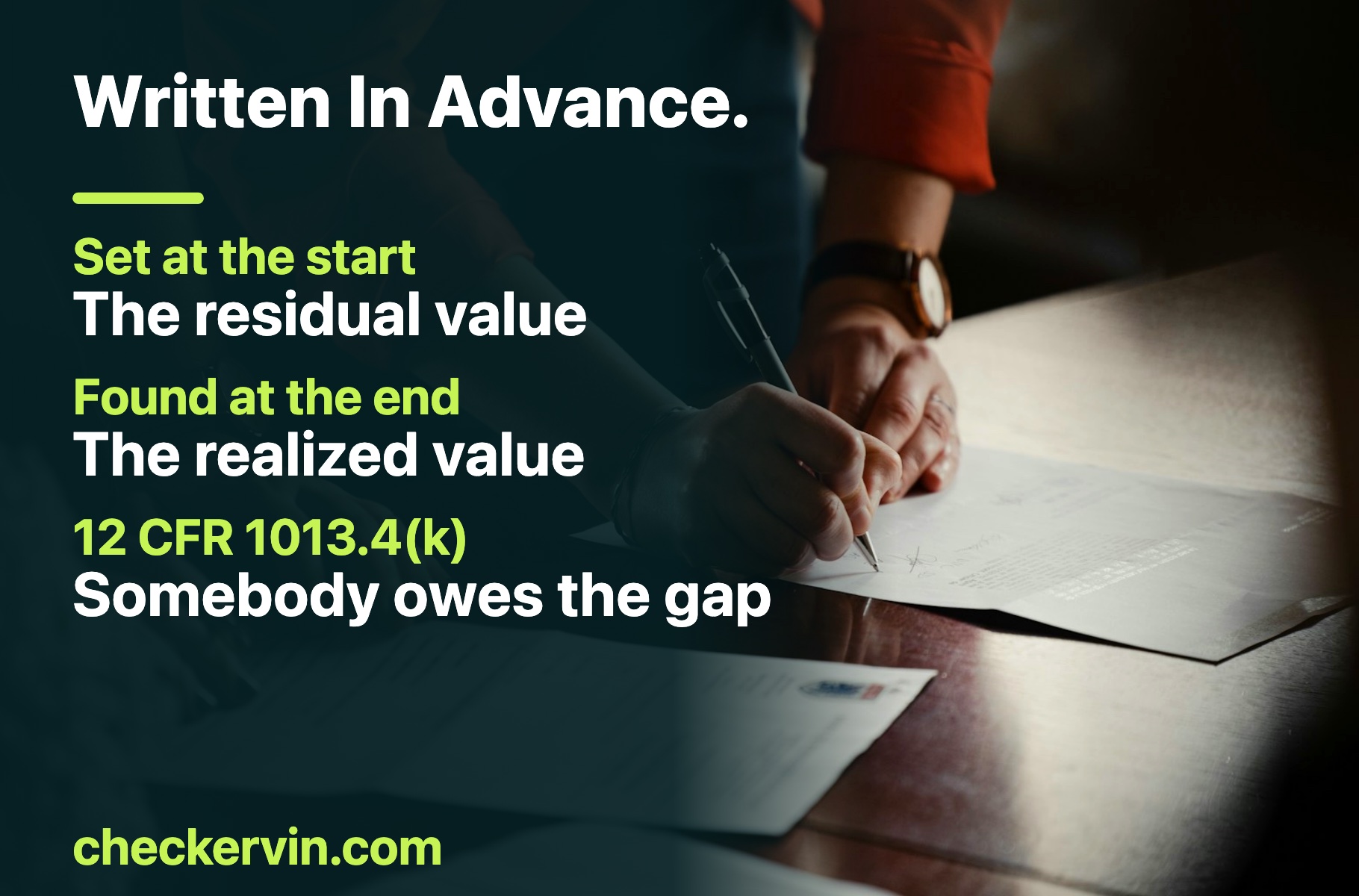
The vocabulary is worth learning because it separates two things that ordinary conversation runs together. The residual value is the predicted worth of the vehicle at the end of the lease, set at the start. The realized value is what the vehicle actually turns out to be worth when the term ends. Every argument about what a car is worth is, underneath, an argument about the gap between those two.
Regulation M requires that gap to be addressed head-on. Under 1013.4(k), the lessor must state the lessee's liability, if any, for the difference between the residual value and the realized value, at early termination or at the end of the term. Under 1013.4(e), an open-end lease must carry a plain warning that the lessee will owe an additional amount if the actual value of the vehicle turns out to be less than the residual value.
There is a third number in the same disclosure, and it is the one closest to what a reader of this page is usually after. Under 1013.4(i), the lessor must state whether the lessee has an option to purchase the vehicle at all — and if the option exists at the end of the term, the actual purchase price. If it exists during the term, the lessor must give either the price or the method for determining it, and say when the option can be exercised.
That is a price for a specific car, fixed in a contract, quoted before anyone knows what the market will do. It is not a market value and should not be mistaken for one — a purchase option can end up well above or well below what the car is worth on the day. But it is a rare example of the thing people are really looking for when they type a VIN into a valuation tool: a number attached to one vehicle that somebody is actually committed to.
The appraisal that is final and binding
Here is the provision that has no equivalent anywhere else in car valuation, and it is two sentences long.
Under 1013.4(l), where the lessee's liability at early termination or at the end of the term is based on the realized value of the vehicle, the lessor must tell the lessee that they may obtain a professional appraisal of the value that could be realized at sale — by an independent third party agreed to by both sides, and at the lessee's own expense. And then the rule adds the part that matters: that appraisal is final and binding on the parties.
Read that against how every other vehicle valuation works. A published book value binds nobody. A dealer's offer binds the dealer only until it expires. An insurer's settlement figure is a position, not a fact. This is the one context where a number somebody puts on a specific car becomes conclusive for everyone involved — and the price of that certainty is that the person who wants it pays for it, and gives up the right to argue afterwards.
- It applies where liability rests on realized value, not to every lease
- The appraiser must be independent and agreed to by both parties
- The lessee pays, so it is worth doing only when the gap is larger than the fee
- It values what could be realized at sale, not what the car means to you
- It is final — you cannot commission it, dislike it, and then dispute it
The three-payment presumption, and why it exists
There is one more piece, and it is the closest thing in federal law to a rule about a valuation being too optimistic.
Where the lessee is liable at the end of the term for the difference between residual and realized value, 1013.4(m)(2) requires a statement about a rebuttable presumption: the residual value is presumed unreasonable and not in good faith to the extent it exceeds the realized value by more than three times the base monthly payment. If the lease calls for payments on some other schedule, the comparison uses three times the average payment allocable to a monthly period.
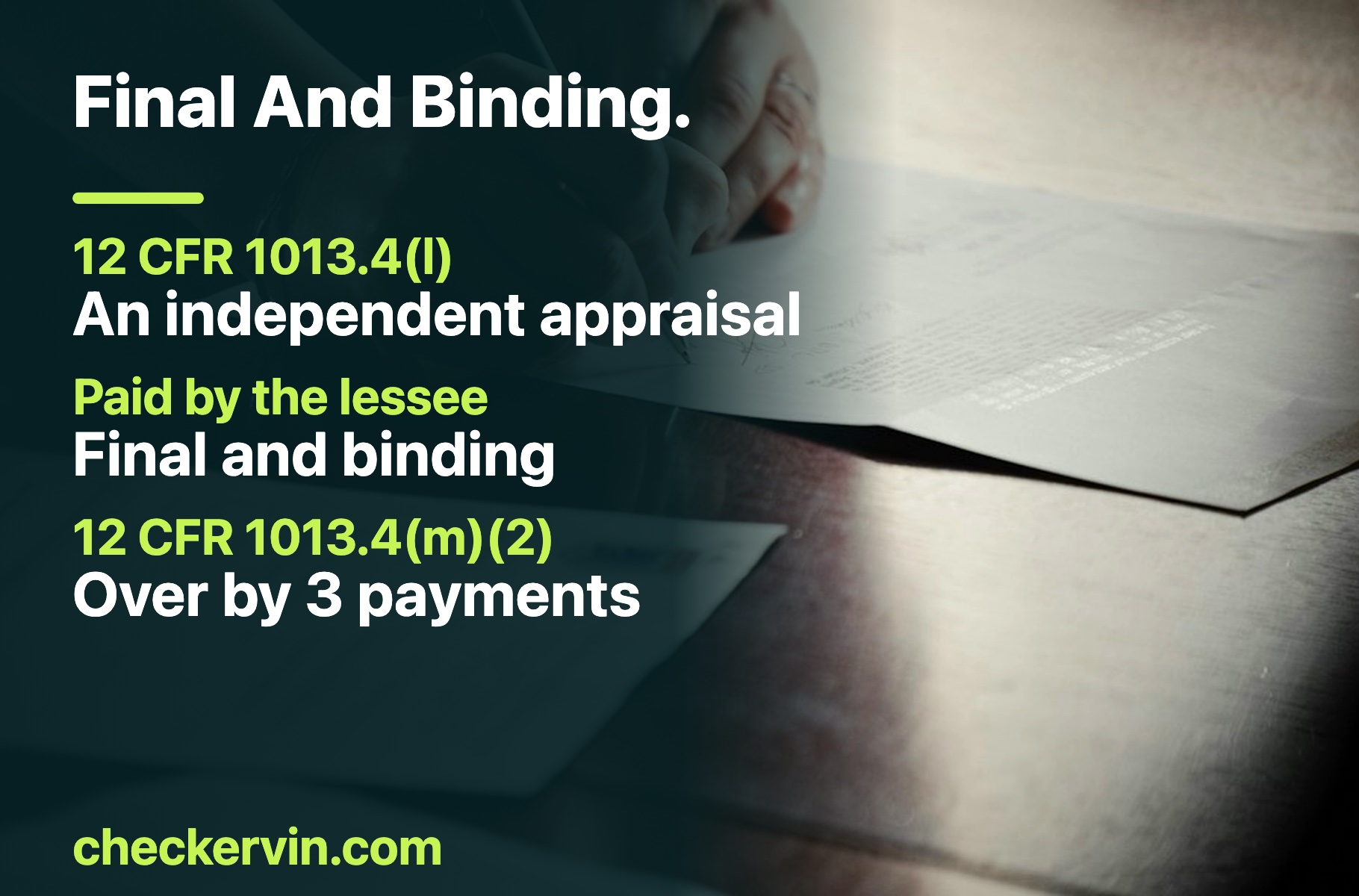
Two things are worth drawing out. The first is that the presumption is rebuttable rather than automatic: a lessor can still show its estimate was honest and well-founded. The second is what the threshold implies. Federal law contemplates that a professionally prepared, contractually binding forecast of a specific vehicle's future value can be wrong by a couple of months' payments without anybody being surprised. The tolerance is built in.
That is a useful calibration for anyone reading a valuation on a screen. If the institution with the strongest possible incentive to predict a car's value accurately — because it owns the car and carries the loss — is allowed a margin of error measured in monthly payments, then a free instant estimate on a website, produced without seeing the vehicle, deserves to be read as a range rather than a figure.
What no valuation can know
Every number produced by every tool is a model of a market, built from transactions involving other cars. None of them has seen yours.
They do not know that the transmission is beginning to slip, that the service book stops at sixty thousand miles, or that the car sat outside under a tree for three years. A person looking at the vehicle knows all of that in twenty minutes.
Our own free check returns the factory build, the specifications and open recalls, and does not produce a valuation. What it does is settle exactly which vehicle you are pricing — which is the one input every valuation tool assumes you already have right.
Where this information comes from
- 12 CFR 1013.4 — content of disclosures (Regulation M)Residual versus realized value, the binding independent appraisal, and the three-payment presumption
- NHTSA vPIC — public VIN decoderThe federal decoder whose base price field returns empty on the vehicles we tested
- NHTSA — odometer fraudWhy the mileage figure underneath any valuation deserves corroboration
- FTC — buying a used carFederal consumer guidance on used purchases, including the Buyers Guide requirement
Keep reading
Frequently asked questions
Can you get a car's value from the VIN alone?
No. The VIN identifies how the vehicle was built — year, make, model, body, engine, plant — and encodes nothing about mileage, condition, options fitted later or where it is being sold. Every valuation tool asks for mileage and condition immediately after you enter the number, which tells you what it actually needs.
Does the government's VIN decoder show a price?
It has a base price field and in practice it comes back empty. NHTSA's vPIC decoder returns over sixty populated facts about a typical vehicle, and the price field is not one of them.
Why do two valuation sites give different numbers for my car?
Because they serve different customers and measure different transactions. One book is built around what dealers and lenders need, another around consumer retail asking prices, and they draw on different transaction sets, so they disagree by design rather than by error.
What single factor changes the value most?
Mileage, for most ordinary vehicles. It is the one variable that is numerically precise, independently recorded at sales and inspections, and directly tied to remaining life — which is also why odometer fraud exists and why a mileage record that contradicts itself destroys value.
Is a free valuation good enough?
For orientation, usually yes. Free tools from the major books will put you in the right range. What they cannot do is see your specific car, which is why a private sale, a trade offer and an insurance settlement can all land on different numbers for the same vehicle.
Decode the VIN before you price the car
Enter the VIN for the factory build, the specifications and any open safety recall on that exact vehicle. Free, and no account needed.
Run a free VIN check