The short answer
- What should you pay?
- Nothing for recalls, theft and specifications — those are free from official sources. Single-digit dollars for the federal title record from an approved NMVTIS provider. Premium pricing only on cars where service depth changes the valuation.
- What is the one check worth paying for?
- The NMVTIS title record. It is the system built to defeat title washing, it costs a few dollars, and it catches the fraud that costs used-car buyers most.
- What is never worth paying for?
- Anything a government source publishes free — and any site promising a complete history at no cost, which is a lead-capture page rather than a report.
$0
Recalls, theft screen, decode
NHTSA and NICB, official sources
Single $
NMVTIS title record
From an approved provider
10×+
Premium report multiple
For network depth, not title data
Before
When to run cheap checks
Screening beats regretting

The market has three tiers, and they hold different data
Almost every argument about report pricing dissolves once you separate the tiers. The free layer is government and industry data published at no cost. The middle layer is the federal title system, resold for a few dollars by approved providers. The premium layer is privately assembled networks of dealer, repair and insurance records that no government database holds. Paying premium prices for tier-one data is waste; skipping tier two to save four dollars is how people buy washed titles.
Tier one: genuinely free, and genuinely useful
| Check | Source and cost |
|---|---|
| Open safety recalls | NHTSA recall lookup — free, by VIN, from the regulator |
| Theft and salvage screen | NICB VINCheck — free from participating insurers |
| Factory build and specifications | VIN decode — free, including here |
| State title status | Some states publish their own free checks, notably Florida |
| Emissions test history | California's BAR publishes full Smog Check history free |
Paid reports repackage most of this. Running it yourself costs nothing and tells you whether a car is worth spending money to investigate further — which is the entire point of a screening layer. Our free report guide walks the whole sequence.
Tier two: the few-dollar record that does the real work
NMVTIS is the federal title system state agencies, insurers and salvage businesses are legally required to report into. Approved providers resell reports from it for single-digit dollars, and that report is the one check most buyers should never skip: it is what makes a salvage brand issued in one state visible after the car is retitled in another. Providers on the government’s approved list — VinAudit, EpicVIN, ClearVin, Bumper and others — compete mostly on price and presentation over the same underlying access.
Why the gap between tiers is so wide
Tier two is a database lookup against a system the government compels people to populate — the marginal cost of one more report is close to nothing, so competition drives price toward it. Tier three is a data-acquisition business: those records exist because someone negotiated, integrated and paid for feeds from thousands of independent businesses, and that cost is recovered per report. Neither price is unfair. They are different products that happen to be sold under the same phrase.
Which tier your purchase justifies
- Screening a shortlist you have not viewed — free tier only; spend nothing until a car is real
- Any private-party purchase over a couple of thousand dollars — free tier plus the NMVTIS title record
- A branded or suspiciously cheap car — NMVTIS record before you even schedule the viewing
- Late-model, low-mileage, premium price — add a tier-three report where service history changes the number
- Dealer purchase with a report already provided — verify independently; a seller's report is a seller's document
Valuation is a separate purchase with its own tiers — car value by VIN, the lender’s book and the consumer one answer different questions.
Does this car justify it? The record has an opinion
“It depends on the car” is where the advice on this question usually stops. It is true and it is useless, because it hands the decision back to the person who asked. The complaint record can make it specific.
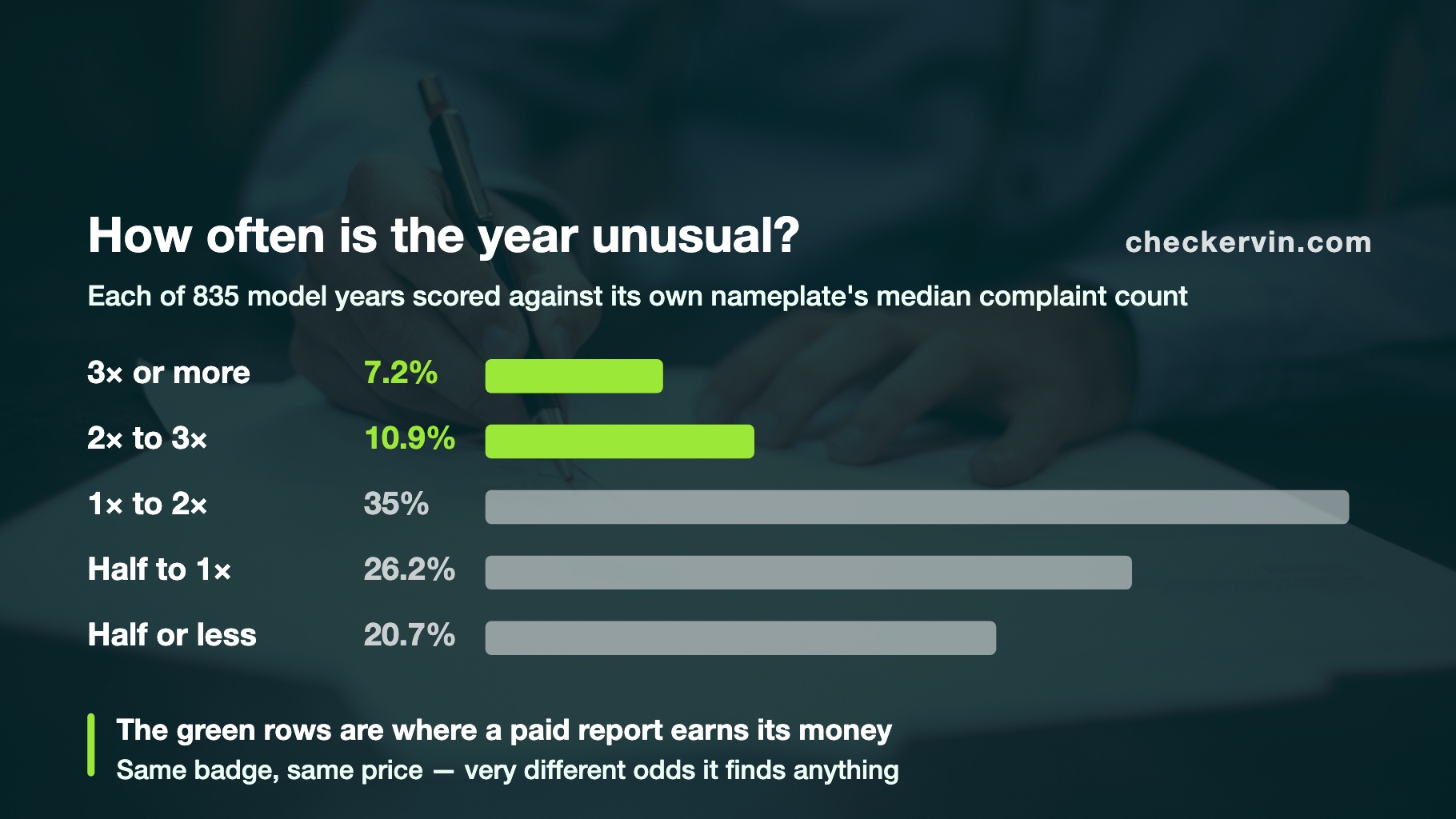
We aggregate NHTSA complaints and recalls across 60 nameplates and 835 model years, and score each year against its own nameplate’s median rather than against other vehicles. That control matters: a car that sells in huge numbers collects more complaints for that reason alone, and comparing it to its own median strips the volume out. What is left is whether a particular year was unusual for that model.
Measured that way, the spend is plainly not a flat decision. Of the 835 model years we can score, 7% carry at least three times their own nameplate’s median complaint count, and 21% carry half of it or less. Same badge, same report price, very different odds that the report finds anything.
| Model year, and how it compares to its own nameplate | What owners reported most |
|---|---|
| 2010 Toyota Prius — 2,826 complaints against a 207 median for the nameplate, about 13.7× | Service brakes, alongside 10 recalls for that year |
| 2013 Nissan Pathfinder — 890 against a median of 92, about 9.7× | Power train, the complaint that dominates its worst years |
| 2016 Hyundai Tucson — 1,615 against a median of 226, about 7.1× | Power train, with 24 fires reported to NHTSA that year |
| 2016 Honda Pilot — 1,680 against a median of 270, about 6.2× | Engine, on a nameplate whose other years sit far lower |
Read the table as a spending rule rather than a verdict on a car. A year sitting far above its own nameplate’s median is a year where the paid title record is easy to justify before you drive anywhere, because there is a documented reason to look harder. A year at or below its median is one where the free tier plus the few-dollar record is usually the whole job, and the next dollar belongs to a mechanic rather than a report.
Our reported-problems index carries the per-year breakdown for each nameplate we cover, and the vehicle pages hold the recall and complaint record for individual model years. Both are free, and both are the same public NHTSA data any paid report repackages for its recall section.
Where this method goes blind, and what to buy instead
A method is only useful if you know where it stops working, so here is the edge of this one. Of the 155 model years in our data from 2020 onward, not one reachthree times their own nameplate’s median.
Read that the wrong way and it says recent cars are trouble-free. It says nothing of the kind. Complaints arrive over years rather than on delivery — owners report a failure when it happens, and most failures happen well after the car is new. A model year that is two or three years old has had two or three years to collect a record, while the median it is being compared against was set by years that have had a decade. The recent end of this distribution is thin because it is young, not because it is clean.
That reverses the usual advice in a useful way. The complaint record is at its most valuable on a car old enough to have one — which is also the car where a premium report is hardest to justify on price. On a two-year-old vehicle the record is quiet by construction, and the few dollars for the federal title record buy you the thing that is actually knowable about it.
One more thing worth reporting because we checked it and it was not there. The received wisdom is that the first model year of a run is the one to avoid, and it would be a convenient trigger for spending money. Measured against the same threshold, 8.3% of first years reach three times their nameplate median against 7.1% of every other year. That gap is too small to act on. Whatever else decides your spend, “it is a first-year car” is not doing the work people think it does.
The report the seller already has
Somewhere in a used-car conversation the seller may offer to show you a report, often at no cost to you. Take it — a free look at more data is not a thing to refuse. Then understand exactly what you have been handed, because it is not the same object as a report you pull yourself, and the difference has nothing to do with anyone being dishonest.
Three things separate the two. The first is choice of network. Whoever paid for that report chose which service to buy, and the services do not hold identical data — they are commercial networks fed by the garages, auctions and insurers that report to each of them, which is why the same VIN can return different histories from different vendors. A report is evidence of what one network holds, not of everything that happened to the car.
The second is timing. A report is a snapshot taken on the day it was run. A car that has been sitting on a lot for two months carries a report from two months ago, and anything recorded since — a title action, a fresh recall, an auction entry — is not in the copy in your hand. The date on the report matters more than its length.
The third is custody. Being shown a report is not the same as holding one. You generally cannot re-run someone else’s report later, cannot check it against a second source, and cannot hand it to a mechanic or a lender. If the deal goes wrong, the document you were shown is not a document you have.
There is a simple way to hold both facts at once. A report the seller supplies is genuinely worth reading, and it is also the only report in this market you did not choose, did not time, and do not keep. That is not a reason to distrust it. It is the reason it belongs alongside your own checks rather than in place of them.
The subscription trap
Several services price a single report close to a month of unlimited access, which is excellent value if you are genuinely shopping and an expensive accident if you forget to cancel. The pattern to watch: a trial that converts to recurring billing, or a “single report” checkout that quietly enrolls you. If a subscription genuinely suits your search, set a calendar reminder the day you buy it. If you need one report, look for a service that sells exactly that.
Cost per decision, not cost per report
Every guide to this question, including the parts of this one above, prices a single report. Nobody buys a single report. A real used-car search looks at a dozen listings, drives a handful, gets serious about two or three, and buys one. The number that actually leaves your account is the cost of running that whole funnel — and once you price the funnel rather than the document, the advice changes.
Use the two facts already established on this page. The federal title record runs in single-digit dollars, and a premium report runs roughly an order of magnitude above it. So one premium report costs about what it costs to run the federal record across ten cars. That is the trade, stated plainly: depth on one vehicle, or title-level coverage across an entire shortlist. Buying premium depth on a car you have not yet driven is paying for detail about a vehicle you may never own.
And the highest-yield check in the whole funnel is the one that costs nothing. Across the 835 model years in our data, 95.1% had at least one safety recall issued — a median of 4 campaigns per model year, and 47.9% had five or more. A check that finds something on nineteen model years out of twenty, for nothing, is the best value available at any tier.
| Stage of the search | What you are buying, and roughly what it costs |
|---|---|
| Every listing you shortlist | Decode, recalls, theft screen — breadth, at no cost |
| The two or three you pursue | The federal title record — the washing check, single-digit dollars each |
| The one you intend to buy | Premium depth, if service history changes the valuation |
| Before money moves | An independent mechanic — the only check that sees the car itself |
The shape to take away is that breadth belongs early and depth belongs late. Breadth is free or nearly free and it is what removes cars from your list; depth is expensive and it only earns its price once a single car is genuinely in play. Most people who feel they overspent on reports did it by buying depth at the top of the funnel, on cars they were never going to buy.
The spending sequence that wastes least
- 1Decode the VIN and check recalls — freeConfirms the car is what the listing claims and surfaces open safety campaigns.
- 2Run the NICB theft and salvage screen — freeTwo minutes, and it catches the cars that should end the conversation immediately.
- 3Buy the NMVTIS title record — a few dollarsOnce a car is a serious candidate. This is the tier that catches title washing.
- 4Add a premium report only if the car warrants itExpensive, late-model, or a service history that materially changes what it is worth.
- 5Spend the real money on a mechanicNo report at any price sees a worn transmission. The inspection is the purchase that pays.
Step one, free: decode the VIN
Decoded from official manufacturer and NHTSA records
Where this information comes from
- NMVTIS — approved data providersWho may sell federal title reports, and to which customers
- NHTSA recall lookupFree open-recall check, the same data paid reports repackage
- NICB VINCheckFree theft and total-loss screen from participating insurers
- FTC — buying a used carYour rights, and the Buyers Guide a dealer must display
Keep reading
Frequently asked questions
How much does a vehicle history report cost?
It depends which tier you buy. Recall, theft and specification checks are free from government and industry sources. An NMVTIS-sourced title report from an approved provider typically costs single-digit dollars. Premium reports from the two incumbents run an order of magnitude higher for a single report, with multi-report packs reducing the per-unit price.
Is a paid vehicle history report worth it?
On any purchase worth several thousand dollars, the few-dollar federal title record is worth it every time — it is the check that catches title washing, which is the fraud that costs buyers most. A premium report earns its price on expensive late-model cars where documented service history and accident depth genuinely change the valuation.
Why is Carfax so expensive compared to other reports?
Because you are paying for a data network rather than a database lookup. Decades of relationships with dealers, repair chains, police departments and insurers produce records no federal system holds. Whether that depth is worth the multiple depends entirely on the car — on a ten-year-old private sale it often is not.
Can I get a vehicle history report free?
Parts of one, genuinely. NHTSA's recall lookup, NICB's theft and salvage screen, and a VIN decode cost nothing and are the same data any paid report repackages for those sections. What no legitimate service gives away free is the complete NMVTIS title record — sites promising a free full history are collecting your details to sell you something.
The seller offered me a free report — is that enough?
It is worth reading and it is not a substitute. Whoever paid for it chose which network to buy, and the networks do not hold identical data. It was run on a date that may be months old, so anything recorded since is missing. And being shown a report is not the same as holding one you can re-run or check against a second source. Read it for the questions it lets you ask, then still pull the federal title record yourself.
Should I buy a report before or after seeing the car?
Cheap checks before, premium after. Run the free layers and a few-dollar title report while you are still deciding which cars to view — that is what stops you driving an hour to see a washed title. Save premium spending for the one vehicle you are close to buying.
Tier one costs nothing — run it now
Decode any VIN free for the factory build, specifications and open safety recalls. No account, no card.
Run a free VIN check