The short answer
- Does 25 years make it legal?
- For NHTSA, yes — 49 CFR 591.5(i)(1). EPA and Customs are separate tests, and EPA's outright exclusions are fixed dates in the 1960s and 1970s.
- Will the VIN tell me?
- It tells you whether the manufacturer was ever registered for US sale. It cannot tell you whether this car cleared Customs properly.
- What is the real risk?
- A vehicle whose import bond was never cleared can be called back by Customs, and that exposure travels with the car rather than the importer.
25 yrs
NHTSA threshold, and it rolls
49 CFR 591.5(i)(1)
1968
EPA gasoline cut-off, and it does not
40 CFR 85.1511(f)(1)
180 days
Before Customs can demand redelivery
19 CFR 12.80
4 of 154
Fields a JDM number decodes
Against 68 for a US car
Three agencies, three different tests
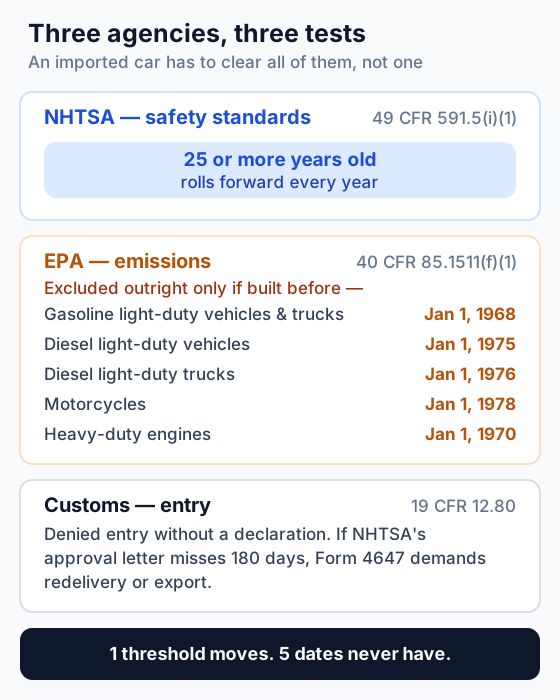
A car imported into the United States has to satisfy three separate federal bodies, and they do not share a definition of “old enough”. The National Highway Traffic Safety Administration cares about the federal motor vehicle safety standards. The Environmental Protection Agency cares about emissions. U.S. Customs and Border Protection cares about whether a valid declaration was filed and whether the vehicle was released against a bond that was later cleared.
The phrase “the 25-year rule” belongs to the first of those three. It is repeated so often, and so confidently, that buyers reasonably assume it is the whole story. It is not, and the mismatch is not subtle: one agency uses a threshold that moves forward every year, and another uses dates that have not moved in five decades.
NHTSA: a threshold that rolls forward every year
49 CFR 591.5 opens by prohibiting importation outright unless a declaration is filed: no person shall import a motor vehicle or item of motor vehicle equipment into the United States unless, at the time it is offered for importation, its importer files a declaration and documentation in a format accepted by Customs. The rest of the section is the list of things that declaration can say.
One of them is the rule everybody knows. Under 49 CFR 591.5(i)(1), the importer may declare that the vehicle is 25 or more years old. That is the entire test — an age, with no requirement that the vehicle meet any safety standard, and no distinction by fuel, body style or country of origin.
Because it is an age rather than a date, it moves. Every month, another month of production crosses the line. That is why the import scene has a calendar culture around it, and why a car that was unimportable last year may be importable now. Hold on to that property, because the next agency does the opposite.
EPA: five dates that have never moved
The Environmental Protection Agency also has an age concept, and it is not an age. Under 40 CFR 85.1511(f)(1), certain vehicles are excluded from the requirements of the Act and may be imported by any person — and the qualifying line is drawn on fixed calendar dates:
| Vehicle type | Excluded if originally manufactured before |
|---|---|
| Gasoline-fueled light-duty vehicles and light-duty trucks | January 1, 1968 |
| Diesel-fueled light-duty vehicles | January 1, 1975 |
| Diesel-fueled light-duty trucks | January 1, 1976 |
| Motorcycles | January 1, 1978 |
| Gasoline and diesel heavy-duty engines | January 1, 1970 |
Read those against the rolling 25 years and the problem is obvious. A car built in 2001 is 25 years old in 2026 and clears NHTSA on age alone. It is nowhere near any of the dates above, so the EPA exclusion does not touch it. The two rules are not two views of the same idea — they are answering different questions, and only one of them gets easier as time passes.
EPA does have an age route — and you cannot use it yourself
There is a second EPA provision, and it is the source of the “21-year rule” that circulates alongside the 25-year one. It is real, and it carries a condition that is almost always dropped in the retelling.
40 CFR 85.1511(f)(2) provides that a vehicle not covered by the fixed exclusions above, but greater than twenty OP years old, is entitled to an exemption from the requirements of the Act — provided that it is imported into the United States by a certificate holder, who must submit the written report the regulation requires at the time of admission.
A certificate holder is a registered independent commercial importer, not a private buyer. So the age route exists, but it runs through a company rather than through you, and it produces paperwork that should exist for any car brought in that way. If a seller describes a car as exempt on age and cannot say which certificate holder imported it, that is a question worth pressing.
One more clause worth knowing, because it closes the loop: 40 CFR 85.1511(h) states that vehicles conditionally or finally admitted still have to comply with the Energy Tax Act of 1978, the Energy Policy and Conservation Act, and any other Federal or state requirements. Clearing an agency is not the same as clearing everything.
Customs: the declaration, the bond, and 180 days
The third test is procedural, and it is the one that most often reaches a second owner. 19 CFR 12.80 covers motor vehicles manufactured on or after January 1, 1968, and it is blunt about the consequence of missing paperwork: a vehicle offered for introduction into the customs territory shall be denied entry unless the importer or consignee files a declaration, in duplicate, with the entry.
Where a nonconforming vehicle is released so it can be brought into conformity, that release runs against a bond, and the regulation puts a clock on it. If the approval letter from NHTSA does not reach the port director within 180 days after entry, the port director issues a Notice of Redelivery on Customs Form 4647, requiring the vehicle to be redelivered to Customs custody — or exported under Customs supervision.
What the federal decoder says about a gray-market car
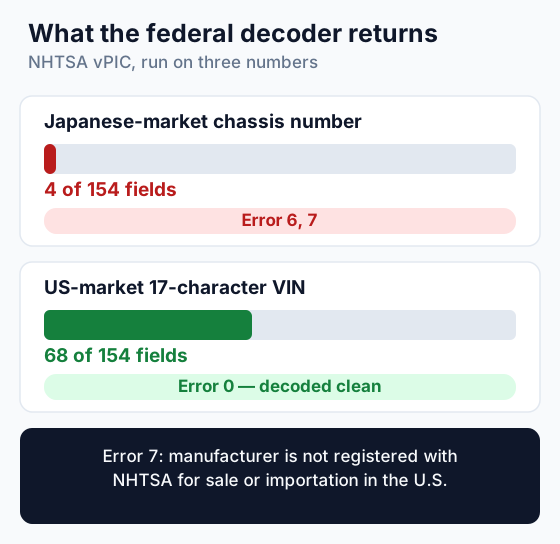
NHTSA runs a free public decoder, and it answers this question more directly than any commercial tool. We ran three numbers through it to see what a buyer would actually get back.
| What we submitted | What NHTSA returned |
|---|---|
| A Japanese-market chassis number in Skyline format | Error 6 and 7 — incomplete VIN, and manufacturer is not registered with NHTSA for sale or importation in the U.S. Four of 154 fields populated |
| A Japanese-market chassis number in Supra format | The same pair of errors, and the same four of 154 fields |
| A US-market 17-character VIN, as a control | Error 0 — decoded clean, check digit correct. Sixty-eight of 154 fields populated, including make, model, year, body class and plant country |
The wording of error 7 is the useful part, because it is the agency’s own sentence rather than an interpretation: manufacturer is not registered with NHTSA for sale or importation in the U.S. for use on U.S. roads. A decoder returning almost nothing is not a broken decoder. It is telling you that the car in the listing was never built for this market, which is exactly the fact the rest of this page hangs on.
You can reproduce that yourself in a minute with our free VIN lookup, and it is worth doing before you drive to see a car advertised as a US-market vehicle.
Cars imported on a route that never allowed a sale
Not every legal import is legal to sell to you. The declaration filed at the border picks one legal theory out of a list, and two of the entries on that list are explicitly temporary — which means a car can have entered the country entirely properly and still have no business being advertised to a US buyer.
Under 19 CFR 12.80(e), one permitted declaration is that the vehicle is intended solely for export, and that the vehicle bears a label or tag saying so. Another is that the importer or consignee is a nonresident of the United States importing the vehicle primarily for personal use for a limited period. 49 CFR 591.5 carries the same shape on the safety side, including a declaration by an importer who will not sell the vehicle to anyone in the United States other than a person also eligible to import it, and who will export it on leaving at the conclusion of a tour of duty.
Those routes exist for good reasons — diplomats, military personnel, race teams, manufacturers moving test cars. The problem is what happens when the car does not leave. A vehicle admitted on a promise of export or on a nonresident’s temporary personal use has never been assessed against the standards a permanent import must meet, so a later sale is not a paperwork technicality. It is a sale of something that was admitted on a condition nobody kept.
What a VIN can settle here, and what it cannot
Being precise about this matters more on imports than on almost any other topic, because the gap between what a number proves and what a buyer wants proved is unusually wide.
| The question | What the number can do |
|---|---|
| Was this car built for the US market? | Answered well — a federal decode either returns a US-market record or tells you the manufacturer is not registered here |
| Is it old enough for the NHTSA declaration? | Answered from the build date, which a decode or the chassis plate will give you |
| Does it meet EPA requirements? | Not answerable from the number — it depends on the fixed exclusions, or on an importer's exemption filing |
| Did it clear Customs correctly? | Not answerable from the number at all. This lives in the entry documents |
| Is the bond released? | Not answerable from the number. Ask for the approval letter or evidence the charge against the bond was canceled |
The documents to ask for, in order of usefulness
- 1The entry paperwork, not the titleA state title proves a state agreed to title it. It does not prove the vehicle entered lawfully. Ask for the customs entry documents that came with the car.
- 2The declaration that was filed at importation49 CFR 591.5 requires one, and which paragraph was declared tells you the whole legal theory of the import — age, conformity, show or display, nonresident use, or export.
- 3For a conformity import, the NHTSA approval letterThis is the document that cancels the charge against the bond under 19 CFR 12.80. Its absence is the exposure described above.
- 4For an EPA age exemption, the certificate holder's name40 CFR 85.1511(f)(2) only works through a certificate holder, so there is a company that filed a written report. A seller who cannot name it has a gap in the story.
- 5The build date from the chassis plateBoth the NHTSA age test and the EPA fixed dates run on original manufacture, not model year, and on older imports those can differ by months.
Red flags on an import listing
- A US-market claim that the federal decoder contradicts — the strongest single signal, and free to check
- "Legal because it is 25 years old" offered as a complete answer rather than as the NHTSA half of one
- A seller who has the title but none of the import documents, and treats the request as unusual
- An age-exemption story with no certificate holder behind it
- A car whose build date sits just the wrong side of a fixed EPA date, described as though the rolling rule covers it
- Recent import, recent title and a quick resale — the pattern where conformity work is least likely to be finished
Before you pay
The order that saves the most wasted travel is: decode first, ask for documents second, inspect third. The decode costs nothing and settles the market question immediately. The documents settle the legal question, and no inspection can substitute for them, because conformity is a paperwork state rather than a physical one.
If the paperwork is complete, an import can be an excellent purchase — the rules exist to be used, and cars brought in properly under them are ordinary property. If the paperwork is missing, the discount you are being offered is almost never large enough, because the downside is not a repair bill. It is a car you may not be allowed to keep.
Decode the VIN free before you go
Decoded from official manufacturer and NHTSA records
Where this information comes from
- 49 CFR 591.5 — declarations required for importationThe declaration requirement, and the 25-or-more-years-old declaration at paragraph (i)(1)
- 40 CFR 85.1511 — exemptions and exclusionsThe five fixed-date exclusions at (f)(1), the certificate-holder route at (f)(2), and the surviving obligations at (h)
- 19 CFR 12.80 — federal motor vehicle safety standards at entryDenial of entry without a declaration, and the 180-day limit before a Notice of Redelivery on Form 4647
- NHTSA vPIC decoderThe free federal decoder behind the error 6 and error 7 results quoted above
Keep reading
Frequently asked questions
Does the 25-year rule make a car legal to import?
It satisfies NHTSA. Under 49 CFR 591.5(i)(1) a vehicle that is 25 or more years old can be declared for importation without meeting the federal motor vehicle safety standards. That is one agency of three. EPA and Customs apply their own tests, and the EPA one is not a rolling 25 years.
What is the EPA rule for importing an old car?
Two different things. Under 40 CFR 85.1511(f)(1) some vehicles are excluded outright by fixed date — gasoline light-duty vehicles built before January 1, 1968, diesel light-duty vehicles before 1975, diesel light-duty trucks before 1976, motorcycles before 1978. Those dates never move. Separately, 85.1511(f)(2) exempts a vehicle more than twenty OP years old, but only when a certificate holder imports it.
Can I tell from the VIN whether a car was imported legally?
No, and any tool claiming otherwise is overselling. A decode can tell you the manufacturer was never registered with NHTSA for US sale, which tells you the car is a gray-market vehicle rather than a US-market one. Whether it cleared Customs properly is answered by the entry paperwork, not the VIN.
What happens if an imported car never cleared its bond?
Under 19 CFR 12.80, if the NHTSA approval letter does not reach the port director within 180 days after entry, Customs issues a Notice of Redelivery on Form 4647 requiring the vehicle to be returned to Customs custody or exported under Customs supervision. That exposure follows the car, not the person who imported it.
Why does a Japanese import fail a VIN decoder?
Because it usually does not have a VIN in the US sense. Japanese domestic vehicles carry a chassis number in a different format, and NHTSA's decoder returns error 7 — the manufacturer is not registered with NHTSA for sale or importation in the United States. The failure is the answer, not a fault in the tool.
Settle the market question before the trip
Decode any VIN free for the factory build, specifications and open safety recalls. No account, no card. Full vehicle history reports are launching soon.
Run a free VIN check