The short answer
- How do you decode a semi truck VIN?
- The same way as any vehicle — 17 characters, manufacturer and country at the front, model year at position ten, plant at eleven. What it identifies is the chassis and cab as built by the truck manufacturer, not the powertrain fitted to it.
- What does the VIN miss on a commercial truck?
- The engine, transmission and axles, which are frequently supplied by other manufacturers and carry their own serial numbers. On a used truck those components matter more to value than the chassis does.
- What should I collect on a used truck?
- Four numbers: the chassis VIN, the engine serial, the transmission serial and the axle tags. Each unlocks a different set of records, parts catalogs and service history.
Chassis
What the VIN describes
Not the powertrain
3+
Serial numbers on one truck
Chassis, engine, transmission
Carrier
What a DOT number identifies
Not the vehicle
Exempt
Heavy trucks and odometers
Above a weight threshold
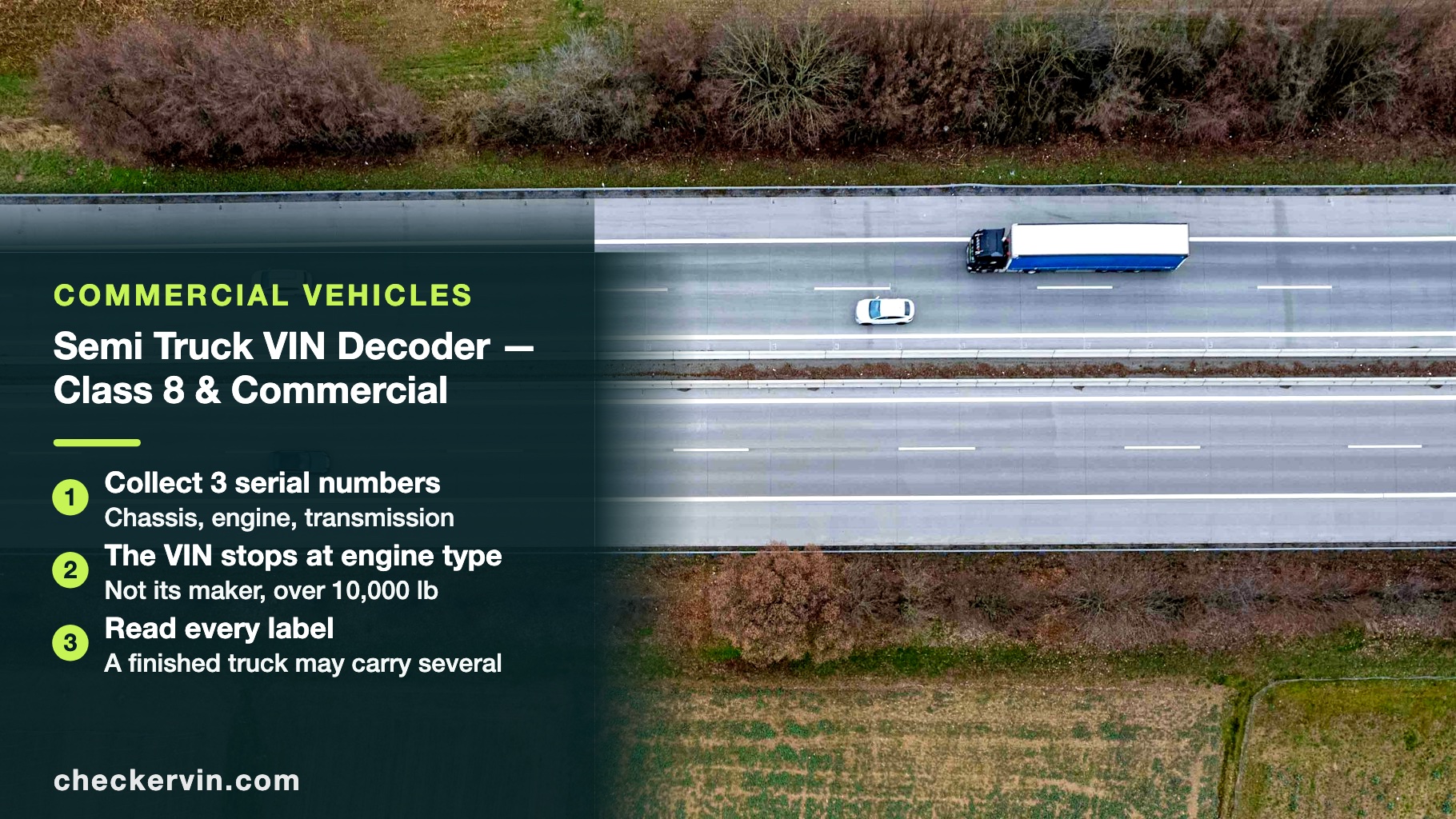
Why commercial identification works differently
A passenger car is designed and built as a single product by one manufacturer. A commercial truck is assembled from major components a buyer specifies individually — the fleet or owner-operator chooses the engine, the transmission, the axle ratio and much else, and the truck manufacturer builds a chassis around that specification.
That is why two trucks of the same make, model and year can be mechanically very different vehicles, and why the VIN alone tells you less about a semi than it does about a car.
Where the VIN is on a commercial truck
- 1The driver's door jambThe primary location on most commercial trucks. The label carries the VIN along with the weight ratings and the build date.
- 2The frame railUsually stamped on the driver's side rail, toward the front. This is the stamping that survives when labels do not.
- 3The base of the windshieldPresent on many trucks, though less consistently placed than on passenger vehicles.
- 4The paperworkTitle, registration and any apportioned plate documentation should all carry the identical number.
Full VIN location coverage across every vehicle type is on the VIN locations page, and the character-by-character breakdown is on how to read a VIN.
Three serial numbers, three histories
This is the section that matters most, and it is the part car buyers never have to think about. Collect all of these before you value a used truck.
| Component | Where its number is, and why you need it |
|---|---|
| Chassis (the VIN) | Door jamb and frame rail. The legal identity — title, registration, recalls. Tells you the make, model year and plant. |
| Engine | Stamped on the block, usually with a data plate. Unlocks the engine manufacturer's service records, rebuild history and parts catalog. Frequently a different company from the truck builder. |
| Transmission | A tag or stamping on the case. Determines ratios, parts and whether it is manual, automated manual or automatic. |
| Axles | Tags on the housings. Give you the ratio, which governs fuel economy and how the truck is geared for its work. |
Brand-specific guides go further on the identifiers each maker registers: Freightliner, Kenworth, Peterbilt and International.
The line at 10,000 pounds, and why the VIN never names the engine
It is worth being exact about the claim this page opens with, because the loose version of it is wrong. A truck’s VIN is not silent about the engine. Federal rule requires it to speak.
49 CFR § 565.15 requires the five characters at positions four through eight to identify a list of attributes, and its Table I sets that list per vehicle type. For a truck the required items are make, model or line, series, chassis, cab type, engine type, brake system and gross vehicle weight rating. Engine type is on the list. So a Class 8 VIN does have to make the engine decipherable.
The question is what “engine type” means, and § 565.12 answers it with a sentence that decides the whole matter:
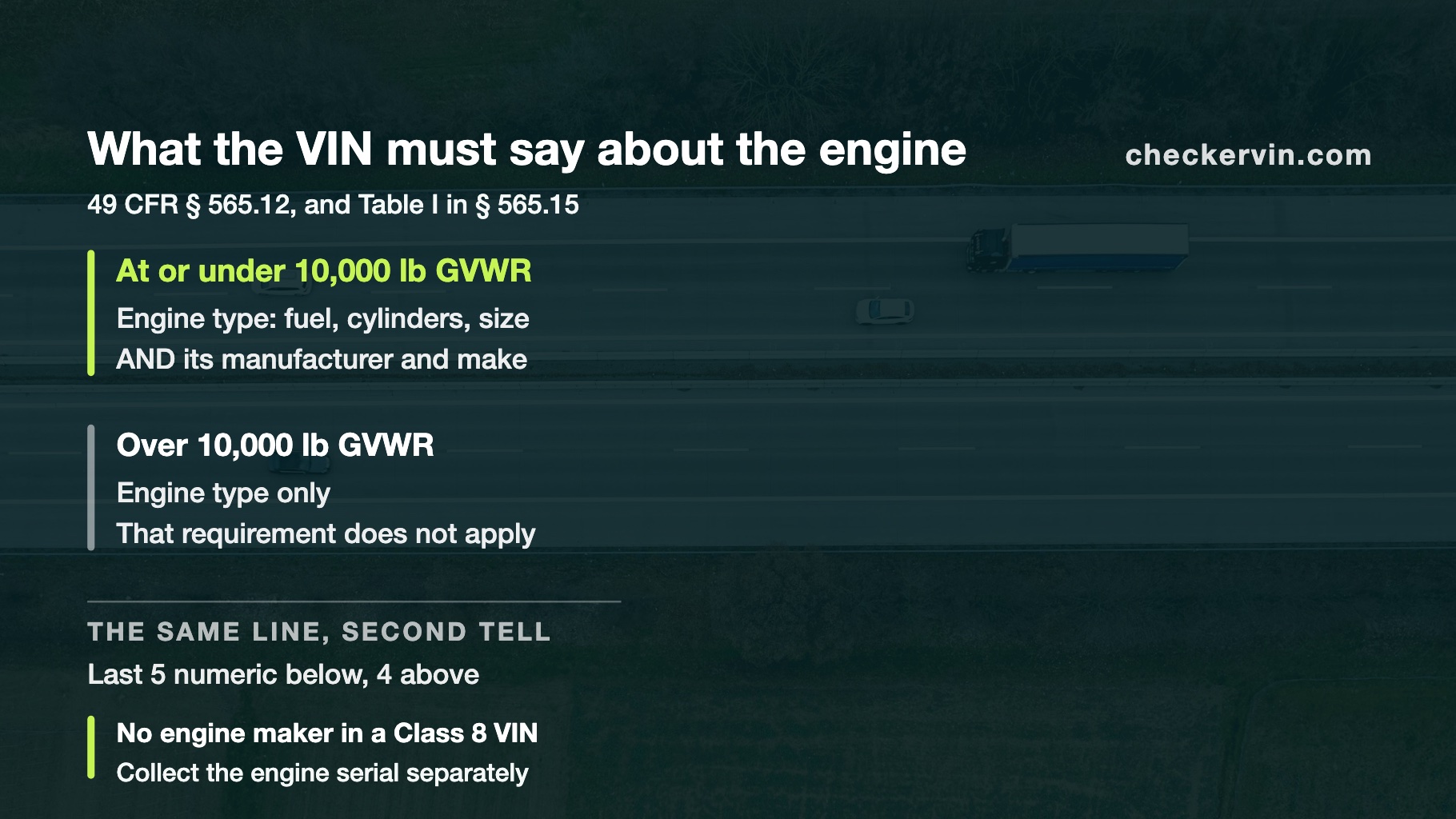
Read the second sentence carefully. The requirement to represent the engine’s specific manufacturer and makeattaches only to passenger cars, multipurpose passenger vehicles, and trucks at or below 10,000 pounds. Above that line it simply does not apply. A Class 8 tractor must encode what kind of engine it has — fuel, cylinders, displacement, output — and is under no obligation to encode whose.
That is the precise reason the engine serial matters so much on a commercial truck, and why every experienced buyer collects it separately. It is not an oversight in the VIN system and it is not manufacturers being unhelpful. The rule that puts an engine maker’s name into a VIN was written for vehicles where the chassis builder and the engine builder are usually the same company, and it stops at the weight where that stops being true.
The same weight line leaves a second, smaller mark you can check by eye. Under § 565.15(d) the last five characters of the VIN must be numeric for passenger cars and for trucks at 10,000 pounds or less, while for every other vehicle it is the last four. On a Class 8 VIN, then, position thirteen is free to be a letter where the equivalent position on a pickup could not be.
GVWR classes 1 to 8
Commercial vehicles are grouped by gross vehicle weight rating, and the class governs licensing, registration, inspection requirements and which rules apply to the operator.
| Group | What it covers |
|---|---|
| Classes 1–2 | Light duty — pickups and vans, including most consumer trucks |
| Class 3 | Light-heavy duty, the boundary where commercial rules start to apply |
| Classes 4–6 | Medium duty — box trucks, larger delivery vehicles, some buses |
| Class 7 | Heavy duty below the top tier — refuse trucks, larger city vehicles |
| Class 8 | The heaviest — tractor units and the largest straight trucks |
The GVWR is on the door jamb label, and the class follows from it. Check it against what you are licensed to drive and what your state requires to register, because both change across the class boundaries.
Incomplete vehicles and second-stage manufacturers
Many commercial vehicles leave the original manufacturer as an incomplete vehicle — a chassis and cab with no body. A second company then builds the body: a box, a tank, a dump bed, a service body, a bus, or a motorhome.
The result carries the chassis manufacturer's VIN, and a separate label from the body builder. It is the same split that governs motorhome identification, and for the same reason: two companies each built part of what you are buying.
- Expect a decode to name the chassis manufacturer, not the body builder
- Find the second-stage manufacturer's label — usually near the driver's door
- Body-side faults and recalls come from the body builder, not the chassis maker
- Parts for the body are sourced separately from chassis parts
- On a specialist body, ask whether the builder is still trading
A work truck can carry more than one certification label
The section above explains that many commercial trucks leave one factory unfinished and are completed by another. That process leaves physical evidence on the vehicle, and knowing what to expect stops a perfectly normal truck from looking suspicious.
49 CFR Part 567 governs certification labels and defines the vocabulary precisely. A chassis-cabis “an incomplete vehicle, with a completed occupant compartment, that requires only the addition of cargo-carrying, work-performing, or load-bearing components to perform its intended functions” — which is exactly what a bare cab and frame is before a body goes on it. A completed vehicleis one that “requires no further manufacturing operations to perform its intended function.” The final-stage manufacturer is whoever performs the operations that turn the first into the second.
Under § 567.5, the incomplete vehicle manufacturer or an intermediate manufacturer must permanently affix its own label to the incomplete vehicle. The rule even anticipates the awkward case: where the specified locations are not practicable, the label may travel with the incomplete vehicle document package to be affixed once the vehicle is far enough along to take it.
| Label you may find | What it is telling you |
|---|---|
| Incomplete vehicle manufacturer's label | The chassis builder's identity and the ratings it built to |
| Intermediate manufacturer's label | Someone modified the chassis between the two ends |
| Final-stage manufacturer's label | Who completed the truck, and the ratings for the finished vehicle |
| An alterer's label | The vehicle was changed after certification, before first sale |
For a buyer the practical reading is short. More than one label is normal on a vocational truck and is not evidence of anything wrong. What matters is that the ratings you plan to work to come from the label for the completed vehicle rather than the chassis that arrived at the body shop, because those two numbers are frequently different and only one of them describes the truck you are buying.
A DOT number identifies the carrier, not the truck
This confusion comes up constantly. A USDOT number is issued to a motor carrier — the business operating commercial vehicles — and it identifies that company for safety record-keeping, inspections and compliance.
It is not a vehicle identifier. One carrier number covers an entire fleet, and when a truck is sold to a different operator it runs under the buyer's number instead. Looking up a DOT number tells you about a company's safety record; it tells you nothing about the individual truck's history.
The odometer exemption on heavy trucks
The exemption has a number, and it is lower than most people assume. 49 CFR § 580.17(a)(1)provides that a transferor need not disclose the odometer reading for “a vehicle having a Gross Vehicle Weight Rating … of more than 16,000 pounds.” The reasoning is that mileage on a commercial vehicle is a less meaningful measure than engine hours and service history.
Note what the exemption is written against. The rule opens “notwithstanding the requirements of §§ 580.5 and 580.7” — the sections that require a disclosure to be made on transfer. It removes a paperwork duty. It is not a statement that the reading on a heavy truck does not matter, and it does not license anyone to alter one; the federal prohibitions on tampering sit elsewhere and are not what this section suspends. The practical effect is narrower than it sounds: you lose the documentary trail, not the relevance of the number.
Set that against the class table above and the reach becomes clear. Sixteen thousand pounds is Class 4 and 5 territory — a medium-duty box truck, a large delivery vehicle, a chassis cab with a service body. The exemption does not begin at Class 8, or at anything most people would call a semi. It begins far down the range, which means a great many trucks that look like oversized vans are sold with no odometer statement at all, and their buyers are usually working from car habits.
The practical consequence for a buyer is that heavy truck mileage carries less documentary backing than car mileage does. You cannot lean on the disclosure trail the way you would on a passenger vehicle — how odometer disclosure works covers the rules that do apply.
- Ask for engine electronic data, which records hours and often idle time
- Idle hours matter as much as road miles on an engine's wear
- Collect service invoices, which record mileage at each visit
- Ask when the engine was last overhauled and by whom
- Treat a mileage figure with no supporting records as an estimate
Glider kits
A glider is a new chassis, cab and frame assembled with a remanufactured or used powertrain rather than a new engine. The finished truck is titled as a new vehicle with its own VIN, while the drivetrain carries prior service life.
That is not inherently a problem, and gliders were built for legitimate commercial reasons. But it means the vehicle's age tells you nothing about the engine's age, and it is exactly the situation where the engine serial and its records matter more than the VIN.
Recalls on commercial vehicles
Commercial trucks fall under NHTSA like passenger vehicles, and recalls are searchable by VIN through the same free lookup. The manufacturer must perform the remedy at no cost to the owner.
The wrinkle is the same as everywhere else in commercial identification: chassis recalls come from the truck manufacturer, while engine recalls come from the engine manufacturer and body recalls from the body builder. Check the VIN, then check with the engine maker separately using the engine serial.
Buying a used commercial truck
- 1Collect all four numbers firstChassis VIN, engine serial, transmission serial, axle tags. Photograph each.
- 2Decode the VIN for the chassisMake, model year, plant, weight rating. This is the identity, not the specification.
- 3Pull the engine's service history with its serialRebuild history, hours and any outstanding campaigns. This is where the money is.
- 4Check the axle ratio against the intended workGearing suited to one kind of haul is wrong for another, and it is expensive to change.
- 5Run the free recall check on the VINThen ask the engine manufacturer separately about engine campaigns.
- 6Ask about idle hours, not just milesEngine electronics record them, and heavy idling ages an engine without adding distance.
- 7Have it inspected by a commercial specialistFrame condition, fifth wheel, brakes and emissions systems are outside a car mechanic's scope.
Where this information comes from
Keep reading
Frequently asked questions
Do semi trucks have VINs?
Yes. Class 8 tractors carry standard 17-character VINs under the same federal standard as cars, and they decode in the same public databases. What differs is how much of the truck the VIN actually describes.
Does the VIN tell me which engine a semi has?
Often not usefully. Commercial trucks are frequently built with engines from a separate manufacturer, and that engine carries its own serial number on the block. The engine, transmission and axles are specified independently and identified independently.
Is a DOT number the same as a VIN?
No, and this is a common confusion. A USDOT number identifies the motor carrier — the company operating the vehicle — not the truck itself. One carrier's number covers its whole fleet, and it changes if the truck is sold to a different operator.
Are heavy trucks exempt from odometer disclosure?
Vehicles above a defined weight rating are exempt from the federal odometer disclosure requirement. That means mileage on a heavy truck is not backed by the same paperwork trail as on a car, so service records and engine data matter more.
What is a glider kit?
A new chassis, cab and frame assembled with a remanufactured or used powertrain rather than a new engine. The truck carries a VIN as a new vehicle while the drivetrain has prior service life — which is why establishing the engine's history separately matters.
Start with the chassis VIN
Decode any commercial truck VIN free for the make, model year, weight rating and open safety recalls. No account.
Run a free VIN check