The short answer
- Is there a standard report?
- No. The obligations sit on the data suppliers — states, insurers, salvage yards — not on the report itself.
- What is always underneath?
- State title records sent every 24 hours, plus monthly junk and salvage reports from insurers and yards.
- What is never in one?
- Structural measurements, restraint-system condition, and any damage that never generated a record.
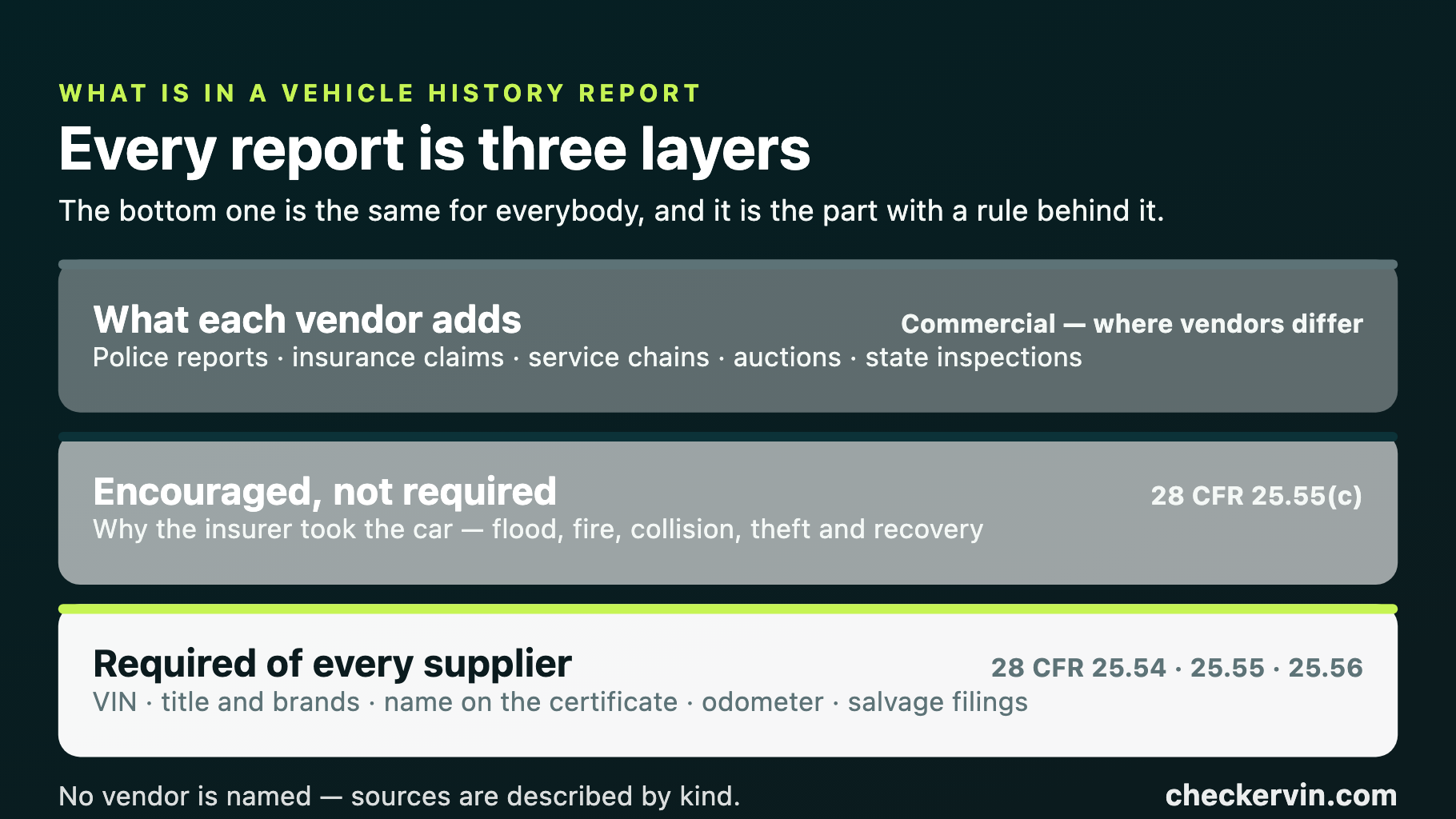
24 hours
How often states report
Titling information, 28 CFR 25.54
Monthly
Insurer and yard filings
Junk and salvage inventories
Encouraged
The reason for a total loss
Not required of carriers
None
Required report contents
The duty is on the suppliers
There is no single report
The phrase behaves like a product name, which is why people ask which one is right. It is closer to a category like “insurance policy” — a description of a kind of thing that several companies sell in different shapes.
No law defines what a vehicle history report must contain. There is no minimum contents list, no certification, and no standard format. What the law does is oblige certain parties to report certain things into certain systems. Everything a vendor sells is downstream of those obligations plus whatever commercial data it has arranged for itself.
That has a practical consequence worth holding on to: when two reports disagree, neither is necessarily wrong or defective. They are different assemblies of overlapping sources.
Why the federal record exists at all
The foundation under every commercial report is a federal system, and the regulation creating it says what it is for. Under 28 CFR 25.51, NMVTIS implements 49 U.S.C. 30502, and its stated purposes are worth reading because they explain the shape of the data.
- To prevent the introduction or reintroduction of stolen motor vehicles into interstate commerce
- To protect states and individual and commercial consumers from fraud
- To reduce the use of stolen vehicles for illicit purposes, including fundraising for criminal enterprises
- To provide consumer protection from unsafe vehicles
Notice that only the last of those is about the car you are buying being any good. The system was built primarily against vehicle theft and title fraud, and consumer protection rides along with it.
What sits underneath all of them
Three federal reporting duties feed the foundation, and they are worth knowing individually because they have different scopes and different holes.
| Who reports, and how often | What they must send |
|---|---|
| Every state, once every 24 hours | Titling information for all automobiles it maintains: the VIN; any description on the certificate of title including any and all brands; the name of the individual or entity the certificate was issued to; junk and salvage acquisition information if the state collects it; and the odometer disclosure required by federal law on the date the title was issued. |
| Insurance carriers, monthly | An inventory of automobiles of the current model year or any of the four prior model years that the carrier obtained and decided were junk or salvage — including any it determined to be a total loss under state law or its own policies. |
| Junk yards, salvage yards and auto recyclers, monthly | An inventory of the junk or salvage automobiles obtained in the prior month, with a supplemental report of final disposition where that was not known at first filing. |
Those three streams are the common inheritance of every report on the market. Our NMVTIS guide covers the federal record they feed and how to buy it directly.
Mandatory, optional, and absent
This is the distinction that makes reports readable, and almost nobody draws it. Within the mandated data there are things a supplier must send, things they are merely encouraged to send, and things nobody is asked for at all.
- Mandatory: the VIN, the title description and its brands, the name on the certificate, the odometer disclosure at issuance
- Mandatory: that an insurer took a vehicle as junk or salvage, within a five-model-year window
- Encouraged but not required: why the insurer took it — flood, fire, collision, or theft and recovery
- Not collected at all: any assessment of the structure, the restraints, or the quality of a repair
Two boundaries narrow the mandated layer further. The insurer duty covers the current model year and the four prior model years, so an older car totaled by a carrier falls outside it. And individuals or entities handling fewer than five salvage, junk or total-loss vehicles a year are outside the salvage-yard requirement entirely.
Junk and salvage are defined terms, and the difference matters
Reports use both words and readers treat them as synonyms for “wrecked”. The regulation defines each one precisely, and the definitions decide what gets reported.
| Term | What 28 CFR 25.52 says |
|---|---|
| Junk automobile | An automobile that is incapable of operating on public streets, roads and highways AND has no value except as a source of parts or scrap |
| Salvage automobile | An automobile designated a total loss by an insurer under the terms of its policies |
Two things follow. A junk automobile has to fail bothlimbs — not driveable and worth nothing but parts or scrap — so a damaged car that still runs is not a junk automobile however bad it looks.
And the salvage definition carries a clause most buyers never hear: a vehicle is a salvage automobile when an insurer designates it a total loss regardless of whether or not the ownership of the vehicle is transferred to the insurance carrier.
Who counts as a salvage yard, and why auction records surface
People are often surprised to see auction entries in a report and assume a vendor bought them from a private source. Frequently the duty reaches them directly, because the regulation defines a salvage yard far more broadly than the phrase suggests.
A note to the definition sweeps in vehicle remarketers and vehicle recyclers, scrap vehicle shredders and scrap metal processors, pull-apart and pick-apart yards, salvage pools, salvage auctions, and other types of auctions handling salvage or junk vehicles, including vehicles declared a total loss.
The verb is broad too. The regulation defines acquiring as owning, possessing, handling, directing, or controlling. That is written to catch an operator who never takes title and merely moves vehicles through, which is exactly how a salvage pool works.
| What people picture | What the definition actually covers |
|---|---|
| A yard full of wrecks | That, plus salvage pools and salvage auctions |
| Businesses that buy cars | Plus anyone owning, possessing, handling, directing or controlling them |
| Scrapyards | Plus shredders, scrap metal processors and pick-apart yards |
| Total losses | Plus junk automobiles obtained in whole or in part |
What a state actually has to send, and how often
The state stream is the backbone of the whole system and its cadence is fixed rather than best-effort. Under 28 CFR 25.54, each state must provide titling information for all automobiles it maintains once every 24 hours.
The contents are specified too, and one item does more work than the rest.
| Required element | Why it matters to you |
|---|---|
| The VIN | The key everything else is filed against |
| Any description on the certificate of title, including any and all brands | This is where salvage, flood, rebuilt and the state's own brands travel |
| The name of the individual or entity the certificate was issued to | How a chain of title is reconstructed |
| Information from junk or salvage operators or insurers regarding acquisition | The link between the title record and the loss record |
“Any and all brands” is the phrase to hold on to. It is why a brand applied in one state is visible to the next, and it is the mechanism title washing has to defeat in order to work.
Your access to it is written into the rule
One provision is worth knowing simply because it tells you the consumer was designed in rather than tolerated. Under 28 CFR 25.53, the operator of NMVTIS must make information available to participating states on request, to government and law enforcement officials on request, and to a prospective purchaser of an automobile, on request of that purchaser.
So a buyer asking for the federal record on a specific vehicle is exercising something the regulation contemplates by name. That is a different position from asking a commercial vendor for a favor, and it is the legal footing under the approved-provider market.
Where the rest of it comes from
Everything else in a commercial report — and it is often most of the visible content — comes from sources with no federal obligation behind them.
| Source | What it adds, and its limit |
|---|---|
| Police accident reports | Real accident records where the vendor has a relationship with the jurisdiction. Coverage is uneven, and a collision with no police involvement produces nothing. |
| Insurance claim data | Claims from participating carriers. A repair paid privately to avoid a premium increase is invisible. |
| Service and repair chains | Maintenance visits at businesses that share data. An independent mechanic who keeps paper records contributes nothing. |
| Auctions and dealer systems | Sale events and sometimes condition data. Our auction guide covers what the salvage listings themselves show. |
| State inspection and emissions programs | Dated mileage readings in states that run them, which is genuinely valuable for checking an odometer series. |
| Manufacturer and recall data | Open safety recalls, which NHTSA also publishes free by VIN, so this is rarely a reason to pay. |
Every one of these is a commercial arrangement rather than a duty, which is why coverage differs between vendors and between regions. Our comparison of the alternatives covers who tends to have what.
Why two reports disagree
Once the layers are clear the disagreements stop being mysterious, and they fall into three kinds.
- 1Different top layersOne vendor has a feed the other does not — a police jurisdiction, a service chain, an auction. Both are accurate about what they can see.
- 2Different interpretations of the same eventsOwner counts are the clearest case: the underlying data is title issuances, and each vendor decides which of those represent a new owner.
- 3Different timingState title data moves daily and the other duties are monthly, so two reports pulled two weeks apart can legitimately differ on a recent event.
Our previous owners guide works through the second case in detail, because it is the one people most often mistake for an error.
What a report answers well
Used for what it is good at, a report is genuinely valuable, and it is worth being specific rather than vague about that.
- Whether a title brand was ever applied, and in which state — the strongest thing in the whole product
- Whether an insurer reported the vehicle as junk, salvage or a total loss within the reporting window
- The sequence of states the car has been titled in, and roughly when it moved
- Dated odometer readings captured at title issuance and at inspections, which is what makes a rollback visible
- Whether it was reported stolen, where the vendor has that feed
Notice that four of those five come from the mandated layer. The foundation is the reliable part, and it is also the part you can buy directly and cheaply through an approved NMVTIS provider.
What no report can tell you
The limits are structural rather than a matter of paying more, and they are the reason a report is a starting point rather than a verdict.
| What it cannot establish | Why not |
|---|---|
| Whether the structure is straight | Nobody is required to measure a repaired car or to publish a measurement, so no feed exists to carry it. Only a measuring shop can answer this. |
| Whether the restraint system works | Airbag condition after a deployment is not reported anywhere. It takes a scan of the restraint module. |
| Damage that never generated a record | A collision repaired privately with no claim leaves nothing for any vendor to find, however much you pay. |
| How well any repair was done | No system captures repair quality. Even a state rebuilt process is generally about identity and parts rather than workmanship. |
| Who owned it | Owner names are personal information in a motor vehicle record and are restricted by federal privacy law. |
Each of those has a page of its own — frame damage, airbag deployment, rebuilt inspections and motor vehicle records — because each is a real gap rather than a caveat.
Choosing a route
The sensible order runs cheapest and most reliable first, which is the opposite of how the market is usually presented to you.
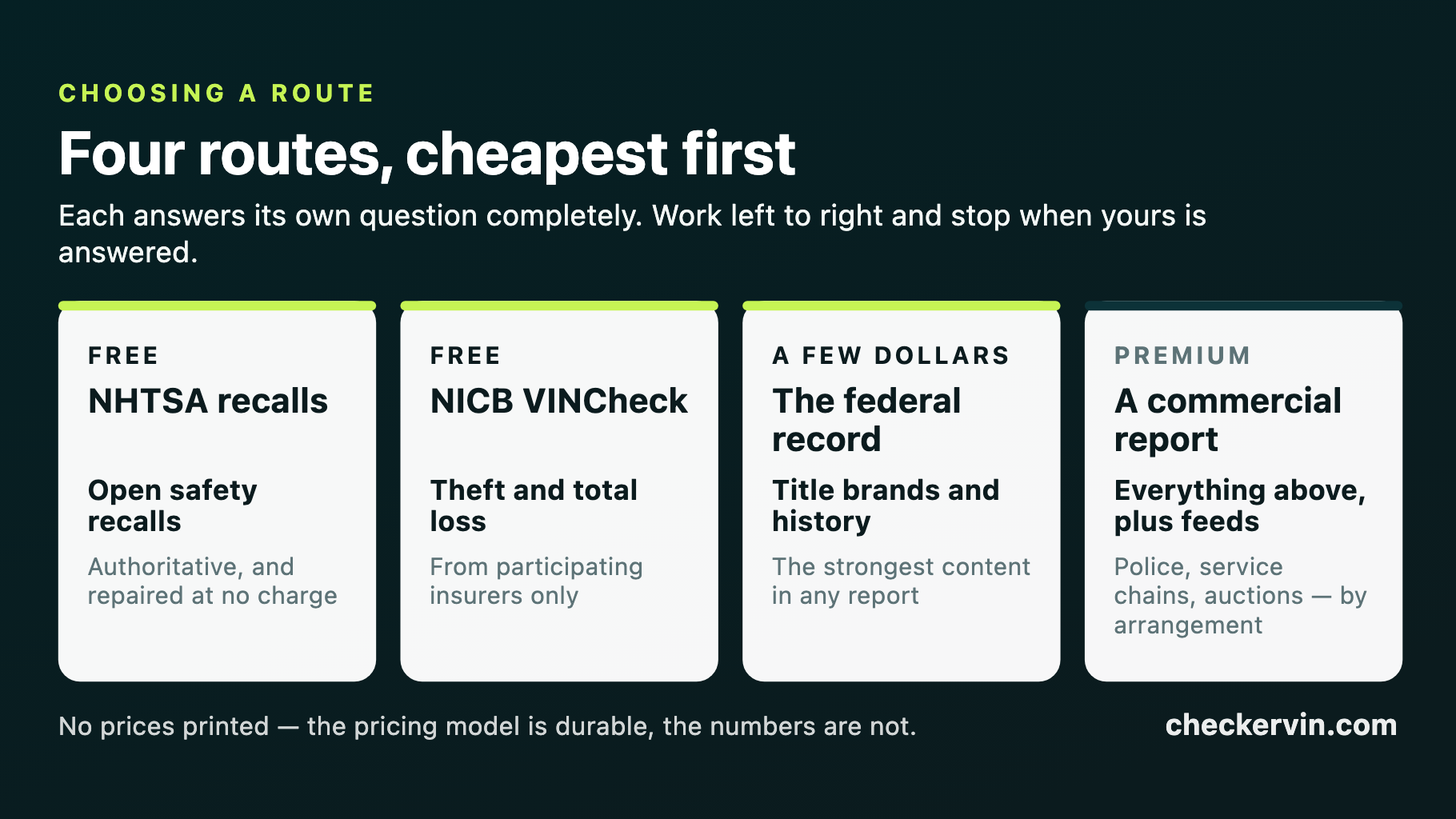
Which of these you need depends on the question you actually have. If you want to know whether a car was ever branded, the federal record is the authoritative answer and the premium report is repeating it. If you want service history on a car maintained at a national chain, that is the top layer and only a commercial report has it.
Our guides to what is genuinely free and what a report costs cover the money side in detail; this page is about matching the route to the question.
Where your state comes in
One more variable decides how much a report can tell you, and it is not the vendor. It is which state the car has lived in.
States differ in what they brand, at what threshold, and with what vocabulary. A car damaged at 70 percent of its value is branded in some states and not others. Some states brand hail damage and at least one excludes a paid hail claim from salvage entirely. Some gate branding by vehicle age. All of that decides whether there was ever a brand for a report to carry.
- Our total loss threshold guide covers why the same wreck is branded in one state and not another
- Our title washing guide covers what happens to a brand when a car crosses a state line
- Each state has its own VIN check page here with that state's rules and lookup routes
Start with the thresholds, then read the state the car was titled in — Texas, California, Florida, New York and the rest each have their own page.
Reading a report you already have
If you are holding one, read it in a specific order rather than top to bottom, because the layers are not equally reliable.
- 1Title brands and the state sequence firstThis is the mandated layer and the strongest content in the document. A brand, or a state appearing once with no other connection to the car, is the finding.
- 2The odometer series nextReadings are captured at title issuance and at inspections. Put them in date order and confirm the series only climbs.
- 3Total-loss and salvage reports thirdRemember the five-model-year insurer window and the small-operator exemption before treating silence as clearance.
- 4Then the commercial layer, with lighter weightAccidents, service and auction events are real when present and prove nothing when absent, because coverage is a commercial arrangement.
- 5Then stop reading and go look at the carEverything the report cannot establish is physical, and all of it is checkable in an hour with a shop.
What a clean report proves
Less than it feels like, and the reason is now easy to state precisely rather than as a general warning.
A clean report means no participating source reported anything. It does not mean no state would have branded the car, because thresholds and age gates differ. It does not mean no insurer took it, because the duty has a model-year boundary. It does not mean no damage occurred, because a private repair generates nothing anywhere. And it says nothing at all about the structure or the restraints, because no feed carries those.
The check sequence
Decode the VIN free for the factory build and specifications. Check open recalls through NHTSA at no cost. Screen for theft and total-loss records through the NICB, also free. Buy the federal NMVTIS record from an approved provider for title brands. Add a commercial report only if you need its top layer for this particular car. Search the auction archives for pre-repair photographs. Then inspect the vehicle and scan the restraint module.
Where this information comes from
- 28 CFR 25.54 — responsibilities of the StatesThe five elements of titling information every state must send once every 24 hours
- 28 CFR 25.55 — responsibilities of insurance carriersThe monthly junk and salvage inventory, its five-model-year window, and the reason for the loss being encouraged rather than required
- 28 CFR 25.56 — junk yards, salvage yards and auto recyclersThe monthly inventory duty, the final-disposition supplement, and the exemption below five vehicles a year
- NMVTIS — official vehicle history recordThe federal record these duties feed, and the list of approved consumer access providers
- FTC — used cars, consumer adviceThe federal consumer guidance on buying used, including getting a history report before you buy
- NICB — VINCheckFree screen for theft and total-loss records reported by participating insurers
Keep reading
Frequently asked questions
Does a total loss still get reported if I keep the car?
Yes. 28 CFR 25.52 defines a salvage automobile as one designated a total loss by an insurer under the terms of its policies, regardless of whether or not the ownership of the vehicle is transferred to the insurance carrier. An owner-retained buyback is still a total loss for reporting purposes.
Why do salvage auction records show up in a history report?
Often because the duty reaches the auction directly. The regulation's salvage yard definition expressly covers salvage pools, salvage auctions, vehicle remarketers, recyclers, shredders, scrap metal processors and pick-apart yards, and it defines acquiring as owning, possessing, handling, directing or controlling a vehicle.
Am I entitled to the federal record as a buyer?
The rule contemplates you by name. 28 CFR 25.53 requires the operator of NMVTIS to make information about an automobile available to a prospective purchaser on that purchaser's request. Access runs through approved providers and they charge, but the entitlement of a buyer to this information is written into the regulation.
What is a vehicle history report?
It is a category of product rather than a single document. Every version is built on the same foundation — state title records, insurer reports of junk and salvage vehicles, and reports from junk yards, salvage yards and auto recyclers — and each vendor then adds whatever else it has been able to buy or collect. That is why the reports overlap heavily and still differ.
What has to be in a vehicle history report?
Nothing, as a matter of law — the obligations sit on the data suppliers, not on the report. Federal rules require states to send title information every 24 hours, insurance carriers to file monthly inventories of junk and salvage automobiles, and salvage operators to report vehicles they obtain. What any vendor does with that, and what else they add, is a commercial decision.
Do vehicle history reports show accidents?
They show accidents that were reported to a source the vendor has access to — a police report, an insurance claim, a repair chain that shares data. A collision repaired privately, with no claim, generates no record for any report to carry. Absence of an accident line is not evidence there was no accident.
Which vehicle history report is the most accurate?
The question does not have a single answer, because they draw on overlapping but different sources. A better approach is to buy the federal NMVTIS record for title brands and total-loss reports, use the free NICB screen for theft, and then decide whether a commercial report's extra sources are worth it for the specific car in front of you.
Does CheckerVIN provide a vehicle history report?
Not today. Our free lookup returns the factory build, specifications and open safety recalls. Accident, title and odometer history are launching soon. This page is written to help you pick the route that works right now, which for most buyers means the federal record plus a free theft screen.
Start with the VIN
Decode any VIN free for the factory build, specifications and open safety recalls. No account, no card.
Run a free VIN check