The short answer
- How do you check a car's history in Florida?
- Run the free national checks first — VIN decode, NHTSA recalls, NICB theft and salvage. Then check Florida's own title record through the FLHSMV motor vehicle information lookup, and the national NMVTIS record for brands other states applied. Finish with a physical flood inspection, which matters more in Florida than anywhere.
- Can you look up a license plate in Florida?
- Private individuals cannot look up an owner from a plate — the federal Driver's Privacy Protection Act restricts it to permitted uses like law enforcement and insurers. What you can do is get the VIN from the seller and check that instead, which is also the more informative route.
- What is the Florida-specific risk?
- Water. Hurricane flooding, coastal storm surge and salt air produce more flood and corrosion damage than most states see, and a meaningful share of it never generates an insurance claim — so it appears on no report and is found only by inspection.
FLHSMV
Florida's motor vehicle agency
Runs its own free lookup
Flood
The Florida-specific risk
Often uninsured, unrecorded
DPPA
Why plate lookups are restricted
Federal privacy law
72 hrs
Before a car can be exported
19 CFR 192.2(c), title in hand
Why Florida is different
Every state has flood cars. Florida has them at scale, and it has them in a form that is hard to detect: warm weather dries interiors fast, salt air makes some corrosion look ordinary, and a large share of storm-damaged vehicles are never claimed against insurance — the owner dries them out and sells.
Add one of the country's biggest used markets, heavy in private sales and recently-arrived vehicles, and the ordinary checklist needs a Florida weighting: the title checks matter, and the physical flood inspection matters more.
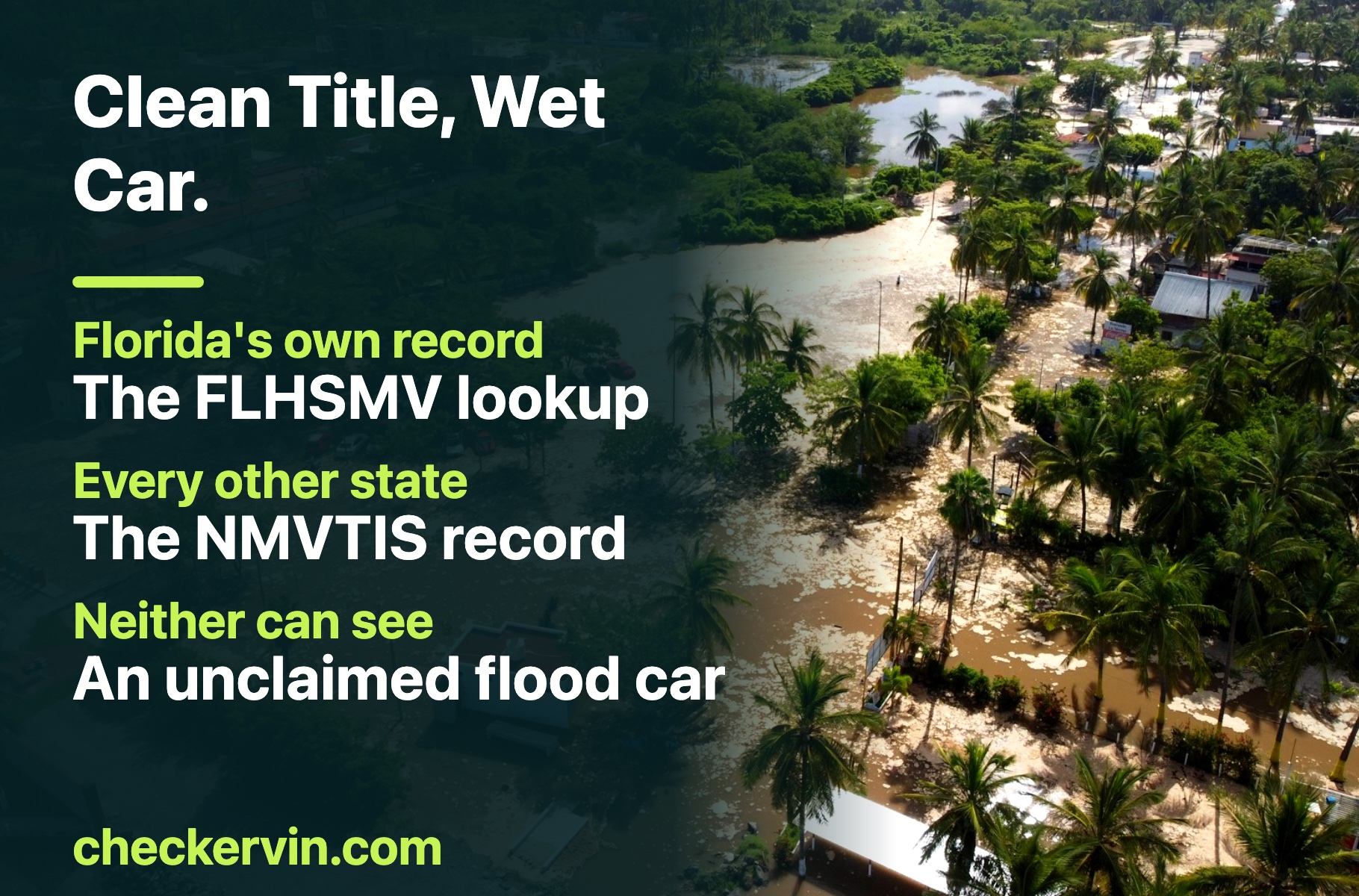
The state’s own lookup, which most buyers never use
Florida's Department of Highway Safety and Motor Vehicles — FLHSMV, the state's equivalent of a DMV — provides an online motor vehicle information lookup. Enter a VIN and it returns the status of a Florida title: whether one exists, and what the state has recorded against it.
- 1Get the VIN from the vehicleWindshield plate and door jamb, checked against each other and the title the seller shows you.
- 2Run the FLHSMV lookupIt shows Florida's own record for that VIN — title status and state-recorded information.
- 3Remember what it cannot seeIt covers Florida's records. A car titled in Georgia last year has its history there, which is what the national NMVTIS check is for.
Flood cars: the risk that defines Florida buying
A flooded car can be totaled and branded, in which case the title record shows it. Or it can be dried, cleaned and sold with no claim ever filed — in which case every report on earth comes back clean, and only the car itself tells the story.
- Silt or sand in the spare wheel well, under carpets and inside seat rails
- Corrosion on connectors and unpainted metal under the dashboard
- A water line or fogging inside headlight and taillight housings
- Musty smell, or an air freshener working suspiciously hard
- Carpet or upholstery newer than the rest of the interior
- Electrical faults that come and go — the signature of water in connectors
- Rust on seat mounting bolts, which nobody thinks to clean
Buying in the months after a hurricane
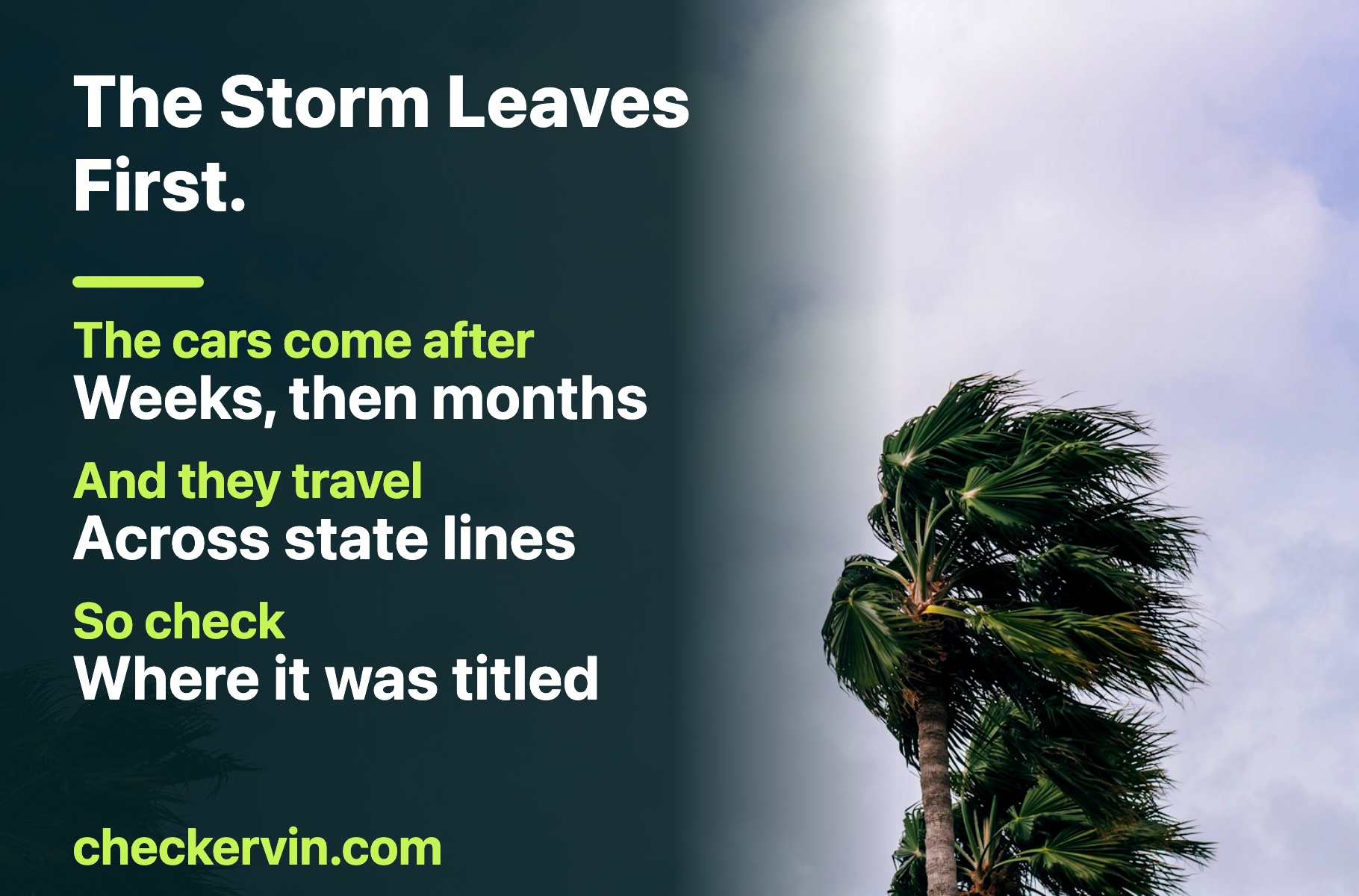
Flood cars enter the market in waves, starting a few weeks after a storm and continuing for a year or more as they move through auctions and across state lines. After a major hurricane, that pattern is national — but it is most concentrated close to the landfall.
- Be more skeptical of freshly detailed cars at below-market prices
- Check where the car was titled and registered during the storm months
- Treat a title that moved states right after a hurricane as a question
- Ask the seller directly whether the car was in the affected area, in writing
- Weight the physical inspection even more heavily than usual
- Run the NICB check — insurers do report the cars that were claimed
Plate lookups are a federal question
Florida plate searches hit the same wall as everywhere: the Driver's Privacy Protection Act keeps registered-owner identities out of consumer hands, sunshine laws notwithstanding. The full legal picture is on the license plate lookup guide — in a sale, the VIN is the number to ask for.
Florida title brands to know
| Brand | What it means in Florida |
|---|---|
| Salvage | Declared a total loss. Florida distinguishes rebuildable salvage from certificates of destruction — the latter can never return to the road. |
| Rebuilt | A former salvage vehicle repaired and passed the state inspection. Legal to drive, permanently branded. |
| Flood | Water-damaged. The brand matters, and its absence proves less in Florida than anywhere — unclaimed flood cars carry clean titles. |
| Certificate of destruction | The terminal designation. A vehicle carrying one cannot legally be retitled for road use — parts and scrap only. |
The full national picture — how brands travel between states and why they never come off — is on the branded title guide.
The full Florida check sequence
- 1Decode the VIN — freeConfirm the car is what the listing says before anything else.
- 2Run the recall check — freeOpen recalls are free to fix and worth knowing before you negotiate.
- 3Run the NICB theft and salvage check — freeFive searches a day, covers participating insurers.
- 4Run the FLHSMV lookup — freeFlorida's own record for the VIN: title status and what the state holds.
- 5Pull the national title record — a few dollarsAn NMVTIS approved provider shows brands from every reporting state, which catches cars that arrived from elsewhere.
- 6Inspect for water, thoroughlyThis is the step that catches what no record shows. In Florida, do not skip it on any car.
Private sales in Florida
Florida's private market is enormous, and private sales carry none of the dealer obligations. The checks above are yours to run, and two Florida-specific habits are worth adding.
- Meet at the tax collector's office to transfer the title — Florida titles are transferred there, and it protects both parties
- Confirm the seller's name matches the title exactly before money moves
- Check both VIN locations against the title, character for character
- Be wary of a title reissued very recently, which can follow a wash or a flood
- Get a bill of sale with the VIN, price, date and both parties' details
Cars that arrived from other states
A large share of Florida's used inventory arrived from elsewhere — snowbird cars, auction vehicles, and stock moved south to a strong market. The Florida record for those cars starts at the border.
That is exactly the situation the national checks exist for: the NMVTIS record carries brands from every reporting state, and the NICB check covers insurer reports nationally. A rust-belt car can also bring corrosion problems Florida rarely produces — check the underbody on anything that spent winters north.
The export lane, and what a seller has to prove to leave
Florida buyers are shopping in a market with an exit. A large share of American used vehicles leave the country through seaports, and Florida has several of the busiest. That matters to a private buyer for a reason that has nothing to do with patriotism and everything to do with paperwork: federal law puts a documentary checkpoint between a used vehicle and the boat, and the shape of that checkpoint tells you which documents actually carry weight.
The rule is 19 CFR Part 192, administered by U.S. Customs and Border Protection. Section 192.2(a) requires a person exporting a used self-propelled vehicle to present to Customs, at the port of exportation, both the vehicle itself and documentation describing it — documentation that must include the Vehicle Identification Number, or the product identification number if the vehicle has no VIN.
The definitions in 192.1 are worth reading, because they are broader than people assume. A “self-propelled vehicle” covers automobiles, trucks, tractors, buses, motorcycles, motor homes, and self-propelled agricultural, construction and special-use equipment — anything designed to run on land but not on rail. And “used” has a precise meaning: a vehicle whose equitable or legal title has been transferred by a manufacturer, distributor or dealer to an ultimate purchaser. The moment a car is genuinely sold to someone who is not buying it to resell, it is “used” for this purpose, however new it looks.
Section 192.2(b)(1)(i) sets out what a U.S.-titled vehicle needs: the original Certificate of Title, or a certified copy, plus two complete copies of it. A Salvage Title that remains in force counts here too — the rule names it explicitly alongside the ordinary certificate.
The timing in 192.2(c) is the part most people never hear about. For vehicles leaving by vessel or aircraft, both the documentation and the vehicle must be presented to Customs at least 72 hours before export. For vehicles leaving by rail, highway or under their own power, the documentation goes in 72 hours ahead and the vehicle is presented at the time of export.
There is also a step that explains why an original document matters more than a good photocopy. Under 192.2(e), Customs itself determines whether the documents submitted are authentic, and once satisfied, marks them. In most cases the originals are handed back to the exporter. Where an original title was presented and retained and then cannot be found before the vehicle sails, the rule says the exporter's authenticated copy stands as evidence that the reporting requirements were met. Section 192.2(d) adds that port directors set and publicize the locations and hours where all of this happens.
The practical lesson for a Florida buyer is that a document becomes trustworthy when an authority has examined it and left a mark on it — not when it looks official. That is the same instinct that should make you want to see a title in person, at the tax collector's office, rather than a photograph of one on a phone.
Liens, and the letter the lienholder has to write
A lien is the quiet risk in a private sale, and Florida's large private market makes it a live one. The export rule handles the same problem, and the way it handles it is instructive.
Under 192.2(b)(1)(ii), if the vehicle is leased or carries a recorded lien in the United States, the original title is not enough. The person exporting it must also give Customs a separate writing from the third party with the interest — the lienholder or lessor — expressly stating that the vehicle may be exported. The rule specifies the form in unusual detail: it must be on the third party's letterhead, contain a complete description of the vehicle including the VIN, name the owner or lienholder, give telephone numbers at which they can be reached, carry an original signature, and state the date it was signed.
Read that as a checklist rather than as customs procedure and it becomes a good private buyer's standard. A lienholder's release that names the VIN, is signed, is dated, and gives you a number you can call is the thing the federal government asks for before it will let a financed car leave. It is not an unreasonable thing to want before you hand over cash for one.
- The release names the vehicle by VIN, not just by make and model
- It identifies the lienholder and gives a number you can actually call
- It carries an original signature, not a photocopy of one
- It is dated, and the date is recent
- You called the number yourself rather than trusting the letterhead
Why the federal rule cares that the VIN is intact
There is one more part of the export rule that belongs on a page about checking a VIN, because it says plainly what the VIN is for.
Section 192.3 sets the penalties. Attempting to export a vehicle without meeting the requirements, or having done so, carries a $500 penalty each. But 192.3(c) is different in kind: a penalty of up to $10,000 may be assessed against anyone who knowingly imports or exports, or attempts to, either a stolen self-propelled vehicle, vessel, aircraft or part of one — or any vehicle or part from which the identification number has been removed, obliterated, tampered with, or altered.
Those four verbs are the point. The federal penalty schedule treats a missing or altered identification number as belonging in the same paragraph as theft, at twenty times the penalty for ordinary paperwork failure. Section 192.3(d) goes further: such a vehicle, or a part of one, may be seized and forfeited under 19 U.S.C. 1627a.
So when a VIN plate looks disturbed — rivets that do not match, a plate sitting proud of the dash, a door-jamb label with the wrong typeface or a cut edge — you are not being fussy by walking away. You are applying the same test the government applies at the dock, and treating the physical VIN as evidence rather than as a label. Check both locations against each other and against the title, character for character, on every car you look at.
Where this information comes from
- 19 CFR 192.2 — requirements for exportationThe VIN, the original title plus two copies, the lienholder letter, and the 72-hour rule
- 19 CFR 192.3 — penalties$500 for paperwork; up to $10,000 where an identification number has been removed or altered
- FLHSMV — Florida Highway Safety and Motor VehiclesFlorida's motor vehicle agency, including its motor vehicle information lookup
- NMVTIS — National Motor Vehicle Title Information SystemThe national title record, covering brands from every reporting state
- NICB VINCheckFree theft and salvage lookup — flood cars that were claimed appear here
- NHTSA recall lookupFree open-recall check by VIN
Keep reading
Frequently asked questions
How do I check a VIN in Florida?
Start with the free checks that work everywhere — a VIN decode, the NHTSA recall lookup and the NICB theft and salvage search — then use Florida's own motor vehicle information lookup through FLHSMV to see the state's title record. For brands reported nationally, an NMVTIS approved provider covers what other states recorded.
Does Florida have a free title check?
Florida's Department of Highway Safety and Motor Vehicles provides an online motor vehicle information lookup where you can check a Florida title's status by VIN. It covers what Florida has on record, which is why it pairs with a national NMVTIS check rather than replacing it.
Can I look up a license plate owner in Florida?
Not as a private individual. The federal Driver's Privacy Protection Act restricts personal information in motor vehicle records to specific permitted uses, and curiosity about another driver is not one of them. Sites promising free plate-to-owner lookups are the thing to be skeptical of.
How do I know if a Florida car is a flood car?
Check the title record for flood and salvage brands, then inspect regardless — many flood cars never generate a claim and carry clean titles. Silt in the spare wheel well, corrosion on connectors, water lines inside light housings and musty carpet are the physical evidence.
Should I be extra careful buying a used car in Florida?
Careful in a specific way. Florida's combination of hurricanes, coastal salt air and a very large used market means flood and corrosion damage are more common than in most states. The checks are the same as anywhere — the flood inspection just carries more weight here.
Check a Florida car before the deposit
Decode any VIN free for the factory build, specifications and open safety recalls. No account, no card.
Run a free VIN check