The short answer
- What makes an auction record worth finding?
- Photographs taken before any repair, plus a damage descriptor and the price paid. No history report describes the damage that concretely.
- Can I find it free?
- Frequently. Several archives of Copart and IAA lot listings are searchable by VIN at no cost, because the listings were public while live.
- Does CheckerVIN return it?
- No. We return the factory build, specifications and open recalls. This page points you at the routes that do work today.
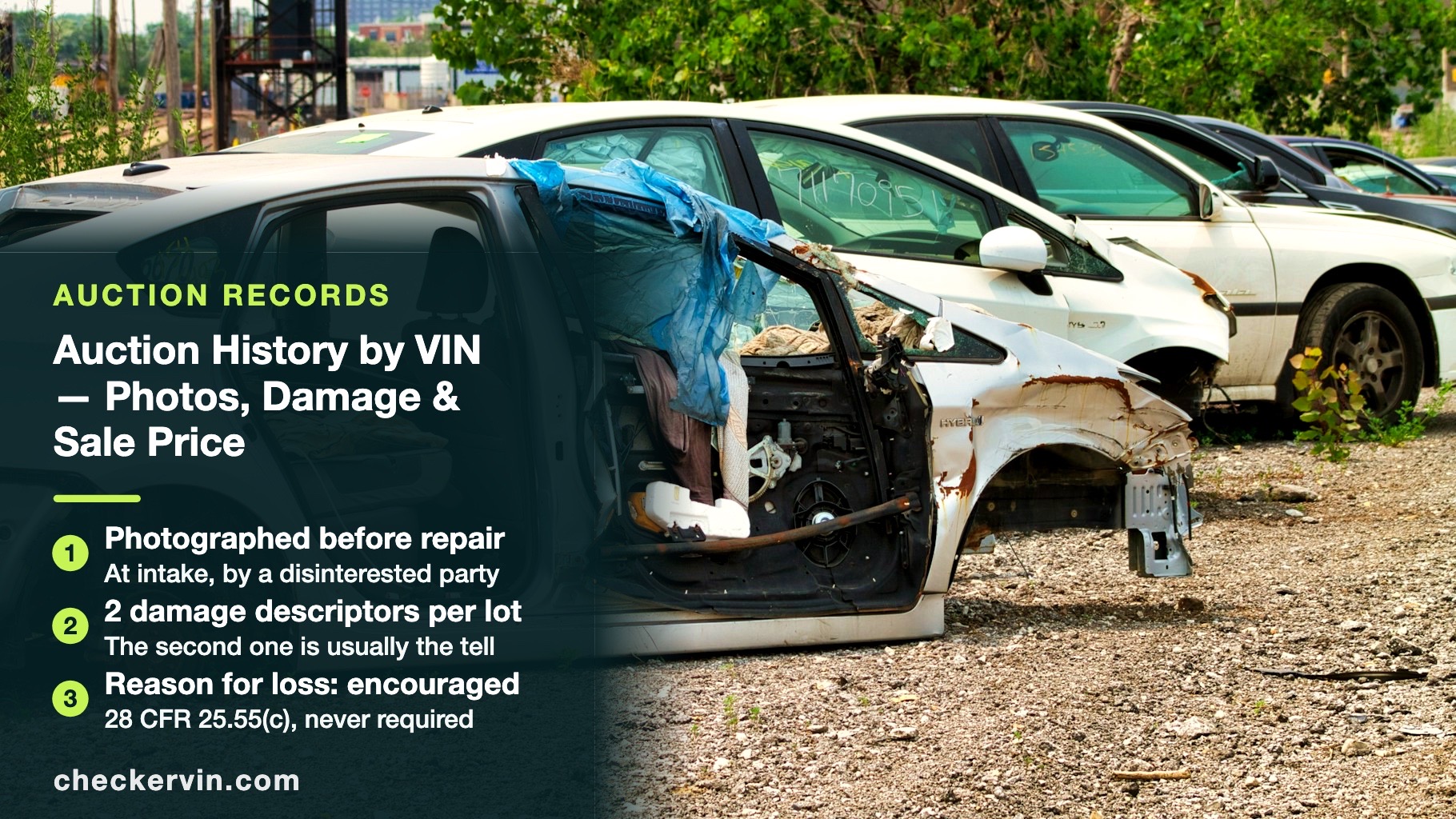
Pre-repair
When the photos were taken
Before anyone tidied it up
Free
Most listing archives
The listings were public when live
Two
Damage descriptors per lot
The second is often the tell
Optional
Reason for loss, federally
28 CFR 25.55(c) only encourages it
Why it beats a history report
A vehicle history report is a list of events. Somebody filed a total loss claim on this date; a title was branded in that state; an odometer reading of so many miles was recorded at a transfer. Each line is true and each line is thin. None of them tells you whether the impact was to the front corner or the B-pillar, whether the airbags went off, or whether the car was sitting on all four wheels when it arrived.
A salvage auction listing answers exactly those questions, because it was written to sell a damaged car to a professional buyer who had to estimate a repair bill from a screen. The incentives run in your favor here in a way they rarely do elsewhere in this business. The auction had every reason to photograph the damage thoroughly and describe it accurately, because a rebuilder who turns up to collect a car worse than advertised is a rebuilder who stops bidding.
There is a second reason the auction listing carries information the federal record does not, and it is written into the regulation. When an insurance carrier reports a junk or salvage vehicle into NMVTIS, the required fields are the identifying ones: the VIN, the date, who the vehicle was obtained from, who owned it at the time of filing. Telling the system why— that it was flood, water, collision or fire damage, or a theft and recovery — sits in a separate paragraph of the rule which says only that carriers are “strongly encouraged” to provide it. Encouraged is not required.
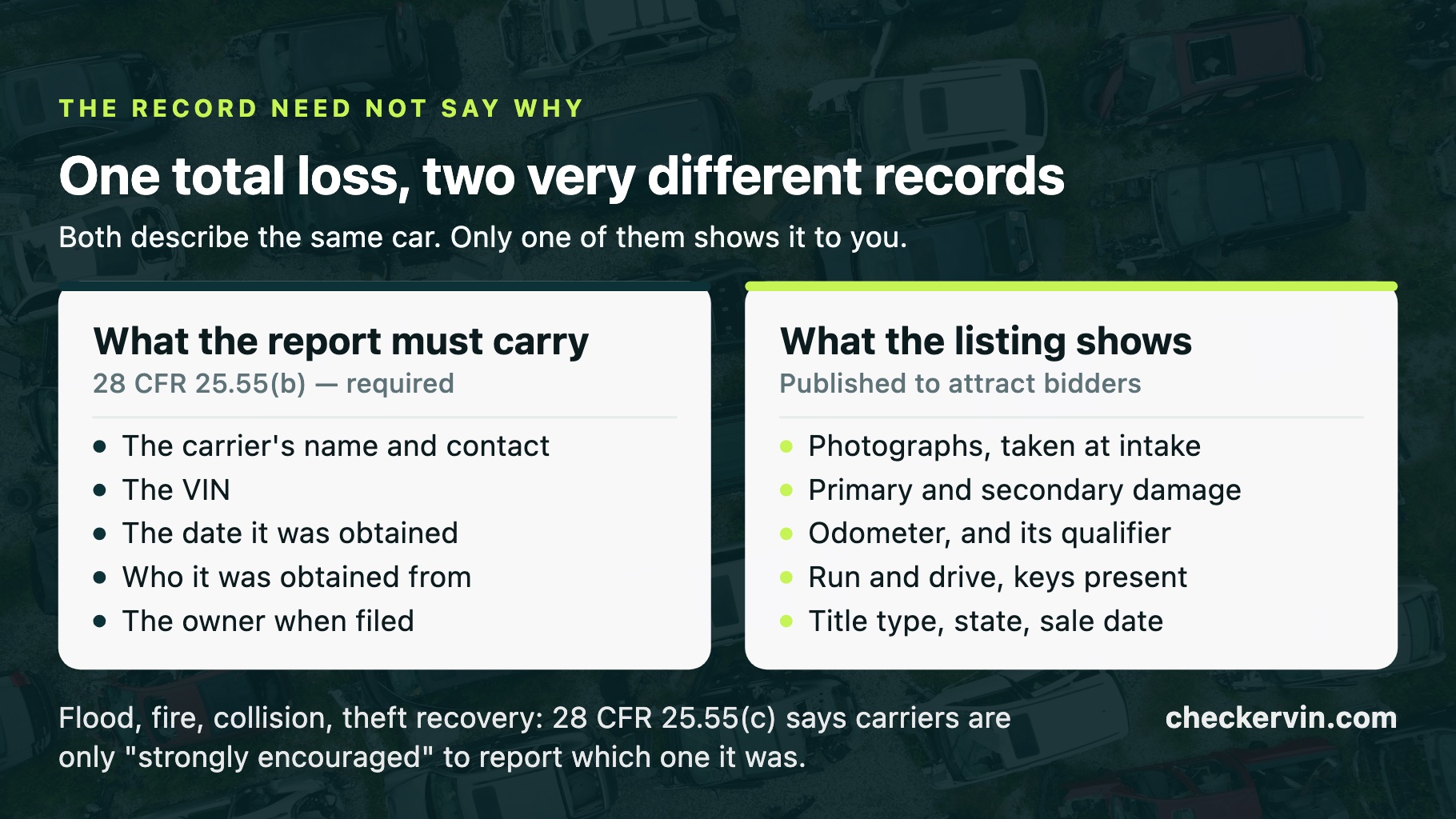
That is the asymmetry worth understanding. The pre-repair photographs were produced for somebody whose interests happened to align with yours, and they were produced before any of the work a current seller is now describing to you. Our accident check guide covers what the record-based routes can and cannot show; an auction listing is the one source that shows rather than tells.
How a car ends up in the record
Nothing appears at a salvage auction by accident, and understanding the route explains both why the record is good and why it is incomplete.
The common path starts with an insurance claim. The insurer assesses the damage against the vehicle’s value, decides that repairing it is uneconomic, settles with the owner and takes ownership of the wreck. It now holds an asset it does not want, and the established way to convert that asset back into cash is to consign it to a salvage auction. The two large operators in the United States are Copart and IAA, and between them they handle an enormous share of that flow.
A second path runs through the owner. Where a settlement is agreed but the owner keeps the vehicle — the owner-retained case — the car may still be sold on later, and it can reach the same auctions by a different door, sometimes years afterward and sometimes after a repair attempt has already been made. A third path involves no insurer at all: fleet disposals, repossessions, charitable donations, and vehicles seized or abandoned all pass through auction channels of one kind or another.
Running alongside that commercial pipeline is a set of federal reporting duties. Insurance carriers must file a monthly inventory of the junk and salvage automobiles they have taken possession of, and junk yards, salvage yards and auto recyclers must file a monthly inventory of the vehicles they obtained, with a supplemental report where the final disposition was not known at the time of the first filing. A single car can therefore leave a trace in the federal record and in an auction listing archive at the same time — and the two are not the same net. Checking one is not a substitute for checking the other. Our NMVTIS guide covers who reports what, and how often.
Keep the sequence in mind when you read a listing. The photographs were taken at intake, which is after the damage and before any repair — a narrow, well-defined moment in the car’s life. Everything the current seller is telling you happened after that shutter closed.
Where to look, free
Several services maintain searchable archives of Copart and IAA lot listings and let you look them up by VIN without payment. They are not leaks and they are not scrapes of anything private: while a lot is live, its photographs, damage descriptors and description are published so that buyers can bid on them. These services keep copies after the sale closes.
That is worth understanding because it tells you where the free tier ends. What is typically free is the archived listing — the photographs, the descriptors, the sale date and frequently the final bid. What is typically charged for is bulk access, historical analytics, or a consolidated report that bundles the listing together with other data. The pricing model varies by service and changes often enough that any figure printed here would be wrong before long.
- 1Search on the full 17-character VINNot the plate, not the year and model. Auction archives are indexed on the VIN, and a partial match returns either nothing or the wrong car.
- 2Try more than one archive before concluding there is nothingCoverage differs between services, and a lot that one archive missed may sit in another. Two or three searches cost you a few minutes.
- 3Download the photographs while they are thereListings do disappear, and a seller's account of the damage tends to improve once the images are gone. Save them locally before you go and view the car.
- 4Note the sale date and the odometer as catalogedBoth are dated data points, and you will need them when you line the auction record up against the title history.
- 5Then buy the federal record separatelyAn auction archive and NMVTIS cover different things. Finding one does not remove the reason to check the other.
The photographs are the evidence
If you take one thing from this page, take this: the photographs matter more than every other field in the listing combined. A damage descriptor is somebody’s one-word summary, entered quickly. A set of thirty images taken in daylight at an intake yard is a record you can form your own opinion from, and it does not depend on trusting whoever typed the summary.
What to look for depends on what the current seller is claiming. If the car is being offered as lightly damaged and properly repaired, the pre-repair images are the test of that account. If it is being offered with no mention of damage at all, they are the whole story, and the conversation you are about to have is a different one.
| In the photographs | What it tells you |
|---|---|
| Deployed airbags, or a cut steering wheel center | A collision severe enough to trigger the restraint system — and a repair expensive enough that it gets skipped or faked |
| Wheels sitting at odd angles, or the car on a flatbed | Suspension or structural damage rather than panel damage; a car that could not be driven onto the transporter |
| A crumpled radiator support, or the engine visible from the front | Impact that reached past the bumper and into structure, which is where alignment and crash performance live |
| Water lines on the interior trim, or silt in the footwells and spare wheel well | Flood exposure, whichever descriptor was recorded on the lot |
| Fire damage under the hood, or soot around the vents and headliner | A category that frequently leaves wiring and sensor faults behind long after the visible damage is gone |
| An intact car with light cosmetic marks and a missing interior | Often a theft recovery rather than a collision — a very different repair, and a very different risk |
| Hail dimpling across horizontal panels only | Weather damage that can total a car on repair cost while leaving the structure entirely untouched |
Compare each image against the car in front of you, panel by panel. Paint texture, panel gaps, weld quality and overspray are covered in our accident check guide. The value of the auction photographs is that they tell you exactly where on this specific car to concentrate that inspection, instead of checking everything with equal attention and finding nothing.
Reading the damage descriptors
Auction listings usually carry two damage descriptors rather than one, and the second is often the more informative. A car listed with front-end damage as primary and undercarriage damage as secondary is describing an impact that went somewhere structural. A car with hail as primary and nothing as secondary is describing a completely different event, with completely different consequences for what you should pay.
The descriptors you will commonly see fall into a handful of families. The exact wording differs between operators and changes over time, so treat the table below as a guide to the shape of the vocabulary rather than an official codebook.
| Descriptor family | What it usually means for a buyer |
|---|---|
| Front end, rear end, side | Directional collision damage. Combined with the photographs, this tells you which structural members were in the load path. |
| All over | Damage on multiple planes — commonly a rollover, a multi-impact collision, or a car that was struck and then left the road. |
| Undercarriage | Impact from below, or a hard grounding. Often the descriptor that turns an apparently cosmetic listing into a structural one. |
| Rollover | Roof and pillar involvement, which is the hardest damage to repair back to original strength and among the easiest to disguise cosmetically. |
| Water or flood | Immersion of some depth. The consequences arrive slowly, through wiring, connectors and control modules. |
| Burn, engine burn, interior burn | Fire, with the qualifier telling you where it started. Heat damage travels considerably further than the scorch marks suggest. |
| Hail | Cosmetic dimpling that can exceed a car's value on repair cost alone while leaving the structure completely sound. |
| Vandalism or stripped | Frequently a theft recovery. The question is what was taken, and whether it was replaced with equivalent parts. |
| Minor dent and scratches, normal wear | The descriptors most worth checking against the photographs, because a car does not usually reach a salvage auction over a scratch. |
| Mechanical | A driveline or engine failure rather than an impact. Cheaper to assess than collision damage, and far easier to verify. |
Treat the descriptor as an index rather than a verdict. They are entered at speed, by people processing a great many vehicles, and they describe what was visible at intake rather than what an engineer would conclude after a strip-down. A listing marked for minor damage whose photographs show a buckled floorpan is telling you that the photographs are right and the descriptor is shorthand.
Run and drive, keys, and the rest
Auction listings carry a set of operational flags that are easy to skim past and worth reading carefully, because they describe the car’s condition in ways the damage descriptor does not.
| Field | How to read it |
|---|---|
| Run and drive status | Usually means the vehicle started and moved under its own power at the yard. It is not a statement that the car is roadworthy, it is frequently assessed over a very short distance, and its absence does not prove the engine is finished. |
| Keys present | A small field with outsized meaning on theft recoveries, and a genuine cost item when absent on a modern car with coded keys and an immobilizer. |
| Odometer reading and its qualifier | Recorded at intake, and frequently marked as not actual, exempt, or exceeds mechanical limits. That qualifier travels with the car and does not wash off in a repair. |
| Estimated retail value | The auction's own figure for the undamaged vehicle, used to frame the lot for bidders. It is not an appraisal of the damaged car and it is not what you should pay. |
| Title type and title state | Which document the vehicle was sold on, and where — the input for everything on our state title guides, and the starting point for spotting a wash. |
| Sale date and lot location | Two dated facts you can line up against the title record. A title issued in a state the car was never sold in is worth a direct question. |
The odometer qualifier deserves particular attention. If a reading was cataloged as not actual at the auction, that is a mileage discrepancy recorded years before the listing you are now reading, by a party with no stake in the sale you are considering. Our odometer rollback check covers how to line that reading up against every other dated reading the car has produced. The series can only climb; a dip anywhere in it is the finding.
What the sale price tells you
The final bid is the field everybody looks at first, and it is the one most often over-interpreted. It is a real number and it does carry information — but it is the price a professional paid for a damaged car at a wholesale auction, on a particular day, in a particular regional market, with a particular set of buyers in the room.
What it genuinely tells you is roughly how the trade assessed the damage. A car that sold for a small fraction of its undamaged value was, in the collective judgment of people who repair cars for a living and bid their own money, badly hurt. A car that sold for a large share of its value was probably lightly damaged, or was wanted for parts that happened to be valuable, or was bid up by two people who both wanted it that day.
What it does not tell you is what the car is worth now, what was spent on it in between, or whether that spending was any good. A high auction price is not reassurance and a low one is not proof of a disaster. A stripped theft recovery and a structurally destroyed collision car can sell for similar money for entirely different reasons, and only the photographs separate them.
There is one more thing the price does that is easy to miss: it dates the damage precisely. A sale date is a hard timestamp, which means everything the seller describes as recent work can be placed against it, and every service record and inspection sorts cleanly into before and after.
The cars no auction record covers
This is the limitation to hold on to, and it is a large one. An auction record exists only for a vehicle that went through an auction. Enormous numbers of damaged cars never do.
- A collision repaired privately with no insurance claim leaves no auction trace at all
- A car damaged below its state's branding threshold usually stays in ordinary retail channels
- An owner who settles and retains the vehicle may repair it and never consign it anywhere
- Damage handled entirely within a dealer group can move without ever reaching a public sale
- Vehicles sold outside the two large salvage operators may not appear in the archives you can search
- Very small salvage operators sit outside the federal reporting duty altogether
That last one is worth stating precisely, because it is the kind of exemption that sounds minor and is not. The federal rule for junk yards, salvage yards and auto recyclers exempts individuals and entities handling fewer than five vehicles a year that are determined to be salvage, junk or total loss from reporting under the salvage-yard requirement. An operator working at that scale is outside the duty entirely.
The insurer duty has a boundary of its own. The monthly carrier report covers automobiles of the current model year or any of the four prior model years — a five-model-year window, described in more detail on our damage reported guide. An older car totaled by an insurer is not swept up by that particular obligation, which is one reason a clean federal result on a ten-year-old car proves considerably less than the same result on a two-year-old one.
So a blank result is genuinely ambiguous. It is consistent with a car that was never seriously damaged, and equally consistent with a car whose damage never generated the kind of record you are searching. The honest reading of “nothing found” is nothing found — not confirmation. That is the same logic as the state branding thresholds on our salvage title VIN check, where a clean title is weaker evidence on an old or cheap car than on a recent, expensive one.
The other auctions you cannot see
There is a second auction world, much larger by volume, that produces almost nothing you can look up. Wholesale dealer auctions exist so that franchised and independent dealers can move inventory between themselves: lease returns, trade-ins that do not suit the lot, rental fleet disposals, and cars that simply did not sell. Access is restricted to licensed dealers, and the results are commercial information among trade participants rather than published listings.
This matters for two practical reasons. First, it explains a common and confusing outcome: you know a car changed hands several times in a short period, and yet no auction record appears anywhere. That pattern is entirely normal for a vehicle that moved through wholesale channels rather than salvage ones, and it is not evidence of concealment.
Second, it sets a boundary on what the free archives can ever do for you. They are archives of salvage auction listings. A car that was never a total loss has no reason to appear in them. If you are researching an ordinary used car with no damage history, the absence of an auction record is the expected result and tells you close to nothing.
How sellers describe an auction car
Cars bought at salvage auction, repaired and resold are a real and legitimate part of the market. Many are competently rebuilt and priced accordingly. But the way they are described in a retail listing follows recognizable patterns, and knowing the patterns saves you a wasted trip across town.
| What the listing says | What to ask next |
|---|---|
| Rebuilt title, fully inspected, drives perfect | Which inspection, carried out by whom, and can you see the paperwork? A state rebuilt process is largely about identity and where the major parts came from — in Texas it runs on a statement form, and in Wisconsin on an appointment with the State Patrol. It is not an appraisal of repair quality. |
| Clean title in hand | Clean in which state, and issued when? Line the issue date up against the auction sale date, because that interval is exactly where a title wash happens. |
| Minor front damage, professionally repaired | Ask for the auction lot photographs by name. A seller who bought the car at auction has seen them, and reluctance to share them is itself an answer. |
| Salvage but never wrecked — it was a theft recovery | Plausible, and entirely checkable. The photographs will show whether the car was stripped or struck, and the two look nothing alike. |
| Flood car, but only the carpets got wet | Where was the water line in the intake photographs? Immersion depth is visible on the trim and the seat rails, and it does not always match the account of it. |
| No mention of damage at all | The one to slow down on. If you found an auction record and the listing does not mention it, the omission is the finding, whatever the repair quality turns out to be. |
None of these are accusations. A seller may genuinely not know a car’s history if they bought it retail themselves, and plenty do not. But the pre-repair photographs let you have a specific, factual conversation instead of a general one, and specific conversations are the ones that get honest answers.
Buying from a salvage auction yourself
If your interest in auction history is not a car somebody is selling you but a car you want to bid on, the calculation changes shape. Salvage auctions are wholesale environments built around professional buyers, and the friction is real.
- Access rules vary — some lots are open to the public and others require a licensed dealer or a registered broker to bid on your behalf
- The bid is not the price: buyer fees, gate fees, storage and payment charges are added afterward and they are not small
- You are responsible for moving the vehicle, and a car that does not run costs meaningfully more to transport
- Inspection is limited to the photographs and whatever on-site preview is offered, which is why the photographs are effectively the product
- The document you receive determines what you can do next, and it is frequently not a title you can register on
That last point is the one that catches people out. A vehicle sold on a certificate of destruction, or an equivalent non-repairable document, cannot be brought back onto the road in most states however good the car looks in the pictures — the document exists precisely to prevent that. A vehicle sold on a salvage certificate can usually be repaired and re-titled, but only after completing the state’s rebuilt titling process, and the title that results carries a brand for the rest of the car’s life.
Read the title type on the lot before you read anything else, including the price. Our branded title guide sets out what each document admits, and the state guides linked below cover the inspection route in individual states, because the thresholds and the paperwork genuinely differ from one to the next.
Cross-checking against the title
Where you do find an auction record, the useful next step is to put it beside the paperwork and see whether the two accounts agree. Frequently they do. When they do not, the disagreement is the most informative thing you will find all day.
- 1Compare the auction title type against the current titleA car sold on a salvage certificate that now carries a clean title from a different state is the classic washing pattern, and exposing exactly that is what the federal record was built for.
- 2Compare the dates, not just the documentsA clean title issued shortly after a salvage auction sale, in a state the car has no other connection to, is a sequence that deserves a direct question.
- 3Compare the auction odometer against every later readingAuction intake readings are dated. Put them in sequence with title transfers and inspection records; a reading that goes backward anywhere is the finding.
- 4Compare the damage in the photographs against the seller's accountNot to catch anyone out, but because a seller who describes the damage accurately before you raise it has told you something useful about how the repair was probably approached.
- 5Buy the federal NMVTIS record regardlessIt covers title brands and reported total losses from participating states and insurers, which is a different net from an auction listing archive and catches different cars.
- 6Then inspect the structureThe pre-repair photographs tell you exactly where to look, which is the single biggest advantage this record gives you over any report you can buy.
The check sequence
Auction history slots into the ordinary sequence rather than replacing it. Decode the VIN free for the factory build and specifications, so you know which car you are researching and whether the one in front of you matches it. Check open recalls through NHTSA at no cost. Screen for theft and total-loss records through the NICB. Search the auction listing archives by VIN. Buy the national NMVTIS record for title brands and reported total losses. Then inspect the vehicle, with the pre-repair photographs open on your phone.
The order matters, because each step is cheaper than the one after it and each one tells you what to look for in the next. If you want the wider picture on what the paid products add over the free ones, our comparison of Carfax alternatives maps the tiers, and what a report costs covers the pricing models without the marketing wrapped around them.
Where this information comes from
- 28 CFR 25.55 — Responsibilities of insurance carriersThe monthly carrier report, its five-model-year window, and the paragraph making the reason for the loss encouraged rather than required
- 28 CFR 25.56 — Junk yards, salvage yards and auto recyclersThe monthly inventory duty, the supplemental disposition report, and the exemption below five vehicles a year
- NMVTIS — official vehicle history recordThe federal title, brand and total-loss record, and the list of approved consumer access providers
- NICB — VINCheckFree screen for theft and total-loss records reported by participating insurance companies
- NHTSA recall lookupOpen safety recalls by VIN, free, and repaired at no charge regardless of how the vehicle is titled
Keep reading
Frequently asked questions
Can I check a car's auction history by VIN for free?
Often, yes. Several services archive Copart and IAA lot listings and let you search them by VIN at no cost, typically showing the photographs, the damage descriptors and the final sale price. They are archives of listings that were public while the lot was live, which is why a free tier can exist at all. What no free service can do is invent a record for a vehicle that never went through a salvage auction.
Does CheckerVIN show auction history?
No, and we would rather say so plainly than have you find out after searching. Our free lookup returns the factory build, specifications and open safety recalls. Accident, title and odometer history are launching soon; auction records are not part of what we return today. This page exists to point you at the routes that do work right now.
What does a salvage auction record actually contain?
Usually a set of photographs taken before any repair, a primary and secondary damage descriptor, an estimated retail value, the odometer reading as entered at intake, whether the car was cataloged as running and driving, whether keys were present, the sale date and the final bid. For a buyer that is a far more concrete account of the damage than a vehicle history report line gives.
Why does a car appear at Copart or IAA at all?
Because an insurer took ownership after settling a total loss claim and disposed of the vehicle through a salvage auction, or because the owner retained it and sold it on later. Separately, auto recyclers, junk yards and salvage yards must report the vehicles they obtain into the federal NMVTIS system each month under 28 CFR 25.56, which is why a car can leave a footprint in more than one place.
Is a car with an auction history always a bad buy?
Not automatically, but it is never a car to buy on the seller's photographs alone. The auction record shows what it looked like before repair, which is exactly the information a seller of a repaired car has the least incentive to volunteer. Price it as a rebuilt vehicle, inspect the structure, and treat the pre-repair photographs as the baseline the current condition has to be explained against.
Start with the VIN
Decode any VIN free for the factory build, specifications and open safety recalls. No account, no card.
Run a free VIN check