The short answer
- Who can get my record?
- Only someone with a use on the federal list — or someone holding your written consent, which covers most legitimate commercial access.
- Can I get my own?
- Yes. Every state publishes a request process, usually online or by mail with a small fee and proof of identity.
- Why bother?
- Insurers and employers price and decide on what it says. An error you have not seen is one you cannot correct in time.
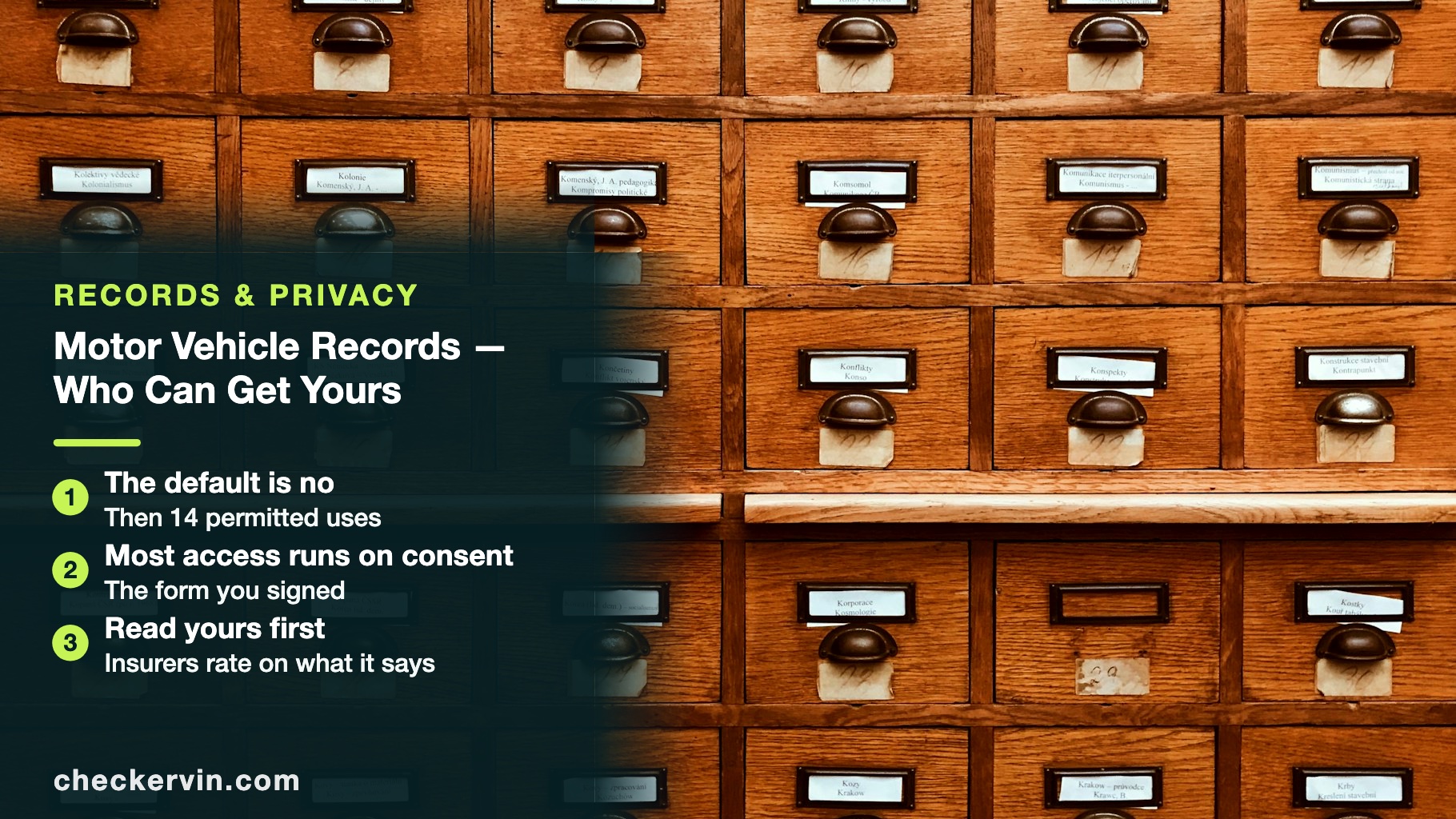
14
Permitted uses in the statute
Everything else is prohibited
Consent
How most commercial access works
The form you signed
CDL
What employers may verify
Commercial licenses specifically
What a motor vehicle record actually is
The phrase sounds administrative, and the federal definition is broader than most people assume. Under 18 U.S.C. § 2725(1), a motor vehicle record is any record pertaining to a driver’s permit, a motor vehicle title, a motor vehicle registration, or an identification card issued by a department of motor vehicles.
Four categories, and they straddle two things people usually keep separate. The driver’s side — license status, endorsements, violations — and the vehicle side, title and registration, are the same class of record for disclosure purposes. A rule written about one reaches the other.
| What people call it | What it usually contains |
|---|---|
| Driving record, MVR, abstract | License status and class, endorsements, restrictions, violations and their dates |
| Vehicle record | Title and registration information for a specific vehicle |
| Certified record | The same content, issued in a form a court or agency will accept |
The names differ by state and so does the fee. What does not differ is the federal framework sitting over all of them, which is where the rest of this page goes.
The default is no, and that shapes everything
Most privacy rules work by granting access and then restricting it. The Driver’s Privacy Protection Act runs the other way, and the direction matters when you are evaluating anybody who claims they can get a record for you.
Read the structure. Disclosure is prohibited; subsection (b) then lists the uses that escape the prohibition. Nobody has general access that is occasionally limited. Everybody who lawfully holds a record is standing on a specific numbered item, and the useful question to ask about any service is which item that is.
There is a stricter inner layer as well. § 2721(a)(2) covers highly restrictedpersonal information — a photograph or image, a social security number, medical or disability information — and that category needs the express consent of the person concerned on top of everything else.
Who may obtain one
The permitted uses are worth reading in full rather than in summary, because the shape of the list is the argument. These are the 14 categories:
- Government agencies carrying out their functions
- Motor vehicle safety, theft, emissions, recalls and product alterations
- Legitimate business, but only to verify the accuracy of information you gave it
- Civil, criminal, administrative or arbitral proceedings
- Research and statistics, where nothing is published or used to contact anyone
- Insurers, for claims investigation, antifraud, rating and underwriting
- Notifying the owners of towed or impounded vehicles
- Licensed private investigators — for a purpose already permitted here
- Employers verifying commercial driver's license information
- Operating private toll facilities
- Other requests, where the State has obtained the individual's express consent
- Bulk marketing and surveys, again on State-obtained express consent
- Any requester holding the individual's written consent
- Any other use specifically authorized by the law of the State holding the record
The shape of that list is worth a second look before the detail. Almost every entry names a role rather than a reason: an agency, an insurer, a court, a toll operator. Access follows from what you are and what you are doing, not from how badly you want to know.
Notice how few of them describe an ordinary person with a reason. The list is built around institutions performing defined functions — courts, insurers, agencies, toll operators — plus two consent routes. Curiosity does not appear anywhere on it, and neither does any general interest in another person.
Three provisions people routinely misread
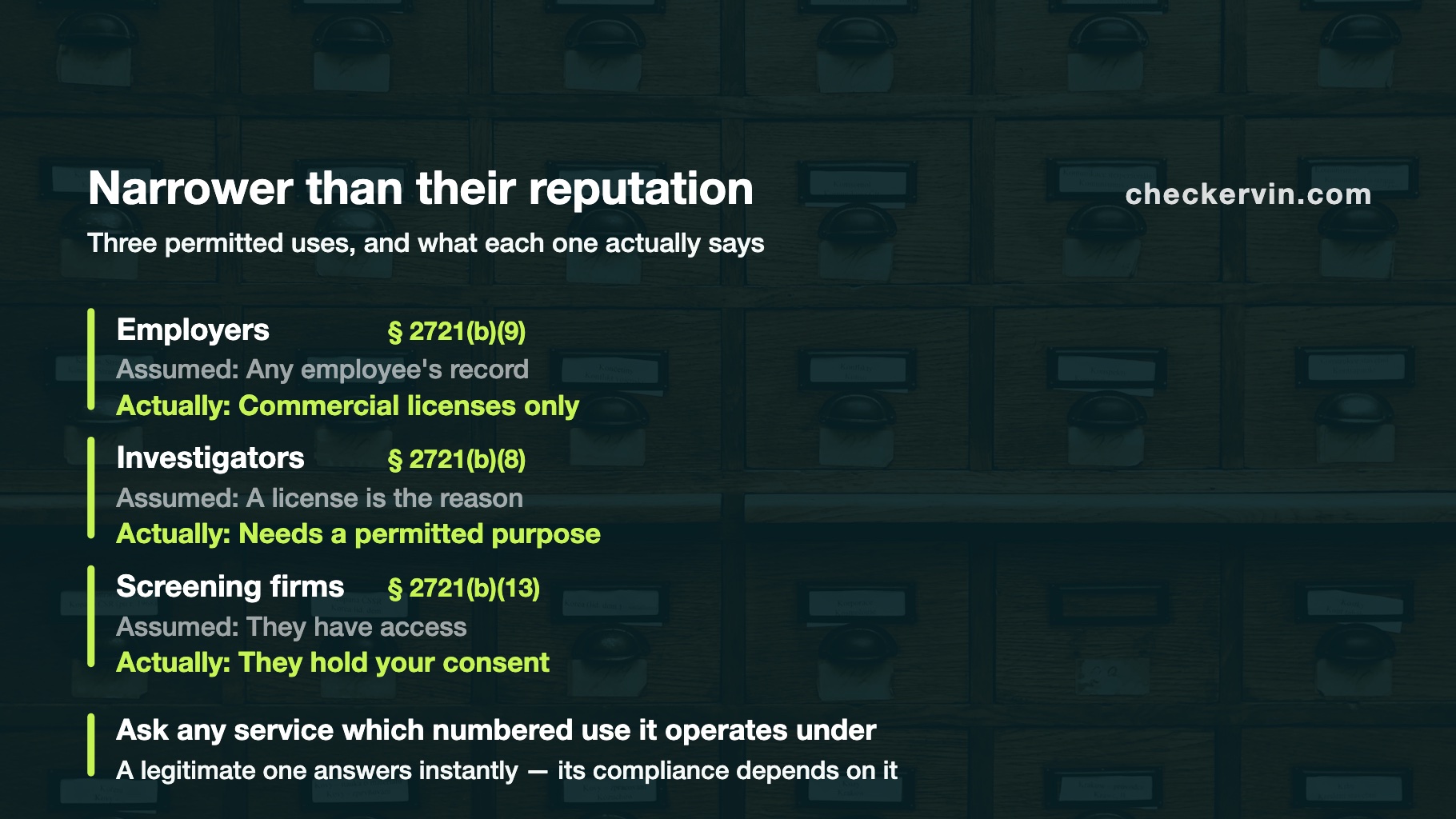
Three items on that list get cited far more often than they support, and each misunderstanding sends someone down a path that does not exist.
| The provision | What it actually permits |
|---|---|
| Employers — § 2721(b)(9) | Obtaining or verifying information about a holder of a commercial driver's license. It is a CDL provision, not a general employment-screening permission. |
| Private investigators — § 2721(b)(8) | Use by a licensed agency for any purpose already permitted under the same subsection. The license qualifies who may act; it does not supply the reason. |
| Consent — § 2721(b)(11), (12) and (13) | Under (13) the requester holds your written consent. Under (11) and (12) the State must have obtained it. Different party, different route. |
The employer one causes the most confusion. Ordinary background screening does happen, and lawfully — but it runs on the consent route rather than the CDL route. The screening company obtains your written consent, which is what the authorization form in a job application is for. If you have ever wondered why that form exists, this is the answer.
Your state can add to the list, within a limit
One item on that list is different in kind from the rest, and it explains why a national answer to “can this person get my record” is always incomplete.
That is a delegation, and a bounded one. The federal list is a floor rather than a ceiling: a state may authorize further uses of its own records, but only uses connected to vehicle operation or public safety. So two people in different states can ask the same question about the same kind of record and get different answers, both correct.
The boundary is worth noticing too. A state could not use this provision to authorize a marketing use, because marketing is not related to the operation of a motor vehicle or to public safety — and the statute deals with marketing separately, under a provision that requires the state to have obtained the individual’s express consent first. Where you see broad claims about what a particular state allows, that limit is the thing to test them against.
Practically, this means your state DMV’s own records page is the authority on what is available to whom where you live, and a national summary — including this one — is a framework rather than an answer.
Why agencies seem to exchange records freely
Anyone who has watched a court, a police department and a DMV move information around will have wondered how that squares with a statute this restrictive. Two features of the Act point the same way.
The first is definitional. Under § 2725(2), a “person” means an individual, organization or entity, “but does not include a State or agency thereof.” The word the prohibition turns on was written to exclude government from the category.
The second is the first permitted use. § 2721(b)(1)covers use by any government agency, including any court or law enforcement agency, in carrying out its functions — and extends to a private contractor acting on behalf of such an agency.
Together those explain the asymmetry people notice. Government access to these records is structured entirely differently from private access, and it is not an exception granted reluctantly at the edge of the statute. It is built into the definition the prohibition depends on.
Getting your own record
None of the above is designed to stand between you and your own file. The Act governs what a DMV may disclose about an individual to other people; every state publishes a route for the individual themselves.
- 1Find your state DMV's records request pageThe document has different names by state — driving record, abstract, motor vehicle report. Search your state's own site rather than a directory.
- 2Decide whether you need it certifiedA certified copy costs more and is what a court or an employer may require. For simply reading what is on file, the ordinary copy is enough.
- 3Expect proof of identity and a feeBoth are normal and both are the point — the process exists to confirm you are the person the record is about.
- 4Read the violations and their datesDates matter as much as entries, because most consequences fall away after a period that varies by state.
- 5Dispute anything wrong, in writingCorrections go through the state agency that holds the record, not through whoever showed it to you.
Why check it before someone else does
The practical argument for reading your own record is that other people are already reading it, and acting on it, at moments when you have no opportunity to explain.
- Insurers use it in rating and underwriting — a violation you forgot about is priced in
- Employers screening for driving roles will see it before you discuss it
- Courts and agencies obtain it in proceedings, where a surprise is expensive
- Errors do occur — a violation attached to the wrong person or never removed on schedule
One more habit is worth building, and it costs nothing. Note the date you requested the record and keep the copy. An insurer or an employer acting on a record months later is acting on a version you can compare against, and a dispute is far easier to run when you can show what the file said on a date you can name.
The last item is the one worth acting on. Records are maintained by people, and an entry that should have dropped off, or a citation recorded against a similar name, is not exotic. Finding one is only possible if you have looked, and correcting one takes time you will not have once a decision is pending.
The insurer clause, and why your premium moved
If you want a single reason to read your own record, it is in one line of the permitted uses, and it is more explicit than most people expect.
Rating and underwriting are named in the statute. Your record is not incidentally available to an insurer pricing your policy — it is a pricing input that federal law expressly contemplates. That is the mechanism behind a premium that moves for reasons nobody explained to you.
The timing is what makes it worth acting on early. Rating happens at quote and at renewal, which are moments chosen by the insurer rather than by you, and a wrong entry costs money at exactly the point you have least opportunity to argue about it. Correcting a record takes weeks and runs through the state agency; a renewal takes a day and runs through a system that simply reads what is there.
The same clause covers claims investigation and antifraud work, which is why a record can surface long after a policy is written. If you are curious what an insurer can see about the vehicle rather than the driver, our insurance lookup guide covers that side.
Vehicle record or driving record — they answer different questions
Both are motor vehicle records federally, but they serve completely different purposes and people frequently request the wrong one.
| If the question is | Ask for |
|---|---|
| What does my driving history look like to an insurer? | Your driving record or abstract |
| Is this car's registration current? | A vehicle record, or a state status tool |
| Who owns this car? | Neither — that is the personal information the Act protects |
| What does this car's title say? | The federal title record, which is a different system entirely |
The third row is the one that ends most searches. Owner identity is exactly what § 2725(3) protects, and no fee removes that. The fourth is the one people should be asking more often when buying: title history lives in the federal NMVTIS record, not in a DMV records request. Our registration lookup guide covers the vehicle-status side in detail.
What the record does not contain
Half the value of reading your own file is discovering what is not in it, because people routinely brace for entries that were never going to appear and miss the ones that were.
| Commonly expected | Whether it is actually there |
|---|---|
| A crash you were involved in | Only if it produced a citation or a state-reportable report — an insurance claim alone does not put it here |
| Criminal history | No. That is a different system entirely, held by different agencies |
| Parking tickets | Usually not on the driving record, though unpaid ones can block a registration renewal |
| Your credit | No. Insurers may use credit-based scores, but they come from elsewhere |
| Every violation forever | No. Most fall off after a period set by state law, which is why dates matter as much as entries |
The first row surprises people most. A collision handled entirely between insurers, with no citation issued, may leave no trace on a driving record at all — while sitting plainly in the insurer’s own claims history, which is a separate file with separate rules. Two people can therefore look at “your record” and mean two different documents that disagree.
The last row is the one to act on. Because entries age off on a schedule set by your state, the same record read six months apart can support a different insurance quote without anything having happened. If a violation is close to its expiry, that timing is worth knowing before you shop a policy.
The reseller chain, and the five-year ledger
Records do leave DMVs lawfully, and some recipients resell. That is regulated too, and the requirement is specific enough to be a useful test.
Under § 2721(c), an authorized recipient may resell or redisclose only for a use permitted under subsection (b) — and any recipient that resells must keep records for five years identifying each person or entity that received the information and the permitted purpose it was to be used for, produced to the motor vehicle department on request.
A legitimate reseller therefore knows, for every record it has ever passed on, who received it and under which permitted purpose. Set that against a website offering to return a stranger’s details to any visitor: either it is not an authorized recipient and does not have the data, or it is claiming to keep a five-year ledger naming every anonymous buyer and their permitted purpose. Neither describes a service that can deliver what it advertises.
Check a vehicle free while you are here
Decoded from official manufacturer and NHTSA records
Where this information comes from
- 18 U.S.C. § 2721 — prohibition on release and use of certain personal informationThe prohibition, the permitted uses, and the resale record-keeping requirement
- 18 U.S.C. § 2725 — definitionsWhat counts as a motor vehicle record, and what counts as personal information
- NMVTIS — approved data providersWhere vehicle title history actually lives, as distinct from a DMV records request
- NHTSA — recalls by VINFree safety campaign lookup, which needs no record request at all
Keep reading
Frequently asked questions
What is a motor vehicle record?
Federal law defines it as any record pertaining to a driver's permit, a vehicle title, a vehicle registration, or an identification card issued by a department of motor vehicles. That is broader than most people expect — it covers both the driving side and the vehicle side, and both sit under the same disclosure rules.
Can my employer pull my driving record?
Not freely, and the provision people cite says something narrower than they think. The federal list permits an employer or its agent to obtain or verify information about a holder of a commercial driver's license. For ordinary employment screening the lawful route is different: the screening company holds your written consent, which is what the form you signed was for.
How do I get my own motor vehicle record?
Through your state DMV, which publishes a request process — usually online, by mail, or in person, with a small fee and proof of identity. The federal restrictions govern disclosure to other people; they are not designed to stand between you and your own record. Check your own state's page, because the name of the document and the fee vary considerably.
Why would I check my own record?
Because insurers and employers act on what it says, and you cannot correct an error you have never seen. Violations, license status and the dates attached to them are what drive an insurance quote or a screening decision, and the time to find a mistake is before a decision is made on it rather than after.
Is a motor vehicle record the same as a background check?
No, though one is often part of the other. A background check is a compiled product assembled by a private company from several sources; a motor vehicle record is a single file held by a state agency. When a screening report shows your driving history, the company obtained that record under your written consent rather than through access of its own — which is why the authorization form exists and why withdrawing consent is meaningful.
What does it cost to request one?
A small fee, set by your state, and usually more for a certified copy than an ordinary one. The fee is not the interesting variable — the format is. If a court, an employer or an insurer has asked for the record, find out whether they need it certified before you pay, because an uncertified copy may not be accepted and you will end up requesting it twice.
Can a private investigator get my record?
Only for a purpose that is already permitted. The statute lets a licensed investigative agency use records for any purpose permitted under that same subsection, which means the license is not itself a reason — there has to be an underlying permitted use, such as a court proceeding or an insurance claim. A license is a qualification, not a key.
Check any VIN free
Factory build, specifications and open safety recalls, decoded from official manufacturer and NHTSA data. No account, no card.
Run a free VIN check