The short answer
- Can records answer this?
- No. No state process measures the structure and the federal report need not say what kind of damage it was.
- What does answer it?
- Measurement against the manufacturer's published dimensions, by an independent shop. Nothing else is conclusive.
- What can I do myself?
- Read panel gaps, weld texture, sealer and overspray. That tells the shop where to look — it does not replace the shop.
None
Records that must describe it
Not state, not federal
Measured
The only conclusive check
Against factory dimensions
Two
Ways a car is built
The phrase means different things
Optional
The one record that shows it
Auction photos, if they exist
The damage no document records
Start with the shape of the problem, because it explains why so much frame-damage advice sends you somewhere that cannot help.
For most questions about a used car there is a record with a rule behind it. Theft has the NICB and the federal system. Odometer readings have disclosure requirements at transfer. Title brands have state statutes. Each of those is a duty somebody owes, which is why the record exists at all.
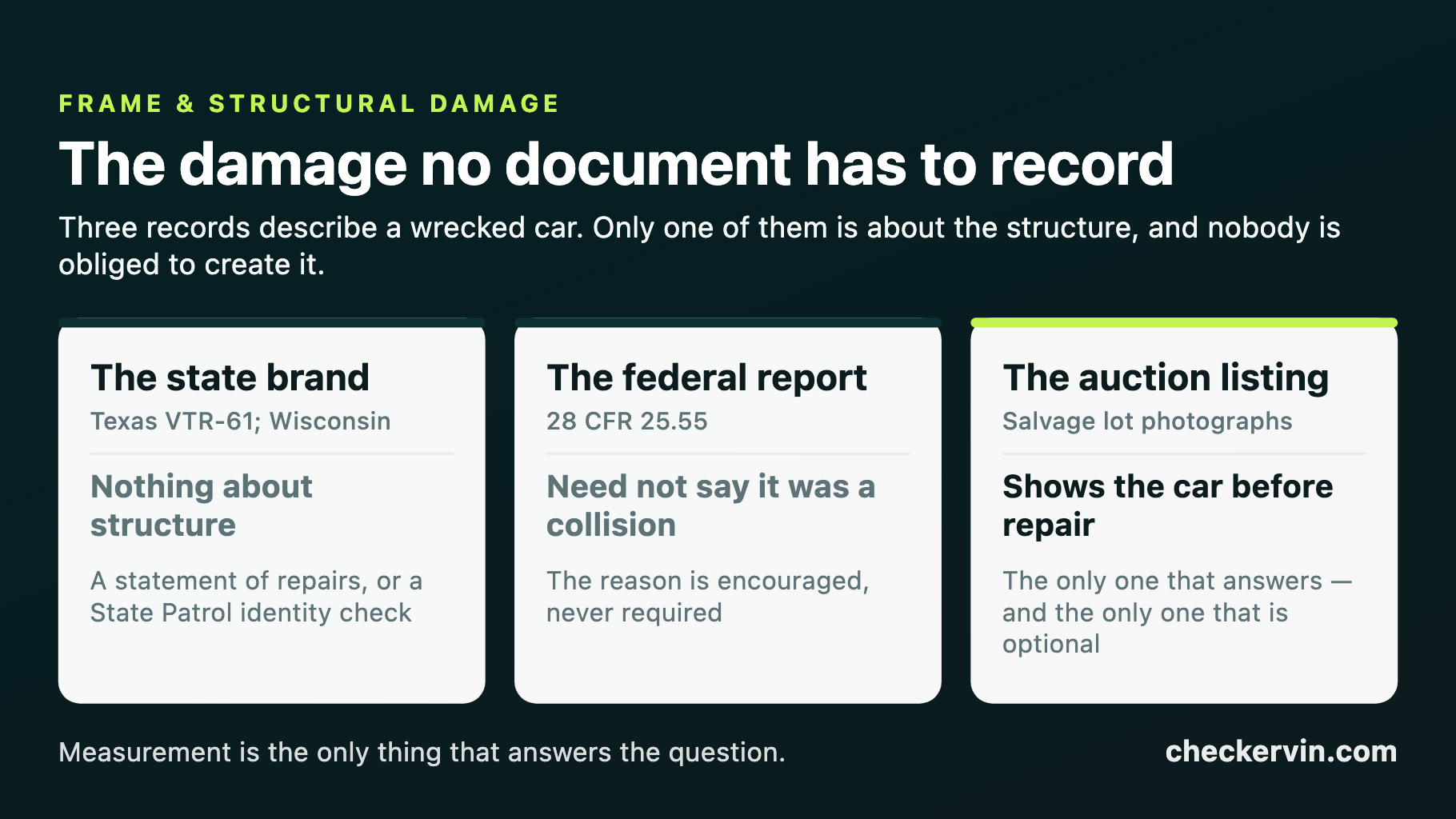
Structural damage has no such duty. Nobody is required to measure a repaired car, nobody is required to publish the measurement, and the records that do exist are about other things — identity, ownership, whether a payout happened. The absence is not a gap somebody forgot to fill. It follows from what each system was built to do, which is why no amount of buying more reports will close it.
What the state process does not do
The most common assumption is that a rebuilt title means somebody official checked the repair. Read the state documents and that mostly is not what happens.
Texas issues a rebuilt salvage title on a Rebuilt Vehicle Statement — a description of the vehicle, an explanation of the repairs, and disclosure of the component part number or donor vehicle identification number for the body, frame or engine where component parts were used. There is no measurement in that, and no standard the repair has to meet.
Wisconsin does require a physical inspection of a repaired salvage vehicle, but the authorized inspectors are State Patrol posts and the appointments are made with law enforcement. That is an identity and stolen-parts function, which is a valuable thing and a different thing.
Our rebuilt title inspection guide covers both procedures in full. The relevant conclusion here is narrow: a rebuilt brand tells you the paperwork satisfied the state, not that the structure was returned to specification.
What the federal record does not say
The federal layer is stronger on identity than any state system, and it is still not about this.
When an insurance carrier reports a junk or salvage automobile, the required contents are identifying: the carrier’s own details, the VIN, the date the vehicle was obtained or designated, who it was obtained from, and who owned it when the report was filed. Five fields, all about who and when.
Telling the system what happened— flood, fire, collision, theft and recovery — appears in a separate paragraph, which says carriers are “strongly encouraged” to provide it. Encouraged, not required. So a fully compliant federal total-loss report can record that a car was written off without ever indicating that it was hit.
A total loss is a money test, not a damage assessment
Before the routes to a clean-looking document, it is worth being precise about the mechanism, because it explains all of them at once.
A total loss is a financial declaration. An insurer compares the cost of repair against the value of the vehicle and decides whether repairing is worth doing. Nothing in that comparison is a judgment about how badly the structure was damaged. The test is money.
| What people assume decides it | What actually decides it |
|---|---|
| How bad the damage looks | The repair estimate against the vehicle's value |
| Whether the structure was hit | Whether the arithmetic crosses a threshold |
| A consistent national standard | A state formula, or an insurer's own policy terms |
Two consequences follow directly, and both are counter-intuitive. Structural damage on a valuable car can fall well short of any threshold, so the vehicle is repaired and keeps a clean title. And an old, cheap car can be totaled by damage that never touched the structure at all, because the bill only has to beat a small number.
The cars that were never branded
There is a third route to a straight-looking document on a bent car, and it involves no concealment at all: the brand never attached.
- A collision repaired privately, with no insurance claim, generates no brand and no report
- Damage below the state's threshold leaves the title clean by the state's own rules
- An age gate can prevent branding outright — Wisconsin's salvage brand needs the car under seven years old
- A high threshold does the same thing — Texas requires repair cost to exceed the vehicle's value before the damage
- Where no brand attached, there is nothing for any state or federal system to report
A car damaged at 75 percent of its value is salvage in Wisconsin and unbranded in Texas, on the same wreck. Our total loss threshold guide sets out why those rules differ so much, and our title washing guide covers what happens when a car crosses between them.
Unibody or body-on-frame
Before you can weigh anybody’s account of a repair, you need to know which kind of vehicle you are looking at, because “frame damage” describes two different physical situations.
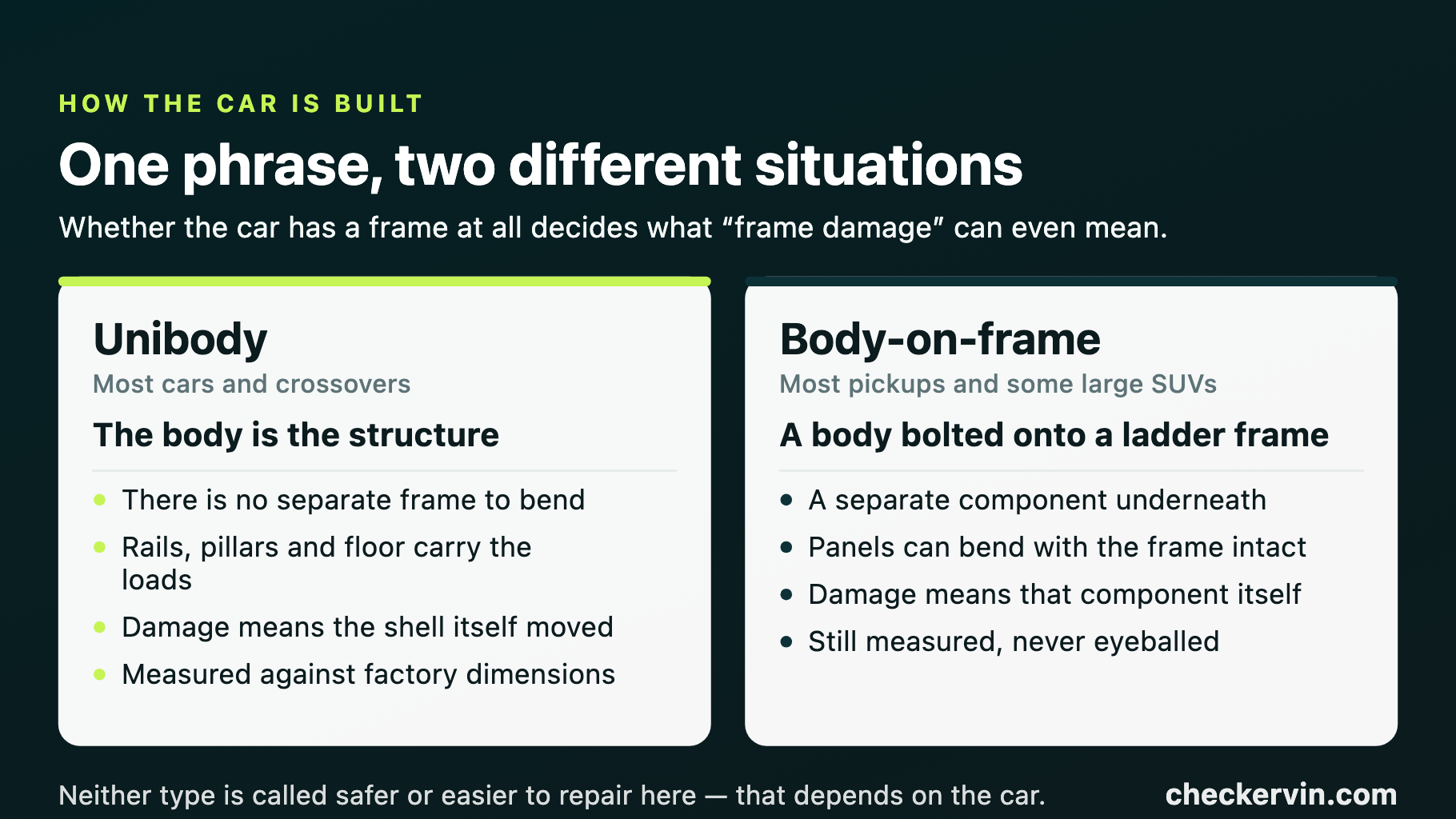
The practical consequence is about what a repair can plausibly achieve. On a body-on-frame truck, panels can be damaged while the frame beneath is untouched, and the frame is a component that can in principle be straightened or replaced. On a unibody, the structure and the thing you sit in are the same object, so returning it to specification is a more exacting job with less margin.
Neither is being called safer or easier here. The point is narrower: a seller saying “it was only frame damage” is saying something quite different depending on which vehicle they are standing next to, and you should know which.
Measurement is the answer
Since no record answers the question, the answer has to be produced rather than looked up. That is what a structural measurement is.
A body shop equipped for this compares the vehicle’s structural reference points against the manufacturer’s published dimensions for that model — on a measuring system, a jig, or a bench. The output is a set of deviations in millimeters, point by point, against a specification that came from the people who built the car.
That is a fundamentally different kind of evidence from everything else on this page. It does not depend on what anyone reported, what a state required, or whether the car went to auction. It is the car being measured against the car it is supposed to be.
- 1Find the pre-repair photographs first, if they existSearch the auction archives by VIN. Knowing where the impact landed tells the shop which points to prioritize, and turns a general check into a targeted one.
- 2Choose a shop with no stake in the saleNot the seller's shop and not one they recommend. A collision shop that measures for insurers does this work daily.
- 3Ask specifically for a structural measurementA pre-purchase inspection is often a road test, a lift check and a scan. Measurement against factory dimensions is a separate request and you have to make it.
- 4Ask for the printout, not the verdictThe deviations point by point are the evidence. A summary of somebody's opinion is much weaker if the sale later goes wrong.
- 5Have the restraint module scanned at the same visitThe other thing no document certifies. Our airbag guide covers what the scan reaches and why the warning lamp does not settle it.
What you can check yourself
None of this replaces the measurement, and all of it is worth doing, because it costs nothing and decides whether to pay for the measurement at all.
| What to look at | What you are looking for |
|---|---|
| Panel gaps, all the way round | Gaps that widen or narrow along their length, or differ side to side. Compare the same gap on both sides rather than judging one in isolation. |
| Door, hood and trunk operation | Doors that need lifting, latches that catch, a hood or trunk that sits proud on one side. Openings are held in shape by the structure around them. |
| Paint texture and color match in daylight | Orange peel that differs panel to panel, or a shade that shifts as you move. Look along the panel, not straight at it. |
| Overspray on trim, glass seals and underbody | Paint where paint does not belong. It marks the boundary of the repair area better than the paint itself does. |
| Factory seam sealer against replacement | Original sealer is applied in a consistent machine pattern. Hand-applied replacement looks and feels different, and shows you which seams were opened. |
| Weld texture at pillars, rails and the radiator support | Factory spot welds are evenly spaced dimples. Ground-flat welds, MIG puddles or spacing that changes indicate a section was replaced. |
| Bolt heads on fenders, hinges and the bumper mount | Wrench marks in the paint on hardware that should never have been turned. |
| The car on level ground, viewed from behind | Whether it tracks straight and sits square. A car that crabs down the road is telling you something no panel gap will. |
Our accident check guide covers the same ground from the records side. Where the two meet is the useful place: a record that says something happened, plus physical signs that point at where.
The photographs that show it
There is one source that shows structural damage directly, and it exists for a minority of cars.
If the vehicle went through a salvage auction, the lot listing carries photographs taken at intake — after the damage and before any repair. A crumpled radiator support, a buckled floorpan, wheels sitting at angles, a car photographed on a flatbed rather than driven on: these are direct observations of the structure in its damaged state.
Our auction history guide covers where to search and how to read a listing. Two cautions. Most cars never went to auction, so a blank result is the normal case and proves nothing. And what the photographs show is the damage, not the repair — they tell you what had to be fixed, which is exactly what to hand the measuring shop.
What to ask the seller
Ask directly. The answers are informative whichever way they go, and the reaction to the last question is the most informative part.
- Has this car had any structural or frame repair, at any point you know of?
- Do you have the repair invoices, and do they list structural or sublet frame work?
- Was it measured after the repair, and is there a printout?
- Which shop did the work, and may I call them?
- Any objection to an independent structural measurement before I buy, at my cost?
A seller who has a measurement printout will produce it immediately, because it is the strongest thing they own. A seller who refuses the last question has answered it. Neither outcome requires you to accuse anybody of anything.
Reading a measurement report
When the printout arrives it will look more intimidating than it is, and three things carry most of the meaning.
| On the report | How to read it |
|---|---|
| Deviation per point, in millimeters | The core output. Small, evenly distributed variation is ordinary manufacturing tolerance; a cluster of larger deviations in one area is a repaired or unrepaired impact zone. |
| Which points deviate, not just how much | Deviation concentrated at one corner tells a different story from deviation along a whole rail. Ask the technician to walk you through where, not only how far. |
| Whether the deviations are symmetrical | Structures are largely symmetrical by design, so comparing left against right is often more revealing than comparing either against the specification. |
| The technician's own summary, last | Read the numbers before the conclusion so the conclusion is something you can weigh rather than something you inherit. |
Nothing re-certifies the vehicle after the repair
The page’s argument so far is that no document has to record the damage. There is a second half to that, and it is stronger: no document re-certifies the car afterwards either.
Every vehicle built for sale in the United States carries a certification label on the driver’s door or door frame. Under 49 CFR 567.4, for a passenger car that label must state that the vehicle conforms to all applicable Federal motor vehicle safety, bumper and theft prevention standards in effect on the date of manufacture shown above.
The date is not decoration. The certification is pinned to it. The manufacturer certified the vehicle as it was built, on the day it was built — and there is no federal process by which a body shop, an insurer, a state inspector or anyone else re-issues that certification after a structure has been cut, pulled and welded.
It also explains why the structural question sits differently from every other used-car question. A worn clutch is a bill. A structure that manages crash energy differently from the way it was designed to is not something that announces itself until the day it matters.
What a dealer may not say, whatever the paperwork says
The questions in the previous section are worth more at a dealership than most buyers realize, because federal rules attach consequences to the answers.
Under 16 CFR 455.1, it is a deceptive act or practice for a used vehicle dealer to misrepresent the mechanical condition of a used vehicle. That is not switched off by an as-is sale: the As Is box disclaims warranties, which are promises about the future, and says nothing about statements describing the car in front of you.
| The provision | What it does |
|---|---|
| 16 CFR 455.1 | Misrepresenting a used vehicle's mechanical condition is a deceptive act or practice |
| 16 CFR 455.3 | The information on the final window form is incorporated into the contract of sale and overrides contrary provisions in it |
| 16 CFR 455.4 | A dealer may not make statements, oral or written, that alter or contradict the required disclosures |
The practical move follows from 455.3. If a dealer will genuinely stand behind an answer about structural history, it belongs written on the Buyers Guide, where the rule gives it force, rather than said across a desk. If they will not write it there, you have learned what the answer was worth.
Is a repaired car ever worth buying
Yes, frequently, and the point of this page is not to send you away from every car with a history.
Structural repair is routine, well-understood work, and a car measured back to specification by a competent shop is a different proposition from one straightened by eye. What makes the difference is not whether damage happened but whether it was measured afterwards — and whether you can see the evidence rather than being told about it.
What should move is the price, and it should move for a specific reason rather than a vague one. A car with documented structural repair and a clean measurement is worth less than an undamaged equivalent and more than an unmeasured one. A car whose owner cannot say whether it was measured is the one to price as an unknown, or walk away from. Our rebuilt title buying guide covers how that discount usually works out.
The check sequence
Decode the VIN free for the factory build and specifications, so you know which vehicle and which construction type you are dealing with. Check open recalls through NHTSA at no cost. Screen through the NICB. Buy the federal NMVTIS record for brands and reported total losses. Search the auction listing archives for pre-repair photographs. Then buy a structural measurement from an independent shop, and have the restraint module scanned in the same visit.
Where this information comes from
- eCFR — 49 CFR 567.4, content of the certification labelRequires the label to state conformity to the applicable federal standards in effect on the date of manufacture shown on it — and nothing re-issues that after a structural repair
- eCFR — 16 CFR Part 455, the FTC Used Car Rule455.1 makes misrepresenting mechanical condition a deceptive practice; 455.3 incorporates the window form into the contract; 455.4 bars contrary statements
- 28 CFR 25.55 — responsibilities of insurance carriersThe five mandatory fields in a carrier's total-loss report, and paragraph (c) placing the reason for the loss among items only encouraged
- TxDMV — Salvage/Nonrepairable Motor Vehicle ManualThe Rebuilt Vehicle Statement, the component part disclosure, and the salvage threshold measured against value before the damage
- Wisconsin DOT — Salvage Vehicle Inspecting Agency ListRepaired salvage vehicles inspected only by authorized inspectors, by appointment, at State Patrol posts
- NMVTIS — official vehicle history recordFederal title brands and reported total losses, and the approved provider list
- NHTSA recall lookupOpen safety recalls by VIN, free, and repaired regardless of how the vehicle is titled
Keep reading
Frequently asked questions
Does anything re-certify a car after structural repair?
No. Under 49 CFR 567.4 the certification label states that the vehicle conforms to the applicable federal standards in effect on the date of manufacture shown on the label. The certification is pinned to that date, and no federal process re-issues it after a structure has been cut, pulled and welded. A good repair may restore the designed behavior; nobody has certified that it did.
Can a dealer tell me a car has no frame damage when it does?
Not without a problem. Under 16 CFR 455.1 it is a deceptive act or practice for a used vehicle dealer to misrepresent the mechanical condition of a used vehicle, and an as-is sale does not change that — the As Is box disclaims warranties rather than licensing statements. Get the answer written onto the Buyers Guide, which under 16 CFR 455.3 is incorporated into the contract and overrides contrary provisions in it.
Why does a structurally damaged car sometimes have a clean title?
Because a total loss is a financial declaration rather than a damage assessment. An insurer compares the repair cost against the vehicle's value, so structural damage on a valuable car can fall well short of any threshold and the car is repaired with a clean title. On an expensive vehicle a clean title is a weak signal about the structure.
Do these dealer rules apply to a private sale?
No. The FTC Used Car Rule applies to dealers, and a private seller sits outside it. Ordinary state law on misrepresentation still exists, but the document-based leverage — the Buyers Guide overriding contrary contract terms — is absent, which puts more weight on getting the car measured.
How do I check a car for frame damage?
You cannot do it from records, because none of them are required to describe the structure. The answer is a measurement: an independent body shop compares the vehicle's structural points against the manufacturer's published dimensions, on a jig or with a computerized measuring system. Everything you can see yourself — panel gaps, weld texture, sealer, overspray — tells you where to have the shop concentrate, not whether the structure is straight.
Will a vehicle history report tell me about frame damage?
Sometimes it carries an accident or total-loss record, which is a reason to investigate. But no report is obliged to describe the structure, and the federal rule behind the total-loss data does not require the reason for the loss to be reported at all. A clean report is not evidence the structure is straight; it is evidence nothing was reported.
Does a rebuilt title mean the frame was checked?
Generally no. Texas issues a rebuilt title on a statement describing the repairs, with no measurement and no standard the repair must meet. Wisconsin requires a physical inspection, but by authorized inspectors at State Patrol posts, which is an identity and stolen-parts function. Neither is an engineering assessment of the structure.
What is the difference between frame damage and unibody damage?
Most modern cars have no separate frame — the body is the structure, so damage to the rails or pillars is damage to the shell you sit in. Body-on-frame vehicles, mainly pickups and some large SUVs, have a ladder frame under a bolted-on body, so the same phrase describes a specific component beneath largely separate panels. The words are used interchangeably and describe different situations.
Does CheckerVIN show frame damage?
No. Our free lookup returns the factory build, specifications and open safety recalls, and accident, title and odometer history are launching soon. Structural condition is not something any VIN lookup can return, which is why this page sends you to a measuring shop rather than to a report.
Start with the VIN
Decode any VIN free for the factory build, specifications and open safety recalls. No account, no card.
Run a free VIN check