The short answer
- Is there one threshold per state?
- No. Some states set a percentage, some compare repair cost to value directly, and some leave it to the insurer's judgment with no percentage in the statute.
- Why do the tables conflict?
- They force a percentage into every row. States that do not use one get a number that does not appear in their law.
- What should I compare instead?
- What counts as repair cost, what counts as value, and whether an age gate applies. Those three vary independently of the percentage.
70%
Wisconsin, of fair market value
And only under seven years old
>100%
Texas, of value before damage
Plus a major component part test
None
California's statute
Uneconomical to repair is a judgment
30–70%
Wisconsin brands below salvage
A brand for cars never totaled
Why the tables disagree
Put four of the published total loss threshold tables side by side and they will not agree. One will name a state as having the lowest threshold in the country; another will give that state a different figure entirely. Two different states will both be listed at 100 percent. A state whose statute contains no percentage will nonetheless have one printed next to its name.
The reason is structural rather than careless. A table has one column, and the column expects a percentage. But states do not all answer this question with a percentage. Some set one explicitly. Some define the test as a comparison — repair cost against value — which produces something that behaves like 100 percent but is not written as a threshold at all. And some decline to quantify it, defining a total loss by whether the party paying for the repair considered it worth doing.
Once a compiler decides every row must contain a number, the states in the second and third groups have to be assigned one. That assignment is an interpretation, and different compilers interpret differently. The contradictions you are seeing are the interpretations disagreeing, not the statutes.
Three instruments, not one number
Every state is answering the same underlying question — at what point does an insurer stop paying to repair a car and total it instead — but the machinery differs in kind, not just in calibration.
| Instrument | How it decides, and an example |
|---|---|
| A fixed percentage of value | The statute or the state's own form names a number. Wisconsin: the estimated or actual repair cost, whichever is greater, exceeds 70 percent of fair market value. |
| Cost measured against value | No percentage appears; the test is whether repair costs more than the car is worth. Texas: damaged or missing a major component part to the extent that the cost of repair, including parts and labor, exceeds the actual value immediately before the damage. |
| A judgment about economics | The statute asks what the responsible party concluded, not what a calculation produced. California: wrecked, destroyed or damaged to the extent that the owner, leasing company, financial institution or insurer considers it uneconomical to repair. |
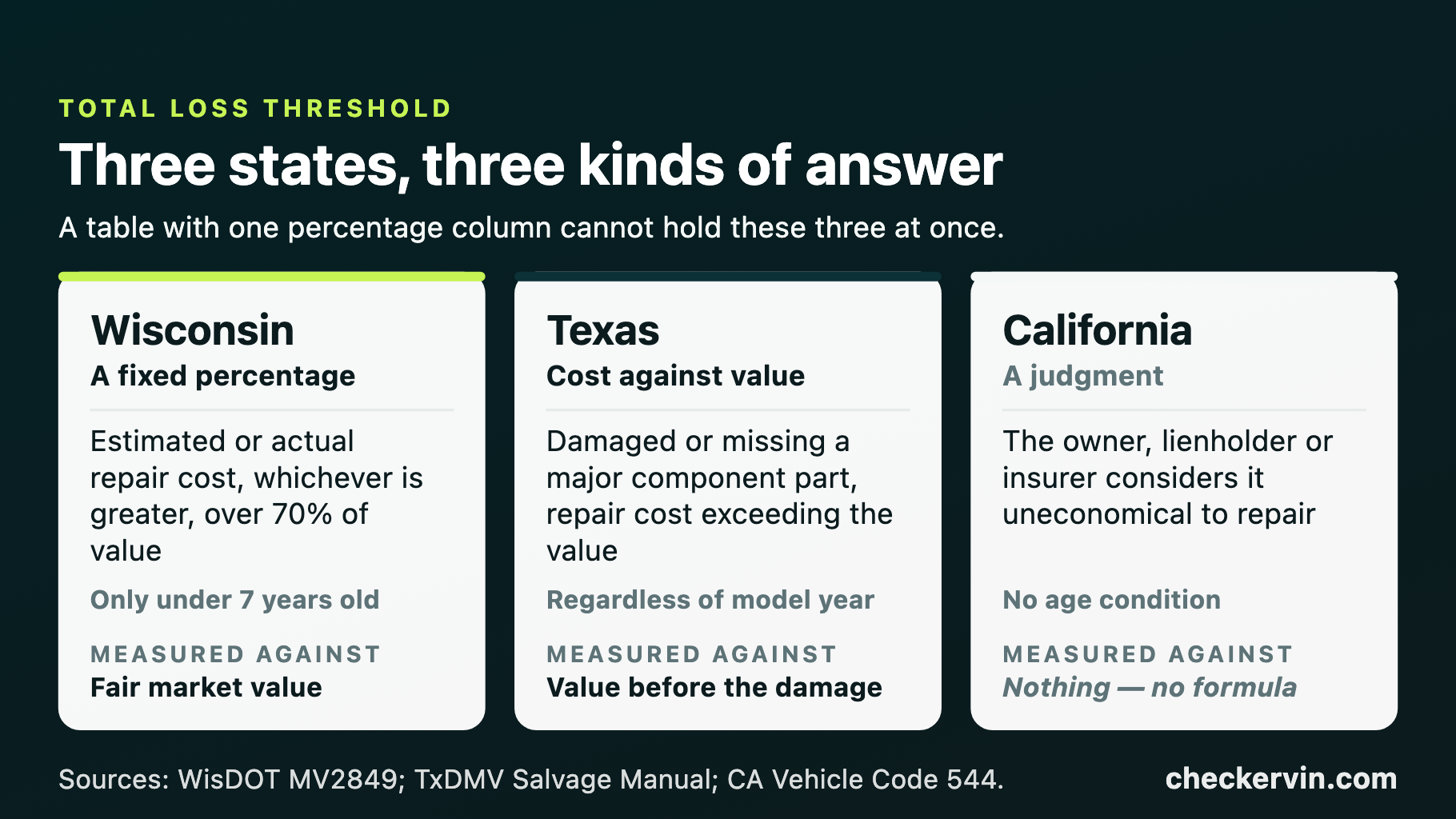
Those three are not points on a scale. A 70 percent rule and an over-100-percent rule differ by calibration; a judgment standard differs by category. You cannot convert California's test into a percentage without inventing one, which is exactly what the tables do. Our California title check covers what that changes about reading a Californian brand.
What counts as the cost of repairs
Suppose two states both used 70 percent. They could still brand different cars, because the numerator is not the same quantity.
Wisconsin's form specifies the estimated or actual repair cost, whichever is greater. That phrasing matters: an estimate that came in high does not stop counting because the eventual repair was cheaper, and a repair that ran over does not stop counting because the estimate was low. Whichever number is larger is the one measured against the threshold.
Texas takes the opposite kind of care, by carving items out. The comparison is to the cost of repair including parts and labor — but the state's salvage manual excludes the cost of materials or labor for repainting the vehicle, and excludes sales tax on the total cost of repairs. On a car with extensive panel damage, repainting is not a rounding error. Removing it, and removing the tax, can move a borderline vehicle back across the line.
What counts as the value
The denominator varies too, and the variation is not cosmetic.
| Value standard | What it means in practice |
|---|---|
| Fair market value | What the vehicle would trade for. Wisconsin's salvage, flood and hail brands are all measured against fair market value. |
| Actual value immediately before the damage | The vehicle's value at the moment before the event, which is how Texas frames the comparison — a pre-damage snapshot rather than a general market figure. |
| Actual cash value | The phrase most insurance policies use, typically market value with depreciation applied. It appears throughout the Texas salvage manual's historical provisions. |
| No value standard at all | Where the test is a judgment about whether repair was economical, the statute never has to define the value it was weighed against. |
These are close enough to sound interchangeable and far enough apart to change outcomes, particularly on older vehicles where market value and depreciated value diverge. If you are disputing a total loss decision, the value standard your state's rule names is worth reading before the percentage is.
The age gate nobody puts in the table
Here is a variable the percentage tables almost never carry, and it decides cases outright.
Wisconsin's salvage brand applies only where the vehicle is less than seven years old. A ten-year-old car in Wisconsin, damaged well past 70 percent of its fair market value, does not meet that brand's definition — the age condition is part of the test, not a footnote to it.
Texas runs the other way and says so explicitly: its salvage and nonrepairable definitions apply regardless of the model year. The manual records that this was a deliberate change — before September 2003, Texas did have a seven-year gate, and the amended definitions removed it.
Wisconsin is not uniformly age-gated either, which is the sort of detail that survives only if you read the form. Its salvage and hail brands both carry the seven-year condition. Its flood brand does not — flood damage is defined purely by repair cost against fair market value, with no age limit at all.
Hail: the same event, two opposite answers
If you want a single example that shows the tables cannot work, use hail.
Wisconsin has a dedicated Hail Damage brand: a vehicle under seven years old, damaged by hail to the extent that the estimated or actual repair cost, whichever is greater, exceeds 70 percent of fair market value. Cross that line in Wisconsin and the title says so permanently.
Texas excludes it. Its salvage definition specifically does not include a motor vehicle for which an insurance company has paid a claim for the cost of repairing hail damage. The insurer can pay a very large hail claim and the vehicle does not become a salvage motor vehicle on that basis.
So the identical storm, the identical car, the identical repair bill produces a branded title in one state and an unbranded one in the other — and no percentage column can express that, because the disagreement is not about where the line sits. It is about whether this kind of damage is on the map at all. Our branded title guide covers how the categories differ more generally.
The brand below the threshold
The tables assume branding is binary: under the threshold nothing happens, over it the car is salvage. Wisconsin shows that assumption is wrong.
Alongside its 70 percent salvage brand, Wisconsin carries an Insurance Claim Paid brand for a vehicle under seven years old that was transferred to the insurer on payment of a claim for damages of 30 percent through 70 percent of fair market value. That is a permanent mark on the title of a car that was never a total loss — it sits entirely below the salvage line.
For a buyer this is unusually good news, because it means a whole band of significant damage that most states leave invisible is written on the document in Wisconsin. For anyone reading a threshold table it is a warning: the number in the column describes one line on a document that may have several.
- A brand can exist below the salvage threshold, so an unbranded title is not the only good outcome to look for
- A state can brand by cause — flood, hail — separately from branding by cost
- Some brands carry an age condition and others in the same state do not
- Reading the state's own brand list beats reading any comparison table
When no percentage governs at all
California is the clearest case, and it is worth quoting the structure rather than paraphrasing it. Its Vehicle Code defines a total loss salvage vehicle as either a vehicle wrecked, destroyed or damaged to the extent that the owner, leasing company, financial institution or insurer considers it uneconomical to repair — and because of that, the vehicle is not repaired for the person who owned it — or a vehicle determined uneconomical to repair for which a total loss payment has been made, whether or not the vehicle is subsequently repaired.
There is no percentage in either branch. The test is what the paying party concluded, plus what then happened to the car. A table that prints a percentage for California is printing something the statute does not contain.
Texas has a second, quieter example of the same thing. Its nonrepairable category — the tier above salvage, for vehicles that cannot return to the road — is defined first by damage to the extent that the only residual value is as a source of parts or scrap metal. That is a qualitative test, and the other routes into the category are procedural rather than numeric: an out-of-state junk document, a dealer report, an owner surrendering ownership for dismantling, or a vehicle sold for export only.
What the federal record does with all this
Above the state rules sits a federal reporting duty, and it is worth knowing what it does and does not capture, because it is what a national history report is drawing on.
Insurance carriers must file a monthly inventory of the junk and salvage automobiles they took possession of. Two features of that duty matter here. First, it covers automobiles of the current model year or any of the four prior model years — a five-model-year window, so an older car totaled by an insurer is not swept up by that particular obligation. Second, the required fields are identifying ones: the VIN, the dates, who the vehicle came from, who owned it at filing. Telling the system why — flood, fire, collision, theft and recovery — sits in a separate paragraph that says carriers are only strongly encouraged to provide it.
So the federal layer records that a total loss happened, within an age window, without being required to record what kind. The state threshold decided whether a brand attached; the federal record notes the event. Neither tells you what the damage was. That gap is why our auction history guide exists — the photographs taken at intake are the only part of this system that shows you the car.
What it means when you are buying
Translate all of this into the practical question: you are looking at a car with a clean title, and you want to know what that clean title is worth as evidence.
- 1Find out which state issued the title, and whenThe rules that governed the branding decision are the issuing state's, not yours, and not the state the car sits in now.
- 2Check whether that state has an age gateIf the car was outside the age window when the damage happened, a brand could not attach however severe it was. The clean title carries much less information.
- 3Check whether that state brands by causeFlood and hail are separate brands in some states and excluded from salvage in others. A clean title in an excluding state says nothing about weather damage.
- 4Look for brands below the salvage lineWhere a state carries something like an Insurance Claim Paid brand, its absence is genuinely informative. Where it does not, mid-range damage leaves no title trace at all.
- 5Then stop reasoning from rules and check the carBuy the federal record, screen free through the NICB, search the auction listing archives, and inspect the structure. The thresholds tell you what a document can mean, not what happened.
What it means if your car was just totaled
If you are on the other side of this — an insurer has declared your car a total loss and you think the call was wrong — the threshold is where most people start arguing and it is usually the weakest ground.
The stronger ground is the two quantities. If your state measures against fair market value, the value figure the insurer used is contestable with comparable sales. If your state excludes certain items from the repair cost — Texas excludes repainting materials and labor, and sales tax on the total repair — then an estimate that included them was computed on the wrong basis. And if your state uses a judgment standard rather than a percentage, there is no arithmetic to dispute, which changes the conversation entirely.
Whether the vehicle is inside an age gate can also decide the branding question separately from the settlement question. Being paid a total loss settlement and having a brand attach to the title are two different events, governed by different rules, and they do not always both happen. Our damage reported guide covers what does and does not reach a report.
Three states, read from the source
Rather than reproduce a fifty-row table we cannot stand behind, here are three states read directly from the state's own statute or form, chosen because they use three different instruments. Every other state has its own rules, and where we have read them they are on that state’s own page, linked below.
| State and instrument | What the source actually says |
|---|---|
| Wisconsin — fixed percentage | Salvage: under seven years old, and the estimated or actual repair cost, whichever is greater, exceeds 70 percent of fair market value. Hail: same test, same age gate. Flood: same cost test, no age gate. Insurance Claim Paid: under seven years, transferred to the insurer on a claim for damages of 30 through 70 percent of fair market value. |
| Texas — cost measured against value | Salvage: any model year; damaged or missing a major component part to the extent that the cost of repair, including parts and labor, exceeds the actual value immediately before the damage. Repainting materials and labor, and sales tax on the repair, are excluded from that cost. Paid hail claims are excluded from the category, as are theft claims unless the vehicle was damaged during the theft beyond its value. Nonrepairable: only residual value is as parts or scrap. |
| California — a judgment, not a calculation | Total loss salvage vehicle: wrecked, destroyed or damaged to the extent that the owner, leasing company, financial institution or insurer considers it uneconomical to repair, and the vehicle is consequently not repaired for its owner; or determined uneconomical to repair with a total loss payment made, whether or not the vehicle is later repaired. No percentage appears in the definition. |
Checking an actual car
Thresholds explain what a document can mean. They cannot tell you about a particular vehicle, and no amount of reading them substitutes for checking one. Decode the VIN free for the factory build and specifications. Check open recalls through NHTSA at no cost. Screen for theft and total-loss records through the NICB. Buy the national NMVTIS record for title brands and reported total losses. Search the auction listing archives for pre-repair photographs. Then inspect the car.
Where this information comes from
- TxDMV — Salvage/Nonrepairable Motor Vehicle ManualThe salvage and nonrepairable definitions, the major component part test, the repainting and sales tax exclusions, and the paid-hail-claim carve-out
- Wisconsin DOT — Form MV2849, title brand notificationThe 70 percent threshold, the estimated-or-actual wording, the seven-year gate, and the 30 to 70 percent Insurance Claim Paid brand
- California Vehicle Code § 544 — total loss salvage vehicleThe definition that contains no percentage, turning instead on whether repair was considered uneconomical
- 28 CFR 25.55 — responsibilities of insurance carriersThe monthly total-loss report, its five-model-year window, and the reason for the loss being encouraged rather than required
- NMVTIS — official vehicle history recordThe federal title, brand and total-loss record, and the approved provider list
- NICB — VINCheckFree screen for theft and total-loss records reported by participating insurers
Keep reading
Frequently asked questions
What is the total loss threshold in my state?
That question has an answer only if your state uses a percentage, and not every state does. California's statutory definition of a total loss salvage vehicle contains no percentage at all — it turns on whether the insurer considered repair uneconomical. Texas compares repair cost against the vehicle's value before the damage, which works out as over 100 percent. Wisconsin uses 70 percent of fair market value with a seven-year age gate. Three states, three different instruments.
Why do the total loss threshold tables online contradict each other?
Because they compress three different legal instruments into one column of percentages. A state that uses a fixed percentage, a state that compares repair cost to value, and a state that leaves it to the insurer's judgment cannot be represented by the same kind of number. Once the tables force a percentage into every row, states without one get a figure that is not in their statute, and states with more than one get whichever the compiler picked.
Does a lower threshold mean more cars get branded?
Usually, but the percentage alone will not tell you, because the two quantities it compares are also defined differently. Wisconsin measures the estimated or actual repair cost, whichever is greater, against fair market value. Texas measures repair cost including parts and labor — but explicitly excluding repainting and sales tax — against the vehicle's value immediately before the damage. The same wreck can produce different ratios before any threshold is applied.
Is a car branded in one state still branded in another?
The brand should follow the vehicle, and the federal NMVTIS system exists largely to make sure it does. But the thresholds that created the brand are the originating state's, so a car branded under a 70 percent rule and a car branded under an over-100 percent rule can carry similar-looking brands describing very different amounts of damage. The brand tells you a line was crossed; it does not tell you where the line was.
Does CheckerVIN tell me whether a car was totaled?
Not today. Our free lookup returns the factory build, specifications and open safety recalls. Accident, title and odometer history are launching soon. For a total-loss or title-brand record right now, buy the federal NMVTIS record from an approved provider and screen free through the NICB first.
Start with the VIN
Decode any VIN free for the factory build, specifications and open safety recalls. No account, no card.
Run a free VIN check