The short answer
- Is it free?
- Yes — no account, no card, no key. It is a public record, which is why so many free decoders read the same data.
- What does it return?
- The build the manufacturer filed, across 144 variables. A given VIN populates a fraction of them.
- What does it not return?
- History of any kind — no accidents, no title brands, no odometer, no owner. Those live elsewhere.
15
Result codes in the catalog
3 of them are warnings
144
Variables in the response
Most VINs populate a fraction
12,340
Makes filed with the agency
Why a printed chart cannot work
What the tool actually is
Two things share the name. There is a web page where you type a VIN and read a table, and there is an open interface that returns the same information as structured data. They are fed by the same records: what manufacturers file with the agency about the vehicles they build for this market.
Neither needs an account, a card or a key. That is unusual enough to be worth stating plainly, because a great deal of the paid VIN industry is built on top of it. When a free decoder tells you the make, model, engine and plant of a car, it is very often reading this and re-presenting it — which is fine, and worth knowing when you are deciding what a service is actually charging you for.
Check any VIN free
Decoded from official manufacturer and NHTSA records
144 variables, and 12,340 makes
Two numbers describe the tool better than a paragraph does, and both are queryable.
| What the agency publishes | How many |
|---|---|
| Variables a decode response is structured around | 144 |
| Makes filed with the agency | 12,340 |
The first explains why a decode looks sparse. The response has a slot for restraint types, plant details, engine configuration, weight ratings and dozens more — but a slot is only filled if the manufacturer filed that detail for that vehicle. Blank fields are usually unfiled data rather than absent equipment, and reading them as absent equipment is the most common way people misuse the result.
The second is the argument against every printed decoder chart in existence. 12,340 makes is not a list anybody memorizes or reprints; the charts that circulate cover perhaps a few dozen mainstream marques and fail silently on the rest, returning something plausible rather than nothing.
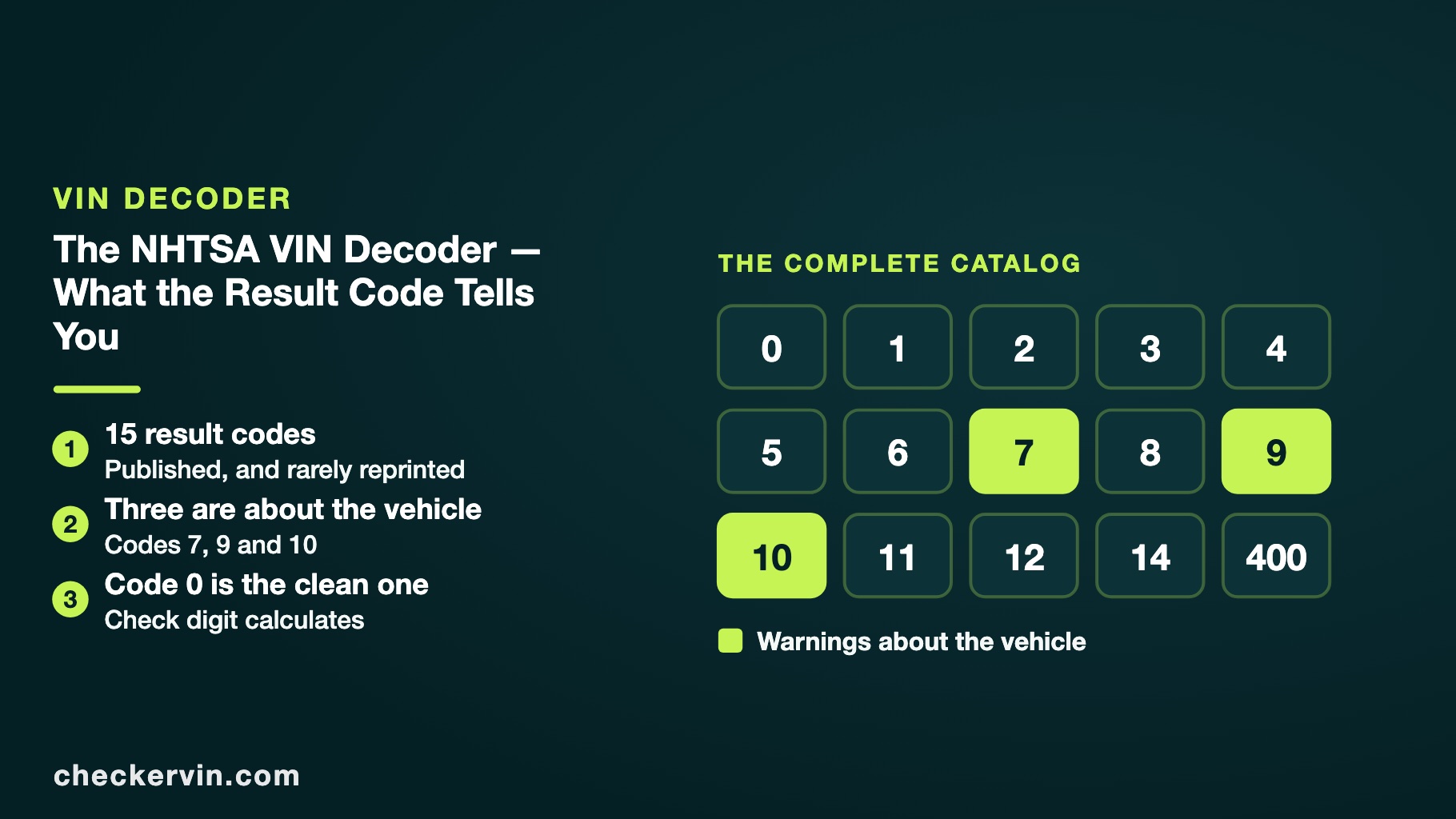
The fifteen result codes, in full
Here is the part that is genuinely hard to find. Every decode comes back with a result code, and the agency publishes the complete catalog of them. Most consumer decoders show you the decoded fields and quietly discard the code — which throws away the only field that tells you how much to trust the rest.
| Code | What it means |
|---|---|
| 0 | VIN decoded clean. Check Digit (9th position) is correct |
| 1 | Check Digit (9th position) does not calculate properly |
| 2 | VIN corrected, error in one position |
| 3 | VIN corrected, error in one position (assuming Check Digit is correct) |
| 4 | VIN corrected, error in one position only (indicated by ! in Suggested VIN), multiple matches found |
| 5 | VIN has errors in few positions |
| 6 | Incomplete VIN |
| 7 | Manufacturer is not registered with NHTSA for sale or importation in the U.S. for use on U.S roads |
| 8 | No detailed data available currently |
| 9 | Glider Warning |
| 10 | Off-Road Vehicle Warning |
| 11 | Incorrect Model Year — Position 10 does not match valid model year codes (I, O, Q, U, Z, 0) |
| 12 | Model Year Warning — model year entered for decoding does not match the 10th position |
| 14 | Unable to provide information for some of the characters in the VIN, based on the manufacturer submission |
| 400 | Invalid Characters Present |
Read them as three groups rather than fifteen items. Code 0is the clean result. Codes 1 through 5 are about the number having something wrong with it that the decoder can sometimes work around. Codes 7, 9 and 10 are not about the number at all — they are about the vehicle, and they are the ones worth stopping on.
The three codes that are warnings about the vehicle
Most result codes describe a problem with what you typed. Three describe a problem with what you are looking at, and on a page about buying a car those are the important ones.
| Code | What it is telling a buyer |
|---|---|
| 7 | The identifier was never filed with the agency for US sale or importation |
| 9 | The number does not identify a motor vehicle in the federal sense — it is a glider |
| 10 | The manufacturer did not certify the product to the federal safety standards |
None of the three means the vehicle is stolen or fraudulent. All three mean the thing in front of you is not the ordinary US-market motor vehicle a buyer usually assumes, and the difference has consequences for titling, registration and insurance that are worth resolving before money moves rather than after.
Code 7 in particular has an innocent explanation most of the time. It appears on vehicles that predate the modern standard, and on vehicles built for other markets. Our pages on classic trucks and imported cars cover those two cases in detail.
Glider and off-road, in the agency's own words
Codes 9 and 10 are worth quoting in full, because both cite the statute and both say something more precise than a summary would.
A glider is a vehicle assembled from a new body and chassis around a used powertrain. The agency’s position, stated in the error text itself, is that such a thing is not a motor vehicle under 49 U.S.C. § 30102(a)(6) and cannot carry a VIN meeting 49 CFR Part 565. If you are being sold something described as a new truck and the decoder returns this, the two statements are not compatible.
This is the one that catches buyers of side-by-sides, utility vehicles and similar machines. The number on the machine looks like a VIN and is not one, because the manufacturer did not certify the product to the Federal Motor Vehicle Safety Standards. It is not a defect — the machine was never meant for the road — but it decides whether the thing can be registered, and our ATV VIN lookup covers what applies instead.
Codes 1 to 5: what the check digit is doing
The middle band of codes all concern the ninth character, which is not part of the vehicle’s description at all. It is a check digit — a value computed from the other sixteen characters so that a single mistyped or transposed character produces a number that fails arithmetic.
| Code | What the decoder did |
|---|---|
| 1 | Noticed the check digit does not calculate, and told you rather than guessing |
| 2 and 3 | Found a single-position error and corrected it |
| 4 | Corrected one position but found multiple matches — it marks the corrected character with an exclamation point |
| 5 | Found errors in several positions and could not resolve them |
| 11 | Position ten is not a valid model year code — the letters I, O, Q, U, Z and the digit 0 are never used |
The practical value is in code 1. A VIN copied off a listing, a text message or a photograph is the most common source of a failed check digit, and the fix is almost always to read the number off the vehicle again rather than to distrust the vehicle. Where a number read carefully off the car itself still fails, that is a different and more serious conversation — see VIN cloning.
The mechanics of the calculation, and the reason three letters never appear anywhere in a VIN, are on how to read a VIN.
Three decodes, three different codes
The catalog is easier to read against real results. Below are three numbers put through the live interface, chosen because each returns a different code.
| What was decoded | Code and result |
|---|---|
| A current-model VIN, complete | 0 — 68 of 154 fields — make, model, year, trim, body class, engine, plant |
| The first eight characters and a wildcard | 6 — 44 fields — make, model, manufacturer and vehicle type, flagged incomplete |
| A 13-character pre-1981 truck number | 6, 7 — 4 fields — nothing usable, and the manufacturer is not on file |
Notice how much survives a partial number. Eight characters and a wildcard still returned the make, the model, the manufacturing company and the vehicle type — enough to confirm you are looking at the vehicle an advertisement claims, though not enough for the model year, which lives in position ten.
The third row is the one worth internalizing. Four populated fields out of 154 is not a broken tool. It is the decoder reporting that this number predates the system it searches, which is exactly what codes 6 and 7 say together.
Beyond the decoder: what else the interface answers
People searching for the federal decoder usually want one VIN decoded. The interface behind it answers a wider set of questions, and several of them are more useful than a single decode when you are checking a listing rather than a car.
| What you can ask for | What comes back |
|---|---|
| DecodeVinValues | One VIN in, the decoded fields out — the endpoint behind most free decoders |
| DecodeWMI | The first three characters alone: who filed the identifier, for what vehicle type, in which country |
| GetModelsForMakeYear | Every model a make filed in a given model year |
| GetWMIsForManufacturer | Every identifier a manufacturer has on file |
| GetAllMakes | The full list of makes |
| GetVehicleVariableValuesList | The permitted values for a field — including the result codes above |
The middle two are the ones that settle arguments. Asking which models a make filed in a given model year is how you test whether a nameplate existed when a listing says it did — the check behind our Lincoln and Pontiac pages. Asking which identifiers a manufacturer filed is how you find out that some marques file none at all, because they are divisions rather than companies.
What the federal decoder will never tell you
This is the limit that matters most, and it is structural rather than a gap somebody intends to fill. The agency’s vehicle data describes what manufacturers built. It does not describe what happened to any particular car afterward.
- Any accident or damage history
- Any title brand — salvage, flood, rebuilt or lemon
- Any odometer record
- Any theft or recovery record
- Who owns the vehicle, or who has owned it
- What the vehicle is worth
Those records exist, but they are fed by states, insurers, salvage yards and auction houses rather than by manufacturers, and they live in different systems with different access rules. A clean decode with result code 0says the number is consistent and recognized. It says nothing whatever about the car’s past.
Using it well, in five steps
The decoder rewards a little discipline, mostly around where the number comes from.
- 1Take the VIN off the vehicle, not the advertisementWindshield base and door-opening label, compared character by character. Most failed check digits are transcription errors from a listing.
- 2Read the result code before the fieldsCode 0 means the rest is trustworthy. Anything else changes how much weight the decoded fields carry.
- 3Treat blank fields as unfiled, not absentA missing transmission or horsepower value usually means the manufacturer did not file it, not that the car lacks the feature.
- 4Check the recalls in the same sittingCampaigns are matched to the VIN, the remedy is free, and it is the highest-value thing you get for nothing.
- 5Then go and buy the historyThe build record cannot answer the questions in the list above. That is a separate search and the one worth paying for.

Where this information comes from
- NHTSA vPIC — VIN decoding APIThe open interface behind the decoder, and the source of every figure on this page
- NHTSA vPIC — result code catalogThe complete list of 15 codes, reproduced above in the agency's wording
- NHTSA vPIC — variable listReturns 144 variables
- 49 CFR Part 565 — Vehicle identification number requirementsThe rule the glider warning refers to
Frequently asked questions
Is the NHTSA VIN decoder free?
Yes, and it needs no account, no card and no API key. The agency publishes both a web decoder and an open interface that anyone can query, which is why so many free decoders — this site included — are reading the same federal data underneath. Nobody is licensing it to you; it is a public record.
What does the NHTSA VIN decoder tell you?
What the manufacturer filed about how the vehicle was built. The response is structured around 144 variables — make, model, model year, body class, vehicle type, engine configuration and displacement, plant location, restraint systems, gross vehicle weight rating and more. A given VIN populates a fraction of them, because manufacturers file different amounts of detail.
What does error code 0 mean on a VIN decode?
That the VIN decoded cleanly and the check digit in the ninth position calculates correctly. It is the result you want. It is not a statement that the vehicle is in good condition or that its history is clean — it is a statement that the number itself is internally consistent and the database recognized it.
Why does the decoder say the manufacturer is not registered with NHTSA?
That is error code 7, and it means the identifier in the number was not filed with the agency for sale or importation into the United States. On a vehicle that predates the modern VIN standard, or on one built for another market, that is expected and says nothing bad about the vehicle. On a car being sold to you as an ordinary US-market vehicle, it is a question worth resolving before any money moves.
What is a Glider Warning?
Error code 9. In the agency's own words, a glider "is not a 'motor vehicle', as defined in 49 U.S.C. 30102(a)(6), and cannot be assigned a VIN that meets 49 CFR Part 565 requirements." If a decode returns that, the number you typed does not identify a motor vehicle in the federal sense, whatever the seller has told you.
Does the NHTSA decoder show accidents or title history?
No, and it never has. It decodes the number into the build the manufacturer filed. Accidents, title brands, odometer records and theft records are held in entirely different systems, most of them fed by states and insurers rather than by manufacturers. A clean decode is not a clean history and the two are not substitutes.
Why does a decoder chart disagree with the NHTSA result?
Because a chart cannot hold the material. The agency's own list of makes runs to 12,340 entries. Any printed or memorized chart is a small sample of that, usually built around a handful of mainstream marques, and it fails silently on everything else by returning something plausible instead of nothing.
Keep reading
Decode a VIN free, on the same federal data
Factory build, specifications and open safety recalls. No account, no card, no key.
Run a free VIN check