The short answer
- Can a VIN check spot a clone?
- No. The number is a real one from a real car, so the history that comes back is real — it just isn't this car's.
- What does catch it?
- Comparing the number across the places the car carries it. Federal law puts it on the dash, the door and, on many lines, up to eighteen major parts.
- What is at stake?
- Florida's motor vehicle department says the vehicle is confiscated and you remain responsible for any outstanding loan.
Clean
What the lookup returns
Correctly, about the wrong car
60 yrs
How long a VIN must stay unique
From the 1980 model year
18
Major parts marked on covered lines
Federal theft prevention standard
Confiscated
The vehicle, if discovered
And the loan stays yours
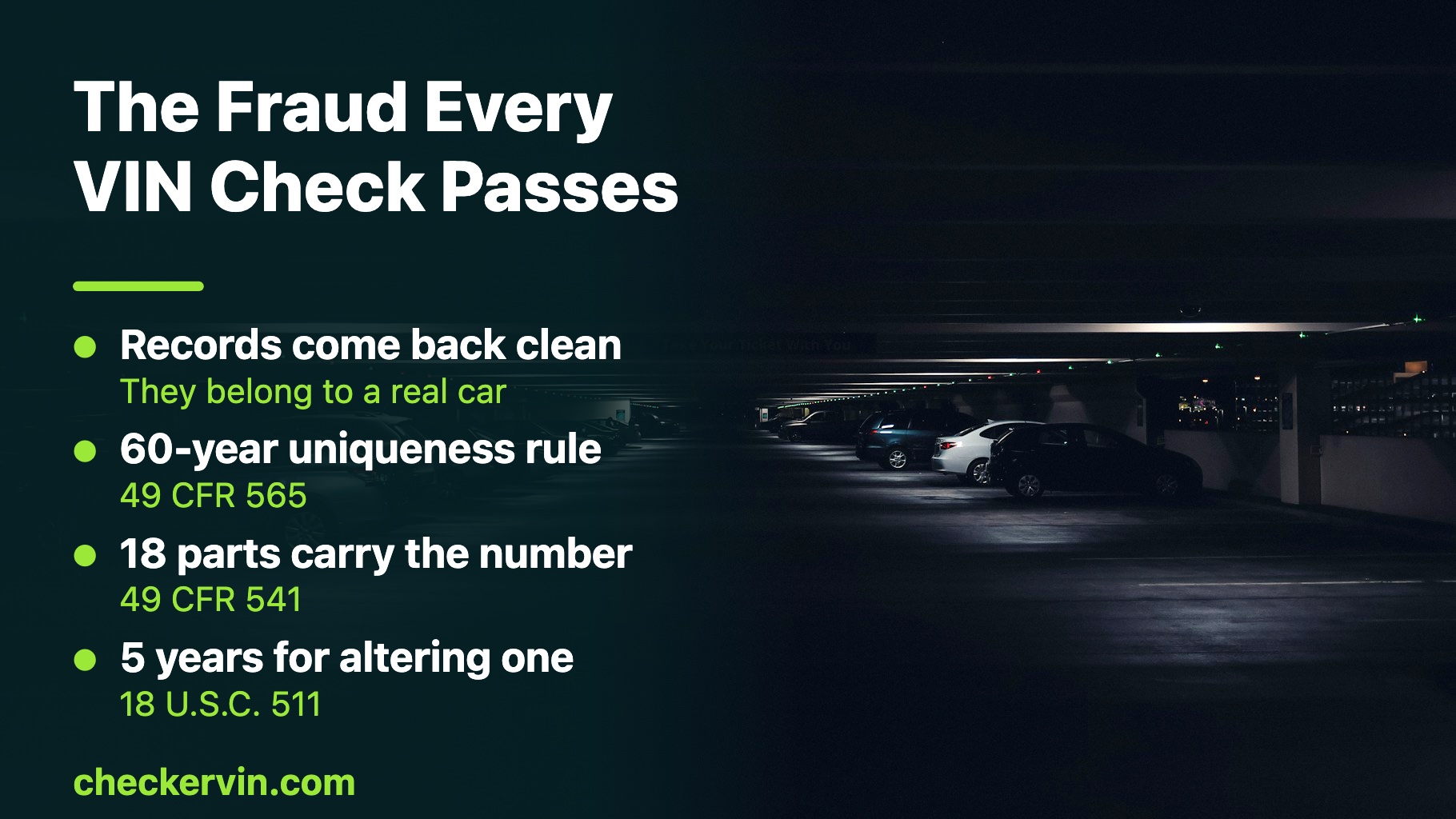
What cloning actually is
Florida’s Department of Highway Safety and Motor Vehicles describes vehicle cloning as an elaborate scheme involving stolen vehicle identification numbers, counterfeit VIN tags and fraudulent documents. The mechanism is simple enough to state in a sentence: take a stolen vehicle, give it the identity of a legitimate vehicle of the same year, make and model that is still registered and on the road somewhere else, and sell it to someone who checks the paperwork.
Everything the buyer verifies belongs to the donor car. That is not a flaw in the buyer’s diligence. It is the point of the exercise, and it is why this particular fraud defeats the checks that catch almost everything else.
Why the records come back clean — ours included
We would rather say this ourselves than have a reader discover it. Run a cloned vehicle’s VIN through our free decode and it will return a clean, coherent, entirely accurate result: the right year, make, model, engine and plant, a valid check digit, and whatever recall status the number carries. Every one of those statements will be true. None of them will be about the car in front of you.
The same is true of a paid history report, a title record, a theft screen and a recall lookup. They are all keyed on the number, and the number is genuine. A record system cannot distinguish two physical objects wearing the same identity — that is a question about objects, and the answer is not in any database.
Cloning, VIN swapping, re-vinning: one statute, three street names
People search for this under several names and they do not mean quite the same thing. It is worth separating them, because the difference decides which check finds the problem — and because the federal statute that governs all of it uses none of the three words.
| The street term | What is physically done |
|---|---|
| VIN cloning | A legitimate vehicle's number is copied onto a stolen one. The donor car is still on the road and its records are genuinely clean |
| VIN swapping | Plates, labels or stamped numbers are moved or substituted so a vehicle wears an identity that is not the one it was built with |
| Re-vinning | A wrecked or salvaged vehicle's identity is transferred onto a different car, so a stolen shell inherits a real title history |
The overlap is large and the boundaries are soft, which is why the words get used interchangeably in forums and listings. What is not soft is the conduct the law describes, and it is worth reading the statute rather than the vocabulary.
One consequence matters to a buyer more than the taxonomy does. Cloning leaves the donor vehicle untouched and its records intact, so the records you pull are real and belong to a car that is fine. Swapping and re-vinning involve physical work on the vehicle in front of you — which means, unlike cloning, they leave marks. That is the opening the rest of this page uses.
The uniqueness the law requires, and the plate it lives on
Federal law is explicit that this identity is supposed to be one-to-one. Under the VIN rules in 49 CFR 565, the VINs of vehicles subject to the federal safety standards and manufactured within a 60-year period beginning with the 1980 model year shall not be identical. A clone is, by definition, a violation of that requirement — two vehicles wearing one number.
The rule also tells you where to look. The plate or label carrying the VIN must be permanently affixed inside the passenger compartment, and it must be readable without moving any part of the vehicle, through the glazing, in daylight, by an observer with 20/20 vision standing outside next to the left windshield pillar — with each character at least 4 mm high.
That is the plate every buyer looks at, and its accessibility is exactly what makes it the one a cloner replaces. Florida’s guidance says to check it for evidence of tampering including scratches or other damage, which is sound as far as it goes. The stronger move is not to inspect that plate harder but to stop treating it as the car’s identity.
The database backstop, and the word the state uses
There is a systemic defense, and it is worth understanding along with its limits. The national title system links state motor vehicle departments, and as Florida puts it, if a car is titled in one state a criminal should not be able to steal its VIN and use it on another vehicle in another state — when a title is applied for, the database should alert motor vehicle offices that the number is already in use.
Note the state’s own choice of word, twice. It is a description of how the system is designed to behave rather than a guarantee that it always does, and a department writing its own consumer page is not hedging for fun. The backstop is real, it operates at the point of titling rather than at the point of sale, and it is not a substitute for looking at the car.
The redundancy that does catch it
The most useful federal rule here is one almost no buyer has heard of. The Federal Motor Vehicle Theft Prevention Standard, 49 CFR 541, specifies performance requirements for identifying numbers or symbols placed on major parts of certain passenger motor vehicles, and states its purpose directly: to reduce the incidence of motor vehicle thefts by facilitating the tracing and recovery of parts from stolen vehicles.
On a covered line, the identifying number appears on the major parts listed in the standard:
- Engine
- Transmission
- Right front fender
- Left front fender
- Hood
- Right front door
- Left front door
- Right rear door
- Left rear door
- Sliding or cargo door(s)
- Front bumper
- Rear bumper
- Right rear quarter panel (passenger cars)
- Left rear quarter panel (passenger cars)
- Right-side assembly (MPVs)
- Left-side assembly (MPVs)
- Pickup box, and/or cargo box (light duty trucks)
- Rear door(s), decklid, tailgate, or hatchback
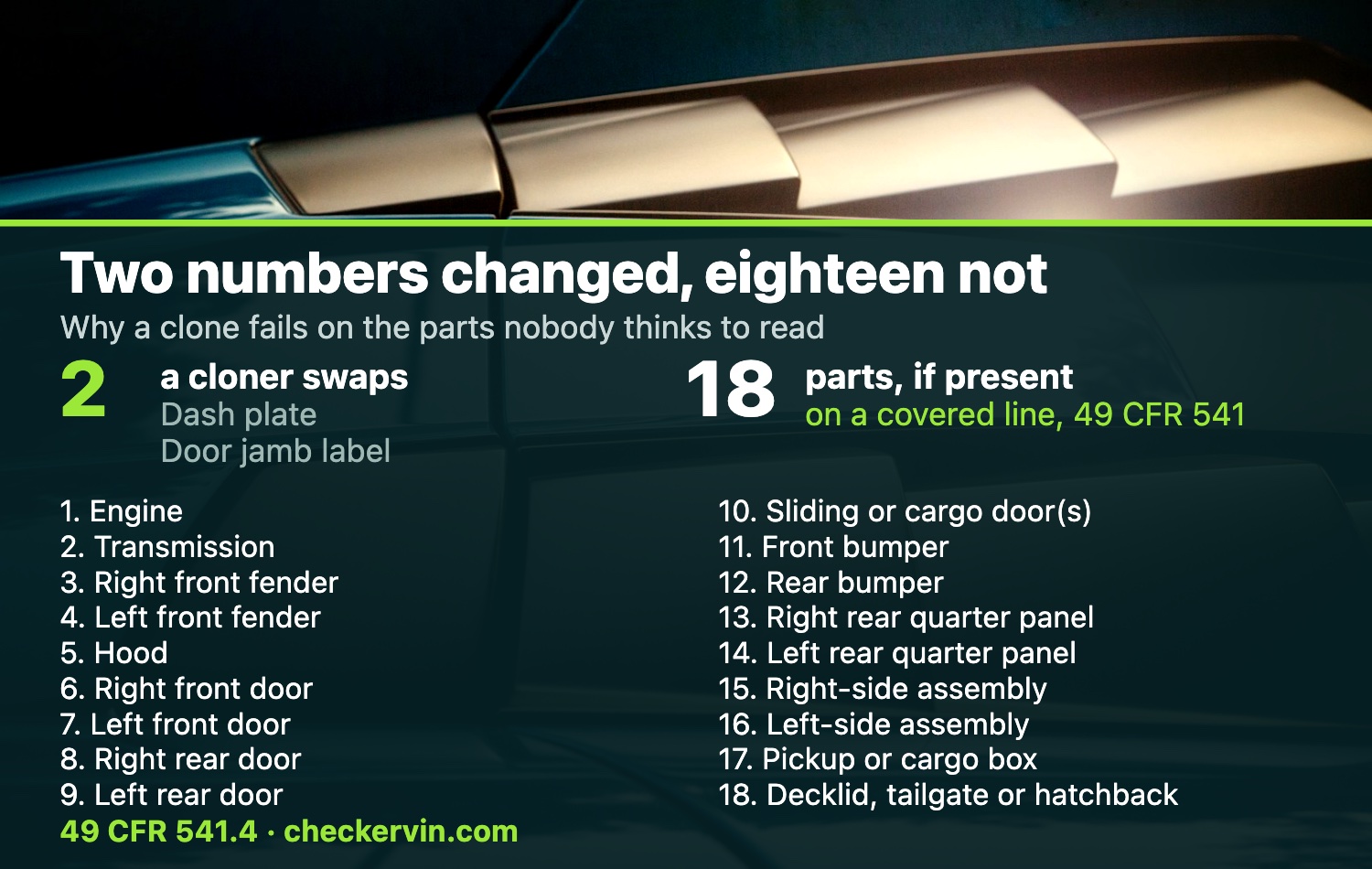
The standard also requires the marking to sit on a surface where it will not be damaged by the tools needed to install the part. The practical consequence for a buyer is the whole value of this page: a cloner can replace a dash plate and a door label in an afternoon. Replacing or re-marking every panel, both bumpers, the engine and the transmission is a different order of work, and it is why a clone tends to fail on the parts nobody thinks to look at.
Why a missing marking proves nothing on its own
The honest qualification, and it matters because acting on a false positive here means accusing someone of a felony. Not every vehicle is parts-marked.
| Situation | Whether parts marking applies |
|---|---|
| Covered high-theft line | Yes — the major parts above carry the identifying number |
| Manufacturer building fewer than 5,000 US vehicles a year | Excluded by the standard |
| A line producing not more than 3,500 vehicles a year | Excluded by the standard |
| Lines with qualifying antitheft devices | May be exempted by petition, listed in the standard's own appendix |
So an absent marking can mean a clone, or it can mean an exempt vehicle. A mismatched marking is the finding — a number on a fender or an engine that disagrees with the dash plate is not something an exemption explains. When the two disagree, stop the transaction and take it to law enforcement rather than to the seller.
The federal crime, and the four exceptions that stop it being a false alarm
There is a specific federal offense here, and it sits in the criminal code rather than in the vehicle safety rules. Under 18 U.S.C. § 511, a person who knowingly removes, obliterates, tampers with, or alters an identification number for a motor vehicle or motor vehicle part shall be fined, imprisoned not more than five years, or both. The same penalty reaches anyone who tampers with a theft-prevention decal with intent to further a vehicle theft.
The section defines its terms narrowly rather than loosely: an identification number is a number or symbol inscribed or affixed for purposes of identification under the federal vehicle statutes — so it is the VIN and the parts markings this page has already described, not any number that happens to be on a car.
- A motor vehicle scrap processor, complying with applicable state law — defined as a business that buys vehicles or parts for reduction to metallic scrap, processing from a fixed location into prepared grades
- A motor vehicle demolisher, likewise under state law — a dismantler or recycler reducing vehicles to scrap unsuitable for use as a vehicle or a part
- A person repairing the vehicle or part, where the removal or alteration is reasonably necessary for the repair
- A person who restores or replaces an identification number in accordance with applicable state law
The third and fourth are the ones that protect an honest seller from your suspicion. A replaced or restored VIN plate is not evidence of a crime on its own — states run procedures for exactly that, usually after a repair or a rebuild, and a vehicle that has been through one carries paperwork saying so. The question to ask is not whether the number has ever been touched. It is whether the seller can produce the state documentation for why.
That is also the sharpest reason to stop the transaction and call law enforcement rather than confronting a seller. If the markings disagree and the explanation is a lawful restoration, there is a state record of it and no harm is done by checking. If they disagree and there is not, you are looking at conduct that carries five years.
What it costs to get this wrong
Most used-car mistakes cost you a repair bill. This one is categorically different, and Florida states the outcome without softening it: if you buy a cloned vehicle and its true pedigree is discovered, the car will be confiscated, leaving you responsible for any outstanding loans.
Read that twice, because the second half is the part people miss. The vehicle goes back to its rightful owner or their insurer. The finance agreement you signed does not go anywhere. You are left paying for a car you no longer have, and your recourse runs against a seller who was, by construction, not who they said they were.
If you think you have already bought one
The page so far assumes you are still deciding. Plenty of people arrive here after the money has moved — a registration that will not go through, a lender asking questions, a number that does not match once somebody finally looked. What follows is deliberately ordered, because the sequence changes how much of it you keep.
- 1Stop driving it, and do not have it repairedA vehicle whose identity is in question is one you may not be able to insure a claim on, and repair work can destroy the very markings that establish what it actually is. Leave the parts numbers alone — under 18 U.S.C. § 511 a repairer may lawfully alter a number where the repair reasonably requires it, and that is the last thing you want happening now.
- 2Write down every number before anyone else touches the carDash plate, door jamb label, and whatever parts markings you can read, photographed in place. If the car is later seized this may be the only record you control of what it was carrying when you had it.
- 3Report it to the state's fraud unit, in writingFlorida, as one example, routes suspected title and registration fraud through a named form to a Motor Vehicle Fraud Unit with a published address, phone, fax and email. Filing creates a dated record of you as the person who reported it rather than the person who was holding it.
- 4Contact law enforcement rather than the sellerThis is the same rule as before the sale and it matters more afterward. A seller who can be persuaded to take the car back is a seller who can also disappear with the evidence, and a private resolution does not undo a stolen vehicle's status.
- 5Tell the lender and the insurer yourselfFlorida's department is explicit that a confiscated vehicle leaves you responsible for any outstanding loan. Both relationships go better when you are the one who raised it, and both are likely to ask for the paperwork you gathered in step two.
- 6Get advice on recovery from whoever sold itRecovery runs against the seller, and how far it gets depends on whether they can be found and what they represented in writing. That is a question for a lawyer in your state rather than for a checklist — but the listing, the messages and the bill of sale are what any of it will be built on, so keep them.
The physical check, in order
- 1Read the dash plate through the windshieldIt is federally required to be readable from outside without moving anything. Note it down rather than photographing it and moving on — you are going to compare it several times.
- 2Open the driver's door and read the jamb labelA second placement, and the first one a hurried cloner may not have matched. Look at whether the label sits flat, whether the finish matches its surroundings, and whether the font is consistent.
- 3Find the parts markings and compare themEngine, transmission, fenders, hood, doors, bumpers, quarter panels. You are not looking for all eighteen — you are looking for two or three that you can read, and for whether they agree with the dash.
- 4Check the number on the paperwork against the number on the carRegistration, title and any service records. Florida's guidance calls out incorrect spellings on paperwork such as titles as a signal in their own right.
- 5If anything disagrees, stop and call law enforcementNot the seller. A mismatch between two federally required markings is not a clerical error to be explained away, and giving the seller the chance to explain gives them the chance to disappear.
The paperwork and pricing signals
Florida’s own list of tips is worth taking seriously because it comes from the agency that processes the fraudulent titles.
- A new or late-model vehicle with no lienholder in its ownership pattern — most cars of that age are financed, and an unencumbered one is worth a question.
- A price substantially below comparable makes and models, which is the recruitment tool for this entire scheme.
- Incorrect spellings on the title or other paperwork.
- Evidence of tampering on the dash VIN plate — scratches, damage, an adhesive line that does not match the vehicle's age.
- A seller who wants to meet away from the address on the documents, or whose name is not the name on the title.
- Pressure to complete quickly, which is the operational requirement of a fraud that fails once the number is queried at a titling office.
None of these is proof and several have innocent explanations. Two or three together on a car whose parts markings you have not been able to read is a different matter.
Where this information comes from
- FLHSMV — Vehicle CloningThe definition, the confiscation consequence, the national-database mechanism and the state's own list of buyer tips
- 18 U.S.C. § 511 — altering or removing motor vehicle identification numbersThe five-year offense, the definition of an identification number, and the four categories of lawful alteration in subsection (b)
- 49 CFR Part 541 — Federal Motor Vehicle Theft Prevention StandardThe purpose, the major parts list in § 541.4, and the small-manufacturer, low-volume and antitheft-device exclusions
- 49 CFR Part 565 — vehicle identification number requirementsThe 60-year uniqueness requirement, and the dash plate readable through the glazing with 4 mm characters
- NMVTIS — consumer information and approved providersThe federal title record the state describes as the systemic backstop
- NICB VINCheckFree theft and total-loss screen — worth running, and keyed on the number like everything else
Keep reading
Frequently asked questions
What is VIN cloning?
Florida's motor vehicle department describes it as an elaborate scheme involving stolen vehicle identification numbers, counterfeit VIN tags and fraudulent documents. A stolen car is given the identity of a legitimate, similar vehicle that is still on the road somewhere else, so the paperwork and the number both look ordinary.
Will a VIN check detect a cloned car?
No, and this is the part worth being blunt about, including about our own free decode. A VIN lookup returns records associated with that number — and the number belongs to a real, legitimate vehicle whose history is genuinely clean. The check is working correctly and returning true information about the wrong car. Detection has to come from comparing the number in several physical places, not from looking it up.
What is VIN swapping, and is it the same as cloning?
They overlap and are often used interchangeably, but they describe different physical work. Cloning copies a legitimate vehicle's number onto a stolen one, leaving the donor car untouched and its records genuinely clean. VIN swapping moves or substitutes the plates and labels themselves so a vehicle wears an identity it was not built with. Federal law uses neither word: 18 U.S.C. § 511 makes it an offense to knowingly remove, obliterate, tamper with or alter an identification number, punishable by up to five years.
Does the check digit catch it?
No. The check digit validates that a VIN is internally consistent, and a cloned VIN is copied from a real vehicle, so it is internally consistent by construction. A decoder confirming that the number is valid and that it describes the right year, make and model is confirming what the cloner intended it to confirm.
What happens if I buy a cloned car?
Florida's department states it plainly: if you buy a cloned vehicle and its true pedigree is discovered, the car will be confiscated, leaving you responsible for any outstanding loans. You lose the vehicle and keep the debt, which is why this is worth ten minutes of checking rather than a paragraph of reassurance.
Decode it, then go and compare it
Decode any VIN free for the factory build, specifications and open safety recalls. No account, no card. Full vehicle history reports are launching soon.
Run a free VIN check