The short answer
- What specs can you get from a VIN?
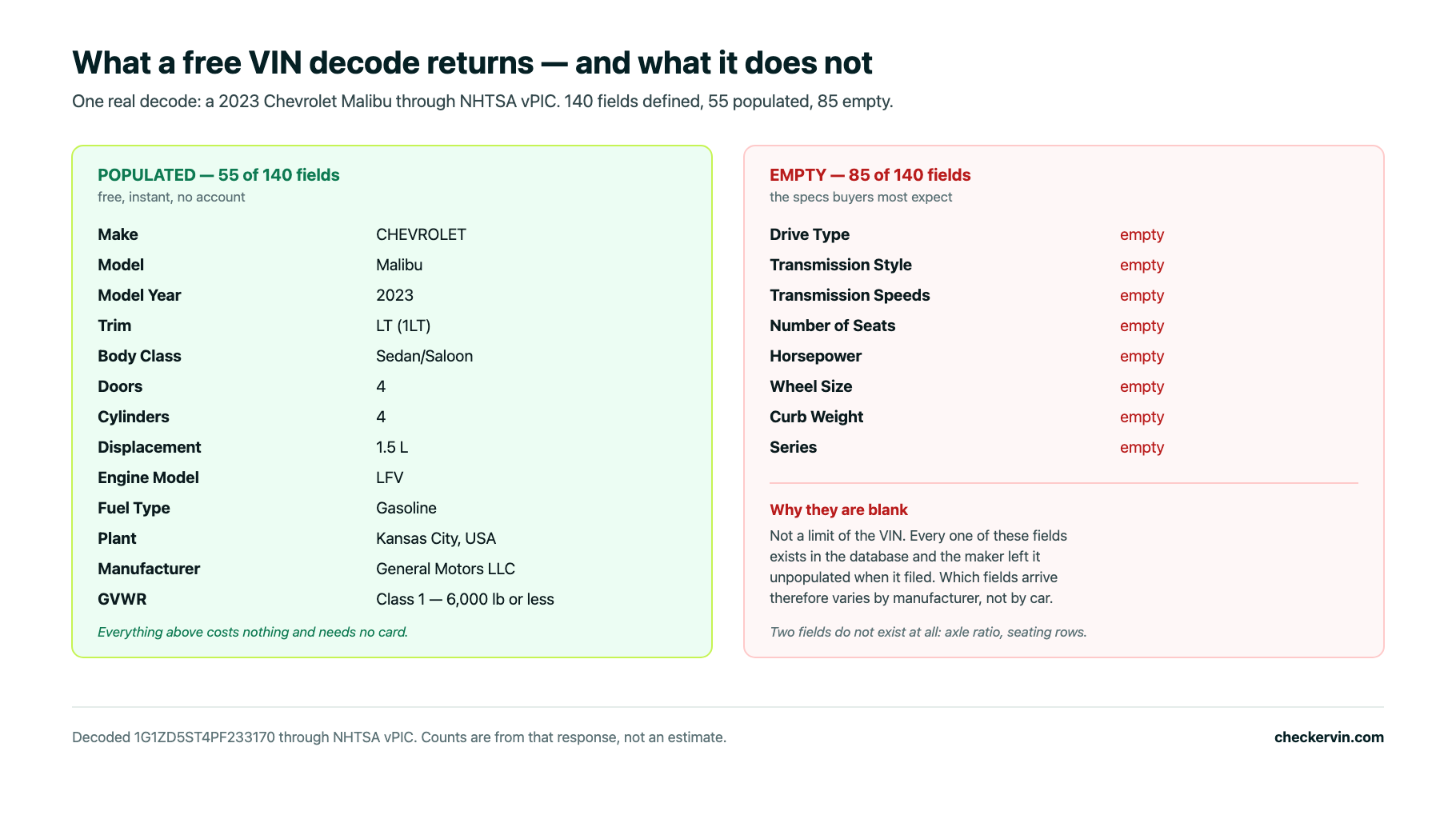
- Make, model, year, trim, body class, doors, engine size and cylinder count, fuel type, assembly plant and weight class — reliably, and at no cost. On the decode behind this page, 55 of 140 fields came back populated.
- What does it leave out?
- Drivetrain, transmission, number of seats, horsepower, wheel size and curb weight were all blank on that same decode. They are defined fields — the manufacturer simply did not fill them in.
- Where do the missing specs live?
- Towing capacity is on the door placard and in the maker's tow guide. Axle ratio is in the RPO or build sheet. Paint code is on its own sticker. None of the three is VIN-encoded at all.
140
Fields the database defines
for this vehicle
55
Fields that came back filled
the factory identity, complete
85
Fields that came back empty
left blank by the manufacturer
$0
What the decode costs
federal data, published openly
What actually comes back
The factory identity arrives complete and it arrives immediately. For the Malibu above, the decode returned the make, the model, the model year, the trim as the manufacturer designates it, the body class, the door count, the cylinder count and displacement, the specific engine model code, the primary fuel type, the assembly plant by city and country, the manufacturing entity, and the gross vehicle weight rating class.
That is a genuinely useful set. It settles what the car is, which is the question behind most spec lookups: confirming a listing matches the vehicle, checking the engine before ordering a part, or establishing the weight class before towing or registering something. None of it costs anything, because it is the manufacturer’s own filing to a federal regulator, published for the public to read.
| What the decode settled | The value it returned |
|---|---|
| Make, model, year | Chevrolet · Malibu · 2023 |
| Trim | LT (1LT), as the maker designates it |
| Body class and doors | Sedan/Saloon · 4 |
| Engine | 4 cylinders · 1.5 L · engine model LFV |
| Fuel type | Gasoline |
| Assembly plant | Kansas City, United States |
| Weight class | Class 1 — 6,000 lb or less |
The fields that come back empty
Now the part most spec pages skip. On that same decode, the following came back with no value at all: drive type, transmission style, transmission speed count, number of seats, engine brake horsepower, front wheel size, curb weight and series.
Read that list again, because it is close to a complete inventory of what people actually want from a spec lookup. Someone checking whether a car is front- or all-wheel drive, whether it is an automatic, whether it seats seven, or what it weighs will get nothing from the decode for this vehicle. That is not a failure of the tool. It is what the record contains.
Why they are empty, and why it varies by make
The federal database defines the field. Populating it is the manufacturer’s job, and compliance varies considerably between makers and across model years. One brand files a rich record including transmission and drivetrain; another files the minimum and leaves the rest blank. Both are reading from the same schema.
The practical consequence is that the same decoder appears to work better on some cars than others, and the reason has nothing to do with the decoder. If a lookup on a Toyota returns more than a lookup on a Chevrolet, that is a difference in what the two companies filed. Any site claiming to return a complete spec sheet for every VIN is either inferring the gaps from the model name or buying the data elsewhere.
Two makers, two entirely different gaps
It would be convenient if manufacturers sorted neatly into thorough filers and lazy ones. They do not, and the second decode is the proof. Running NHTSA’s own documented example VIN pattern — a 2011 BMW X3 — returns just 27 populated fields against the Malibu’s 55. Fewer than half as many.
And yet the BMW answers two of the exact questions the Chevrolet refused. Drive type comes back as all-wheel drive. Engine brake horsepower comes back as 300. Both were blank on the Malibu, which filed twice as many fields overall.
| Field | 2023 Chevrolet Malibu · 2011 BMW X3 |
|---|---|
| Fields populated | 55 of 140 · 27 of 140 |
| Drive type | empty · AWD/All-Wheel Drive |
| Horsepower | empty · 300 |
| Transmission style | empty · empty |
| Number of seats | empty · empty |
| Curb weight | empty · empty |
So the useful rule is not that some makers file more. It is that makers file different things, and which ones you get is not predictable from the brand, the price or the model year. A decode that comes back thin on one car and rich on the next is showing you two filings, not two qualities of tool. The only way to know what a particular VIN will yield is to run it.
Every spec, and where it lives
Each attribute below has its own page working through how that specific value is established, what the decode gives you, and what to do when it is silent. Start with the question you actually have rather than reading a full spec sheet.
| The spec you want | Where it comes from |
|---|---|
| Body style | The decode returns it directly — see body style by VIN |
| Engine size | Cylinders and displacement come back reliably |
| Fuel type | Returned as primary fuel, with secondary where hybrid |
| Trim level | Returned as the maker designates it, not as a dealer named it |
| Drivetrain | A defined field, often blank — the placard or build sheet settles it |
| Transmission | A defined field, often blank — the build sheet settles it |
| Seating capacity | A defined field, often blank — the door placard is definitive |
| Tire size | The door placard carries the original fitment, not the VIN |
| Towing capacity | Not VIN-encoded — the maker's tow guide, by configuration |
| Axle ratio | Not a field at all — the RPO list or build sheet |
| Paint code | A separate sticker in the maker's own color system |
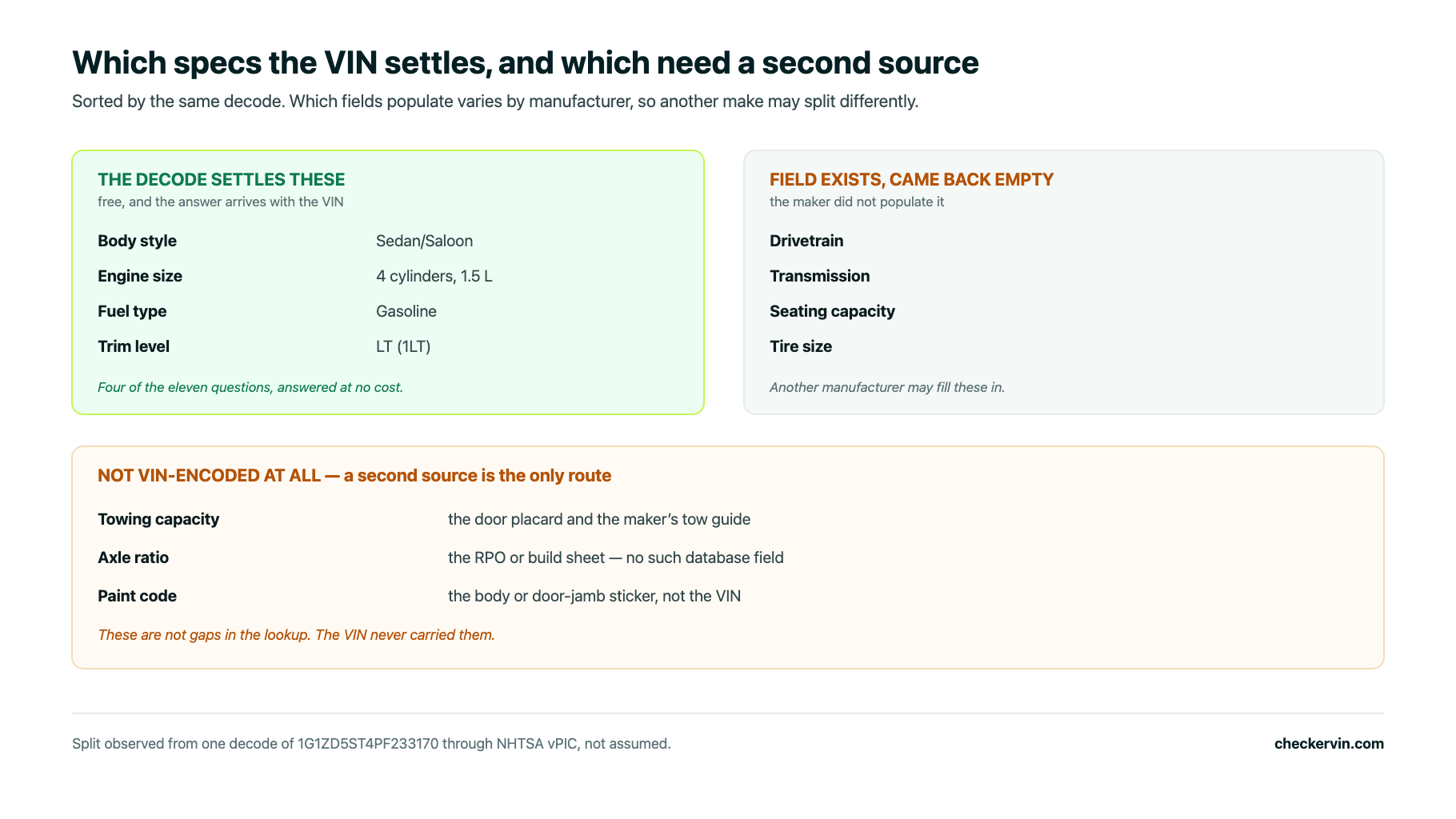
- Decode first — it is free and it settles four of the eleven in seconds
- Photograph the driver's door jamb — placard specs beat any lookup for what was actually fitted
- Pull the build sheet where the option-level answer matters
- Treat a confidently-filled field that another decoder leaves blank as an inference
The specs the VIN never carried
Three of the eleven are worth separating out, because no decoder will ever return them and a page that promises otherwise is selling a guess. Towing capacity depends on the configuration as built and on the maker’s own rating tables. Axle ratio is not a field in the federal schema at all. Paint code is recorded on a separate sticker, in a color system that belongs to the manufacturer rather than to any standard.
These are not gaps in the lookup. They are questions the VIN was never designed to answer. The standard governs a set of identifying characteristics and a checksum; it was never an equipment manifest, which is precisely why the window sticker and the build sheet exist as separate documents.
Running the decode
- 1Find the VIN and read all 17 charactersThe base of the windshield on the driver's side reads from outside the car; the door-jamb sticker is the second copy. Confirm they match before trusting either.
- 2Decode itEnter it here, or use NHTSA's own decoder directly. Both read the same federal filing, so both return the same fields.
- 3Note what came back blankThe blanks are your to-do list, not an error. Write down which of the eleven the decode left unanswered.
- 4Photograph the door placard for the restTire size, seating and weight ratings are printed there for the car as built, which beats any database for what was actually fitted.
What a spec decode cannot tell you
A decode describes the vehicle as manufactured. It says nothing whatever about the one in front of you. It cannot know that the engine was replaced, that the transmission was rebuilt, that the wheels are not the originals, or that the car has been sitting for two years. Those are condition questions and only an inspection answers them.
It is also silent on history. Whether the car was in a crash, carries a title brand, or has an odometer discrepancy is a different record entirely — one that comes from state title systems and insurers rather than from the manufacturer’s filing. The free vehicle history report page sets out which parts of that record are public and which are sold.
When the decode is not enough: the build sheet
For anything at option-package level — which seats, which audio system, which axle, which paint — the document you want is the build sheet or the original window sticker. Both record what was actually assembled rather than what the model line could contain, and both routinely answer the fields a decode leaves blank.
That is the honest hierarchy for spec questions: the decode establishes the vehicle in seconds for nothing, the door placard settles what was fitted, and the build sheet settles what was ordered.
Where this information comes from
- NHTSA vPIC — the VIN decoding APIThe federal database behind every field on this page, free and public
- NHTSA VIN decoderThe agency's own front end to the same records
- 49 CFR Part 565 — Vehicle Identification Number requirementsWhat the VIN is required to encode, which is why it is not an equipment list
Keep reading
Frequently asked questions
Can you get full car specs from a VIN for free?
Partly, and the gap matters. A free NHTSA decode returns the factory identity reliably — make, model, year, trim, body class, engine size, fuel type, assembly plant and weight class. It frequently leaves drivetrain, transmission, seating capacity, horsepower and curb weight empty. On one real decode of a 2023 Malibu, 55 of 140 fields came back populated and 85 were blank.
Why does a VIN decoder show blank fields?
Because the manufacturer did not populate them. Those fields exist in the federal database and the maker left them empty when it filed. That is why the same decoder returns richer results for one make than another — the variation is in the filing, not in the VIN or the tool reading it.
Does a VIN tell you the transmission?
Sometimes, and not reliably. Transmission style and speed count are defined fields in the NHTSA database, but many manufacturers leave them blank. Where the decode is silent, the build sheet, the door placard or the original window sticker will answer it.
Can a VIN tell you the paint color or the axle ratio?
No. Neither is VIN-encoded. Paint is recorded on a separate body or door-jamb sticker in the maker's own color system, and axle ratio is not even a field in the federal database — it lives in the RPO list or build sheet. A decoder that appears to supply either is inferring it, not reading it.
What is the difference between a VIN decode and a window sticker?
The decode returns what the manufacturer filed about the vehicle type. The window sticker records what was actually built and fitted, including option packages and the original price. For equipment-level questions the sticker is the better document, and the decode is the faster one.